| {"year": "2012", "tier": "T3", "problem_label": "1", "problem_type": null, "exam": "INMO", "problem": "Let $A B C D$ be a quadrilateral inscribed in a circle. Suppose $A B=$ $\\sqrt{2+\\sqrt{2}}$ and $A B$ subtends $135^{\\circ}$ at the centre of the circle. Find the maximum possible area of $A B C D$.\n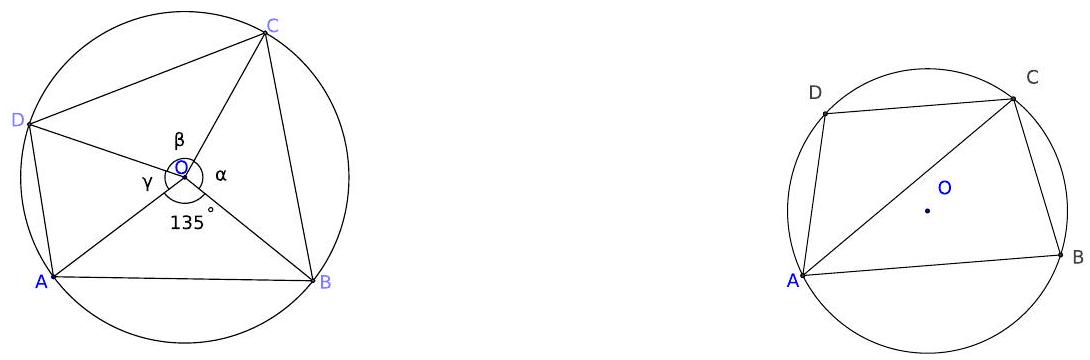", "solution": "Let $O$ be the centre of the circle in which $A B C D$ is inscribed and let $R$ be its radius. Using cosine rule in triangle $A O B$, we have\n\n$$\n2+\\sqrt{2}=2 R^{2}\\left(1-\\cos 135^{\\circ}\\right)=R^{2}(2+\\sqrt{2})\n$$\n\nHence $R=1$.\n\nConsider quadrilateral $A B C D$ as in the second figure above. Join $A C$. For $[A D C]$ to be maximum, it is clear that $D$ should be the mid-point of the arc $A C$ so that its distance from the segment $A C$ is maximum. Hence $A D=D C$ for $[A B C D]$ to be maximum. Similarly, we conclude that $B C=C D$. Thus $B C=C D=D A$ which fixes the quadrilateral $A B C D$. Therefore each of the sides $B C, C D, D A$ subtends equal angles at the centre $O$.\n\nLet $\\angle B O C=\\alpha, \\angle C O D=\\beta$ and $\\angle D O A=\\gamma$. Observe that\n\n$$\n[A B C D]=[A O B]+[B O C]+[C O D]+[D O A]=\\frac{1}{2} \\sin 135^{\\circ}+\\frac{1}{2}(\\sin \\alpha+\\sin \\beta+\\sin \\gamma)\n$$\n\nNow $[A B C D]$ has maximum area if and only if $\\alpha=\\beta=\\gamma=\\left(360^{\\circ}-\\right.$ $\\left.135^{\\circ}\\right) / 3=75^{\\circ}$. Thus\n\n$$\n[A B C D]=\\frac{1}{2} \\sin 135^{\\circ}+\\frac{3}{2} \\sin 75^{\\circ}=\\frac{1}{2}\\left(\\frac{1}{\\sqrt{2}}+3 \\frac{\\sqrt{3}+1}{2 \\sqrt{2}}\\right)=\\frac{5+3 \\sqrt{3}}{4 \\sqrt{2}}\n$$\n\nAlternatively, we can use Jensen's inequality. Observe that $\\alpha, \\beta, \\gamma$ are all less than $180^{\\circ}$. Since $\\sin x$ is concave on $(0, \\pi)$, Jensen's inequality gives\n\n$$\n\\frac{\\sin \\alpha+\\sin \\beta+\\sin \\gamma}{3} \\leq \\sin \\left(\\frac{\\alpha+\\beta+\\gamma}{3}\\right)=\\sin 75^{\\circ}\n$$\n\nHence\n\n$$\n[A B C D] \\leq \\frac{1}{2 \\sqrt{2}}+\\frac{3}{2} \\sin 75^{\\circ}=\\frac{5+3 \\sqrt{3}}{4 \\sqrt{2}}\n$$\n\nwith equality if and only if $\\alpha=\\beta=\\gamma=75^{\\circ}$.", "metadata": {"resource_path": "INMO/segmented/en-2012.jsonl", "problem_match": "\n1.", "solution_match": "\nSolution:"}} |
| {"year": "2012", "tier": "T3", "problem_label": "2", "problem_type": null, "exam": "INMO", "problem": "Let $p_{1}<p_{2}<p_{3}<p_{4}$ and $q_{1}<q_{2}<q_{3}<q_{4}$ be two sets of prime numbers such that $p_{4}-p_{1}=8$ and $q_{4}-q_{1}=8$. Suppose $p_{1}>5$ and $q_{1}>5$. Prove that 30 divides $p_{1}-q_{1}$.", "solution": "Since $p_{4}-p_{1}=8$, and no prime is even, we observe that $\\left\\{p_{1}, p_{2}, p_{3}, p_{4}\\right\\}$ is a subset of $\\left\\{p_{1}, p_{1}+2, p_{1}+4, p_{1}+6, p_{1}+8\\right\\}$. Moreover $p_{1}$ is larger than 3 . If $p_{1} \\equiv 1(\\bmod 3)$, then $p_{1}+2$ and $p_{1}+8$ are divisible by 3 . Hence we do not get 4 primes in the set $\\left\\{p_{1}, p_{1}+2, p_{1}+4, p_{1}+6, p_{1}+8\\right\\}$. Thus $p_{1} \\equiv 2(\\bmod 3)$ and $p_{1}+4$ is not a prime. We get $p_{2}=p_{1}+2, p_{3}=$ $p_{1}+6, p_{4}=p_{1}+8$.\n\nConsider the remainders of $p_{1}, p_{1}+2, p_{1}+6, p_{1}+8$ when divided by 5 . If $p_{1} \\equiv 2(\\bmod 5)$, then $p_{1}+8$ is divisible by 5 and hence is not a prime. If $p_{1} \\equiv 3(\\bmod 5)$, then $p_{1}+2$ is divisible by 5. If $p_{1} \\equiv 4(\\bmod 5)$, then $p_{1}+6$ is divisible by 5 . Hence the only possibility is $p_{1} \\equiv 1(\\bmod 5)$.\n\nThus we see that $p_{1} \\equiv 1(\\bmod 2), p_{1} \\equiv 2(\\bmod 3)$ and $p_{1} \\equiv 1(\\bmod 5)$. We conclude that $p_{1} \\equiv 11(\\bmod 30)$.\n\nSimilarly $q_{1} \\equiv 11(\\bmod 30)$. It follows that 30 divides $p_{1}-q_{1}$.", "metadata": {"resource_path": "INMO/segmented/en-2012.jsonl", "problem_match": "\n2.", "solution_match": "\nSolution:"}} |
| {"year": "2012", "tier": "T3", "problem_label": "3", "problem_type": null, "exam": "INMO", "problem": "Define a sequence $\\left\\langle f_{0}(x), f_{1}(x), f_{2}(x), \\ldots\\right\\rangle$ of functions by\n\n$$\nf_{0}(x)=1, \\quad f_{1}(x)=x, \\quad\\left(f_{n}(x)\\right)^{2}-1=f_{n+1}(x) f_{n-1}(x), \\text { for } n \\geq 1\n$$\n\nProve that each $f_{n}(x)$ is a polynomial with integer coefficients.", "solution": "Observe that\n\n$$\nf_{n}^{2}(x)-f_{n-1}(x) f_{n+1}(x)=1=f_{n-1}^{2}(x)-f_{n-2}(x) f_{n}(x)\n$$\n\nThis gives\n\n$$\nf_{n}(x)\\left(f_{n}(x)+f_{n-2}(x)\\right)=f_{n-1}\\left(f_{n-1}(x)+f_{n+1}(x)\\right)\n$$\n\nWe write this as\n\n$$\n\\frac{f_{n-1}(x)+f_{n+1}(x)}{f_{n}(x)}=\\frac{f_{n-2}(x)+f_{n}(x)}{f_{n-1}(x)}\n$$\n\nUsing induction, we get\n\n$$\n\\frac{f_{n-1}(x)+f_{n+1}(x)}{f_{n}(x)}=\\frac{f_{0}(x)+f_{2}(x)}{f_{1}(x)}\n$$\n\nObserve that\n\n$$\nf_{2}(x)=\\frac{f_{1}^{2}(x)-1}{f_{0}(x)}=x^{2}-1\n$$\n\nHence\n\n$$\n\\frac{f_{n-1}(x)+f_{n+1}(x)}{f_{n}(x)}=\\frac{1+\\left(x^{2}-1\\right)}{x}=x\n$$\n\nThus we obtain\n\n$$\nf_{n+1}(x)=x f_{n}(x)-f_{n-1}(x)\n$$\n\nSince $f_{0}(x), f_{1}(x)$ and $f_{2}(x)$ are polynomials with integer coefficients, induction again shows that $f_{n}(x)$ is a polynomial with integer coefficients.\n\nNote: We can get $f_{n}(x)$ explicitly:\n\n$$\nf_{n}(x)=x^{n}-\\binom{n-1}{1} x^{n-2}+\\binom{n-2}{2} x^{n-4}-\\binom{n-3}{3} x^{n-6}+\\cdots\n$$", "metadata": {"resource_path": "INMO/segmented/en-2012.jsonl", "problem_match": "\n3.", "solution_match": "\nSolution:"}} |
| {"year": "2012", "tier": "T3", "problem_label": "4", "problem_type": null, "exam": "INMO", "problem": "Let $A B C$ be a triangle. An interior point $P$ of $A B C$ is said to be good if we can find exactly 27 rays emanating from $P$ intersecting the sides of the triangle $A B C$ such that the triangle is divided by these rays into 27 smaller triangles of equal area. Determine the number of good points for a given triangle $A B C$.", "solution": "Let $P$ be a good point. Let $l, m, n$ be respetively the number of parts the sides $B C, C A, A B$ are divided by the rays starting from $P$. Note that a ray must pass through each of the vertices the triangle $A B C$; otherwise we get some quadrilaterals.\n\nLet $h_{1}$ be the distance of $P$ from $B C$. Then $h_{1}$ is the height for all the triangles with their bases on $B C$. Equality of areas implies that all these bases have equal length. If we denote this by $x$, we get $l x=a$. Similarly, taking $y$ and $z$ as the lengths of the bases of triangles on $C A$ and $A B$ respectively, we get $m y=b$ and $n z=c$. Let $h_{2}$ and $h_{3}$ be the distances of $P$ from $C A$ and $A B$ respectively. Then\n\n$$\nh_{1} x=h_{2} y=h_{3} z=\\frac{2 \\Delta}{27}\n$$\n\nwhere $\\Delta$ denotes the area of the triangle $A B C$. These lead to\n\n$$\nh_{1}=\\frac{2 \\Delta}{27} \\frac{l}{a}, \\quad h_{1}=\\frac{2 \\Delta}{27} \\frac{m}{b}, \\quad h_{1}=\\frac{2 \\Delta}{27} \\frac{n}{c}\n$$\n\nBut\n\n$$\n\\frac{2 \\Delta}{a}=h_{a}, \\quad \\frac{2 \\Delta}{b}=h_{b}, \\quad \\frac{2 \\Delta}{c}=h_{c}\n$$\n\nThus we get\n\n$$\n\\frac{h_{1}}{h_{a}}=\\frac{l}{27}, \\quad \\frac{h_{2}}{h_{b}}=\\frac{m}{27}, \\quad \\frac{h_{3}}{h_{c}}=\\frac{n}{27}\n$$\n\nHowever, we also have\n\n$$\n\\frac{h_{1}}{h_{a}}=\\frac{[P B C]}{\\Delta}, \\quad \\frac{h_{2}}{h_{b}}=\\frac{[P C A]}{\\Delta}, \\quad \\frac{h_{3}}{h_{c}}=\\frac{[P A B]}{\\Delta}\n$$\n\nAdding these three relations,\n\n$$\n\\frac{h_{1}}{h_{a}}+\\frac{h_{2}}{h_{b}}+\\frac{h_{3}}{h_{c}}=1\n$$\n\nThus\n\n$$\n\\frac{l}{27}+\\frac{m}{27}+\\frac{n}{27}=\\frac{h_{1}}{h_{a}}+\\frac{h_{2}}{h_{b}}+\\frac{h_{3}}{h_{c}}=1\n$$\n\nWe conclude that $l+m+n=27$. Thus every good point $P$ determines a partition $(l, m, n)$ of 27 such that there are $l, m, n$ equal segments respectively on $B C, C A, A B$.\n\nConversely, take any partition $(l, m, n)$ of 27 . Divide $B C, C A, A B$ respectively in to $l, m, n$ equal parts. Define\n\n$$\nh_{1}=\\frac{2 l \\Delta}{27 a}, \\quad h_{2}=\\frac{2 m \\Delta}{27 b}\n$$\n\nDraw a line parallel to $B C$ at a distance $h_{1}$ from $B C$; draw another line parallel to $C A$ at a distance $h_{2}$ from $C A$. Both lines are drawn such that they intersect at a point $P$ inside the triangle $A B C$. Then\n\n$$\n[P B C]=\\frac{1}{2} a h_{1}=\\frac{l \\Delta}{27}, \\quad[P C A]=\\frac{m \\Delta}{27}\n$$\n\nHence\n\n$$\n[P A B]=\\frac{n \\Delta}{27}\n$$\n\nThis shows that the distance of $P$ from $A B$ is\n\n$$\nh_{3}=\\frac{2 n \\Delta}{27 c}\n$$\n\nTherefore each traingle with base on $C A$ has area $\\frac{\\Delta}{27}$. We conclude that all the triangles which partitions $A B C$ have equal areas. Hence $P$ is a good point.\n\nThus the number of good points is equal to the number of positive integral solutions of the equation $l+m+n=27$. This is equal to\n\n$$\n\\binom{26}{2}=325\n$$", "metadata": {"resource_path": "INMO/segmented/en-2012.jsonl", "problem_match": "\n4.", "solution_match": "\nSolution:"}} |
| {"year": "2012", "tier": "T3", "problem_label": "5", "problem_type": null, "exam": "INMO", "problem": "Let $A B C$ be an acute-angled triangle, and let $D, E, F$ be points on $B C$, $C A, A B$ respectively such that $A D$ is the median, $B E$ is the internal angle bisector and $C F$ is the altitude. Suppose $\\angle F D E=\\angle C, \\angle D E F=$ $\\angle A$ and $\\angle E F D=\\angle B$. Prove that $A B C$ is equilateral.", "solution": "Since $\\triangle B F C$ is right-angled at $F$, we have\n\n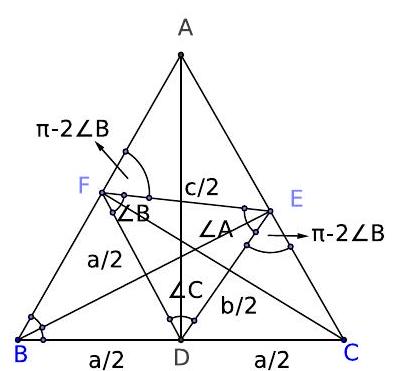\n$F D=B D=C D=a / 2$. Hence $\\angle B F D=\\angle B$. Since $\\angle E F D=$ $\\angle B$, we have $\\angle A F E=\\pi-2 \\angle B$. Since $\\angle D E F=\\angle A$, we also get $\\angle C E D=\\pi-2 \\angle B$. Applying sine rule in $\\triangle D E F$, we have\n\n$$\n\\frac{D F}{\\sin A}=\\frac{F E}{\\sin C}=\\frac{D E}{\\sin B}\n$$\n\nThus we get $F E=c / 2$ and $D E=b / 2$. Sine rule in $\\triangle C E D$ gives\n\n$$\n\\frac{D E}{\\sin C}=\\frac{C D}{\\sin (\\pi-2 B)}\n$$\n\nThus $(b / \\sin C)=(a / 2 \\sin B \\cos B)$. Solving for $\\cos B$, we have\n\n$$\n\\cos B=\\frac{a \\sin c}{2 b \\sin B}=\\frac{a c}{2 b^{2}}\n$$\n\nSimilarly, sine rule in $\\triangle A E F$ gives\n\n$$\n\\frac{E F}{\\sin A}=\\frac{A E}{\\sin (\\pi-2 B)}\n$$\n\nThis gives (since $A E=b c /(a+c)$ ), as earlier,\n\n$$\n\\cos B=\\frac{a}{a+c}\n$$\n\nComparing the two values of $\\cos B$, we get $2 b^{2}=c(a+c)$. We also have\n\n$$\nc^{2}+a^{2}-b^{2}=2 c a \\cos B=\\frac{2 a^{2} c}{a+c}\n$$\n\nThus\n\n$$\n4 a^{2} c=(a+c)\\left(2 c^{2}+2 a^{2}-2 b^{2}\\right)=(a+c)\\left(2 c^{2}+2 a^{2}-c(a+c)\\right)\n$$\n\nThis reduces to $2 a^{3}-3 a^{2} c+c^{3}=0$. Thus $(a-c)^{2}(2 a+c)=0$. We conclude that $a=c$. Finally\n\n$$\n2 b^{2}=c(a+c)=2 c^{2}\n$$\n\nWe thus get $b=c$ and hence $a=c=b$. This shows that $\\triangle A B C$ is equilateral.", "metadata": {"resource_path": "INMO/segmented/en-2012.jsonl", "problem_match": "\n5.", "solution_match": "\nSolution:"}} |
| {"year": "2012", "tier": "T3", "problem_label": "6", "problem_type": null, "exam": "INMO", "problem": "Let $f: \\mathbb{Z} \\rightarrow \\mathbb{Z}$ be a function satisfying $f(0) \\neq 0, f(1)=0$ and\n\n(i) $f(x y)+f(x) f(y)=f(x)+f(y)$;\n\n(ii) $(f(x-y)-f(0)) f(x) f(y)=0$,\n\nfor all $x, y \\in \\mathbb{Z}$, simultaneously.\n\n(a) Find the set of all possible values of the function $f$.\n\n(b) If $f(10) \\neq 0$ and $f(2)=0$, find the set of all integers $n$ such that $f(n) \\neq 0$.", "solution": "Setting $y=0$ in the condition (ii), we get\n\n$$\n(f(x)-f(0)) f(x)=0\n$$\n\nfor all $x$ (since $f(0) \\neq 0$ ). Thus either $f(x)=0$ or $f(x)=f(0)$, for all $x \\in \\mathbb{Z}$. Now taking $x=y=0$ in (i), we see that $f(0)+f(0)^{2}=2 f(0)$. This shows\nthat $f(0)=0$ or $f(0)=1$. Since $f(0) \\neq 0$, we must have $f(0)=1$. We conclude that\n\n$$\n\\text { either } f(x)=0 \\text { or } f(x)=1 \\text { for each } x \\in \\mathbb{Z}\n$$\n\nThis shows that the set of all possible value of $f(x)$ is $\\{0,1\\}$. This completes (a).\n\nLet $S=\\{n \\in \\mathbb{Z} \\mid f(n) \\neq 0\\}$. Hence we must have $S=\\{n \\in \\mathbb{Z} \\mid f(n)=1\\}$ by (a). Since $f(1)=0,1$ is not in $S$. And $f(0)=1$ implies that $0 \\in S$. Take any $x \\in \\mathbb{Z}$ and $y \\in S$. Using (ii), we get\n\n$$\nf(x y)+f(x)=f(x)+1\n$$\n\nThis shows that $x y \\in S$. If $x \\in \\mathbb{Z}$ and $y \\in \\mathbb{Z}$ are such that $x y \\in S$, then (ii) gives\n\n$$\n1+f(x) f(y)=f(x)+f(y)\n$$\n\nThus $(f(x)-1)(f(y)-1)=0$. It follows that $f(x)=1$ or $f(y)=1$; i.e., either $x \\in S$ or $y \\in S$. We also observe from (ii) that $x \\in S$ and $y \\in S$ implies that $f(x-y)=1$ so that $x-y \\in S$. Thus $S$ has the properties:\n\n(A) $x \\in \\mathbb{Z}$ and $y \\in S$ implies $x y \\in S$;\n\n(B) $x, y \\in \\mathbb{Z}$ and $x y \\in S$ implies $x \\in S$ or $y \\in S$;\n\n(C) $x, y \\in S$ implies $x-y \\in S$.\n\nNow we know that $f(10) \\neq 0$ and $f(2)=0$. Hence $f(10)=1$ and $10 \\in S$; and $2 \\notin S$. Writing $10=2 \\times 5$ and using (B), we conclude that $5 \\in S$ and $f(5)=1$. Hence $f(5 k)=1$ for all $k \\in \\mathbb{Z}$ by (A).\n\nSuppose $f(5 k+l)=1$ for some $l, 1 \\leq l \\leq 4$. Then $5 k+l \\in S$. Choose $u \\in \\mathbb{Z}$ such that $l u \\equiv 1(\\bmod 5)$. We have $(5 k+l) u \\in S$ by (A). Moreover, $l u=1+5 m$ for some $m \\in \\mathbb{Z}$ and\n\n$$\n(5 k+l) u=5 k u+l u=5 k u+5 m+1=5(k u+m)+1\n$$\n\nThis shows that $5(k u+m)+1 \\in S$. However, we know that $5(k u+m) \\in S$. By (C), $1 \\in S$ which is a contradiction. We conclude that $5 k+l \\notin S$ for any $l, 1 \\leq l \\leq 4$. Thus\n\n$$\nS=\\{5 k \\mid k \\in \\mathbb{Z}\\}\n$$\n\n$\\qquad$", "metadata": {"resource_path": "INMO/segmented/en-2012.jsonl", "problem_match": "\n6.", "solution_match": "\nSolution:"}} |
|
|


