| {"year": "2017", "tier": "T3", "problem_label": "1", "problem_type": null, "exam": "INMO", "problem": "In the given figure, $A B C D$ is a square paper. It is folded along $E F$ such that $A$ goes to a point $A^{\\prime} \\neq C, B$ on the side $B C$ and $D$ goes to $D^{\\prime}$. The line $A^{\\prime} D^{\\prime}$ cuts $C D$ in $G$. Show that the inradius of the triangle $G C A^{\\prime}$ is the sum of the inradii of the triangles $G D^{\\prime} F$ and $A^{\\prime} B E$.\n\n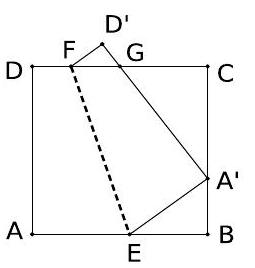", "solution": "Observe that the triangles $G C A^{\\prime}$ and $A^{\\prime} B E$ are similar to the triangle $G D^{\\prime} F$. If $G F=u, G D^{\\prime}=v$ and $D^{\\prime} F=w$, then we have\n\n$$\nA^{\\prime} G=p u, C G=p v, A^{\\prime} C=p w, \\quad A^{\\prime} E=q u, B E=q w, A^{\\prime} B=q v\n$$\n\nIf $r$ is the inradius of $\\triangle G D^{\\prime} F$, then $p r$ and $q r$ are respectively the inradii of triangles $G C A^{\\prime}$ and $A^{\\prime} B E$. We have to show that $p r=r+q r$. We also observe that\n\n$$\nA E=E A^{\\prime}, \\quad D F=F D^{\\prime}\n$$\n\nTherefore\n\n$$\np w+q v=q w+q u=w+u+p v=v+p u\n$$\n\nThe last two equalities give $(p-1)(u-v)=w$. The first two equalities give $(p-q) w=q(u-v)$. Hence\n\n$$\n\\frac{p-q}{q}=\\frac{u-v}{w}=\\frac{1}{p-1}\n$$\n\nThis simplifies to $p(p-q-1)=0$. Since $p \\neq 0$, we get $p=q+1$. This implies that $p r=q r+r$.", "metadata": {"resource_path": "INMO/segmented/en-sol-inmo_17.jsonl", "problem_match": "\n1.", "solution_match": "\nSolution:"}} |
| {"year": "2017", "tier": "T3", "problem_label": "2", "problem_type": null, "exam": "INMO", "problem": "Suppose $n \\geq 0$ is an integer and all the roots of $x^{3}+\\alpha x+4-\\left(2 \\times 2016^{n}\\right)=0$ are integers. Find all possible values of $\\alpha$.", "solution": "Let $u, v, w$ be the roots of $x^{3}+\\alpha x+4-\\left(2 \\times 2016^{n}\\right)=0$. Then $u+v+w=0$ and $u v w=-4+\\left(2 \\times 2016^{n}\\right)$. Therefore we obtain\n\n$$\nu v(u+v)=4-\\left(2 \\times 2016^{n}\\right)\n$$\n\nSuppose $n \\geq 1$. Then we see that $u v(u+v) \\equiv 4\\left(\\bmod 2016^{n}\\right)$. Therefore $u v(u+v) \\equiv 1$ $(\\bmod 3)$ and $u v(u+v) \\equiv 1(\\bmod 9)$. This implies that $u \\equiv 2(\\bmod 3)$ and $v \\equiv 2(\\bmod 3)$. This shows that modulo 9 the pair $(u, v)$ could be any one of the following:\n\n$$\n(2,2),(2,5),(2,8),(5,2),(5,5),(5,8),(8,2),(8,5),(8,8)\n$$\n\nIn each case it is easy to check that $u v(u+v) \\not \\equiv 4(\\bmod 9)$. Hence $n=0$ and $u v(u+v)=2$. It follows that $(u, v)=(1,1),(1,-2)$ or $(-2,1)$. Thus\n\n$$\n\\alpha=u v+v w+w u=u v-(u+v)^{2}=-3\n$$\n\nfor every pair $(u, v)$.", "metadata": {"resource_path": "INMO/segmented/en-sol-inmo_17.jsonl", "problem_match": "\n2.", "solution_match": "\nSolution 1:"}} |
| {"year": "2017", "tier": "T3", "problem_label": "2", "problem_type": null, "exam": "INMO", "problem": "Suppose $n \\geq 0$ is an integer and all the roots of $x^{3}+\\alpha x+4-\\left(2 \\times 2016^{n}\\right)=0$ are integers. Find all possible values of $\\alpha$.", "solution": "Let $a, b, c \\in \\mathbb{Z}$ be the roots of the given equation for some $n \\in \\mathbb{N}_{0}$. By Vieta Theorem, we know that\n\n$$\n\\begin{gathered}\na+b+c=0 \\\\\na b+b c+c a=\\alpha \\\\\na b c=2 \\times 2016^{n}-4\n\\end{gathered}\n$$\n\nIf possible, let us have $n \\geq 1$. Since $7 \\mid 2016$, we have that\n\n$$\n7|a b c+4 \\Longrightarrow 7| 3(a b c+4) \\Longrightarrow 7|3 a b c+12 \\Longrightarrow 7| 3 a b c+5\n$$\n\nSince we have $a+b+c=0$, we get that $3 a b c=a^{3}+b^{3}+c^{3}$. Substituting this in the earlier expression, we get that\n\n$$\na^{3}+b^{3}+c^{3}+5 \\equiv 0 \\quad(\\bmod 7)\n$$\n\nConsider below, a table calculating the residues of cubes modulo 7 .\n\n| $x$ | 0 | 1 | 2 | 3 | 4 | 5 | 6 |\n| :---: | :---: | :---: | :---: | :---: | :---: | :---: | :---: |\n| $x^{3}$ | 0 | 1 | 1 | -1 | 1 | -1 | -1 |\n\nHence, we know that if $x \\in \\mathbb{N}$, then we have $x^{3} \\equiv 0,1,-1(\\bmod 7)$. Since $a^{3}+b^{3}+c^{3} \\equiv 2$ $(\\bmod 7)$, we see that we must have one of the numbers divisible by 7 and the other two numbers, when cubed, must leave 1 as remainder modulo 7. Without of generality, let us assume that\n\n$$\na \\equiv 0 \\quad(\\bmod 7), \\quad b^{3}, c^{3} \\equiv 1 \\quad(\\bmod 7)\n$$\n\nHence, we have $b, c \\equiv 1,2,4(\\bmod 7)$. We will consider all possible values of $b+c$ modulo 7 . Since the expression is symmetric in $b, c$, modulo 7 , we will consider $b \\leq c$.\n\n| $b$ | 1 | 1 | 1 | 2 | 2 | 4 |\n| :---: | :---: | :---: | :---: | :---: | :---: | :---: |\n| $c$ | 1 | 2 | 4 | 2 | 4 | 4 |\n| $b+c$ | 2 | 3 | 5 | 4 | 6 | 1 |\n\nWe see that, in all the above cases, we get $7 \\nmid\\langle b+c$. But this is a contradiction, since 7$| a+b+c$ and $7 \\mid a$ together imply that $7 \\mid b+c$. Hence, we cannot have $n \\geq 1$. Hence, the only possible value is $n=0$. Substituting this value in the original equation, the equation becomes\n\n$$\nx^{3}+\\alpha x+2=0\n$$\n\nSolving the equations $a+b+c=0$ and $a b c=-2$ in integers, we see that the only possible solutions $(a, b, c)$ are permutations of $(1,1,-2)$. In case of any permutation, $\\alpha=-3$. Substituting this value of $\\alpha$ back in the equation, we see that we indeed, get integer roots. Hence, the only possible value for $\\alpha$ is -3 .", "metadata": {"resource_path": "INMO/segmented/en-sol-inmo_17.jsonl", "problem_match": "\n2.", "solution_match": "\nSolution 2:"}} |
| {"year": "2017", "tier": "T3", "problem_label": "3", "problem_type": null, "exam": "INMO", "problem": "Find the number of triples $(x, a, b)$ where $x$ is a real number and $a, b$ belong to the set $\\{1,2,3,4,5,6,7,8,9\\}$ such that\n\n$$\nx^{2}-a\\{x\\}+b=0\n$$\n\nwhere $\\{x\\}$ denotes the fractional part of the real number $x$. (For example $\\{1.1\\}=0.1=$ $\\{-0.9\\}$.", "solution": "Let us write $x=n+f$ where $n=[x]$ and $f=\\{x\\}$. Then\n\n$$\nf^{2}+(2 n-a) f+n^{2}+b=0\n$$\n\nObserve that the product of the roots of (1) is $n^{2}+b \\geq 1$. If this equation has to have a solution $0 \\leq f<1$, the larger root of (1) is greater 1 . We conclude that the equation (1) has a real root less than 1 only if $P(1)<0$ where $P(y)=y^{2}+(2 n-a) y+n^{2}+2 b$. This gives\n\n$$\n1+2 n-a+n^{2}+2 b<0\n$$\n\nTherefore we have $(n+1)^{2}+b<a$. If $n \\geq 2$, then $(n+1)^{2}+b \\geq 10>a$. Hence $n \\leq 1$. If $n \\leq-4$, then again $(n+1)^{2}+b \\geq 10>a$. Thus we have the range for $n:-3,-2,-1,0,1$. If $n=-3$ or $n=1$, we have $(n+1)^{2}=4$. Thus we must have $4+b<a$. If $a=9$, we must have $b=4,3,2,1$ giving 4 values. For $a=8$, we must have $b=3,2,1$ giving 3 values. Similarly, for $a=7$ we get 2 values of $b$ and $a=6$ leads to 1 value of $b$. In each case we get a real value of $f<1$ and this leads to a solution for $x$. Thus we get totally $2(4+3+2+1)=20$ values of the triple $(x, a, b)$.\n\nFor $n=-2$ and $n=0$, we have $(n+1)^{2}=1$. Hence we require $1+b<a$. We again count pairs $(a, b)$ such that $a-b>1$. For $a=9$, we get 7 values of $b$; for $a=8$ we get 6 values of $b$ and so on. Thus we get $2(7+6+5+4+3+2+1)=56$ values for the triple $(x, a, b)$.\n\nSuppose $n=-1$ so that $(n+1)^{2}=0$. In this case we require $b<a$. We get $8+7+6+5+$ $4+3+2+1=36$ values for the triple $(x, a, b)$.\n\nThus the total number of triples $(x, a, b)$ is $20+56+36=112$.", "metadata": {"resource_path": "INMO/segmented/en-sol-inmo_17.jsonl", "problem_match": "\n3.", "solution_match": "\nSolution:"}} |
| {"year": "2017", "tier": "T3", "problem_label": "4", "problem_type": null, "exam": "INMO", "problem": "Let $A B C D E$ be a convex pentagon in which $\\angle A=\\angle B=\\angle C=\\angle D=120^{\\circ}$ and whose side lengths are 5 consecutive integers in some order. Find all possible values of $A B+B C+C D$.", "solution": "Let $A B=a, B C=b$, and $C D=c$. By symmetry, we may assume that $c<a$. We show that $D E=a+b$ and $E A=b+c$.\n\n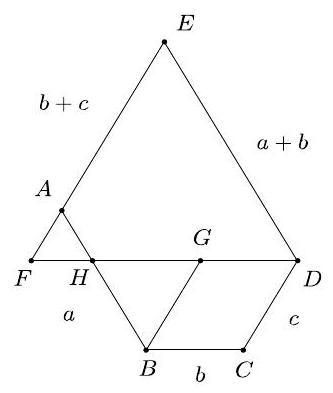\n\nDraw a line parallel to $B C$ through $D$. Extend $E A$ to meet this line at $F$. Draw a line parallel to $C D$ through $B$ and let it intersect $D F$ in $G$. Let $A B$ intersect $D F$ in $H$. We have $\\angle F D E=60^{\\circ}$ and $\\angle E=60^{\\circ}$. Hence $E F D$ is an equilateral triangle. Similarly $A F H$ and $B G H$ are also equilateral triangles. Hence $H G=G B=c$. Moreover, $D G=b$. Therefore $H D=b+c$. But $H D=A E$ since $F H=F A$ and $F D=F E$. Also $A H=a-B H=$ $a-B G=a-c$. Hence $E D=E F=E A+A F=b+c+A H=(b+c)+(a-c)=b+a$.\n\nWe have five possibilities:\n\n(1) $b<c<a<b+c<a+b$;\n\n(2) $c<b<a<b+c<a+b$;\n\n(3) $c<a<b<b+c<a+b$;\n\n(4) $b<c<b+c<a<a+b$;\n\n(5) $c<b<b+c<a<a+b$.\n\nIn (1), we see that $c<a<b+c$ are three consecutive integers provided $b=2$. Hence we get $c=3$ and $a=4$. In this case $b+c=5$ and $a+b=6$ so that we have five consecutive integrs $2,3,4,5,6$ as side lengths. In (2), $b<a<b+c$ form three consecutive integrs only when $c=2$. Hence $b=3, a=4$. But then $b+c=5$ and $a+b=7$. Thus the side lengths are $2,3,4,6,7$ which are not consecutive integers. In case (3), $b<b+c$ are two consecutive integrs so that $c=1$. Hence $a=2$ and $b=3$. We get $b+c=4$ and $a+b=5$ so that the consecutive integers $1,2,3,4,5$ form the side lengths. In case (4), we have $c<b+c$ as two consecutive integers and hence $b=1$. Therefore $c=2, b+c=3, a=4$ and $a+b=5$ which is admissible. Finally, in case (5) we have $b<b+c$ as two consecutive integers, so that $c=1$. Thus $b=2, b+c=3, a=4$ and $a+b=6$. We do not get consecutive integers.\n\nTherefore the only possibilities are $(a, b, c)=(4,2,3),(2,3,1)$ and $(4,1,2)$. This shows that $a+b+c=9,6$ or 7 . Thus there are three possible sums $A B+B C+C A$, namely, 6,7 or 9 .", "metadata": {"resource_path": "INMO/segmented/en-sol-inmo_17.jsonl", "problem_match": "\n4.", "solution_match": "\nSolution 1:"}} |
| {"year": "2017", "tier": "T3", "problem_label": "4", "problem_type": null, "exam": "INMO", "problem": "Let $A B C D E$ be a convex pentagon in which $\\angle A=\\angle B=\\angle C=\\angle D=120^{\\circ}$ and whose side lengths are 5 consecutive integers in some order. Find all possible values of $A B+B C+C D$.", "solution": "As in the earlier solution, $E D=d=a+b$ and $E A=e=b+c$. Let the sides be $x-2, x-1, x, x+1, x+2$. Then $x \\geq 3$. We also have $x+2 \\geq x-1+x-2$ so that $x \\leq 5$. Thus $x=3,4$ or 5 . If $x=5$, the sides are $\\{3,4,5,6,7\\}$ and here we do not have two pairs which add to a number in the set. Hence $x=3$ or 4 and we get the sets as $\\{1,2,3,4,5\\}$ or $\\{2,3,4,5,6\\}$. With the set $\\{1,2,3,4,5\\}$ we get\n\n$$\n(a, b, c, d, e)=(2,3,1,5,4),(4,1,2,5,3)\n$$\n\nFrom the set $\\{2,3,4,5,6\\}$, we get $(a, b, c, d, e)=(4,2,3,6,5)$. Thus we see that $a+b+c=6,7$ or 9 .", "metadata": {"resource_path": "INMO/segmented/en-sol-inmo_17.jsonl", "problem_match": "\n4.", "solution_match": "\nSolution 2:"}} |
| {"year": "2017", "tier": "T3", "problem_label": "4", "problem_type": null, "exam": "INMO", "problem": "Let $A B C D E$ be a convex pentagon in which $\\angle A=\\angle B=\\angle C=\\angle D=120^{\\circ}$ and whose side lengths are 5 consecutive integers in some order. Find all possible values of $A B+B C+C D$.", "solution": "We use the same notations and we get $d=a+b$ and $e=b+c$. If $a \\geq 5$, we see that $d-b \\geq 5$. But the maximum difference in a set of 5 consecutive integers is 4 . Hence $a \\leq 4$. Similarly, we see $b \\leq 4$ and $c \\leq 4$. Thus we see that $a+b+c \\leq 2+3+4=9$. But $a+b+c \\geq 1+2+3=6$. It follows that $a+b+c=6,7,8$ or 9 . If we take $(a, b, c, d, e)=(1,3,2,4,5)$, we get $a+b+c=6$. Similarly, $(a, b, c, d, e)=(2,1,4,3,5)$ gives $a+b+c=7$, For $a+b+c=8$, the only we we can get $1+3+4=8$. Here we cannot accommodate 2 and consecutiveness is lost. For 9 , we can have $(a, b, c, d, e)=(3,2,4,5,6)$ and $a+b+c=9$.", "metadata": {"resource_path": "INMO/segmented/en-sol-inmo_17.jsonl", "problem_match": "\n4.", "solution_match": "\nSolution 3:"}} |
| {"year": "2017", "tier": "T3", "problem_label": "5", "problem_type": null, "exam": "INMO", "problem": "Let $A B C$ be a triangle with $\\angle A=90^{\\circ}$ and $A B<A C$. Let $A D$ be the altitude from $A$ on to $B C$. Let $P, Q$ and $I$ denote respectively the incentres of triangles $A B D, A C D$ and $A B C$. Prove that $A I$ is perpendicular to $P Q$ and $A I=P Q$.", "solution": "Draw $P S \\| B C$ and $Q S \\| A D$. Then $P S Q$ is a right-angled triangle with $\\angle P S Q=90^{\\circ}$. Observe that $P S=r_{1}+r_{2}$ and $S Q=r_{2}-r_{1}$, where $r_{1}$ and $r_{2}$ are the inradii of triangles $A B D$ and $A C D$, respectively. We observe that triangles $D A B$ and $D C A$ are similar to triangle $A C B$.\n\n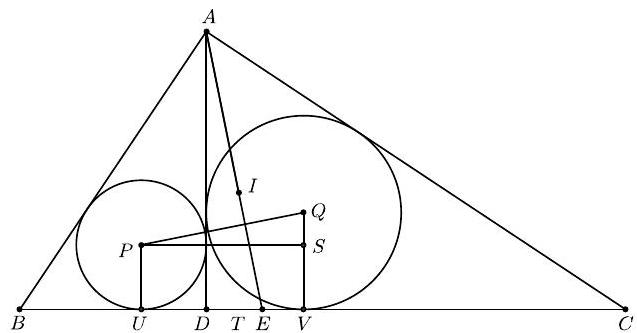\n\nHence\n\n$$\nr_{1}=\\frac{c}{a} r, \\quad r_{2}=\\frac{b}{a} r\n$$\n\nwhere $r$ is the inradius of triangle $A B C$. Thus we get\n\n$$\n\\frac{P S}{S Q}=\\frac{r_{2}+r_{1}}{r_{2}-r_{1}}=\\frac{b+c}{b-c}\n$$\n\nOn the otherhand $A D=h=b c / a$. We also have $B E=c a /(b+c)$ and\n\n$$\nB D^{2}=c^{2}-h^{2}=c^{2}-\\frac{b^{2} c^{2}}{a^{2}}=\\frac{c^{4}}{a^{2}}\n$$\n\nHence $B D=c^{2} / a$. Therefore\n\n$$\nD E=B E-B D=\\frac{c a}{b+c}-\\frac{c^{2}}{a}=\\frac{c b(b-c)}{a(b+c)}\n$$\n\nThus we get\n\n$$\n\\frac{A D}{D E}=\\frac{b+c}{b-c}=\\frac{P S}{S Q}\n$$\n\nSince $\\angle A D E=90^{\\circ}=\\angle P S Q$, we conclude that $\\triangle A D E \\sim \\triangle P S Q$. Since $A D \\perp P S$, it follows that $A E \\perp P Q$.\n\nWe also observe that\n\n$$\nP Q^{2}=P S^{2}+S Q^{2}=\\left(r_{2}+r_{1}\\right)^{2}+\\left(r_{2}-r_{1}\\right)^{2}=2\\left(r_{1}^{2}+r_{2}^{2}\\right)\n$$\n\nHowever\n\n$$\nr_{1}^{2}+r_{2}^{2}=\\frac{c^{2}+b^{2}}{a^{2}} r^{2}=r^{2}\n$$\n\nHence $P Q=\\sqrt{2} r$. We also observe that $A I=r \\operatorname{cosec}(A / 2)=r \\operatorname{cosec}\\left(45^{\\circ}\\right)=\\sqrt{2} r$. Thus $P Q=A I$.", "metadata": {"resource_path": "INMO/segmented/en-sol-inmo_17.jsonl", "problem_match": "\n5.", "solution_match": "\nSolution:"}} |
| {"year": "2017", "tier": "T3", "problem_label": "5", "problem_type": null, "exam": "INMO", "problem": "Let $A B C$ be a triangle with $\\angle A=90^{\\circ}$ and $A B<A C$. Let $A D$ be the altitude from $A$ on to $B C$. Let $P, Q$ and $I$ denote respectively the incentres of triangles $A B D, A C D$ and $A B C$. Prove that $A I$ is perpendicular to $P Q$ and $A I=P Q$.", "solution": "In the figure, we have made the construction as mentioned in the hint. Since $P, Q$ are the incentres of $\\triangle A B D, \\triangle A C D, D P, D Q$ are the internal angle bisectors of $\\angle A D B, \\angle A D C$ respectively. Since $A D$ is the altitude on the hypotenuse $B C$ in $\\triangle A B C$, we have that $\\angle P D Q=45^{\\circ}+45^{\\circ}=90^{\\circ}$. It also implies that\n\n$$\n\\triangle A B C \\sim \\triangle D B A \\sim \\triangle D A C\n$$\n\nThis implies that all corresponding length in the above mentioned triangles have the same ratio.\n\n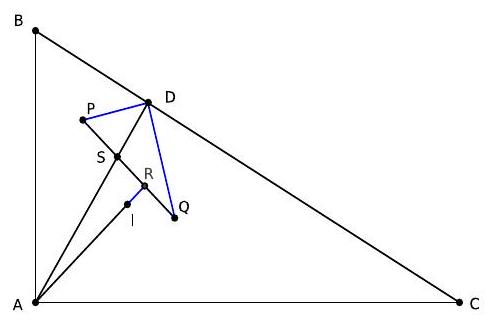\n\nIn particular,\n\n$$\n\\begin{aligned}\n& \\frac{A I}{B C}=\\frac{D P}{A B}=\\frac{D Q}{A C} \\\\\n\\Longrightarrow \\quad & \\frac{A I^{2}}{B C^{2}}=\\frac{D P^{2}}{A B^{2}}=\\frac{D Q^{2}}{A C^{2}}=\\frac{D P^{2}+D Q^{2}}{A B^{2}+A C^{2}} \\\\\n\\Longrightarrow \\quad & \\frac{A I^{2}}{B C^{2}}=\\frac{P Q^{2}}{B C^{2}}, \\quad \\text { by Pythagoras Theorem in } \\triangle A B C, \\triangle P D Q \\\\\n\\Longrightarrow \\quad & A I=P Q\n\\end{aligned}\n$$\n\nas required.\n\nFor the second, part, we note that from the above relations, we have $\\triangle A B C \\sim \\triangle D P Q$. Let us take $\\angle A C B=\\theta$. Then, we get\n\n$$\n\\begin{aligned}\n\\angle P S D & =180^{\\circ}-(\\angle S P D+\\angle S D P) \\\\\n& =180^{\\circ}-\\left(90^{\\circ}-\\theta+45^{\\circ}\\right) \\\\\n& =45^{\\circ}+\\theta\n\\end{aligned}\n$$\n\nThis gives us that\n\n$$\n\\begin{aligned}\n\\angle A R S & =180^{\\circ}-(\\angle A S R+\\angle S A R) \\\\\n& =180^{\\circ}-(\\angle P S D+\\angle S A C-\\angle I A C) \\\\\n& =180^{\\circ}-\\left(45^{\\circ}+\\theta+90^{\\circ}-\\theta-45^{\\circ}\\right) \\\\\n& =90^{\\circ}\n\\end{aligned}\n$$\n\nas required. Hence, we get that $A I=P Q$ and $A I \\perp P Q$.", "metadata": {"resource_path": "INMO/segmented/en-sol-inmo_17.jsonl", "problem_match": "\n5.", "solution_match": "\nSolution 2:"}} |
| {"year": "2017", "tier": "T3", "problem_label": "5", "problem_type": null, "exam": "INMO", "problem": "Let $A B C$ be a triangle with $\\angle A=90^{\\circ}$ and $A B<A C$. Let $A D$ be the altitude from $A$ on to $B C$. Let $P, Q$ and $I$ denote respectively the incentres of triangles $A B D, A C D$ and $A B C$. Prove that $A I$ is perpendicular to $P Q$ and $A I=P Q$.", "solution": "We know that the angle bisector of $\\angle B$ passes through $P, I$ which implies that $B, P, I$ are collinear. Similarly, $C, Q, I$ are also collinear. Since $I$ is the incentre of $\\triangle A B C$, we know that\n\n$$\n\\angle P I Q=\\angle B I C=90^{\\circ}+\\frac{\\angle A}{2}=135^{\\circ}\n$$\n\nJoin $A P, A Q$. We know that $\\angle B A P=\\frac{1}{2} \\angle B A D=\\frac{1}{2} \\angle C$. Also, $\\angle A B P=\\frac{1}{2} \\angle B$. Hence by Exterior Angle Theorem in $\\triangle A B P$, we get that\n\n$$\n\\angle A P I=\\angle A B P+\\angle B A P=\\frac{1}{2}(\\angle B+\\angle C)=45^{\\circ}\n$$\n\nSimilarly in $\\triangle A D C$, we get that $\\angle A Q I=45^{\\circ}$. Also, we have\n\n$$\n\\angle P A I=\\angle B A I-\\angle B A P=45^{\\circ}-\\frac{\\angle C}{2}=\\frac{\\angle B}{2}\n$$\n\nSimilarly, we get $\\angle Q A I=\\frac{\\angle C}{2}$.\n\nNow applying Sine Rule in $\\triangle A P I$, we get\n\n$$\n\\frac{I P}{\\sin \\angle P A I}=\\frac{A I}{\\sin \\angle A P I} \\Longrightarrow I P=\\sqrt{2} A I \\sin \\frac{B}{2}\n$$\n\nSimilarly, applying Sine Rule in $\\triangle A Q I$, we get\n\n$$\n\\frac{I Q}{\\sin \\angle P A I}=\\frac{A I}{\\sin \\angle A Q I} \\Longrightarrow I Q=\\sqrt{2} A I \\sin \\frac{C}{2}\n$$\n\nApplying Cosine Rule in $\\triangle P I Q$ gives us that\n\n$$\n\\begin{aligned}\nP Q^{2} & =I P^{2}+I Q^{2}-2 \\cdot I P \\cdot I Q \\cos \\angle P I Q \\\\\n& =2 A I^{2}\\left(\\sin ^{2} \\frac{B}{2}+\\sin ^{2} \\frac{C}{2}+\\sqrt{2} \\sin \\frac{B}{2} \\sin \\frac{C}{2}\\right)\n\\end{aligned}\n$$\n\nWe will prove that $\\left(\\sin ^{2} \\frac{B}{2}+\\sin ^{2} \\frac{C}{2}+\\sqrt{2} \\sin \\frac{B}{2} \\sin \\frac{C}{2}\\right)=\\frac{1}{2}$. In any $\\triangle X Y Z$, we have that\n\n$$\n\\sum_{c y c} \\sin ^{2} \\frac{X}{2}=1-2 \\prod \\sin \\frac{X}{2}\n$$\n\nUsing this in $\\triangle A B C$, and using the fact that $\\angle A=90^{\\circ}$, we get\n\n$$\n\\begin{aligned}\n& \\sin ^{2} \\frac{A}{2}+\\sin ^{2} \\frac{B}{2}+\\sin ^{2} \\frac{C}{2}=1-2 \\sin \\frac{A}{2} \\sin \\frac{B}{2} \\sin \\frac{C}{2} \\\\\n\\Longrightarrow \\quad & \\frac{1}{2}+\\sin ^{2} \\frac{B}{2}+\\sin ^{2} \\frac{C}{2}=1-\\sqrt{2} \\sin \\frac{B}{2} \\sin \\frac{C}{2} \\\\\n\\Longrightarrow \\quad & \\left(\\sin ^{2} \\frac{B}{2}+\\sin ^{2} \\frac{C}{2}+\\sqrt{2} \\sin \\frac{B}{2} \\sin \\frac{C}{2}\\right)=\\frac{1}{2}\n\\end{aligned}\n$$\n\nwhich was to be proved. Hence we get $P Q=A I$.\n\nThe second part of the problem can be obtained by angle-chasing as outlined in Solution 2 .", "metadata": {"resource_path": "INMO/segmented/en-sol-inmo_17.jsonl", "problem_match": "\n5.", "solution_match": "\nSolution 3:"}} |
| {"year": "2017", "tier": "T3", "problem_label": "5", "problem_type": null, "exam": "INMO", "problem": "Let $A B C$ be a triangle with $\\angle A=90^{\\circ}$ and $A B<A C$. Let $A D$ be the altitude from $A$ on to $B C$. Let $P, Q$ and $I$ denote respectively the incentres of triangles $A B D, A C D$ and $A B C$. Prove that $A I$ is perpendicular to $P Q$ and $A I=P Q$.", "solution": "Observe that $\\angle A P B=\\angle A Q C=135^{\\circ}$. Thus $\\angle A P I=\\angle A Q I=45^{\\circ}$ (since $B-P-I$ and $C-Q-I)$. Note $\\angle P A Q=1 / 2 \\angle A=45^{\\circ}$. Let $X=B I \\cap A Q$ and $Y=C I \\cap A P$. Therefore $\\angle A X P=180-\\angle A P I-\\angle P A Q=90^{\\circ}$. Similarly $\\angle A Y Q=90^{\\circ}$. Hence $I$ is the orthocentre of triangle $P A Q$. Therefore $A I$ is perpendicular to $P Q$. Also $A I=2 R_{P A Q} \\cos 45^{\\circ}=2 R_{P A Q} \\sin 45^{\\circ}=P Q$.", "metadata": {"resource_path": "INMO/segmented/en-sol-inmo_17.jsonl", "problem_match": "\n5.", "solution_match": "\nSolution 4:"}} |
| {"year": "2017", "tier": "T3", "problem_label": "6", "problem_type": null, "exam": "INMO", "problem": "Let $n \\geq 1$ be an integer and consider the sum\n\n$$\nx=\\sum_{k \\geq 0}\\binom{n}{2 k} 2^{n-2 k} 3^{k}=\\binom{n}{0} 2^{n}+\\binom{n}{2} 2^{n-2} \\cdot 3+\\binom{n}{4} 2^{n-4} \\cdot 3^{2}+\\cdots\n$$\n\nShow that $2 x-1,2 x, 2 x+1$ form the sides of a triangle whose area and inradius are also integers.", "solution": "Consider the binomial expansion of $(2+\\sqrt{3})^{n}$. It is easy to check that\n\n$$\n(2+\\sqrt{3})^{n}=x+y \\sqrt{3}\n$$\n\nwhere $y$ is also an integer. We also have\n\n$$\n(2-\\sqrt{3})^{n}=x-y \\sqrt{3}\n$$\n\nMultiplying these two relations, we obtain $x^{2}-3 y^{2}=1$.\n\nSince all the terms of the expansion of $(2+\\sqrt{3})^{n}$ are positive, we see that\n\n$$\n2 x=(2+\\sqrt{3})^{n}+(2-\\sqrt{3})^{n}=2\\left(2^{n}+\\binom{n}{2} 2^{n-2} \\cdot 3+\\cdots\\right) \\geq 4\n$$\n\nThus $x \\geq 2$. Hence $2 x+1<2 x+(2 x-1)$ and therefore $2 x-1,2 x, 2 x+1$ are the sides of a triangle. By Heron's formula we have\n\n$$\n\\Delta^{2}=3 x(x+1)(x)(x-1)=3 x^{2}\\left(x^{2}-1\\right)=9 x^{2} y^{2}\n$$\n\nHence $\\Delta=3 x y$ which is an integer. Finally, its inradius is\n\n$$\n\\frac{\\text { area }}{\\text { perimeter }}=\\frac{3 x y}{3 x}=y\n$$\n\nwhich is also an integer.", "metadata": {"resource_path": "INMO/segmented/en-sol-inmo_17.jsonl", "problem_match": "\n6.", "solution_match": "\nSolution:"}} |
| {"year": "2017", "tier": "T3", "problem_label": "6", "problem_type": null, "exam": "INMO", "problem": "Let $n \\geq 1$ be an integer and consider the sum\n\n$$\nx=\\sum_{k \\geq 0}\\binom{n}{2 k} 2^{n-2 k} 3^{k}=\\binom{n}{0} 2^{n}+\\binom{n}{2} 2^{n-2} \\cdot 3+\\binom{n}{4} 2^{n-4} \\cdot 3^{2}+\\cdots\n$$\n\nShow that $2 x-1,2 x, 2 x+1$ form the sides of a triangle whose area and inradius are also integers.", "solution": "We will first show that the numbers $2 x_{n}-1,2 x_{n}, 2 x_{n}+1$ form the sides of a triangle. To show that, it suffices to prove that $2 x_{n}-1+2 x_{n}>2 x_{n}+1$. If possible, let the converse hold. Then, we see that we must have $4 x_{n}-1 \\leq 2 x_{n}+1$, which implies that $x_{n} \\leq 1$. But we see that even for the smallest value of $n=1$, we have that $x_{n}>1$. Hence, the numbers are indeed sides of a triangle.\n\nLet $\\Delta_{n}, r_{n}, s_{n}$ denote respectively, the area, inradius and semiperimeter of the triangle with sides $2 x_{n}-1,2 x_{n}, 2 x_{n}+1$. By Heron's Formula for the area of a triangle, we see that\n\n$$\n\\Delta_{n}=\\sqrt{3 x_{n}\\left(x_{n}-1\\right) x_{n}\\left(x_{n}+1\\right)}=x_{n} \\sqrt{3\\left(x_{n}^{2}-1\\right)}\n$$\n\nIf possible, let $\\Delta_{n}$ be an integer for all $n \\in \\mathbb{N}$. We see that due to the presence of the first term $\\binom{n}{0} 2^{n}$, we have $3 \\nmid x_{n}, \\forall n \\in \\mathbb{N}$. Hence, we get that $3 \\mid x_{n}^{2}-1$. Hence, we can write $x_{n}^{2}-1$ as $3 m$ for some $m \\in \\mathbb{N}$. Then, we can also write\n\n$$\n\\Delta_{n}=3 x_{n} \\sqrt{m}\n$$\n\nNote that we have assumed that $\\Delta_{n}$ is an integer. Hence, we see that we must have $m$ to be a perfect square. Consequently, we get that\n\n$$\nr_{n}=\\frac{\\Delta_{n}}{s_{n}}=\\frac{\\Delta_{n}}{3 x_{n}}=\\sqrt{m} \\in \\mathbb{Z}\n$$\n\nHence, it only remains to show that $\\Delta_{n} \\in \\mathbb{Z}, \\forall n \\in \\mathbb{N}$. In other words, it suffices to show that $3\\left(x_{n}^{2}-1\\right)$ is a perfect square for all $n \\in \\mathbb{N}$.\n\nWe see that we can write $x_{n}$ as\n\n$$\n\\begin{aligned}\nx_{n} & =\\frac{1}{2}\\left(2 \\sum_{k \\geq 0}\\binom{n}{2 k} 2^{n-2 k} 3^{k}\\right) \\\\\n& =\\frac{1}{2}\\left((2+\\sqrt{3})^{n}+(2-\\sqrt{3})^{n}\\right) \\\\\n3 x_{n}^{2}-3 & =\\frac{3}{4}\\left((2+\\sqrt{3})^{2 n}+(2-\\sqrt{3})^{2 n}+2(2+\\sqrt{3})^{n}(2-\\sqrt{3})^{n}\\right)-3 \\\\\n& =\\frac{3}{4}\\left((2+\\sqrt{3})^{2 n}+(2-\\sqrt{3})^{2 n}-2(2+\\sqrt{3})^{n}(2-\\sqrt{3})^{n}\\right) \\\\\n& =\\left(\\frac{\\sqrt{3}}{2}\\left((2+\\sqrt{3})^{n}-(2-\\sqrt{3})^{n}\\right)\\right)^{2}\n\\end{aligned}\n$$\n\nWe are left to show that the quantity obtained in the above equation is an integer. But we see that if we define\n\n$$\na_{n}=\\frac{\\sqrt{3}}{2}\\left((2+\\sqrt{3})^{n}-(2-\\sqrt{3})^{n}\\right), \\quad \\forall n \\in \\mathbb{N}\n$$\n\nthe sequence $\\left\\langle a_{k}\\right\\rangle_{k=1}^{\\infty}$ thus obtained is exactly the solution for the recursion given by\n\n$$\na_{n+2}=4 a_{n+1}-a_{n}, \\quad \\forall n \\in \\mathbb{N}, \\quad a_{1}=3, a_{2}=12\n$$\n\nHence, clearly, each $a_{n}$ is obviously an integer, thus completing the proof. $\\qquad$", "metadata": {"resource_path": "INMO/segmented/en-sol-inmo_17.jsonl", "problem_match": "\n6.", "solution_match": "\nSolution 2:"}} |
|
|


