| {"year": "2011", "tier": "T1", "problem_label": "4", "problem_type": null, "exam": "RMM", "problem": "Given a positive integer $n=\\prod_{i=1}^{s} p_{i}^{\\alpha_{i}}$, we write $\\Omega(n)$ for the total number $\\sum_{i=1}^{s} \\alpha_{i}$ of prime factors of $n$, counted with multiplicity. Let $\\lambda(n)=(-1)^{\\Omega(n)}$ (so, for example, $\\left.\\lambda(12)=\\lambda\\left(2^{2} \\cdot 3^{1}\\right)=(-1)^{2+1}=-1\\right)$.\n\nProve the following two claims:\ni) There are infinitely many positive integers $n$ such that $\\lambda(n)=\\lambda(n+1)=+1 ;$\nii) There are infinitely many positive integers $n$ such that $\\lambda(n)=\\lambda(n+1)=-1$.\n(ROMANIA) DAN SchwARZ", "solution": "Notice that we have $\\Omega(m n)=\\Omega(m)+\\Omega(n)$ for all positive integers $m, n$ ( $\\Omega$ is a completely additive arithmetic function), translating into $\\lambda(m n)=\\lambda(m) \\cdot \\lambda(n)$ (so $\\lambda$ is a completely multiplicative arithmetic function), hence $\\lambda(p)=-1$ for any prime $p$, and $\\lambda\\left(k^{2}\\right)=\\lambda(k)^{2}=+1$ for all positive integers $k$.[1]\nThe start (first 100 terms) of the sequence $\\mathfrak{S}=(\\lambda(n))_{n \\geq 1}$ is\n$+1,-1,-1,+1,-1,+1,-1,-1,+1,+1,-1,-1,-1,+1,+1,+1,-1,-1,-1,-1$,\n$+1,+1,-1,+1,+1,+1,-1,-1,-1,-1,-1,-1,+1,+1,+1,+1,-1,+1,+1,+1$,\n$-1,-1,-1,-1,-1,+1,-1,-1,+1,-1,+1,-1,-1,+1,+1,+1,+1,+1,-1,+1$,\n$-1,+1,-1,+1,+1,-1,-1,-1,+1,-1,-1,-1,-1,+1,-1,-1,+1,-1,-1,-1$,\n$+1,+1,-1,+1,+1,+1,+1,+1,-1,+1,+1,-1,+1,+1,+1,+1,-1,-1,-1,+1$.\ni) The Pell equation $x^{2}-6 y^{2}=1$ has infinitely many solutions in positive integers; all solutions are given by $\\left(x_{n}, y_{n}\\right)$, where $x_{n}+y_{n} \\sqrt{6}=(5+2 \\sqrt{6})^{n}$. Since $\\lambda\\left(6 y^{2}\\right)=1$ and also $\\lambda\\left(6 y^{2}+1\\right)=\\lambda\\left(x^{2}\\right)=1$, the thesis is proven.\n\nAlternative Solution. Take any existing pair with $\\lambda(n)=$ $\\lambda(n+1)=1$. Then $\\lambda\\left((2 n+1)^{2}-1\\right)=\\lambda\\left(4 n^{2}+4 n\\right)=\\lambda(4) \\cdot \\lambda(n)$. $\\lambda(n+1)=1$, and also $\\lambda\\left((2 n+1)^{2}\\right)=\\lambda(2 n+1)^{2}=1$, so we have built a larger $(1,1)$ pair.\nii) The equation $3 x^{2}-2 y^{2}=1$ (again Pell theory) has also infinitely many solutions in positive integers, given by $\\left(x_{n}, y_{n}\\right)$, where $x_{n} \\sqrt{3}+y_{n} \\sqrt{2}=(\\sqrt{3}+\\sqrt{2})^{2 n+1}$. Since $\\lambda\\left(2 y^{2}\\right)=$ -1 and $\\lambda\\left(2 y^{2}+1\\right)=\\lambda\\left(3 x^{2}\\right)=-1$, the thesis is proven.\n\nAlternative Solution. Assume $(\\lambda(n-1), \\lambda(n))$ is the largest $(-1,-1)$ pair, therefore $\\lambda(n+1)=1$ and $\\lambda\\left(n^{2}+n\\right)=\\lambda(n)$. $\\lambda(n+1)=-1$, therefore again $\\lambda\\left(n^{2}+n+1\\right)=1$. But then $\\lambda\\left(n^{3}-1\\right)=\\lambda(n-1) \\cdot \\lambda\\left(n^{2}+n+1\\right)=-1$, and also $\\lambda\\left(n^{3}\\right)=$ $\\lambda(n)^{3}=-1$, so we found yet a larger such pair than the one we started with, contradiction.\n\nAlternative Solution. Assume the pairs of consecutive terms $(-1,-1)$ in $\\mathfrak{S}$ are finitely many. Then from some rank on we only have subsequences ( $1,-1,1,1, \\ldots, 1,-1,1$ ). By\n\"doubling\" such a subsequence (like at point ii)), we will produce\n\n$$\n(-1, ?, 1, ?,-1, ?,-1, ?, \\ldots, ?,-1, ?, 1, ?,-1)\n$$\n\nAccording with our assumption, all ?-terms ought to be 1 , hence the produced subsequence is\n\n$$\n(-1,1,1,1,-1,1,-1,1, \\ldots, 1,-1,1,1,1,-1)\n$$\n\nand so the \"separating packets\" of l's contain either one or three terms. Now assume some far enough ( $1,1,1,1)$ or $(-1,1,1,-1)$ subsequence of $\\mathfrak{S}$ were to exist. Since it lies within some \"doubled\" subsequence, it contradicts the structure described above, which thus is the only prevalent from some rank on. But then all the positions of the ( -1 )terms will have the same parity. However though, we have $\\lambda(p)=\\lambda\\left(2 p^{2}\\right)=-1$ for all odd primes $p$, and these terms have different parity of their positions. A contradiction has been reached.[2]\n\nAlternative Solution for both i) and ii). (I. Bogdanov) Take $\\varepsilon \\in\\{-1,1\\}$. There obviously exist infinitely many $n$ such that $\\lambda(2 n+1)=\\varepsilon$ (just take $2 n+1$ to be the product of an appropriate number of odd primes). Now, if either $\\lambda(2 n)=\\varepsilon$ or $\\lambda(2 n+2)=\\varepsilon$, we are done; otherwise $\\lambda(n)=-\\lambda(2 n)=$ $-\\lambda(2 n+2)=\\lambda(n+1)=\\varepsilon$. Therefore, for such an $n$, one of the three pairs $(n, n+1),(2 n, 2 n+1)$ or $(2 n+1,2 n+2)$ fits the bill.\n\nWe have thus proved the existence in $\\mathfrak{S}$ of infinitely many occurrences of all possible subsequences of length 1 , viz. $(+1)$ and $(-1)$, and of length 2 , viz. $(+1,-1),(-1,+1)$, $(+1,+1)$ and $(-1,-1) .[3]$", "metadata": {"resource_path": "RMM/segmented/en-2011-Sols2011D2.jsonl", "problem_match": "\nProblem 4.", "solution_match": "\nSolution."}} |
| {"year": "2011", "tier": "T1", "problem_label": "5", "problem_type": null, "exam": "RMM", "problem": "For every $n \\geq 3$, determine all the configurations of $n$ distinct points $X_{1}, X_{2}, \\ldots, X_{n}$ in the plane, with the property that for any pair of distinct points $X_{i}, X_{j}$ there exists a permutation $\\sigma$ of the integers $\\{1, \\ldots, n\\}$, such that $\\mathrm{d}\\left(X_{i}, X_{k}\\right)=\\mathrm{d}\\left(X_{j}, X_{\\sigma(k)}\\right)$ for all $1 \\leq k \\leq n$.\n(We write $\\mathrm{d}(X, Y)$ to denote the distance between points $X$ and $Y$.)\n(United Kingdom) LuKe BetTs", "solution": "Let us first prove that the points must be concyclic. Assign to each point $X_{k}$ the vector $x_{k}$ in a system of orthogonal coordinates whose origin is the point of mass of the configuration, thus $\\frac{1}{n} \\sum_{k=1}^{n} x_{k}=0$.\n\nThen $\\mathrm{d}^{2}\\left(X_{i}, X_{k}\\right)=\\left\\|x_{i}-x_{k}\\right\\|^{2}=\\left\\langle x_{i}-x_{k}, x_{i}-x_{k}\\right\\rangle=$ $\\left\\|x_{i}\\right\\|^{2}-2\\left\\langle x_{i}, x_{k}\\right\\rangle+\\left\\|x_{k}\\right\\|^{2}$, hence $\\sum_{k=1}^{n} \\mathrm{~d}^{2}\\left(X_{i}, X_{k}\\right)=n\\left\\|x_{i}\\right\\|^{2}-$\n$2\\left\\langle x_{i}, \\sum_{k=1}^{n} x_{k}\\right\\rangle+\\sum_{k=1}^{n}\\left\\|x_{k}\\right\\|^{2}=n\\left\\|x_{i}\\right\\|^{2}+\\sum_{k=1}^{n}\\left\\|x_{k}\\right\\|^{2}=n\\left\\|x_{j}\\right\\|^{2}+$ $\\sum_{k=1}^{n}\\left\\|x_{\\sigma(k)}\\right\\|^{2}=\\sum_{k=1}^{n} \\mathrm{~d}^{2}\\left(X_{j}, X_{\\sigma(k)}\\right)$, therefore $\\left\\|x_{i}\\right\\|=\\left\\|x_{j}\\right\\|$ for all pairs $(i, j)$. The points are thus concyclic (lying on a circle centred at $O(0,0)$ ).\nLet now $m$ be the least angular distance between any two points. Two points situated at angular distance $m$ must be adjacent on the circle. Let us connect each pair of such two points with an edge. The graph $G$ obtained must be regular, of degree $\\operatorname{deg}(G)=1$ or 2 . If $n$ is odd, since $\\sum_{k=1}^{n} \\operatorname{deg}\\left(X_{k}\\right)=$ $n \\operatorname{deg}(G)=2|E|$, we must have $\\operatorname{deg}(G)=2$, hence the configuration is a regular $n$-gon.\n\nIf $n$ is even, we may have the configuration of a regular $n$-gon, but we also may have $\\operatorname{deg}(G)=1$. In that case, let $M$ be the next least angular distance between any two points; such points must also be adjacent on the circle. Let us connect each pair of such two points with an edge, in order to get a graph $G^{\\prime}$. A similar reasoning yields $\\operatorname{deg}\\left(G^{\\prime}\\right)=1$, thus the configuration is that of an equiangular $n$-gon (with alternating equal side-lengths).", "metadata": {"resource_path": "RMM/segmented/en-2011-Sols2011D2.jsonl", "problem_match": "\nProblem 5.", "solution_match": "\nSolution."}} |
| {"year": "2011", "tier": "T1", "problem_label": "6", "problem_type": null, "exam": "RMM", "problem": "The cells of a square $2011 \\times 2011$ array are labelled with the integers $1,2, \\ldots, 2011^{2}$, in such a way that every label is used exactly once. We then identify the lefthand and right-hand edges, and then the top and bottom, in the normal way to form a torus (the surface of a doughnut).\n\nDetermine the largest positive integer $M$ such that, no matter which labelling we choose, there exist two neighbouring cells with the difference of their labels at least M.[4]\n(ROMANIA) DAN SchwarZ\nPreamble. For a planar $N \\times N$ array, it is folklore that this value is $M=N$, with some easy models shown below. As such, the problem is mentioned in [Béla Bollobás - The Art of Mathematics], 21. Neighbours in a Matrix.\n\nThis is not necessarily a flaw on the actual problem, which is presented in a brand novel setting; on the contrary, some general previous knowledge on such type of problems (which we think must be encouraged) is beneficial in searching for the right ideas of a proof.\n\nThe idea for a proof goes along the lines of finding a moment in the consecutive filling with numbers of the array, when there are at least $N$ pairs of adjacent filled/yet-unfilled cells (with either distinct filled cells or distinct yet-unfilled cells). Then, when the cell next to that bearing the least label is filled, the difference between its label and the one being filled will be at least $N$.\n\n| 1 | 2 | $\\ldots$ | N |\n| :---: | :---: | :---: | :---: |\n| $\\mathrm{~N}+1$ | $\\mathrm{~N}+2$ | $\\ldots$ | 2 N |\n| $\\vdots$ | $\\vdots$ | $\\ddots$ | $\\vdots$ |\n| $(\\mathrm{~N}-1) \\mathrm{N}+1$ | $(\\mathrm{~N}-1) \\mathrm{N}+2$ | $\\ldots$ | $\\mathrm{~N}^{2}$ |\n\nA planar parallel $N \\times N$ model array.\n\n| 1 | 2 | 4 | $\\ldots$ | | $\\mathrm{~N}(\\mathrm{~N}-1) / 2+1$ |\n| :---: | :---: | :---: | :---: | :---: | :---: |\n| 3 | 5 | $\\ldots$ | $\\mathrm{~N}(\\mathrm{~N}-1) / 2+2$ | | |\n| 6 | | $\\ldots$ | | | |\n| $\\vdots$ | $\\vdots$ | $\\vdots$ | $\\ddots$ | $\\vdots$ | $\\vdots$ |\n| | $\\mathrm{~N}(\\mathrm{~N}+1) / 2-1$ | $\\ldots$ | | $\\mathrm{~N}^{2}-2$ | |\n| $\\mathrm{~N}(\\mathrm{~N}+1) / 2$ | | $\\ldots$ | $\\mathrm{~N}^{2}-1$ | $\\mathrm{~N}^{2}$ | |\n\nA planar diagonal $N \\times N$ model array.", "solution": "For the toroidal case, it is clear the statement of the problem is referring to the cells of a $\\mathbb{Z}_{N} \\times \\mathbb{Z}_{N}$ lattice on the surface of the torus, labeled with the numbers $1,2, \\ldots, N^{2}$, where one has to determine the least possible maximal absolute value $M$ of the difference of labels assigned to orthogonally adjacent cells.\n\nThe toroidal $N=2$ case is trivially seen to be $M=2$ (thus coinciding with the planar case).\n\n\nThe unique $2 \\times 2$ toroidal array.\n\nFor $N \\geq 3$ we will prove that value to be at least $M \\geq$ $2 N-1$. Consider such a configuration, and color all cells of the square in white. Go along the cells labeled 1, 2, etc. coloring them in black, stopping just on the cell bearing the least label $k$ which, after assigned and colored in black, makes that all lines of a same orientation (rows, or columns, or both) contain at least two black cells (that is, before coloring in black the cell labeled $k$, at least one row and at least one column contained at most one black cell). Wlog assume this happens for rows. Then at most one row is all black, since if two were then the stopping condition would have been fulfilled before cell labeled $k$ (if the cell labeled $k$ were to be on one of these rows, then all rows would have contained at least two black cells before, while if not, then all columns would have contained at least two black cells before).\n\nNow color in red all those black cells adjacent to a white cell. Since each row, except the potential all black one, contained at least two black and one white cell, it will now contain at least two red cells. For the potential all black row, any of the neighbouring rows contains at least one white cell, and so the cell adjacent to it has been colored red. In total we have therefore colored red at least $2(N-1)+1=2 N-1$ cells.\n\nThe least label of the red cells has therefore at most the value $k+1-(2 N-1)$. When the white cell adjacent to it will eventually be labeled, its label will be at least $k+1$, therefore their difference is at least $(k+1)-(k+1-(2 N-1))=2 N-1$.\n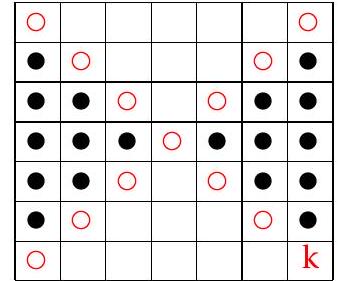\n\nExample of coloring the array.\nThe models are kind of hard to find, due to the fact that the direct proof offers little as to their structure (it is difficult to determine the equality case during the argument involving the inequality with the bound, and then, even this is not sure to be prone to being prolonged to a full labeling of the array).\n\nThe weaker fact the value $M$ is not larger than $2 N$ is proved by the general model exhibited below (presented so that partial credits may be awarded).\n\n| $\\mathrm{N}+1$ | $\\mathrm{~N}+2$ | $\\ldots$ | 2 N |\n| :---: | :---: | :---: | :---: |\n| $3 \\mathrm{~N}+1$ | $3 \\mathrm{~N}+2$ | $\\cdots$ | 4 N |\n| $\\vdots$ | $\\vdots$ | $\\ddots$ | $\\vdots$ |\n| $(2 \\ell-1) \\mathrm{N}+1$ | $(2 \\ell-1) \\mathrm{N}+2$ | $\\ldots$ | $2 \\ell \\mathrm{~N}$ |\n| $\\vdots$ | $\\vdots$ | $\\ddots$ | $\\vdots$ |\n| $2 k \\mathrm{~N}+1$ | $2 k \\mathrm{~N}+2$ | $\\ldots$ | $(2 k+1) \\mathrm{N}$ |\n| $\\vdots$ | $\\vdots$ | $\\ddots$ | $\\vdots$ |\n| $2 \\mathrm{~N}+1$ | $2 \\mathrm{~N}+2$ | $\\ldots$ | 3 N |\n| 1 | 2 | $\\ldots$ | N |\n\nA general model for $M=2 N$ in a $N \\times N$ array.\nBy examining some small $N>2$ cases, one comes up with the idea of spiral models for the true value $M=2 N-1$. The models presented are for odd $N$ (since 2011 is odd); similar models exist for even $N$ (but are less symmetric). The color red (preceded by green) marks the moment where the largest difference $M=2 N-1$ first appears.\n[1] Also see Sloane's Online Encyclopædia of Integer Sequences (OEIS), sequence A001222 for $\\Omega$ and sequence A008836 for $\\lambda$, which is called Liouville's function. Its summatory function $\\sum_{d \\mid n} \\lambda(d)$ is equal to 1 for a perfect square $n$, and 0 otherwise.\nPólya conjectured that $L(n):=\\sum_{k=1}^{n} \\lambda(k) \\leq 0$ for all $n$, but this has been proven false by Minoru Tanaka, who in 1980 computed that for $n=906,151,257$ its value was positive. Turán showed that if $T(n):=\\sum_{k=1}^{n} \\frac{\\lambda(k)}{k} \\geq 0$ for all large enough $n$, that\n\n| 7 | 2 | 6 |\n| :--- | :--- | :--- |\n| 3 | 1 | 5 |\n| 8 | 4 | 9 |\n\nTABLE I: The spiral $3 \\times 3$ array.\n\n| 16 | 14 | 7 | 13 | 16 |\n| :---: | :---: | :---: | :---: | :---: |\n| 12 | 8 | 2 | 6 | 12 |\n| 9 | 3 | 1 | 5 | 9 |\n| 15 | 10 | 4 | 11 | 15 |\n| 16 | 14 | 7 | 13 | |\n| | | | | |\n\nTABLE II: The spiral $4 \\times 4$ array.\n\n| 23 | 16 | 7 | 15 | 22 |\n| :---: | :---: | :---: | :---: | :---: |\n| 17 | 8 | 2 | 6 | 14 |\n| 9 | 3 | 1 | 5 | 13 |\n| 18 | 10 | 4 | 12 | 21 |\n| 24 | 19 | 11 | 20 | 25 |\n\nTABLE III: The spiral $5 \\times 5$ array.\n\n| 47 | 40 | 29 | 16 | 28 | 39 | 46 |\n| :---: | :---: | :---: | :---: | :---: | :---: | :---: |\n| 41 | 30 | 17 | 7 | 15 | 27 | 38 |\n| 31 | 18 | 8 | 2 | 6 | 14 | 26 |\n| 19 | 9 | 3 | 1 | 5 | 13 | 25 |\n| 32 | 20 | 10 | 4 | 12 | 24 | 37 |\n| 42 | 33 | 21 | 11 | 23 | 36 | 45 |\n| 48 | 43 | 34 | 22 | 35 | 44 | 49 |\n\nTABLE IV: The spiral $7 \\times 7$ array.\n\n| $(2 \\mathrm{n}+1)^{2}-2$ | $(2 \\mathrm{n}+1)^{2}-9$ | $\\ldots$ | | $\\mathrm{n}(2 \\mathrm{n}-1)+1$ | | $\\ldots$ | $(2 \\mathrm{n}+1)^{2}-10$ | $(2 \\mathrm{n}+1)^{2}-3$ |\n| :---: | :---: | :---: | :---: | :---: | :---: | :---: | :---: | :---: |\n| $(2 \\mathrm{n}+1)^{2}-8$ | | $\\ldots$ | $\\mathrm{n}(2 \\mathrm{n}-1)+2$ | | $\\mathrm{n}(2 \\mathrm{n}-1)$ | $\\ldots$ | | $(2 \\mathrm{n}+1)^{2}-11$ |\n| $\\vdots$ | $\\vdots$ | $\\ddots$ | $\\vdots$ | $\\vdots$ | $\\vdots$ | $\\ddots$ | $2 \\mathrm{n}(\\mathrm{n}+1)+3$ | $\\vdots$ |\n| | $2 \\mathrm{n}^{2}$ | $\\ldots$ | 8 | 2 | 6 | $\\ldots$ | $2 \\mathrm{n}(\\mathrm{n}-1)+2$ | $2 \\mathrm{n}(\\mathrm{n}+1)+2$ |\n| $2 \\mathrm{n}^{2}+1$ | | $\\ldots$ | 3 | 1 | 5 | $\\ldots$ | | $2 \\mathrm{n}(\\mathrm{n}+1)+1$ |\n| | $2 \\mathrm{n}^{2}+2$ | $\\ldots$ | 10 | 4 | 12 | $\\ldots$ | $2 \\mathrm{n}(\\mathrm{n}+1)$ | |\n| | $\\vdots$ | $\\ddots$ | $\\vdots$ | $\\vdots$ | $\\vdots$ | $\\ddots$ | $\\vdots$ | $\\vdots$ |\n| $\\vdots$ | $\\vdots$ | $\\ldots$ | $\\mathrm{n}(2 \\mathrm{n}+1)$ | | $\\mathrm{n}(2+1)+2$ | $\\ldots$ | | $(2 \\mathrm{n}+1)^{2}-4$ |\n| $(2 \\mathrm{n}+1)^{2}-7$ | | $\\ldots$ | $\\mathrm{n}(2 \\mathrm{n}+1)+1$ | | $\\ldots$ | $(2 \\mathrm{n}+1)^{2}-5$ | $(2 \\mathrm{n}+1)^{2}$ | |\n| $(2 \\mathrm{n}+1)^{2}-1$ | $(2 \\mathrm{n}+1)^{2}-6$ | $\\ldots$ | | | | | | |\n\nTABLE V: The general spiral $N \\times N$ array for $N=2 n+1 \\geq 5$.\nwill imply Riemann's Hypothesis; however, Haselgrove proved it is negative infinitely often.\n[2] Using the same procedure for point i), we only need notice that $\\lambda\\left((2 k+1)^{2}\\right)=\\lambda\\left((2 k)^{2}\\right)=1$, and these terms again are of different parity of their position.\n[3] Is this true for subsequences of all lengths $\\ell=3,4$, etc.? If no, up to which length $\\ell \\geq 2$ ?\n[4] Cells with coordinates $(x, y)$ and $\\left(x^{\\prime}, y^{\\prime}\\right)$ are considered to be neighbours if $x=x^{\\prime}$ and $y-y^{\\prime} \\equiv \\pm 1(\\bmod 2011)$, or if $y=y^{\\prime}$ and $x-x^{\\prime} \\equiv \\pm 1(\\bmod 2011)$.", "metadata": {"resource_path": "RMM/segmented/en-2011-Sols2011D2.jsonl", "problem_match": "\nProblem 6.", "solution_match": "\nSolution."}} |


