| {"year": "2012", "tier": "T1", "problem_label": "1", "problem_type": null, "exam": "RMM", "problem": "Given a finite group of boys and girls, a covering set of boys is a set of boys such that every girl knows at least one boy in that set; and a covering set of girls is a set of girls such that every boy knows at least one girl in that set. Prove that the number of covering sets of boys and the number of covering sets of girls have the same parity. (Acquaintance is assumed to be mutual.)", "solution": ". A set $X$ of boys is separated from a set $Y$ of girls if no boy in $X$ is an acquaintance of a girl in $Y$. Similarly, a set $Y$ of girls is separated from a set $X$ of boys if no girl in $Y$ is an acquaintance of a boy in $X$. Since acquaintance is assumed mutual, separation is symmetric: $X$ is separated from $Y$ if and only if $Y$ is separated from $X$.\n\nThis enables doubly counting the number $n$ of ordered pairs $(X, Y)$ of separated sets $X$, of boys, and $Y$, of girls, and thereby showing that it is congruent modulo 2 to both numbers in question.\n\nGiven a set $X$ of boys, let $Y_{X}$ be the largest set of girls separated from $X$, to deduce that $X$ is separated from exactly $2^{\\left|Y_{X}\\right|}$ sets of girls. Consequently, $n=\\sum_{X} 2^{\\left|Y_{X}\\right|}$ which is clearly congruent modulo 2 to the number of covering sets of boys.\n\nMutatis mutandis, the argument applies to show $n$ congruent modulo 2 to the number of covering sets of girls.\n\nRemark. The argument in this solution translates verbatim in terms of the adjancency matrix of the associated acquaintance graph.", "metadata": {"resource_path": "RMM/segmented/en-2012-Solutions2012-1.jsonl", "problem_match": "\nProblem 1.", "solution_match": "\nSolution 1"}} |
| {"year": "2012", "tier": "T1", "problem_label": "1", "problem_type": null, "exam": "RMM", "problem": "Given a finite group of boys and girls, a covering set of boys is a set of boys such that every girl knows at least one boy in that set; and a covering set of girls is a set of girls such that every boy knows at least one girl in that set. Prove that the number of covering sets of boys and the number of covering sets of girls have the same parity. (Acquaintance is assumed to be mutual.)", "solution": ". (Ilya Bogdanov) Let $B$ denote the set of boys, let $G$ denote the set of girls and induct on $|B|+|G|$. The assertion is vacuously true if either set is empty.\n\nNext, fix a boy $b$, let $B^{\\prime}=B \\backslash\\{b\\}$, and let $G^{\\prime}$ be the set of all girls who do not know $b$. Notice that:\n(1) a covering set of boys in $B^{\\prime} \\cup G$ is still one in $B \\cup G$; and\n(2) a covering set of boys in $B \\cup G$ which is no longer one in $B^{\\prime} \\cup G$ is precisely the union of a covering set of boys in $B^{\\prime} \\cup G^{\\prime}$ and $\\{b\\}$,\nso the number of covering sets of boys in $B \\cup G$ is the sum of those in $B^{\\prime} \\cup G$ and $B^{\\prime} \\cup G^{\\prime}$. On the other hand,\n$\\left(1^{\\prime}\\right)$ a covering set of girls in $B \\cup G$ is still one in $B^{\\prime} \\cup G$; and\n$\\left(2^{\\prime}\\right)$ a covering set of girls in $B^{\\prime} \\cup G$ which is no longer one in $B \\cup G$ is precisely a covering set of girls in $B^{\\prime} \\cup G^{\\prime}$,\nso the number of covering sets of girls in $B \\cup G$ is the difference of those in $B^{\\prime} \\cup G$ and $B^{\\prime} \\cup G^{\\prime}$. Since the assertion is true for both $B^{\\prime} \\cup G$ and $B^{\\prime} \\cup G^{\\prime}$ by the induction hypothesis, the conclusion follows.", "metadata": {"resource_path": "RMM/segmented/en-2012-Solutions2012-1.jsonl", "problem_match": "\nProblem 1.", "solution_match": "\nSolution 2"}} |
| {"year": "2012", "tier": "T1", "problem_label": "1", "problem_type": null, "exam": "RMM", "problem": "Given a finite group of boys and girls, a covering set of boys is a set of boys such that every girl knows at least one boy in that set; and a covering set of girls is a set of girls such that every boy knows at least one girl in that set. Prove that the number of covering sets of boys and the number of covering sets of girls have the same parity. (Acquaintance is assumed to be mutual.)", "solution": ". (Géza Kós) Let $B$ and $G$ denote the sets of boys and girls, respectively. For every pair $(b, g) \\in B \\times G$, write $f(b, g)=0$ if they know each other, and $f(b, g)=1$ otherwise. A set $X$ of boys is covering if and only if\n\n$$\n\\prod_{g \\in G}\\left(1-\\prod_{b \\in X} f(b, g)\\right)=1\n$$\n\nHence the number of covering sets of boys is\n\n$$\n\\begin{aligned}\n\\sum_{X \\subseteq B} \\prod_{g \\in G}\\left(1-\\prod_{b \\in X} f(b, g)\\right) & \\equiv \\sum_{X \\subseteq B} \\prod_{g \\in G}\\left(1+\\prod_{b \\in X} f(b, g)\\right) \\\\\n& =\\sum_{X \\subseteq B} \\sum_{Y \\subseteq G} \\prod_{b \\in X} \\prod_{g \\in Y} f(b, g) \\quad(\\bmod 2)\n\\end{aligned}\n$$\n\nBy symmetry, the same is valid for the number of covering sets of girls.", "metadata": {"resource_path": "RMM/segmented/en-2012-Solutions2012-1.jsonl", "problem_match": "\nProblem 1.", "solution_match": "\nSolution 3"}} |
| {"year": "2012", "tier": "T1", "problem_label": "2", "problem_type": null, "exam": "RMM", "problem": "Given a triangle $A B C$, let $D, E$, and $F$ respectively denote the midpoints of the sides $B C, C A$, and $A B$. The circle $B C F$ and the line $B E$ meet again at $P$, and the circle $A B E$ and the line $A D$ meet again at $Q$. Finally, the lines $D P$ and $F Q$ meet at $R$. Prove that the centroid $G$ of the triangle $A B C$ lies on the circle $P Q R$.", "solution": ". We will use the following lemma.\nLemma. Let $A D$ be a median in triangle $A B C$. Then $\\cot \\angle B A D=2 \\cot A+\\cot B$ and $\\cot \\angle A D C=\\frac{1}{2}(\\cot B-\\cot C)$.\n\nProof. Let $C C_{1}$ and $D D_{1}$ be the perpendiculars from $C$ and $D$ to $A B$. Using the signed lengths we write\n\n$$\n\\cot B A D=\\frac{A D_{1}}{D D_{1}}=\\frac{\\left(A C_{1}+A B\\right) / 2}{C C_{1} / 2}=\\frac{C C_{1} \\cot A+C C_{1}(\\cot A+\\cot B)}{C C_{1}}=2 \\cot A+\\cot B\n$$\n\nSimilarly, denoting by $A_{1}$ the projection of $A$ onto $B C$, we get\n\n$$\n\\cot A D C=\\frac{D A_{1}}{A A_{1}}=\\frac{B C / 2-A_{1} C}{A A_{1}}=\\frac{\\left(A A_{1} \\cot B+A A_{1} \\cot C\\right) / 2-A A_{1} \\cot C}{A A_{1}}=\\frac{\\cot B-\\cot C}{2} .\n$$\n\nThe Lemma is proved.\nTurning to the solution, by the Lemma we get\n\n$$\n\\begin{aligned}\n\\cot \\angle B P D & =2 \\cot \\angle B P C+\\cot \\angle P B C=2 \\cot \\angle B F C+\\cot \\angle P B C \\quad(\\text { from circle } B F P C) \\\\\n& =2 \\cdot \\frac{1}{2}(\\cot A-\\cot B)+2 \\cot B+\\cot C=\\cot A+\\cot B+\\cot C\n\\end{aligned}\n$$\n\nSimilarly, $\\cot \\angle G Q F=\\cot A+\\cot B+\\cot C$, so $\\angle G P R=\\angle G Q F$ and $G P R Q$ is cyclic.\nRemark. The angle $\\angle G P R=\\angle G Q F$ is the Brocard angle.", "metadata": {"resource_path": "RMM/segmented/en-2012-Solutions2012-1.jsonl", "problem_match": "\nProblem 2.", "solution_match": "\nSolution 1"}} |
| {"year": "2012", "tier": "T1", "problem_label": "2", "problem_type": null, "exam": "RMM", "problem": "Given a triangle $A B C$, let $D, E$, and $F$ respectively denote the midpoints of the sides $B C, C A$, and $A B$. The circle $B C F$ and the line $B E$ meet again at $P$, and the circle $A B E$ and the line $A D$ meet again at $Q$. Finally, the lines $D P$ and $F Q$ meet at $R$. Prove that the centroid $G$ of the triangle $A B C$ lies on the circle $P Q R$.", "solution": ". (Ilya Bogdanov and Marian Andronache) We also prove that $\\angle(R P, P G)=\\angle(R Q, Q G)$, or $\\angle(D P, P G)=\\angle(F Q, Q G)$.\n\nLet $S$ be the point on ray $G D$ such that $A G \\cdot G S=C G \\cdot G F$ (so the points $A, S, C, F$ are concyclic). Then $G P \\cdot G E=G P \\cdot \\frac{1}{2} G B=\\frac{1}{2} C G \\cdot G F=\\frac{1}{2} A G \\cdot G S=G D \\cdot G S$, hence the points $E, P, D, S$ are also concyclic, and $\\angle(D P, P G)=\\angle(G S, S E)$. The problem may therefore be rephrased as follows:\nGiven a triangle $A B C$, let $D, E$ and $F$ respectively denote the midpoints of the sides $B C, C A$ and $A B$. The circle $A B E$, respectively, $A C F$, and the line $A D$ meet again at $Q$, respectively, $S$. Prove that $\\angle A Q F=\\angle A S E($ and $E S=F Q)$.\n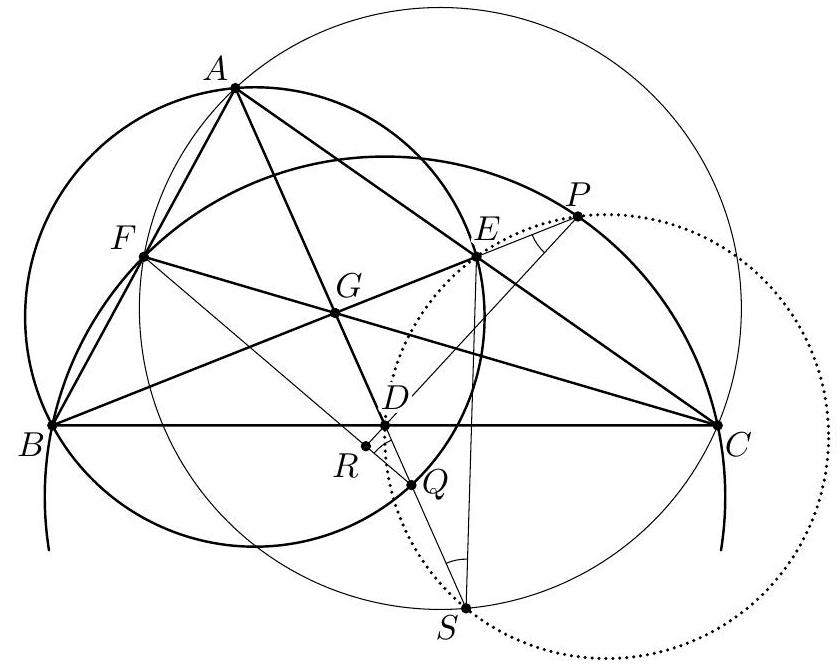\n\nUpon inversion of pole $A$, the problem reads:\nGiven a triangle $A E^{\\prime} F^{\\prime}$, let the symmedian from $A$ meet the medians from $E^{\\prime}$ and $F^{\\prime}$ at $K=Q^{\\prime}$ and $L=S^{\\prime}$, respectively. Prove that the angles $A E^{\\prime} L$ and $A F^{\\prime} K$ are congruent.\n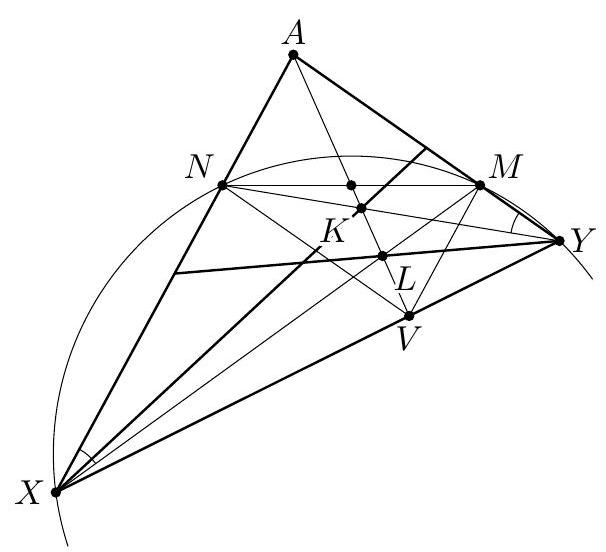\n\nTo prove this, denote $E^{\\prime}=X, F^{\\prime}=Y$. Let the symmedian from $A$ meet the side $X Y$ at $V$ and let the lines $X L$ and $Y K$ meet the sides $A Y$ and $A X$ at $M$ and $N$, respectively. Since the points $K$ and $L$ lie on the medians, we have $V M\\|A X, V N\\| A Y$. Hence $A M V N$ is a parallelogram, the symmedian $A V$ of triangle $A X Y$ supports the median of triangle $A M N$, which implies that the triangles $A M N$ and $A X Y$ are similar. Hence the points $M, N, X, Y$ are concyclic, and $\\angle A X M=\\angle A Y N$, QED.\n\nRemark 1. We know that the points $X, Y, M, N$ are concyclic. Invert back from $A$ and consider the circles $A F Q$ and $A E S$ : the former meets $A C$ again at $M^{\\prime}$ and the latter meets $A B$ again at $N^{\\prime}$. Then the points $E, F, M^{\\prime}, N^{\\prime}$ are concyclic.\n\nRemark 2. The inversion at pole $A$ also allows one to show that $\\angle A Q F$ is the Brocard angle, thus providing one more solution. In our notation, it is equivalent to the fact that the points $Y$, $K$, and $Z$ are collinear, where $Z$ is the Brocard point (so $\\angle Z A X=\\angle Z Y A=\\angle Z X Y$ ). This is valid because the lines $A V, X K$, and $Y Z$ are the radical axes of the following circles: (i) passing through $X$ and tangent to $A Y$ at $A$; (ii) passing through $Y$ and tangent to $A X$ at $A$; and (iii) passing through $X$ and tangent to $A Y$ at $Y$. The point $K$ is the radical center of these three circles.", "metadata": {"resource_path": "RMM/segmented/en-2012-Solutions2012-1.jsonl", "problem_match": "\nProblem 2.", "solution_match": "\nSolution 2"}} |
| {"year": "2012", "tier": "T1", "problem_label": "2", "problem_type": null, "exam": "RMM", "problem": "Given a triangle $A B C$, let $D, E$, and $F$ respectively denote the midpoints of the sides $B C, C A$, and $A B$. The circle $B C F$ and the line $B E$ meet again at $P$, and the circle $A B E$ and the line $A D$ meet again at $Q$. Finally, the lines $D P$ and $F Q$ meet at $R$. Prove that the centroid $G$ of the triangle $A B C$ lies on the circle $P Q R$.", "solution": ". (Ilya Bogdanov) Again, we will prove that $\\angle(D P, P G)=\\angle(F Q, Q G)$. Mark a point $T$ on the ray $G F$ such that $G F \\cdot G T=G Q \\cdot G D$; then the points $F, Q, D, T$ are concyclic, and $\\angle(F Q, Q G)=\\angle(T G, T D)=\\angle(T C, T D)$.\n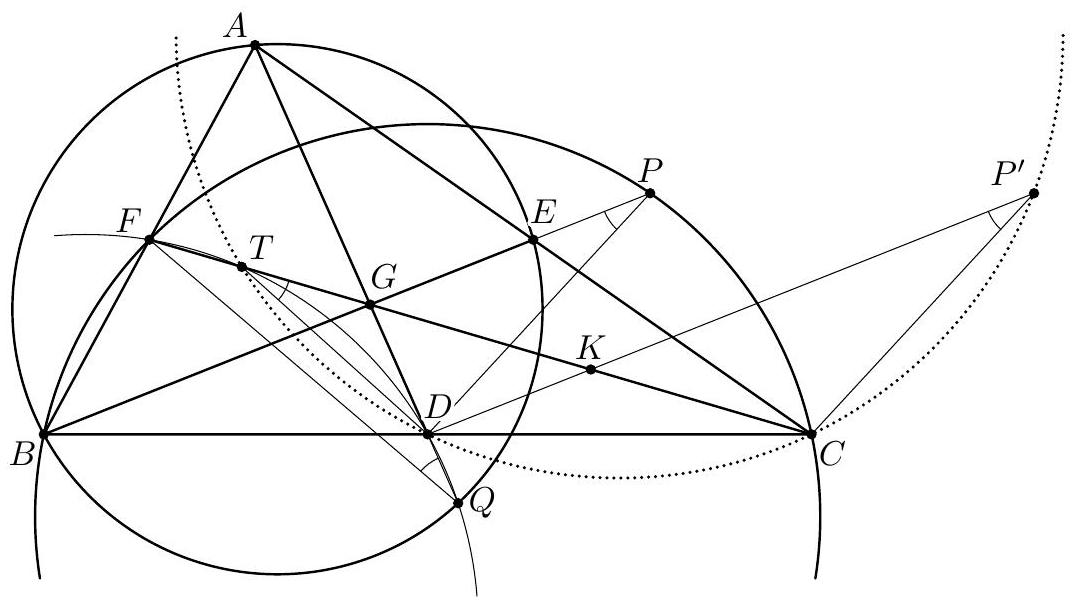\n\nShift the point $P$ by the vector $\\overrightarrow{B D}$ to obtain point $P^{\\prime}$. Then $\\angle(D P, P G)=\\angle\\left(C P^{\\prime}, P^{\\prime} D\\right)$, and we need to prove that $\\angle\\left(C P^{\\prime}, P^{\\prime} D\\right)=\\angle(C T, T D)$. This is precisely the condition that the points $T, D, C, P^{\\prime}$ be concyclic.\n\nDenote $G E=x, G F=y$. Then $G P \\cdot G B=G C \\cdot G F$, so $G P=y^{2} / x$. On the other hand, $G B \\cdot G E=G Q \\cdot G A=2 G Q \\cdot G D=2 G T \\cdot G F$, so $G T=x^{2} / y$. Denote by $K$ the point of intersection of $D P^{\\prime}$ and $C T$; we need to prove that $T K \\cdot K C=D K \\cdot K P^{\\prime}$.\n\nNow, $D P^{\\prime}=B P=B G+G P=2 x+y^{2} / x, C T=C G+G T=2 y+x^{2} / y, D K=B G / 2=x$, $C K=C G / 2=y$. Hence the desired equality reads $x\\left(x+y^{2} / x\\right)=y\\left(y+x^{2} / y\\right)$ which is obvious.\n\nRemark. The points $B, T, E$, and $C$ are concyclic, hence the point $T$ is also of the same kind as $P$ and $Q$.", "metadata": {"resource_path": "RMM/segmented/en-2012-Solutions2012-1.jsonl", "problem_match": "\nProblem 2.", "solution_match": "\nSolution 3"}} |
| {"year": "2012", "tier": "T1", "problem_label": "3", "problem_type": null, "exam": "RMM", "problem": "Each positive integer number is coloured red or blue. A function $f$ from the set of positive integer numbers into itself has the following two properties:\n(a) if $x \\leq y$, then $f(x) \\leq f(y)$; and\n(b) if $x, y$ and $z$ are all (not necessarily distinct) positive integer numbers of the same colour and $x+y=z$, then $f(x)+f(y)=f(z)$.\n\nProve that there exists a positive number $a$ such that $f(x) \\leq a x$ for all positive integer numbers $x$.", "solution": "For integer $x, y$, by a segment $[x, y]$ we always mean the set of all integers $t$ such that $x \\leq t \\leq y$; the length of this segment is $y-x$.\n\nIf for every two positive integers $x, y$ sharing the same colour we have $f(x) / x=f(y) / y$, then one can choose $a=\\max \\{f(r) / r, f(b) / b\\}$, where $r$ and $b$ are arbitrary red and blue numbers, respectively. So we can assume that there are two red numbers $x, y$ such that $f(x) / x \\neq f(y) / y$.\n\nSet $m=x y$. Then each segment of length $m$ contains a blue number. Indeed, assume that all the numbers on the segment $[k, k+m]$ are red. Then\n\n$$\n\\begin{aligned}\n& f(k+m)=f(k+x y)=f(k+x(y-1))+f(x)=\\cdots=f(k)+y f(x), \\\\\n& f(k+m)=f(k+x y)=f(k+(x-1) y)+f(y)=\\cdots=f(k)+x f(y),\n\\end{aligned}\n$$\n\nso $y f(x)=x f(y)$ - a contradiction. Now we consider two cases.\nCase 1. Assume that there exists a segment $[k, k+m]$ of length $m$ consisting of blue numbers. Define $D=\\max \\{f(k), \\ldots, f(k+m)\\}$. We claim that $f(z)-f(z-1) \\leq D$, whatever $z>k$, and the conclusion follows. Consider the largest blue number $b_{1}$ not exceeding $z$, so $z-b_{1} \\leq m$, and some blue number $b_{2}$ on the segment $\\left[b_{1}+k, b_{1}+k+m\\right]$, so $b_{2}>z$. Write $f\\left(b_{2}\\right)=f\\left(b_{1}\\right)+f\\left(b_{2}-b_{1}\\right) \\leq f\\left(b_{1}\\right)+D$ to deduce that $f(z+1)-f(z) \\leq f\\left(b_{2}\\right)-f\\left(b_{1}\\right) \\leq D$, as claimed.\n\nCase 2. Each segment of length $m$ contains numbers of both colours. Fix any red number $R \\geq 2 m$ such that $R+1$ is blue and set $D=\\max \\{f(R), f(R+1)\\}$. Now we claim that $f(z+1)-f(z) \\leq D$, whatever $z>2 m$. Consider the largest red number $r$ not exceeding $z$ and the largest blue number $b$ smaller than $r$; then $0<z-b=(z-r)+(r-b) \\leq 2 m$, and $b+1$ is red. Let $t=b+R+1$; then $t>z$. If $t$ is blue, then $f(t)=f(b)+f(R+1) \\leq f(b)+D$, and $f(z+1)-f(z) \\leq f(t)-f(b) \\leq D$. Otherwise, $f(t)=f(b+1)+f(R) \\leq f(b+1)+D$, hence $f(z+1)-f(z) \\leq f(t)-f(b+1) \\leq D$, as claimed.", "metadata": {"resource_path": "RMM/segmented/en-2012-Solutions2012-1.jsonl", "problem_match": "\nProblem 3.", "solution_match": "\nSolution."}} |
|
|


