| {"year": "2012", "tier": "T1", "problem_label": "4", "problem_type": null, "exam": "RMM", "problem": "Prove that there are infinitely many positive integer numbers $n$ such that $2^{2^{n}+1}+1$ be divisible by $n$, but $2^{n}+1$ be not.", "solution": ". Throughout the solution $n$ stands for a positive integer. By Euler's theorem, $\\left(2^{3^{n}}+1\\right)\\left(2^{3^{n}}-1\\right)=2^{2 \\cdot 3^{n}}-1 \\equiv 0\\left(\\bmod 3^{n+1}\\right)$. Since $2^{3^{n}}-1 \\equiv 1(\\bmod 3)$, it follows that $2^{3^{n}}+1$ is divisible by $3^{n+1}$.\n\nThe number $\\left(2^{3^{n+1}}+1\\right) /\\left(2^{3^{n}}+1\\right)=2^{2 \\cdot 3^{n}}-2^{3^{n}}+1$ is greater than 3 and congruent to 3 modulo 9 , so it has a prime factor $p_{n}>3$ that does not divide $2^{3^{n}}+1$ (otherwise, $2^{3^{n}} \\equiv-1$ (mod $\\left.p_{n}\\right)$, so $2^{2 \\cdot 3^{n}}-2^{3^{n}}+1 \\equiv 3\\left(\\bmod p_{n}\\right)$, contradicting the fact that $p_{n}$ is a factor greater than 3 of $2^{2 \\cdot 3^{n}}-2^{3^{n}}+1$ ).\n\nWe now show that $a_{n}=3^{n} p_{n}$ satisfies the conditions in the statement. Since $2^{a_{n}}+1 \\equiv$ $2^{3^{n}}+1 \\not \\equiv 0\\left(\\bmod p_{n}\\right)$, it follows that $a_{n}$ does not divide $2^{a_{n}}+1$.\n\nOn the other hand, $3^{n+1}$ divides $2^{3^{n}}+1$ which in turn divides $2^{a_{n}}+1$, so $2^{3^{n+1}}+1$ divides $2^{2^{a_{n}}+1}+1$. Finally, both $3^{n}$ and $p_{n}$ divide $2^{3^{n+1}}+1$, so $a_{n}$ divides $2^{2^{a_{n}}+1}+1$.\n\nAs $n$ runs through the positive integers, the $a_{n}$ are clearly pairwise distinct and the conclusion follows.", "metadata": {"resource_path": "RMM/segmented/en-2012-Solutions2012-2.jsonl", "problem_match": "\nProblem 4.", "solution_match": "\nSolution 1"}} |
| {"year": "2012", "tier": "T1", "problem_label": "4", "problem_type": null, "exam": "RMM", "problem": "Prove that there are infinitely many positive integer numbers $n$ such that $2^{2^{n}+1}+1$ be divisible by $n$, but $2^{n}+1$ be not.", "solution": ". (Géza Kós) We show that the numbers $a_{n}=\\left(2^{3^{n}}+1\\right) / 9, n \\geq 2$, satisfy the conditions in the statement. To this end, recall the following well-known facts:\n(1) If $N$ is an odd positive integer, then $\\nu_{3}\\left(2^{N}+1\\right)=\\nu_{3}(N)+1$, where $\\nu_{3}(a)$ is the exponent of 3 in the decomposition of the integer $a$ into prime factors; and\n(2) If $M$ and $N$ are odd positive integers, then $\\left(2^{M}+1,2^{N}+1\\right)=2^{(M, N)}+1$, where $(a, b)$ is the greatest common divisor of the integers $a$ and $b$.\nBy (1), $a_{n}=3^{n-1} m$, where $m$ is an odd positive integer not divisible by 3 , and by (2),\n\n$$\n\\left(m, 2^{a_{n}}+1\\right) \\left\\lvert\\,\\left(2^{3^{n}}+1,2^{a_{n}}+1\\right)=2^{\\left(3^{n}, a_{n}\\right)}+1=2^{3^{n-1}}+1<\\frac{2^{3^{n}}+1}{3^{n+1}}=m\\right.\n$$\n\nso $m$ cannot divide $2^{a_{n}}+1$.\nOn the other hand, $3^{n-1} \\mid 2^{2^{a_{n}}+1}+1$, for $\\nu_{3}\\left(2^{2^{a_{n}}+1}+1\\right)>\\nu_{3}\\left(2^{a_{n}}+1\\right)>\\nu_{3}\\left(a_{n}\\right)=n-1$, and $m \\mid 2^{2^{a_{n}}+1}+1$, for $3^{n-1} \\mid a_{n}$, so $3^{n} \\mid 2^{a_{n}}+1$ whence $m\\left|2^{3^{n}}+1\\right| 2^{2^{a_{n}}+1}+1$. Since $3^{n-1}$ and $m$ are coprime, the conclusion follows.\n\nRemarks. There are several variations of these solutions. For instance, let $b_{1}=3$ and $b_{n+1}=$ $2^{b_{n}}+1, n \\geq 1$, and notice that $b_{n}$ divides $b_{n+1}$. It can be shown that there are infinitely many indices $n$ such that some prime factor $p_{n}$ of $b_{n+1}$ does not divide $b_{n}$. One checks that for these $n$ 's the $a_{n}=p_{n} b_{n-1}$ satisfy the required conditions.\n\nFinally, the numbers $3^{n} \\cdot 571, n \\geq 2$, form yet another infinite set of positive integers fulfilling the conditions in the statement - the details are omitted.", "metadata": {"resource_path": "RMM/segmented/en-2012-Solutions2012-2.jsonl", "problem_match": "\nProblem 4.", "solution_match": "\nSolution 2"}} |
| {"year": "2012", "tier": "T1", "problem_label": "4", "problem_type": null, "exam": "RMM", "problem": "Prove that there are infinitely many positive integer numbers $n$ such that $2^{2^{n}+1}+1$ be divisible by $n$, but $2^{n}+1$ be not.", "solution": ". (Dušan Djukić) Assume that $n$ satisfies the conditions of the problem. We claim that the number $N=2^{n}+1>n$ also satisfies these conditions.\n\nFirstly, since $n \\nmid N$, the fact (2) from Solution 2 allows to conclude that $2^{n}+1 \\nmid 2^{N}+1$, or $N \\nmid 2^{N}+1$. Next, since $n \\mid 2^{2^{n}+1}+1=2^{N}+1$, we obtain from the same fact that $N=2^{n}+1 \\mid 2^{2^{N}+1}+1$, thus confirming our claim.\n\nHence, it suffices to provide only one example, hence obtaining an infinite series by the claim. For instance, one may easily check that the number $n=57$ fits.", "metadata": {"resource_path": "RMM/segmented/en-2012-Solutions2012-2.jsonl", "problem_match": "\nProblem 4.", "solution_match": "\nSolution 3"}} |
| {"year": "2012", "tier": "T1", "problem_label": "5", "problem_type": null, "exam": "RMM", "problem": "Given a positive integer number $n \\geq 3$, colour each cell of an $n \\times n$ square array one of $\\left[(n+2)^{2} / 3\\right]$ colours, each colour being used at least once. Prove that the cells of some $1 \\times 3$ or $3 \\times 1$ rectangular subarray have pairwise distinct colours.", "solution": "For more convenience, say that a subarray of the $n \\times n$ square array bears a colour if at least two of its cells share that colour.\n\nWe shall prove that the number of $1 \\times 3$ and $3 \\times 1$ rectangular subarrays, which is $2 n(n-2)$, exceeds the number of such subarrays, each of which bears some colour. The key ingredient is the estimate in the lemma below.\n\nLemma. If a colour is used exactly $p$ times, then the number of $1 \\times 3$ and $3 \\times 1$ rectangular subarrays bearing that colour does not exceed $3(p-1)$.\n\nAssume the lemma for the moment, let $N=\\left[(n+2)^{2} / 3\\right]$ and let $n_{i}$ be the number of cells coloured the $i$ th colour, $i=1, \\ldots, N$, to deduce that the number of $1 \\times 3$ and $3 \\times 1$ rectangular subarrays, each of which bears some colour, is at most\n\n$$\n\\sum_{i=1}^{N} 3\\left(n_{i}-1\\right)=3 \\sum_{i=1}^{N} n_{i}-3 N=3 n^{2}-3 N<3 n^{2}-\\left(n^{2}+4 n\\right)=2 n(n-2)\n$$\n\nand thereby conclude the proof.\nBack to the lemma, the assertion is clear if $p=1$, so let $p>1$.\nWe begin by showing that if a row contains exactly $q$ cells coloured $C$, then the number $r$ of $3 \\times 1$ rectangular subarrays bearing $C$ does not exceed $3 q / 2-1$; of course, a similar estimate holds for a column. To this end, notice first that the case $q=1$ is trivial, so we assume that $q>1$. Consider the incidence of a cell $c$ coloured $C$ and a $3 \\times 1$ rectangular subarray $R$ bearing $C$ :\n\n$$\n\\langle c, R\\rangle= \\begin{cases}1 & \\text { if } c \\subset R \\\\ 0 & \\text { otherwise. }\\end{cases}\n$$\n\nNotice that, given $R, \\sum_{c}\\langle c, R\\rangle \\geq 2$, and, given $c, \\sum_{R}\\langle c, R\\rangle \\leq 3$; moreover, if $c$ is the leftmost or rightmost cell, then $\\sum_{R}\\langle c, R\\rangle \\leq 2$. Consequently,\n\n$$\n2 r \\leq \\sum_{R} \\sum_{c}\\langle c, R\\rangle=\\sum_{c} \\sum_{R}\\langle c, R\\rangle \\leq 2+3(q-2)+2=3 q-2\n$$\n\nwhence the conclusion.\nFinally, let the $p$ cells coloured $C$ lie on $k$ rows and $\\ell$ columns and notice that $k+\\ell \\geq 3$, for $p>1$. By the preceding, the total number of $3 \\times 1$ rectangular subarrays bearing $C$ does not exceed $3 p / 2-k$, and the total number of $1 \\times 3$ rectangular subarrays bearing $C$ does not exceed $3 p / 2-\\ell$, so the total number of $1 \\times 3$ and $3 \\times 1$ rectangular subarrays bearing $C$ does not exceed $(3 p / 2-k)+(3 p / 2-\\ell)=3 p-(k+\\ell) \\leq 3 p-3=3(p-1)$. This completes the proof.\n\nRemarks. In terms of the total number of cells, the number $N=\\left[(n+2)^{2} / 3\\right]$ of colours is asymptotically close to the minimum number of colours required for some $1 \\times 3$ or $3 \\times 1$ rectangular subarray to have all cells of pairwise distinct colours, whatever the colouring. To see this, colour the cells with the coordinates $(i, j)$, where $i+j \\equiv 0(\\bmod 3)$ and $i, j \\in\\{0,1, \\ldots, n-1\\}$, one colour each, and use one additional colour $C$ to colour the remaining cells. Then each $1 \\times 3$ and each $3 \\times 1$ rectangular subarray has exactly two cells coloured $C$, and the number of colours is $\\left\\lceil n^{2} / 3\\right\\rceil+1$ if $n \\equiv 1$ or $2(\\bmod 3)$, and $\\left\\lceil n^{2} / 3\\right\\rceil$ if $n \\equiv 0(\\bmod 3)$. Consequently, the minimum number of colours is $n^{2} / 3+O(n)$.", "metadata": {"resource_path": "RMM/segmented/en-2012-Solutions2012-2.jsonl", "problem_match": "\nProblem 5.", "solution_match": "\nSolution."}} |
| {"year": "2012", "tier": "T1", "problem_label": "6", "problem_type": null, "exam": "RMM", "problem": "Let $A B C$ be a triangle and let $I$ and $O$ respectively denote its incentre and circumcentre. Let $\\omega_{A}$ be the circle through $B$ and $C$ and tangent to the incircle of the triangle $A B C$; the circles $\\omega_{B}$ and $\\omega_{C}$ are defined similarly. The circles $\\omega_{B}$ and $\\omega_{C}$ through $A$ meet again at $A^{\\prime}$; the points $B^{\\prime}$ and $C^{\\prime}$ are defined similarly. Prove that the lines $A A^{\\prime}, B B^{\\prime}$ and $C C^{\\prime}$ are concurrent at a point on the line $I O$.", "solution": "Let $\\gamma$ be the incircle of the triangle $A B C$ and let $A_{1}, B_{1}, C_{1}$ be its contact points with the sides $B C, C A, A B$, respectively. Let further $X_{A}$ be the point of contact of the circles $\\gamma$ and $\\omega_{A}$. The latter circle is the image of the former under a homothety centred at $X_{A}$. This homothety sends $A_{1}$ to a point $M_{A}$ on $\\omega_{A}$ such that the tangent to $\\omega_{A}$ at $M_{A}$ is parallel to $B C$. Consequently, $M_{A}$ is the midpoint of the arc $B C$ of $\\omega_{A}$ not containing $X_{A}$. It follows that the angles $M_{A} X_{A} B$ and $M_{A} B C$ are congruent, so the triangles $M_{A} B A_{1}$ and $M_{A} X_{A} B$ are similar: $M_{A} B / M_{A} X_{A}=M_{A} A_{1} / M_{A} B$. Rewrite the latter $M_{A} B^{2}=M_{A} A_{1} \\cdot M_{A} X_{A}$ to deduce that $M_{A}$ lies on the radical axis $\\ell_{B}$ of $B$ and $\\gamma$. Similarly, $M_{A}$ lies on the radical axis $\\ell_{C}$ of $C$ and $\\gamma$.\n\nDefine the points $X_{B}, X_{C}, M_{B}, M_{C}$ and the line $\\ell_{A}$ in a similar way and notice that the lines $\\ell_{A}, \\ell_{B}, \\ell_{C}$ support the sides of the triangle $M_{A} M_{B} M_{C}$. The lines $\\ell_{A}$ and $B_{1} C_{1}$ are both perpendicular to $A I$, so they are parallel. Similarly, the lines $\\ell_{B}$ and $\\ell_{C}$ are parallel to $C_{1} A_{1}$ and $A_{1} B_{1}$, respectively. Consequently, the triangle $M_{A} M_{B} M_{C}$ is the image of the triangle $A_{1} B_{1} C_{1}$ under a homothety $\\Theta$. Let $K$ be the centre of $\\Theta$ and let $k=M_{A} K / A_{1} K=M_{B} K / B_{1} K=$ $M_{C} K / C_{1} K$ be the similitude ratio. Notice that the lines $M_{A} A_{1}, M_{B} B_{1}$ and $M_{C} C_{1}$ are concurrent at $K$.\n\nSince the points $A_{1}, B_{1}, X_{A}, X_{B}$ are concyclic, $A_{1} K \\cdot K X_{A}=B_{1} K \\cdot K X_{B}$. Multiply both sides by $k$ to get $M_{A} K \\cdot K X_{A}=M_{B} K \\cdot K X_{B}$ and deduce thereby that $K$ lies on the radical axis $C C^{\\prime}$ of $\\omega_{A}$ and $\\omega_{B}$. Similarly, both lines $A A^{\\prime}$ and $B B^{\\prime}$ pass through $K$.\n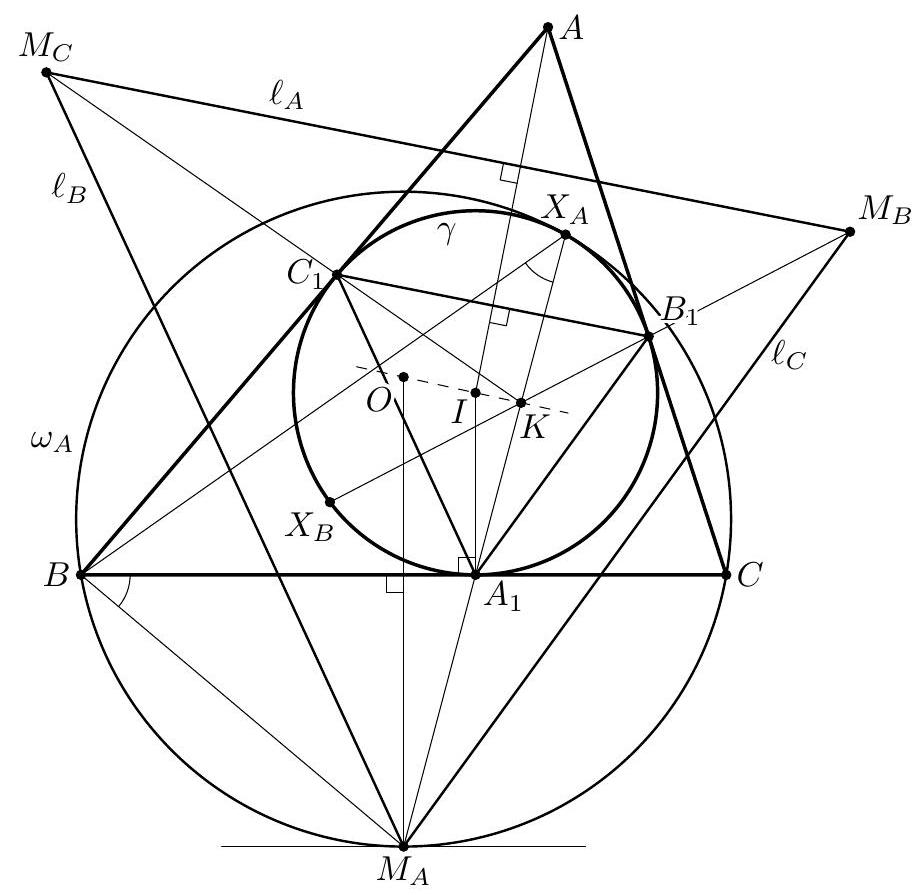\n\nFinally, consider the image $O^{\\prime}$ of $I$ under $\\Theta$. It lies on the line through $M_{A}$ parallel to $A_{1} I$ (and hence perpendicular to $B C$ ); since $M_{A}$ is the midpoint of the $\\operatorname{arc} B C$, this line must be $M_{A} O$. Similarly, $O^{\\prime}$ lies on the line $M_{B} O$, so $O^{\\prime}=O$. Consequently, the points $I, K$ and $O$ are collinear.\n\nRemark 1. Many steps in this solution allow different reasonings. For instance, one may\nsee that the lines $A_{1} X_{A}$ and $B_{1} X_{B}$ are concurrent at point $K$ on the radical axis $C C^{\\prime}$ of the circles $\\omega_{A}$ and $\\omega_{B}$ by applying Newton's theorem to the quadrilateral $X_{A} X_{B} A_{1} B_{1}$ (since the common tangents at $X_{A}$ and $X_{B}$ intersect on $C C^{\\prime}$ ). Then one can conclude that $K A_{1} / K B_{1}=$ $K M_{A} / K M_{B}$, thus obtaining that the triangles $M_{A} M_{B} M_{C}$ and $A_{1} B_{1} C_{1}$ are homothetical at $K$ (and therefore $K$ is the radical center of $\\omega_{A}, \\omega_{B}$, and $\\omega_{C}$ ). Finally, considering the inversion with the pole $K$ and the power equal to $K X_{1} \\cdot K M_{A}$ followed by the reflection at $P$ we see that the circles $\\omega_{A}, \\omega_{B}$, and $\\omega_{C}$ are invariant under this transform; next, the image of $\\gamma$ is the circumcircle of $M_{A} M_{B} M_{C}$ and it is tangent to all the circles $\\omega_{A}, \\omega_{B}$, and $\\omega_{C}$, hence its center is $O$, and thus $O, I$, and $K$ are collinear.\n\nRemark 2. Here is an outline of an alternative approach to the first part of the solution. Let $J_{A}$ be the excentre of the triangle $A B C$ opposite $A$. The line $J_{A} A_{1}$ meets $\\gamma$ again at $Y_{A}$; let $Z_{A}$ and $N_{A}$ be the midpoints of the segments $A_{1} Y_{A}$ and $J_{A} A_{1}$, respectively. Since the segment $I J_{A}$ is a diameter in the circle $B C Z_{A}$, it follows that $B A_{1} \\cdot C A_{1}=Z_{A} A_{1} \\cdot J_{A} A_{1}$, so $B A_{1} \\cdot C A_{1}=N_{A} A_{1} \\cdot Y_{A} A_{1}$. Consequently, the points $B, C, N_{A}$ and $Y_{A}$ lie on some circle $\\omega_{A}^{\\prime}$.\n\nIt is well known that $N_{A}$ lies on the perpendicular bisector of the segment $B C$, so the tangents to $\\omega_{A}^{\\prime}$ and $\\gamma$ at $N_{A}$ and $A_{1}$ are parallel. It follows that the tangents to these circles at $Y_{A}$ coincide, so $\\omega_{A}^{\\prime}$ is in fact $\\omega_{A}$, whence $X_{A}=Y_{A}$ and $M_{A}=N_{A}$. It is also well known that the midpoint $S_{A}$ of the segment $I J_{A}$ lies both on the circumcircle $A B C$ and on the perpendicular bisector of $B C$. Since $S_{A} M_{A}$ is a midline in the triangle $A_{1} I J_{A}$, it follows that $S_{A} M_{A}=r / 2$, where $r$ is the radius of $\\gamma$ (the inradius of the triangle $A B C$ ). Consequently, each of the points $M_{A}, M_{B}$ and $M_{C}$ is at distance $R+r / 2$ from $O$ (here $R$ is the circumradius). Now proceed as above.\n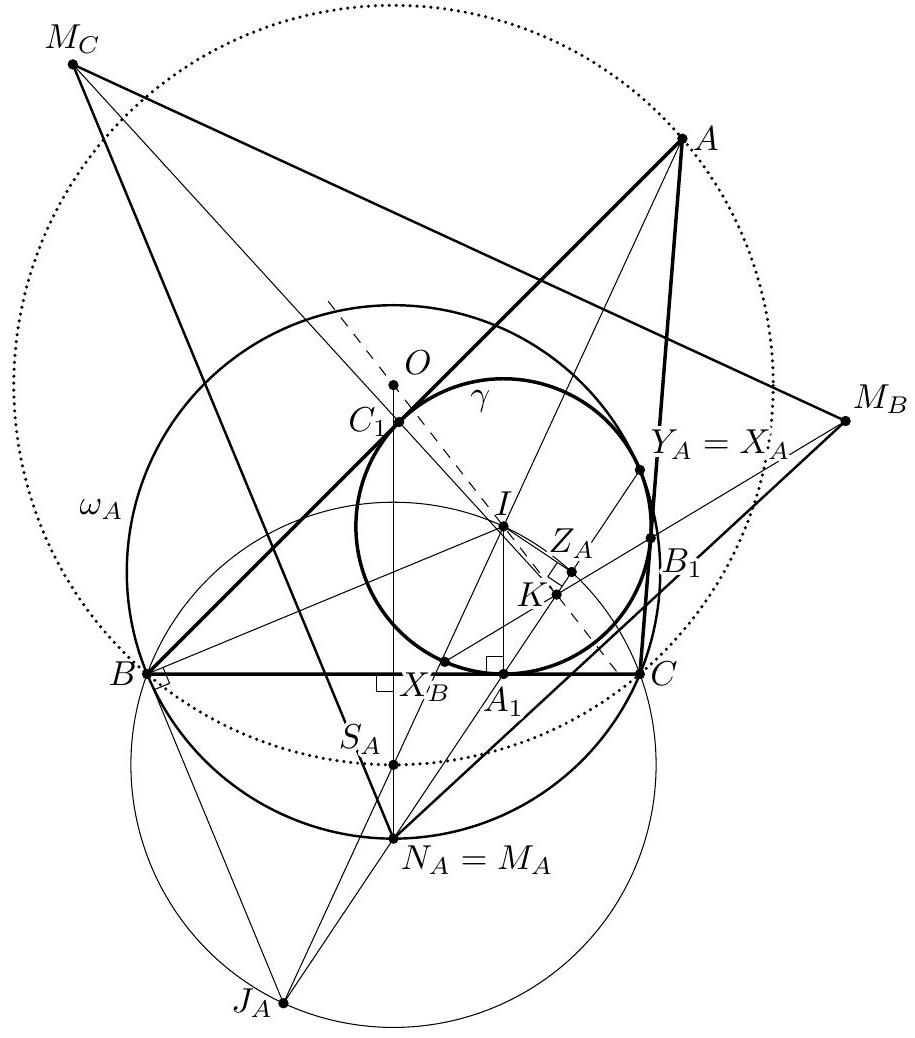", "metadata": {"resource_path": "RMM/segmented/en-2012-Solutions2012-2.jsonl", "problem_match": "\nProblem 6.", "solution_match": "\nSolution."}} |
|
|


