| {"year": "2017", "tier": "T1", "problem_label": "4", "problem_type": null, "exam": "RMM", "problem": "In the Cartesian plane, let $\\mathcal{G}_{1}$ and $\\mathcal{G}_{2}$ be the graphs of the quadratic functions $f_{1}(x)=p_{1} x^{2}+q_{1} x+r_{1}$ and $f_{2}(x)=p_{2} x^{2}+q_{2} x+r_{2}$, where $p_{1}>0>p_{2}$. The graphs $\\mathcal{G}_{1}$ and $\\mathcal{G}_{2}$ cross at distinct points $A$ and $B$. The four tangents to $\\mathcal{G}_{1}$ and $\\mathcal{G}_{2}$ at $A$ and $B$ form a convex quadrilateral which has an inscribed circle. Prove that the graphs $\\mathcal{G}_{1}$ and $\\mathcal{G}_{2}$ have the same axis of symmetry.\n\n## Alexey Zaslavsky, Russia", "solution": ". Let $\\mathcal{A}_{i}$ and $\\mathcal{B}_{i}$ be the tangents to $\\mathcal{G}_{i}$ at $A$ and $B$, respectively, and let $C_{i}=\\mathcal{A}_{i} \\cap \\mathcal{B}_{i}$. Since $f_{1}(x)$ is convex and $f_{2}(x)$ is concave, the convex quadrangle formed by the four tangents is exactly $A C_{1} B C_{2}$.\nLemma. If $C A$ and $C B$ are the tangents drawn from a point $C$ to the graph $\\mathcal{G}$ of a quadratic trinomial $f(x)=p x^{2}+q x+r, A, B \\in \\mathcal{G}, A \\neq B$, then the abscissa of $C$ is the arithmetic mean of the abscissae of $A$ and $B$.\nProof. Assume, without loss of generality, that $C$ is at the origin, so the equations of the two tangents have the form $y=k_{a} x$ and $y=k_{b} x$. Next, the abscissae $x_{A}$ and $x_{B}$ of the tangency points $A$ and $B$, respectively, are multiple roots of the polynomials $f(x)-k_{a} x$ and $f(x)-k_{b} x$, respectively. By the Vieta theorem, $x_{A}^{2}=r / p=x_{B}^{2}$, so $x_{A}=-x_{B}$, since the case $x_{A}=x_{B}$ is ruled out by $A \\neq B$.\n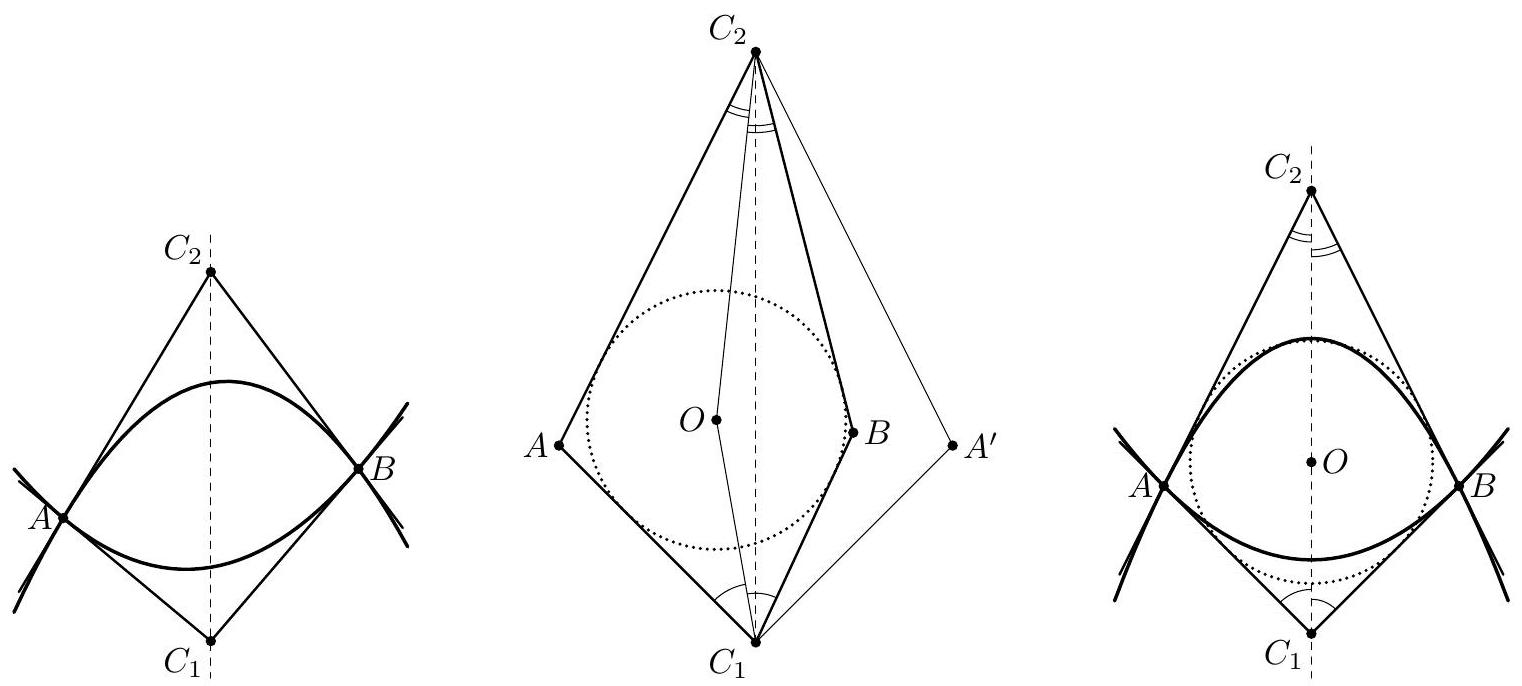\n\nThe Lemma shows that the line $C_{1} C_{2}$ is parallel to the $y$-axis and the points $A$ and $B$ are equidistant from this line.\n\nSuppose, if possible, that the incentre $O$ of the quadrangle $A C_{1} B C_{2}$ does not lie on the line $C_{1} C_{2}$. Assume, without loss of generality, that $O$ lies inside the triangle $A C_{1} C_{2}$ and let $A^{\\prime}$ be the reflection of $A$ in the line $C_{1} C_{2}$. Then the ray $C_{i} B$ emanating from $C_{i}$ lies inside the angle $A C_{i} A^{\\prime}$, so $B$ lies inside the quadrangle $A C_{1} A^{\\prime} C_{2}$, whence $A$ and $B$ are not equidistant from $C_{1} C_{2}-$ a contradiction.\n\nThus $O$ lies on $C_{1} C_{2}$, so the lines $A C_{i}$ and $B C_{i}$ are reflections of one another in the line $C_{1} C_{2}$, and $B=A^{\\prime}$. Hence $y_{A}=y_{B}$, and since $f_{i}(x)=y_{A}+p_{i}\\left(x-x_{A}\\right)\\left(x-x_{B}\\right)$, the line $C_{1} C_{2}$ is the axis of symmetry of both parabolas, as required.", "metadata": {"resource_path": "RMM/segmented/en-2017-Solutions_RMM2017-2.jsonl", "problem_match": "\nProblem 4.", "solution_match": "\nSolution 1"}} |
| {"year": "2017", "tier": "T1", "problem_label": "4", "problem_type": null, "exam": "RMM", "problem": "In the Cartesian plane, let $\\mathcal{G}_{1}$ and $\\mathcal{G}_{2}$ be the graphs of the quadratic functions $f_{1}(x)=p_{1} x^{2}+q_{1} x+r_{1}$ and $f_{2}(x)=p_{2} x^{2}+q_{2} x+r_{2}$, where $p_{1}>0>p_{2}$. The graphs $\\mathcal{G}_{1}$ and $\\mathcal{G}_{2}$ cross at distinct points $A$ and $B$. The four tangents to $\\mathcal{G}_{1}$ and $\\mathcal{G}_{2}$ at $A$ and $B$ form a convex quadrilateral which has an inscribed circle. Prove that the graphs $\\mathcal{G}_{1}$ and $\\mathcal{G}_{2}$ have the same axis of symmetry.\n\n## Alexey Zaslavsky, Russia", "solution": ". Use the standard equation of a tangent to a smooth curve in the plane, to deduce that the tangents at two distinct points $A$ and $B$ on the parabola of equation $y=p x^{2}+q x+r$,\n$p \\neq 0$, meet at some point $C$ whose coordinates are\n\n$$\nx_{C}=\\frac{1}{2}\\left(x_{A}+x_{B}\\right) \\quad \\text { and } \\quad y_{C}=p x_{A} x_{B}+q \\cdot \\frac{1}{2}\\left(x_{A}+x_{B}\\right)+r .\n$$\n\nUsage of the standard formula for Euclidean distance yields\n\n$$\nC A=\\frac{1}{2}\\left|x_{B}-x_{A}\\right| \\sqrt{1+\\left(2 p x_{A}+q\\right)^{2}} \\quad \\text { and } \\quad C B=\\frac{1}{2}\\left|x_{B}-x_{A}\\right| \\sqrt{1+\\left(2 p x_{B}+q\\right)^{2}},\n$$\n\nso, after obvious manipulations,\n\n$$\nC B-C A=\\frac{2 p\\left(x_{B}-x_{A}\\right)\\left|x_{B}-x_{A}\\right|\\left(p\\left(x_{A}+x_{B}\\right)+q\\right)}{\\sqrt{1+\\left(2 p x_{A}+q\\right)^{2}}+\\sqrt{1+\\left(2 p x_{B}+q\\right)^{2}}}\n$$\n\nNow, write the condition in the statement in the form $C_{1} B-C_{1} A=C_{2} B-C_{2} A$, apply the above formula and clear common factors to get\n\n$$\n\\frac{p_{1}\\left(p_{1}\\left(x_{A}+x_{B}\\right)+q_{1}\\right)}{\\sqrt{1+\\left(2 p_{1} x_{A}+q_{1}\\right)^{2}}+\\sqrt{1+\\left(2 p_{1} x_{B}+q_{1}\\right)^{2}}}=\\frac{p_{2}\\left(p_{2}\\left(x_{A}+x_{B}\\right)+q_{2}\\right)}{\\sqrt{1+\\left(2 p_{2} x_{A}+q_{2}\\right)^{2}}+\\sqrt{1+\\left(2 p_{2} x_{B}+q_{2}\\right)^{2}}}\n$$\n\nNext, use the fact that $x_{A}$ and $x_{B}$ are the solutions of the quadratic equation $\\left(p_{1}-p_{2}\\right) x^{2}+$ $\\left(q_{1}-q_{2}\\right) x+r_{1}-r_{2}=0$, so $x_{A}+x_{B}=-\\left(q_{1}-q_{2}\\right) /\\left(p_{1}-p_{2}\\right)$, to obtain\n\n$$\n\\frac{p_{1}\\left(p_{1} q_{2}-p_{2} q_{1}\\right)}{\\sqrt{1+\\left(2 p_{1} x_{A}+q_{1}\\right)^{2}}+\\sqrt{1+\\left(2 p_{1} x_{B}+q_{1}\\right)^{2}}}=\\frac{p_{2}\\left(p_{1} q_{2}-p_{2} q_{1}\\right)}{\\sqrt{1+\\left(2 p_{2} x_{A}+q_{2}\\right)^{2}}+\\sqrt{1+\\left(2 p_{2} x_{B}+q_{2}\\right)^{2}}} .\n$$\n\nFinally, since $p_{1} p_{2}<0$ and the denominators above are both positive, the last equality forces $p_{1} q_{2}-p_{2} q_{1}=0$; that is, $q_{1} / p_{1}=q_{2} / p_{2}$, so the two parabolas have the same axis.\n\nRemarks. The are, of course, several different proofs of the Lemma in Solution 1 - in particular, computational. Another argument relies on the following consequence of focal properties: The tangents to a parabola at two points meet at the circumcentre of the triangle formed by the focus and the orthogonal projections of those points on the directrix. Since the directrix of the parabola in the lemma is parallel to the axis of abscissae, the conclusion follows.", "metadata": {"resource_path": "RMM/segmented/en-2017-Solutions_RMM2017-2.jsonl", "problem_match": "\nProblem 4.", "solution_match": "\nSolution 2"}} |
| {"year": "2017", "tier": "T1", "problem_label": "5", "problem_type": null, "exam": "RMM", "problem": "Fix an integer $n \\geq 2$. An $n \\times n$ sieve is an $n \\times n$ array with $n$ cells removed so that exactly one cell is removed from every row and every column. A stick is a $1 \\times k$ or $k \\times 1$ array for any positive integer $k$. For any sieve $A$, let $m(A)$ be the minimal number of sticks required to partition $A$. Find all possible values of $m(A)$, as $A$ varies over all possible $n \\times n$ sieves.\n\nPalmer Mebane and Nikolai Beluhov", "solution": ". Given $A, m(A)=2 n-2$, and it is achieved, for instance, by dissecting $A$ along all horizontal (or vertical) grid lines. It remains to prove that $m(A) \\geq 2 n-2$ for every $A$.\n\nBy holes we mean the cells which are cut out from the board. The cross of a hole in $A$ is the union of the row and the column through that hole.\n\nArguing indirectly, consider a dissection of $A$ into $2 n-3$ or fewer sticks. Horizontal sticks are all labelled $h$, and vertical sticks are labelled $v ; 1 \\times 1$ sticks are both horizontal and vertical, and labelled arbitrarily. Each cell of $A$ inherits the label of the unique containing stick.\n\nAssign each stick in the dissection to the cross of the unique hole on its row, if the stick is horizontal; on its column, if the stick is vertical.\n\nSince there are at most $2 n-3$ sticks and exactly $n$ crosses, there are two crosses each of which is assigned to at most one stick in the dissection. Let the crosses be $c$ and $d$, centred at $a=\\left(x_{a}, y_{a}\\right)$ and $b=\\left(x_{b}, y_{b}\\right)$, respectively, and assume, without loss of generality, $x_{a}<x_{b}$ and $y_{a}<y_{b}$. The sticks covering the cells $\\left(x_{a}, y_{b}\\right)$ and $\\left(x_{b}, y_{a}\\right)$ have like labels, for otherwise one of the two crosses would be assigned to at least two sticks. Say the common label is $v$, so each of $c$ and $d$ contains a stick covering one of those two cells. It follows that the lower (respectively, upper) arm of $c$ (respectively, $d$ ) is all- $h$, and the horizontal arms of both crosses are all- $v$, as illustrated below.\n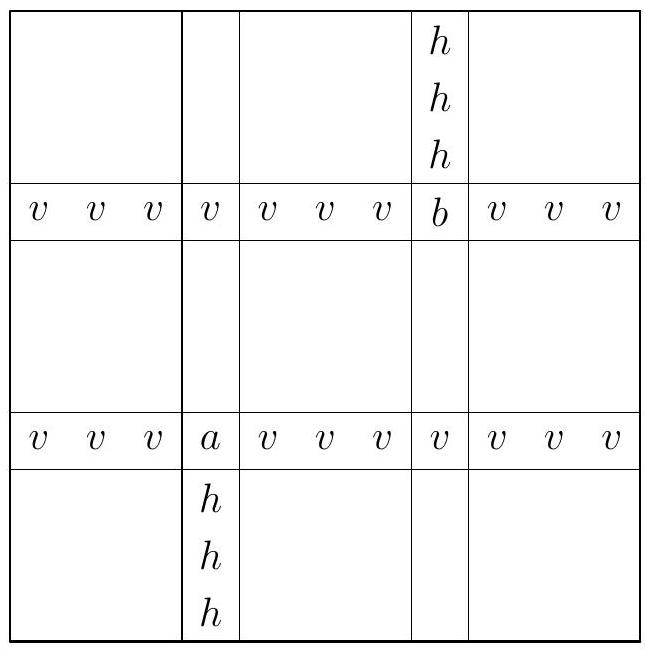\n\nEach of the rows between the rows of $a$ and $b$, that is, rows $y_{a}+1, y_{a}+2, \\ldots, y_{b}-1$, contains a hole. The column of each such hole contains at least two $v$-sticks. All other columns contain at least one $v$-stick each. In addition, all rows below $a$ and all rows above $b$ contain at least one $h$-stick each. This amounts to a total of at least $2\\left(y_{b}-y_{a}-1\\right)+\\left(n-y_{b}+y_{a}+1\\right)+\\left(n-y_{b}\\right)+\\left(y_{a}-1\\right)=2 n-2$ sticks. A contradiction.\n\nRemark. One may find a different argument finishing the solution. Since $c$ and $d$ are proven to contain one stick each, there is a third cross $e$ centred at $\\left(x_{*}, y_{*}\\right)$ also containing at most one stick. It meets the horizontal arms of $c$ and $d$ at two $v$-cells, so all the cells where two of the three crosses meet are labelled with $v$. Now, assuming (without loss of generality) that $y_{a}<y_{*}<y_{b}$, we obtain that both vertical arms of $e$ contain $v$-cells, so $e$ is assigned to two different $v$-sticks. A contradiction.", "metadata": {"resource_path": "RMM/segmented/en-2017-Solutions_RMM2017-2.jsonl", "problem_match": "\nProblem 5.", "solution_match": "\nSolution 1"}} |
| {"year": "2017", "tier": "T1", "problem_label": "5", "problem_type": null, "exam": "RMM", "problem": "Fix an integer $n \\geq 2$. An $n \\times n$ sieve is an $n \\times n$ array with $n$ cells removed so that exactly one cell is removed from every row and every column. A stick is a $1 \\times k$ or $k \\times 1$ array for any positive integer $k$. For any sieve $A$, let $m(A)$ be the minimal number of sticks required to partition $A$. Find all possible values of $m(A)$, as $A$ varies over all possible $n \\times n$ sieves.\n\nPalmer Mebane and Nikolai Beluhov", "solution": ". (Ilya Bogdanov) We provide a different proof that $m(A) \\geq 2 n-2$.\n\nCall a stick vertical if it is contained in some column, and horizontal if it is contained in some row; $1 \\times 1$ sticks may be called arbitrarily, but any of them is supposed to have only one direction. Assign to each vertical/horizontal stick the column/row it is contained in. If each row and each column is assigned to some stick, then there are at least $2 n$ sticks, which is even more than we want. Thus we assume, without loss of generality, that some exceptional row $R$ is not assigned to any stick. This means that all $n-1$ existing cells in $R$ belong to $n-1$ distinct vertical sticks; call these sticks central.\n\nNow we mark $n-1$ cells on the board in the following manner. ( $\\downarrow$ ) For each hole $c$ below $R$, we mark the cell just under $c$; $(\\uparrow)$ for each hole $c$ above $R$, we mark the cell just above $c$; and $(\\bullet)$ for the hole $r$ in $R$, we mark both the cell just above it and just below it. We have described $n+1$ cells, but exactly two of them are out of the board; so $n-1$ cells are marked within the board. A sample marking is shown in the figure below, where the marked cells are crossed.\n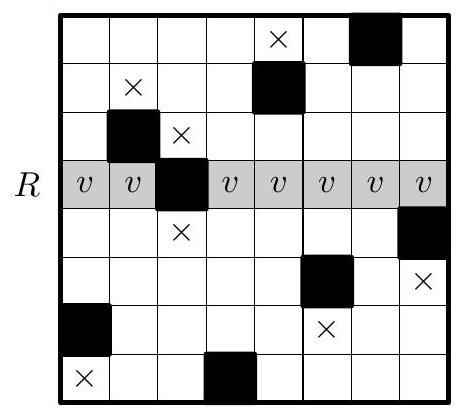\n\nNotice that all the marked cells lie in different rows, and all of them are marked in different columns, except for those two marked for $(\\bullet)$; but the latter two have a hole $r$ between them. So no two marked cells may belong to the same stick. Moreover, none of them lies in a central stick, since the marked cells are separated from $R$ by the holes. Thus the marked cells should be covered by $n-1$ different sticks (call them border) which are distinct from the central sticks. This shows that there are at least $(n-1)+(n-1)=2 n-2$ distinct sticks, as desired.", "metadata": {"resource_path": "RMM/segmented/en-2017-Solutions_RMM2017-2.jsonl", "problem_match": "\nProblem 5.", "solution_match": "\nSolution 2"}} |
| {"year": "2017", "tier": "T1", "problem_label": "5", "problem_type": null, "exam": "RMM", "problem": "Fix an integer $n \\geq 2$. An $n \\times n$ sieve is an $n \\times n$ array with $n$ cells removed so that exactly one cell is removed from every row and every column. A stick is a $1 \\times k$ or $k \\times 1$ array for any positive integer $k$. For any sieve $A$, let $m(A)$ be the minimal number of sticks required to partition $A$. Find all possible values of $m(A)$, as $A$ varies over all possible $n \\times n$ sieves.\n\nPalmer Mebane and Nikolai Beluhov", "solution": ". In order to prove $m(A) \\geq 2 n-2$, it suffices to show that there are $2 n-2$ cells in $A$, no two of which may be contained in the same stick.\n\nTo this end, consider the bipartite graph $G$ with parts $G_{h}$ and $G_{v}$, where the vertices in $G_{h}$ (respectively, $G_{v}$ ) are the $2 n-2$ maximal sticks $A$ is dissected into by all horizontal (respectively, vertical) grid lines, two sticks being joined by an edge in $G$ if and only if they share a cell.\n\nWe show that $G$ admits a perfect matching by proving that it fulfils the condition in Hall's theorem; the $2 n-2$ cells corresponding to the edges of this matching form the desired set. It is sufficient to show that every subset $S$ of $G_{h}$ has at least $|S|$ neighbours (in $G_{v}$, of course).\n\nLet $L$ be the set of all sticks in $S$ that contain a cell in the leftmost column of $A$, and let $R$ be the set of all sticks in $S$ that contain a cell in the rightmost column of $A$; let $\\ell$ be the length of the longest stick in $L$ (zero if $L$ is empty), and let $r$ be the length of the longest stick in $R$ (zero if $R$ is empty).\n\nSince every row of $A$ contains exactly one hole, $L$ and $R$ partition $S$; and since every column of $A$ contains exactly one hole, neither $L$ nor $R$ contains two sticks of the same size, so $\\ell \\geq|L|$ and $r \\geq|R|$, whence $\\ell+r \\geq|L|+|R|=|S|$.\n\nIf $\\ell+r \\leq n$, we are done, since there are at least $\\ell+r \\geq|S|$ vertical sticks covering the cells of the longest sticks in $L$ and $R$. So let $\\ell+r>n$, in which case the sticks in $S$ span all $n$ columns, and notice that we are again done if $|S| \\leq n$, to assume further $|S|>n$.\n\nLet $S^{\\prime}=G_{h} \\backslash S$, let $T$ be set of all neighbours of $S$, and let $T^{\\prime}=G_{v} \\backslash T$. Since the sticks in $S$ span all $n$ columns, $|T| \\geq n$, so $\\left|T^{\\prime}\\right| \\leq n-2$. Transposition of the above argument (replace $S$ by $T^{\\prime}$, shows that $\\left|T^{\\prime}\\right| \\leq\\left|S^{\\prime}\\right|$, so $|S| \\leq|T|$.\nRemark. Here is an alternative argument for $s=|S|>n$. Add to $S$ two empty sticks formally present to the left of the leftmost hole and to the right of the rightmost one. Then there are at\nleast $s-n+2$ rows containing two sticks from $S$, so two of them are separated by at least $s-n$ other rows. Each hole in those $s-n$ rows separates two vertical sticks from $G_{v}$ both of which are neighbours of $S$. Thus the vertices of $S$ have at least $n+(s-n)$ neighbours.", "metadata": {"resource_path": "RMM/segmented/en-2017-Solutions_RMM2017-2.jsonl", "problem_match": "\nProblem 5.", "solution_match": "\nSolution 3"}} |
| {"year": "2017", "tier": "T1", "problem_label": "5", "problem_type": null, "exam": "RMM", "problem": "Fix an integer $n \\geq 2$. An $n \\times n$ sieve is an $n \\times n$ array with $n$ cells removed so that exactly one cell is removed from every row and every column. A stick is a $1 \\times k$ or $k \\times 1$ array for any positive integer $k$. For any sieve $A$, let $m(A)$ be the minimal number of sticks required to partition $A$. Find all possible values of $m(A)$, as $A$ varies over all possible $n \\times n$ sieves.\n\nPalmer Mebane and Nikolai Beluhov", "solution": ". Yet another proof of the estimate $m(A) \\geq 2 n-2$. We use the induction on $n$. Now we need the base cases $n=2,3$ which can be completed by hands.\n\nAssume now that $n>3$ and consider any dissection of $A$ into sticks. Define the cross of a hole as in Solution 1, and notice that each stick is contained in some cross. Thus, if the dissection contains more than $n$ sticks, then there exists a cross containing at least two sticks. In this case, remove this cross from the sieve to obtain an $(n-1) \\times(n-1)$ sieve. The dissection of the original sieve induces a dissection of the new array: even if a stick is partitioned into two by the removed cross, then the remaining two parts form a stick in the new array. After this operation has been performed, the number of sticks decreases by at least 2, and by the induction hypothesis the number of sticks in the new dissection is at least $2 n-4$. Hence, the initial dissection contains at least $(2 n-4)+2=2 n-2$ sticks, as required.\n\nIt remains to rule out the case when the dissection contains at most $n$ sticks. This can be done in many ways, one of which is removal a cross containing some stick. The resulting dissection of an $(n-1) \\times(n-1)$ array contains at most $n-1$ sticks, which is impossible by the induction hypothesis since $n-1<2(n-1)-2$.\n\nRemark. The idea of removing a cross containing at least two sticks arises naturally when one follows an inductive approach. But it is much trickier to finish the solution using this approach, unless one starts to consider removing each cross instead of removing a specific one.", "metadata": {"resource_path": "RMM/segmented/en-2017-Solutions_RMM2017-2.jsonl", "problem_match": "\nProblem 5.", "solution_match": "\nSolution 4"}} |
| {"year": "2017", "tier": "T1", "problem_label": "6", "problem_type": null, "exam": "RMM", "problem": "Let $A B C D$ be any convex quadrilateral and let $P, Q, R, S$ be points on the segments $A B, B C, C D$, and $D A$, respectively. It is given that the segments $P R$ and $Q S$ dissect $A B C D$ into four quadrilaterals, each of which has perpendicular diagonals. Show that the points $P, Q, R, S$ are concyclic.\n\nNikOlai Beluhov", "solution": ". We start with a lemma which holds even in a more general setup.\nLemma 1. Let $P Q R S$ be a convex quadrangle whose diagonals meet at $O$. Let $\\omega_{1}$ and $\\omega_{2}$ be the circles on diameters $P Q$ and $R S$, respectively, and let $\\ell$ be their radical axis. Finally, choose the points $A, B$, and $C$ outside this quadrangle so that: the point $P$ (respectively, $Q$ ) lies on the segment $A B$ (respectively, $B C$ ); and $A O \\perp P S, B O \\perp P Q$, and $C O \\perp Q R$. Then the three lines $A C, P Q$, and $\\ell$ are concurrent or parallel.\n\nProof. Assume first that the lines $P R$ and $Q S$ are not perpendicular. Let $H_{1}$ and $H_{2}$ be the orthocentres of the triangles $O S P$ and $O Q R$, respectively; notice that $H_{1}$ and $H_{2}$ do not coincide.\n\nSince $H_{1}$ is the radical centre of the circles on diameters $R S, S P$, and $P Q$, it lies on $\\ell$. Similarly, $H_{2}$ lies on $\\ell$, so the lines $H_{1} H_{2}$ and $\\ell$ coincide.\n\nThe corresponding sides of the triangles $A P H_{1}$ and $C Q H_{2}$ meet at $O, B$, and the orthocentre of the triangle $O P Q$ (which lies on $O B$ ). By Desargues' theorem, the lines $A C, P Q$ and $\\ell$ are concurrent or parallel.\n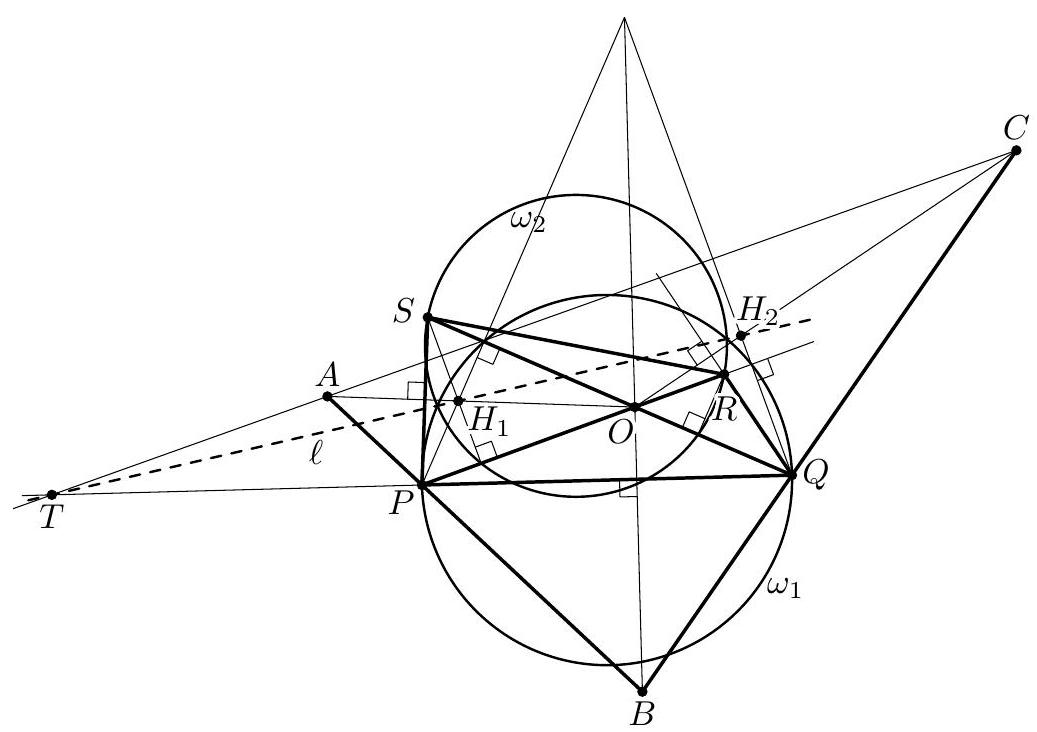\n\nThe case when $P R \\perp Q S$ may be considered as a limit case, since the configuration in the statement of the lemma allows arbitrarily small perturbations. The lemma is proved.\n\nBack to the problem, let the segments $P R$ and $Q S$ cross at $O$, let $\\omega_{1}$ and $\\omega_{2}$ be the circles on diameters $P Q$ and $R S$, respectively, and let $\\ell$ be their radical axis. By the Lemma, the three lines $A C$, $\\ell$, and $P Q$ are concurrent or parallel, and similarly so are the three lines $A C, \\ell$, and $R S$. Thus, if the lines $A C$ and $\\ell$ are distinct, all four lines are concurrent or pairwise parallel.\n\nThis is clearly the case when the lines $P S$ and $Q R$ are not parallel (since $\\ell$ crosses $O A$ and $O C$ at the orthocentres of $O S P$ and $O Q R$, these orthocentres being distinct from $A$ and $C$ ). In this case, denote the concurrency point by $T$. If $T$ is not ideal, then we have $T P \\cdot T Q=T R \\cdot T S$ (as $T \\in \\ell$ ), so $P Q R S$ is cyclic. If $T$ is ideal (i.e., all four lines are parallel), then the segments $P Q$ and $R S$ have the same perpendicular bisector (namely, the line of centers of $\\omega_{1}$ and $\\omega_{2}$ ), and $P Q R S$ is cyclic again.\n\nAssume now $P S$ and $Q R$ parallel. By symmetry, $P Q$ and $R S$ may also be assumed parallel: otherwise, the preceding argument goes through after relabelling. In this case, we need to prove that the parallelogram $P Q R S$ is a rectangle.\n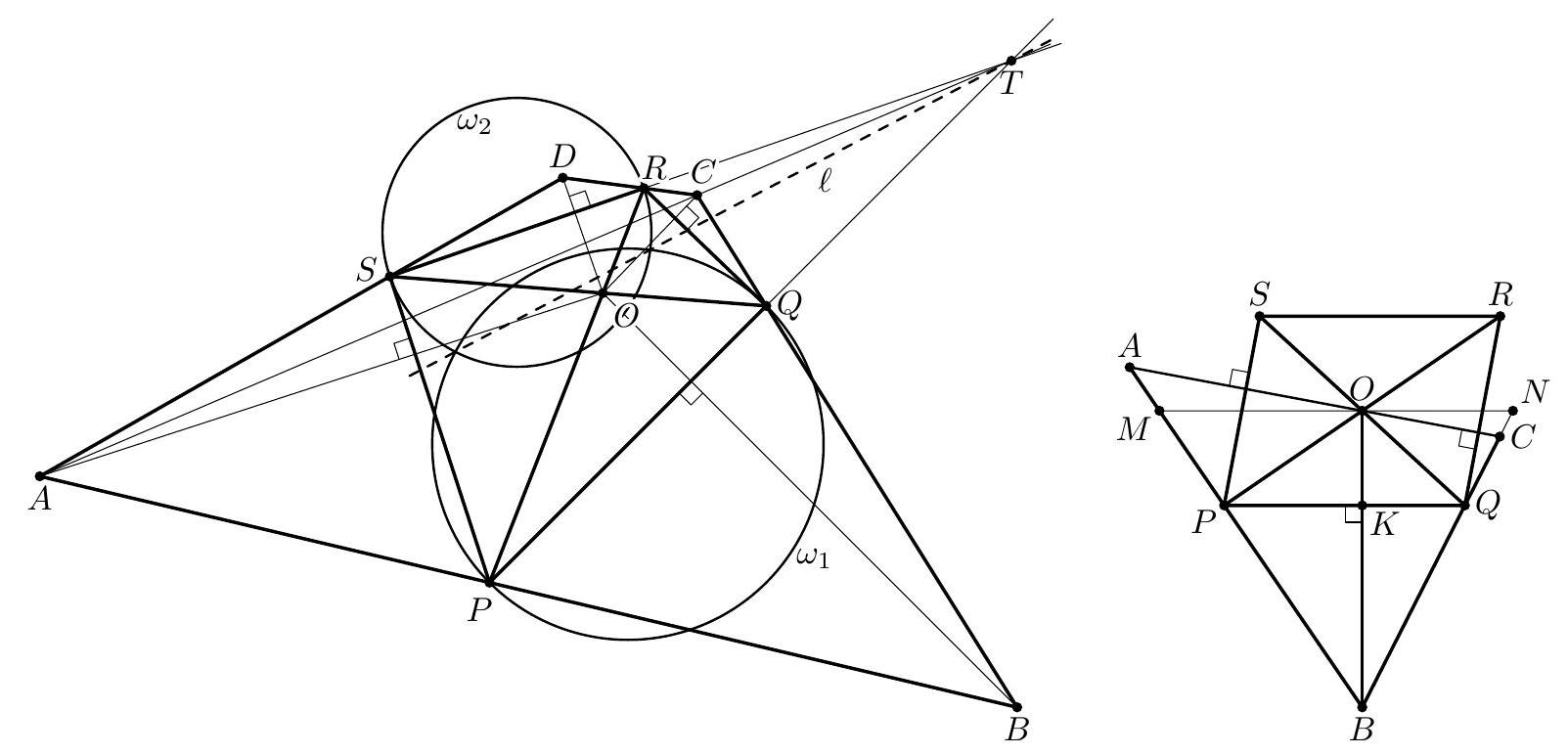\n\nSuppose, by way of contradiction, that $O P>O Q$. Let the line through $O$ and parallel to $P Q$ meet $A B$ at $M$, and $C B$ at $N$. Since $O P>O Q$, the angle $S P Q$ is acute and the angle $P Q R$ is obtuse, so the angle $A O B$ is obtuse, the angle $B O C$ is acute, $M$ lies on the segment $A B$, and $N$ lies on the extension of the segment $B C$ beyond $C$. Therefore: $O A>O M$, since the angle $O M A$ is obtuse; $O M>O N$, since $O M: O N=K P: K Q$, where $K$ is the projection of $O$ onto $P Q$; and $O N>O C$, since the angle $O C N$ is obtuse. Consequently, $O A>O C$.\n\nSimilarly, $O R>O S$ yields $O C>O A$ : a contradiction. Consequently, $O P=O Q$ and $P Q R S$ is a rectangle. This ends the proof.", "metadata": {"resource_path": "RMM/segmented/en-2017-Solutions_RMM2017-2.jsonl", "problem_match": "\nProblem 6.", "solution_match": "\nSolution 1"}} |
| {"year": "2017", "tier": "T1", "problem_label": "6", "problem_type": null, "exam": "RMM", "problem": "Let $A B C D$ be any convex quadrilateral and let $P, Q, R, S$ be points on the segments $A B, B C, C D$, and $D A$, respectively. It is given that the segments $P R$ and $Q S$ dissect $A B C D$ into four quadrilaterals, each of which has perpendicular diagonals. Show that the points $P, Q, R, S$ are concyclic.\n\nNikOlai Beluhov", "solution": ". (Ilya Bogdanov) To begin, we establish a useful lemma.\nLemma 2. If $P$ is a point on the side $A B$ of a triangle $O A B$, then\n\n$$\n\\frac{\\sin A O P}{O B}+\\frac{\\sin P O B}{O A}=\\frac{\\sin A O B}{O P}\n$$\n\nProof. Let $[X Y Z]$ denote the area of a triangle $X Y Z$, to write\n$0=2([A O B]-[P O B]-[P O C])=O A \\cdot O B \\cdot \\sin A O B-O B \\cdot O P \\cdot \\sin P O B-O P \\cdot O A \\cdot \\sin A O P$,\nand divide by $O A \\cdot O B \\cdot O P$ to get the required identity.\nA similar statement remains valid if the point $C$ lies on the line $A B$; the proof is obtained by using signed areas and directed lengths.\n\nWe now turn to the solution. We first prove some sort of a converse statement, namely:\nClaim. Let $P Q R S$ be a cyclic quadrangle with $O=P R \\cap Q S$; assume that no its diagonal is perpendicular to a side. Let $\\ell_{A}, \\ell_{B}, \\ell_{C}$, and $\\ell_{D}$ be the lines through $O$ perpendicular to $S P$, $P Q, Q R$, and $R S$, respectively. Choose any point $A \\in \\ell_{A}$ and successively define $B=A P \\cap \\ell_{B}$, $C=B Q \\cap \\ell_{C}, D=C R \\cap \\ell_{D}$, and $A^{\\prime}=D S \\cap \\ell_{A}$. Then $A^{\\prime}=A$.\n\nProof. We restrict ourselves to the case when the points $A, B, C, D$, and $A^{\\prime}$ lie on $\\ell_{A}, \\ell_{B}$, $\\ell_{C}, \\ell_{D}$, and $\\ell_{A}$ on the same side of $O$ as their points of intersection with the respective sides of the quadrilateral $P Q R S$. Again, a general case is obtained by suitable consideration of directed lengths.\n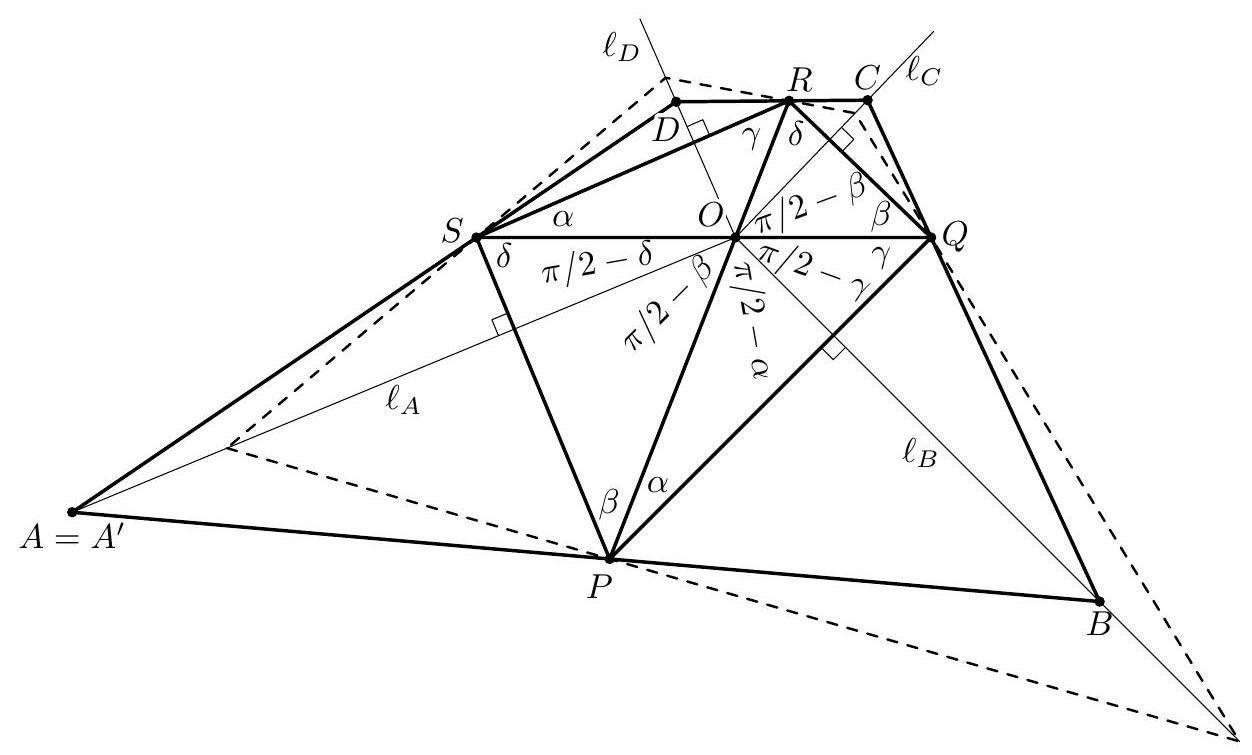\n\nDenote\n\n$$\n\\begin{gathered}\n\\alpha=\\angle Q P R=\\angle Q S R=\\pi / 2-\\angle P O B=\\pi / 2-\\angle D O S \\\\\n\\beta=\\angle R P S=\\angle R Q S=\\pi / 2-\\angle A O P=\\pi / 2-\\angle Q O C \\\\\n\\gamma=\\angle S Q P=\\angle S R P=\\pi / 2-\\angle B O Q=\\pi / 2-\\angle R O D \\\\\n\\delta=\\angle P R Q=\\angle P S Q=\\pi / 2-\\angle C O R=\\pi / 2-\\angle S O A\n\\end{gathered}\n$$\n\nBy Lemma 2 applied to the lines $A P B, P Q C, C R D$, and $D S A^{\\prime}$, we get\n\n$$\n\\begin{array}{ll}\n\\frac{\\sin (\\alpha+\\beta)}{O P}=\\frac{\\cos \\alpha}{O A}+\\frac{\\cos \\beta}{O B}, & \\frac{\\sin (\\beta+\\gamma)}{O Q}=\\frac{\\cos \\beta}{O B}+\\frac{\\cos \\gamma}{O C} \\\\\n\\frac{\\sin (\\gamma+\\delta)}{O R}=\\frac{\\cos \\gamma}{O C}+\\frac{\\cos \\delta}{O D}, & \\frac{\\sin (\\delta+\\alpha)}{O S}=\\frac{\\cos \\delta}{O D}+\\frac{\\cos \\alpha}{O A^{\\prime}}\n\\end{array}\n$$\n\nAdding the two equalities on the left and subtracting the two on the right, we see that the required equality $A=A^{\\prime}$ (i.e., $\\cos \\alpha / O A=\\cos \\alpha / O A^{\\prime}$, in view of $\\cos \\alpha \\neq 0$ ) is equivalent to the relation\n\n$$\n\\frac{\\sin Q P S}{O P}+\\frac{\\sin S R Q}{O R}=\\frac{\\sin P Q R}{O Q}+\\frac{\\sin R S P}{O S}\n$$\n\nLet $d$ denote the circumdiameter of $P Q R S$, so $\\sin Q P S=\\sin S R Q=Q S / d$ and $\\sin R S P=$ $\\sin P Q R=P R / d$. Thus the required relation reads\n\n$$\n\\frac{Q S}{O P}+\\frac{Q S}{O R}=\\frac{P R}{O S}+\\frac{P R}{O Q}, \\quad \\text { or } \\quad \\frac{Q S \\cdot P R}{O P \\cdot O R}=\\frac{P R \\cdot Q S}{O S \\cdot O Q}\n$$\n\nThe last relation is trivial, due again to cyclicity.\nFinally, it remains to derive the problem statement from our Claim. Assume that $P Q R S$ is not cyclic, e.g., that $O P \\cdot O R>O Q \\cdot O S$, where $O=P R \\cap Q S$. Mark the point $S^{\\prime}$ on the ray $O S$ so that $O P \\cdot O R=O Q \\cdot O S^{\\prime}$. Notice that no diagonal of $P Q R S$ is perpendicular to a side, so the quadrangle $P Q R S^{\\prime}$ satisfies the conditions of the claim.\n\nLet $\\ell_{A}^{\\prime}$ and $\\ell_{D}^{\\prime}$ be the lines through $O$ perpendicular to $P S^{\\prime}$ and $R S^{\\prime}$, respectively. Then $\\ell_{A}^{\\prime}$ and $\\ell_{D}^{\\prime}$ cross the segments $A P$ and $R D$, respectively, at some points $A^{\\prime}$ and $D^{\\prime}$. By the Claim, the line $A^{\\prime} D^{\\prime}$ passes through $S^{\\prime}$. This is impossible, because the segment $A^{\\prime} D^{\\prime}$ crosses the segment $O S$ at some interior point, while $S^{\\prime}$ lies on the extension of this segment. This contradiction completes the proof.\n\nRemark. According to the author, there is a remarkable corollary that is worth mentioning: Four lines dissect a convex quadrangle into nine smaller quadrangles to make it into a $3 \\times 3$ array\n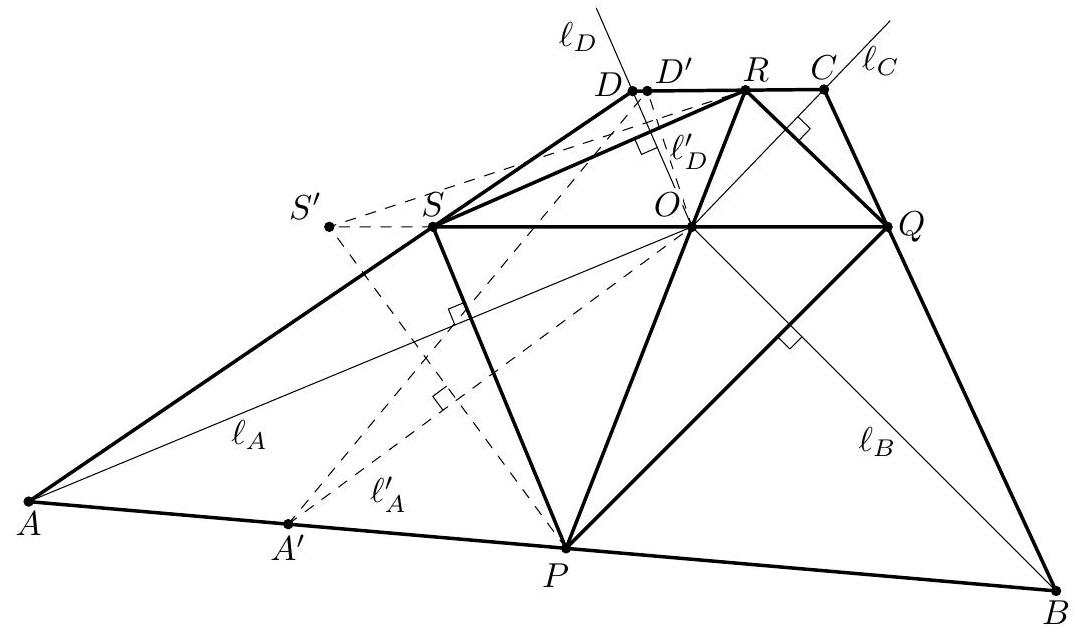\nof quadrangular cells. Label these cells 1 through 9 from left to right and from top to bottom. If the first eight cells are orthodiagonal, then so is the ninth.", "metadata": {"resource_path": "RMM/segmented/en-2017-Solutions_RMM2017-2.jsonl", "problem_match": "\nProblem 6.", "solution_match": "\nSolution 2"}} |
|
|


