| {"year": "2021", "tier": "T1", "problem_label": "1", "problem_type": null, "exam": "RMM", "problem": "Let $T_{1}, T_{2}, T_{3}, T_{4}$ be pairwise distinct collinear points such that $T_{2}$ lies between $T_{1}$ and $T_{3}$, and $T_{3}$ lies between $T_{2}$ and $T_{4}$. Let $\\omega_{1}$ be a circle through $T_{1}$ and $T_{4}$; let $\\omega_{2}$ be the circle through $T_{2}$ and internally tangent to $\\omega_{1}$ at $T_{1}$; let $\\omega_{3}$ be the circle through $T_{3}$ and externally tangent to $\\omega_{2}$ at $T_{2}$; and let $\\omega_{4}$ be the circle through $T_{4}$ and externally tangent to $\\omega_{3}$ at $T_{3}$. A line crosses $\\omega_{1}$ at $P$ and $W, \\omega_{2}$ at $Q$ and $R, \\omega_{3}$ at $S$ and $T$, and $\\omega_{4}$ at $U$ and $V$, the order of these points along the line being $P, Q, R, S, T, U, V, W$. Prove that $P Q+T U=R S+V W$.\n\nHungary, Geza Kos", "solution": "Let $O_{i}$ be the centre of $\\omega_{i}, i=1,2,3,4$. Notice that the isosceles triangles $O_{i} T_{i} T_{i-1}$ are similar (indices are reduced modulo 4 ), to infer that $\\omega_{4}$ is internally tangent to $\\omega_{1}$ at $T_{4}$, and $O_{1} O_{2} O_{3} O_{4}$ is a (possibly degenerate) parallelogram.\n\nLet $F_{i}$ be the foot of the perpendicular from $O_{i}$ to $P W$. The $F_{i}$ clearly bisect the segments $P W, Q R, S T$ and $U V$, respectively.\n\nThe proof can now be concluded in two similar ways.\n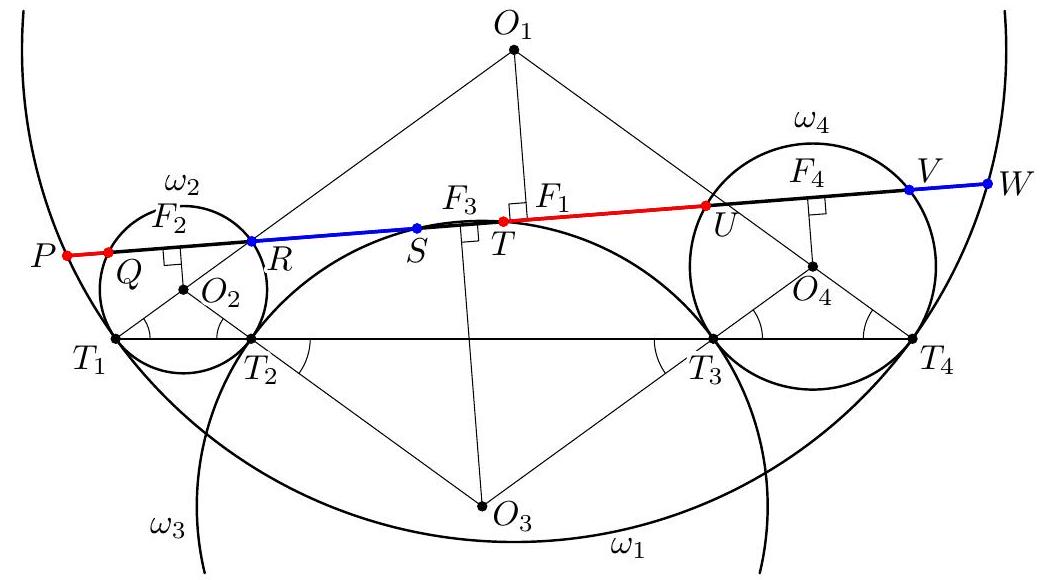\n\nFirst Approach. Since $O_{1} O_{2} O_{3} O_{4}$ is a parallelogram, $\\overrightarrow{F_{1} F_{2}}+\\overrightarrow{F_{3} F_{4}}=\\mathbf{0}$ and $\\overrightarrow{F_{2} F_{3}}+\\overrightarrow{F_{4} F_{1}}=\\mathbf{0}$; this still holds in the degenerate case, for if the $O_{i}$ are collinear, then they all lie on the line $T_{1} T_{4}$, and each $O_{i}$ is the midpoint of the segment $T_{i} T_{i+1}$. Consequently,\n\n$$\n\\begin{aligned}\n\\overrightarrow{P Q}-\\overrightarrow{R S}+\\overrightarrow{T U}-\\overrightarrow{V W}= & \\left(\\overrightarrow{P F_{1}}+\\overrightarrow{F_{1} F_{2}}+\\overrightarrow{F_{2} Q}\\right)-\\left(\\overrightarrow{R F_{2}}+\\overrightarrow{F_{2} F_{3}}+\\overrightarrow{F_{3} S}\\right) \\\\\n& +\\left(\\overrightarrow{T F_{3}}+\\overrightarrow{F_{3} F_{4}}+\\overrightarrow{F_{4} U}\\right)-\\left(\\overrightarrow{V F_{4}}+\\overrightarrow{F_{4} F_{1}}+\\overrightarrow{F_{1} W}\\right) \\\\\n= & \\left(\\overrightarrow{P F_{1}}-\\overrightarrow{F_{1} W}\\right)-\\left(\\overrightarrow{R F_{2}}-\\overrightarrow{F_{2} Q}\\right)+\\left(\\overrightarrow{T F_{3}}-\\overrightarrow{F_{3} S}\\right)-\\left(\\overrightarrow{V F_{4}}-\\overrightarrow{F_{4} U}\\right) \\\\\n& +\\left(\\overrightarrow{F_{1} F_{2}}+\\overrightarrow{F_{3} F_{4}}\\right)-\\left(\\overrightarrow{F_{2} F_{3}}+\\overrightarrow{F_{4} F_{1}}\\right)=\\mathbf{0}\n\\end{aligned}\n$$\n\nAlternatively, but equivalently, $\\overrightarrow{P Q}+\\overrightarrow{T U}=\\overrightarrow{R S}+\\overrightarrow{V W}$, as required.\nSecond Approach. This is merely another way of reading the previous argument. Fix an orientation of the line $P W$, say, from $P$ towards $W$, and use a lower case letter to denote the coordinate of a point labelled by the corresponding upper case letter.\n\nSince the diagonals of a parallelogram bisect one another, $f_{1}+f_{3}=f_{2}+f_{4}$, the common value being twice the coordinate of the projection to $P W$ of the point where $O_{1} O_{3}$ and $O_{2} O_{4}$ cross; the relation clearly holds in the degenerate case as well.\n\nPlug $f_{1}=\\frac{1}{2}(p+w), f_{2}=\\frac{1}{2}(q+r), f_{3}=\\frac{1}{2}(s+t)$ and $f_{4}=\\frac{1}{2}(u+v)$ into the above equality to get $p+w+s+t=q+r+u+v$. Alternatively, but equivalently, $(q-p)+(u-t)=(s-r)+(w-v)$, that is, $P Q+T U=R Q+V W$, as required.", "metadata": {"resource_path": "RMM/segmented/en-2021-RMM2021-Day1-English_Solutions.jsonl", "problem_match": "\nProblem 1.", "solution_match": "\nSolution."}} |
| {"year": "2021", "tier": "T1", "problem_label": "2", "problem_type": null, "exam": "RMM", "problem": "Xenia and Sergey play the following game. Xenia thinks of a positive integer $N$ not exceeding 5000. Then she fixes 20 distinct positive integers $a_{1}, a_{2}, \\ldots, a_{20}$ such that, for each $k=1,2, \\ldots, 20$, the numbers $N$ and $a_{k}$ are congruent modulo $k$. By a move, Sergey tells Xenia a set $S$ of positive integers not exceeding 20, and she tells him back the set $\\left\\{a_{k}: k \\in S\\right\\}$ without spelling out which number corresponds to which index. How many moves does Sergey need to determine for sure the number Xenia thought of?\n\nRussia, Sergey Kudrya", "solution": "Sergey can determine Xenia's number in 2 but not fewer moves.\nWe first show that 2 moves are sufficient. Let Sergey provide the set $\\{17,18\\}$ on his first move, and the set $\\{18,19\\}$ on the second move. In Xenia's two responses, exactly one number occurs twice, namely, $a_{18}$. Thus, Sergey is able to identify $a_{17}, a_{18}$, and $a_{19}$, and thence the residue of $N$ modulo $17 \\cdot 18 \\cdot 19=5814>5000$, by the Chinese Remainder Theorem. This means that the given range contains a single number satisfying all congruences, and Sergey achieves his goal.\n\nTo show that 1 move is not sufficient, let $M=\\operatorname{lcm}(1,2, \\ldots, 10)=2^{3} \\cdot 3^{2} \\cdot 5 \\cdot 7=2520$. Notice that $M$ is divisible by the greatest common divisor of every pair of distinct positive integers not exceeding 20. Let Sergey provide the set $S=\\left\\{s_{1}, s_{2}, \\ldots, s_{k}\\right\\}$. We show that there exist pairwise distinct positive integers $b_{1}, b_{2}, \\ldots, b_{k}$ such that $1 \\equiv b_{i}\\left(\\bmod s_{i}\\right)$ and $M+1 \\equiv b_{i-1}\\left(\\bmod s_{i}\\right)$ (indices are reduced modulo $k$ ). Thus, if in response Xenia provides the set $\\left\\{b_{1}, b_{2}, \\ldots, b_{k}\\right\\}$, then Sergey will be unable to distinguish 1 from $M+1$, as desired.\n\nTo this end, notice that, for each $i$, the numbers of the form $1+m s_{i}, m \\in \\mathbb{Z}$, cover all residues modulo $s_{i+1}$ which are congruent to $1(\\equiv M+1)$ modulo $\\operatorname{gcd}\\left(s_{i}, s_{i+1}\\right) \\mid M$. Xenia can therefore choose a positive integer $b_{i}$ such that $b_{i} \\equiv 1\\left(\\bmod s_{i}\\right)$ and $b_{i} \\equiv M+1\\left(\\bmod s_{i+1}\\right)$. Clearly, such choices can be performed so as to make the $b_{i}$ pairwise distinct, as required.", "metadata": {"resource_path": "RMM/segmented/en-2021-RMM2021-Day1-English_Solutions.jsonl", "problem_match": "\nProblem 2.", "solution_match": "\nSolution."}} |
| {"year": "2021", "tier": "T1", "problem_label": "3", "problem_type": null, "exam": "RMM", "problem": "A number of 17 workers stand in a row. Every contiguous group of at least 2 workers is a brigade. The chief wants to assign each brigade a leader (which is a member of the brigade) so that each worker's number of assignments is divisible by 4. Prove that the number of such ways to assign the leaders is divisible by 17 .\n\nRussia, Mikhail Antipov", "solution": "Assume that every single worker also forms a brigade (with a unique possible leader). In this modified setting, we are interested in the number $N$ of ways to assign leadership so that each worker's number of assignments is congruent to 1 modulo 4.\n\nConsider the variables $x_{1}, x_{2}, \\ldots, x_{17}$ corresponding to the workers. Assign each brigade (from the $i$-th through the $j$-th worker) the polynomial $f_{i j}=x_{i}+x_{i+1}+\\cdots+x_{j}$, and form the product $f=\\prod_{1 \\leq i \\leq j \\leq 17} f_{i j}$. The number $N$ is the sum $\\Sigma(f)$ of the coefficients of all monomials $x_{1}^{\\alpha_{1}} x_{2}^{\\alpha_{2}} \\ldots x_{17}^{\\alpha_{17}}$ in the expansion of $f$, where the $\\alpha_{i}$ are all congruent to 1 modulo 4 . For any polynomial $P$, let $\\Sigma(P)$ denote the corresponding sum. From now on, all polynomials are considered with coefficients in the finite field $\\mathbb{F}_{17}$.\n\nRecall that for any positive integer $n$, and any integers $a_{1}, a_{2}, \\ldots, a_{n}$, there exist indices $i \\leq j$ such that $a_{i}+a_{i+1}+\\cdots+a_{j}$ is divisible by $n$. Consequently, $f\\left(a_{1}, a_{2}, \\ldots, a_{17}\\right)=0$ for all $a_{1}, a_{2}, \\ldots, a_{17}$ in $\\mathbb{F}_{17}$.\n\nNow, if some monomial in the expansion of $f$ is divisible by $x_{i}^{17}$, replace that $x_{i}^{17}$ by $x_{i}$; this does not alter the above overall vanishing property (by Fermat's Little Theorem), and preserves $\\Sigma(f)$. After several such changes, $f$ transforms into a polynomial $g$ whose degree in each variable does not exceed 16 , and $g\\left(a_{1}, a_{2}, \\ldots, a_{17}\\right)=0$ for all $a_{1}, a_{2}, \\ldots, a_{17}$ in $\\mathbb{F}_{17}$. For such a polynomial, an easy induction on the number of variables shows that it is identically zero. Consequently, $\\Sigma(g)=0$, so $\\Sigma(f)=0$ as well, as desired.", "metadata": {"resource_path": "RMM/segmented/en-2021-RMM2021-Day1-English_Solutions.jsonl", "problem_match": "\nProblem 3.", "solution_match": "\nSolution."}} |
|
|