| {"year": "2021", "tier": "T1", "problem_label": "4", "problem_type": null, "exam": "RMM", "problem": "Consider an integer $n \\geq 2$ and write the numbers $1,2, \\ldots, n$ down on a board. A move consists in erasing any two numbers $a$ and $b$, and, for each $c$ in $\\{a+b,|a-b|\\}$, writing $c$ down on the board, unless $c$ is already there; if $c$ is already on the board, do nothing. For all integers $n \\geq 2$, determine whether it is possible to be left with exactly two numbers on the board after a finite number of moves.\n\n## China", "solution": "The answer is in the affirmative for all $n \\geq 2$. Induct on $n$. Leaving aside the trivial case $n=2$, deal first with particular cases $n=5$ and $n=6$.\n\nIf $n=5$, remove first the pair $(2,5)$, notice that $3=|2-5|$ is already on the board, so $7=2+5$ alone is written down. Removal of the pair $(3,4)$ then leaves exactly two numbers on the board, 1 and 7 , since $|3 \\pm 4|$ are both already there.\n\nIf $n=6$, remove first the pair $(1,6)$, notice that $5=|1-6|$ is already on the board, so $7=1+6$ alone is written down. Next, remove the pair $(2,5)$ and notice that $|2 \\pm 5|$ are both already on the board, so no new number is written down. Finally, removal of the pair $(3,4)$ provides a single number to be written down, $1=|3-4|$, since $7=3+4$ is already on the board. At this stage, the process comes to an end: 1 and 7 are the two numbers left.\n\nIn the remaining cases, the problem for $n$ is brought down to the corresponding problem for $\\lceil n / 2\\rceil<n$ by a finite number of moves. The conclusion then follows by induction.\n\nLet $n=4 k$ or $4 k-1$, where $k$ is a positive integer. Remove the pairs $(1,4 k-1),(3,4 k-3), \\ldots$, $(2 k-1,2 k+1)$ in turn. Each time, two odd numbers are removed, and the corresponding $c=|a \\pm b|$ are even numbers in the range 2 through $4 k$, of which one is always $4 k$. These even numbers are already on the board at each stage, so no $c$ is to be written down, unless $n=4 k-1$ in which case $4 k$ is written down during the first move. The outcome of this $k$-move round is the string of even numbers 2 through $4 k$ written down on the board. At this stage, the problem is clearly brought down to the case where the numbers on the board are $1,2, \\ldots, 2 k=\\lceil n / 2\\rceil$, as desired.\n\nFinally, let $n=4 k+1$ or $4 k+2$, where $k \\geq 2$. Remove first the pair $(4,2 k+1)$ and notice that no new number is to be written down on the board, since $4+(2 k+1)=2 k+5 \\leq 4 k+1 \\leq n$. Next, remove the pairs $(1,4 k+1),(3,4 k-1), \\ldots,(2 k-1,2 k+3)$ in turn. As before, at each of these stages, two odd numbers are removed; the corresponding $c=|a \\pm b|$ are even numbers, this time in the range 4 through $4 k+2$, of which one is always $4 k+2$; and no new numbers are to be written down on the board, except $4=|(2 k-1)-(2 k+3)|$ during the last move, and, possibly, $4 k+2=1+(4 k+1)$ during the first move if $n=4 k+1$. Notice that 2 has not yet been involved in the process, to conclude that the outcome of this $(k+1)$-move round is the string of even numbers 2 through $4 k+2$ written down on the board. At this stage, the problem is clearly brought down to the case where the numbers on the board are $1,2, \\ldots, 2 k+1=\\lceil n / 2\\rceil$, as desired.", "metadata": {"resource_path": "RMM/segmented/en-2021-RMM2021-Day2-English_Solutions.jsonl", "problem_match": "\nProblem 4.", "solution_match": "\nSolution."}} |
| {"year": "2021", "tier": "T1", "problem_label": "4", "problem_type": null, "exam": "RMM", "problem": "Consider an integer $n \\geq 2$ and write the numbers $1,2, \\ldots, n$ down on a board. A move consists in erasing any two numbers $a$ and $b$, and, for each $c$ in $\\{a+b,|a-b|\\}$, writing $c$ down on the board, unless $c$ is already there; if $c$ is already on the board, do nothing. For all integers $n \\geq 2$, determine whether it is possible to be left with exactly two numbers on the board after a finite number of moves.\n\n## China", "solution": ". We will prove the following, more general statement:\nClaim. Write down a finite number (at least two) of pairwise distinct positive integers on a board. A move consists in erasing any two numbers $a$ and $b$, and, for each $c$ in $\\{a+b,|a-b|\\}$, writing $c$ down on the board, unless $c$ is already there; if $c$ is already on the board, do nothing. Then it is possible to be left with exactly two numbers on the board after a finite number of moves.\n\nNotice that, if we divide all numbers on the board by some common factor, the resulting process goes on equally well. Such a reduction can therefore be performed after any move.\n\nNotice that we cannot be left with less than two numbers. So it suffices to show that, given $k$ positive integers on the board, $k \\geq 3$, we can always decrease their number by at least 1 . Arguing indirectly, choose a set of $k \\geq 3$ positive integers $S=\\left\\{a_{1}, \\ldots, a_{k}\\right\\}$ which cannot be reduced in size by a sequence of moves, having a minimal possible sum $\\sigma$. So, in any sequence of moves applied to $S$, two numbers are erased and exactly two numbers appear on each move. Moreover, the sum of any resulting set of $k$ numbers is at least $\\sigma$.\n\nNotice that, given two numbers $a>b$ on the board, we can replace them by $a+b$ and $a-b$, and then, performing a move on the two new numbers, by $(a+b)+(a-b)=2 a$ and $(a+b)-(a-b)=2 b$. So we can double any two numbers on the board.\n\nWe now show that, if the board contains two even numbers $a$ and $b$, we can divide them both by 2 , while keeping the other numbers unchanged. If $k$ is even, split the other numbers into pairs to multiply each pair by 2 ; then clear out the common factor 2 . If $k$ is odd, split all numbers but $a$ into pairs to multiply each by 2 ; then do the same for all numbers but $b$; finally, clear out the common factor 4.\n\nBack to the problem, if two of the numbers $a_{1}, \\ldots, a_{k}$ are even, reduce them both by 2 to get a set with a smaller sum, which is impossible. Otherwise, two numbers, say, $a_{1}<a_{2}$, are odd, and we may replace them by the two even numbers $a_{1}+a_{2}$ and $a_{2}-a_{1}$, and then by $\\frac{1}{2}\\left(a_{1}+a_{2}\\right)$ and $\\frac{1}{2}\\left(a_{2}-a_{1}\\right)$, to get a set with a smaller sum, which is again impossible.", "metadata": {"resource_path": "RMM/segmented/en-2021-RMM2021-Day2-English_Solutions.jsonl", "problem_match": "\nProblem 4.", "solution_match": "\nSolution 2"}} |
| {"year": "2021", "tier": "T1", "problem_label": "5", "problem_type": null, "exam": "RMM", "problem": "Let $n$ be a positive integer. The kingdom of Zoomtopia is a convex polygon with integer sides, perimeter $6 n$, and $60^{\\circ}$ rotational symmetry (that is, there is a point $O$ such that a $60^{\\circ}$ rotation about $O$ maps the polygon to itself). In light of the pandemic, the government of Zoomtopia would like to relocate its $3 n^{2}+3 n+1$ citizens at $3 n^{2}+3 n+1$ points in the kingdom so that every two citizens have a distance of at least 1 for proper social distancing. Prove that this is possible. (The kingdom is assumed to contain its boundary.)\n\nUSA, Ankan Bhattacharya", "solution": "Let $P$ denote the given polygon, i.e., the kingdom of Zoomtopia. Throughout the solution, we interpret polygons with integer sides and perimeter $6 k$ as $6 k$-gons with unit sides (some of their angles may equal $180^{\\circ}$ ). The argument hinges on the claim below:\nClaim. Let $P$ be a convex polygon satisfying the problem conditions - i.e., it has integer sides, perimeter $6 n$, and $60^{\\circ}$ rotational symmetry. Then $P$ can be tiled with unit equilateral triangles and unit lozenges with angles at least $60^{\\circ}$, with tiles meeting completely along edges, so that the tile configuration has a total of exactly $3 n^{2}+3 n+1$ distinct vertices.\nProof. Induct on $n$. The base case, $n=1$, is clear.\nNow take a polygon $P$ of perimeter $6 n \\geq 12$. Place six equilateral triangles inwards on six edges corresponding to each other upon rotation at $60^{\\circ}$. It is possible to stick a lozenge to each other edge, as shown in the Figure below.\n\nWe show that all angles of the lozenges are at least $60^{\\circ}$. Let an edge $X Y$ of the polygon bearing some lozenge lie along a boundary segment between edges $A B$ and $C D$ bearing equilateral triangles $A B P$ and $C D Q$. Then the angle formed by $\\overrightarrow{X Y}$ and $\\overrightarrow{B P}$ is between those formed by $\\overrightarrow{A B}, \\overrightarrow{B P}$ and $\\overrightarrow{C D}, \\overrightarrow{C Q}$, i.e., between $60^{\\circ}$ and $120^{\\circ}$, as desired.\n\nRemoving all obtained tiles, we get a $60^{\\circ}$-symmetric convex $6(n-1)$-gon with unit sides which can be tiled by the inductive hypothesis. Finally, the number of vertices in the tiling of $P$ is $6 n+3(n-1)^{2}+3(n-1)+1=3 n^{2}+3 n+1$, as desired.\n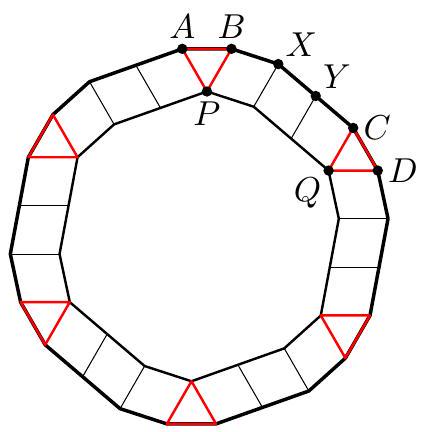\n\nUsing the Claim above, we now show that the citizens may be placed at the $3 n^{2}+3 n+1$ tile vertices.\n\nConsider any tile $T_{1}$; its vertices are at least 1 apart from each other. Moreover, let $B A C$ be a part of the boundary of some tile $T$, and let $X$ be any point of the boundary of $T$, lying outside the half-open intervals $[A, B)$ and $[A, C)$ (in this case, we say that $X$ is not adjacent to $A$ ). Then $A X \\geq \\sqrt{3} / 2$.\n\nNow consider any two tile vertices $A$ and $B$. If they are vertices of the same tile we already know $A B \\geq 1$; otherwise, the segment $A B$ crosses the boundaries of some tiles containing $A$ and $B$ at some points $X$ and $Y$ not adjacent to $A$ and $B$, respectively. Hence $A B \\geq A X+Y B \\geq \\sqrt{3}>1$.", "metadata": {"resource_path": "RMM/segmented/en-2021-RMM2021-Day2-English_Solutions.jsonl", "problem_match": "\nProblem 5.", "solution_match": "\nSolution."}} |
| {"year": "2021", "tier": "T1", "problem_label": "6", "problem_type": null, "exam": "RMM", "problem": "Initially, a non-constant polynomial $S(x)$ with real coefficients is written down on a board. Whenever the board contains a polynomial $P(x)$, not necessarily alone, one can write down on the board any polynomial of the form $P(C+x)$ or $C+P(x)$, where $C$ is a real constant. Moreover, if the board contains two (not necessarily distinct) polynomials $P(x)$ and $Q(x)$, one can write $P(Q(x))$ and $P(x)+Q(x)$ down on the board. No polynomial is ever erased from the board.\n\nGiven two sets of real numbers, $A=\\left\\{a_{1}, a_{2}, \\ldots, a_{n}\\right\\}$ and $B=\\left\\{b_{1}, b_{2}, \\ldots, b_{n}\\right\\}$, a polynomial $f(x)$ with real coefficients is $(A, B)$-nice if $f(A)=B$, where $f(A)=\\left\\{f\\left(a_{i}\\right): i=1,2, \\ldots, n\\right\\}$.\n\nDetermine all polynomials $S(x)$ that can initially be written down on the board such that, for any two finite sets $A$ and $B$ of real numbers, with $|A|=|B|$, one can produce an $(A, B)$-nice polynomial in a finite number of steps.\n\nIran, Navid SafaEi", "solution": "The required polynomials are all polynomials of an even degree $d \\geq 2$, and all polynomials of odd degree $d \\geq 3$ with negative leading coefficient.\n\nPart I. We begin by showing that any (non-constant) polynomial $S(x)$ not listed above is not $(A, B)$-nice for some pair $(A, B)$ with either $|A|=|B|=2$, or $|A|=|B|=3$.\n\nIf $S(x)$ is linear, then so are all the polynomials appearing on the board. Therefore, none of them will be $(A, B)$-nice, say, for $A=\\{1,2,3\\}$ and $B=\\{1,2,4\\}$, as desired.\n\nOtherwise, $\\operatorname{deg} S=d \\geq 3$ is odd, and the leading coefficient is positive. In this case, we make use of the following technical fact, whose proof is presented at the end of the solution.\n\nClaim. There exists a positive constant $T$ such that $S(x)$ satisfies the following condition:\n\n$$\nS(b)-S(a) \\geq b-a \\quad \\text { whenever } \\quad b-a \\geq T\n$$\n\nFix a constant $T$ provided by the Claim. Then, an immediate check shows that all newly appearing polynomials on the board also satisfy $(*)$ (with the same value of $T$ ). Therefore, none of them will be $(A, B)$-nice, say, for $A=\\{0, T\\}$ and $B=\\{0, T / 2\\}$, as desired.\n\nPart II. We show that the polynomials listed in the Answer satisfy the requirements. We will show that for any $a_{1}<a_{2}<\\cdots<a_{n}$ and any $b_{1} \\leq b_{2} \\leq \\cdots \\leq b_{n}$ there exists a polynomial $f(x)$ satisfying $f\\left(a_{i}\\right)=b_{\\sigma(i)}$ for all $i=1,2, \\ldots, n$, where $\\sigma$ is some permutation.\n\nThe proof goes by induction on $n \\geq 2$. It is based on the following two lemmas, first of which is merely the base case $n=2$; the proofs of the lemmas are also at the end of the solution.\n\nLemma 1. For any $a_{1}<a_{2}$ and any $b_{1}, b_{2}$ one can write down on the board a polynomial $F(x)$ satisfying $F\\left(a_{i}\\right)=b_{i}, i=1,2$.\n\nLemma 2. For any distinct numbers $a_{1}<a_{2}<\\cdots<a_{n}$ one can produce a polynomial $F(x)$ on the board such that the list $F\\left(a_{1}\\right), F\\left(a_{2}\\right), \\ldots, F\\left(a_{n}\\right)$ contains exactly $n-1$ distinct numbers, and $F\\left(a_{1}\\right)=F\\left(a_{2}\\right)$.\n\nNow, in order to perform the inductive step, we may replace the polynomial $S(x)$ with its shifted copy $S(C+x)$ so that the values $S\\left(a_{i}\\right)$ are pairwise distinct. Applying Lemma 2 , we get a polynomial $f(x)$ such that only two among the numbers $c_{i}=f\\left(a_{i}\\right)$ coincide, namely $c_{1}$ and $c_{2}$. Now apply Lemma 1 to get a polynomial $g(x)$ such that $g\\left(a_{1}\\right)=b_{1}$ and $g\\left(a_{2}\\right)=b_{2}$. Apply the inductive hypothesis in order to obtain a polynomial $h(x)$ satisfying $h\\left(c_{i}\\right)=b_{i}-g\\left(a_{i}\\right)$ for all $i=2,3, \\ldots, n$. Then the polynomial $h(f(x))+g(x)$ is a desired one; indeed, we have $h\\left(f\\left(a_{i}\\right)\\right)+g\\left(a_{i}\\right)=h\\left(c_{i}\\right)+g\\left(a_{i}\\right)=b_{i}$ for all $i=2,3, \\ldots, n$, and finally $h\\left(f\\left(a_{1}\\right)\\right)+g\\left(a_{1}\\right)=$ $h\\left(c_{1}\\right)+g\\left(a_{1}\\right)=b_{2}-g\\left(a_{2}\\right)+g\\left(a_{1}\\right)=b_{1}$.\n\nIt remains to prove the Claim and the two Lemmas.\nProof of the Claim. There exists some segment $\\Delta=\\left[\\alpha^{\\prime}, \\beta^{\\prime}\\right]$ such that $S(x)$ is monotone increasing outside that segment. Now one can choose $\\alpha \\leq \\alpha^{\\prime}$ and $\\beta \\geq \\beta^{\\prime}$ such that $S(\\alpha)<\\min _{x \\in \\Delta} S(x)$ and\n$S(\\beta)>\\max _{x \\in \\Delta} S(x)$. Therefore, for any $x, y, z$ with $x \\leq \\alpha \\leq y \\leq \\beta \\leq z$ we get $S(x) \\leq S(\\alpha) \\leq$ $S(y) \\leq S(\\beta) \\leq S(z)$.\n\nWe may decrease $\\alpha$ and increase $\\beta$ (preserving the condition above) so that, in addition, $S^{\\prime}(x)>3$ for all $x \\notin[\\alpha, \\beta]$. Now we claim that the number $T=3(\\beta-\\alpha)$ fits the bill.\n\nIndeed, take any $a$ and $b$ with $b-a \\geq T$. Even if the segment $[a, b]$ crosses $[\\alpha, \\beta]$, there still is a segment $\\left[a^{\\prime}, b^{\\prime}\\right] \\subseteq[a, b] \\backslash(\\alpha, \\beta)$ of length $b^{\\prime}-a^{\\prime} \\geq(b-a) / 3$. Then\n\n$$\nS(b)-S(a) \\geq S\\left(b^{\\prime}\\right)-S\\left(a^{\\prime}\\right)=\\left(b^{\\prime}-a^{\\prime}\\right) \\cdot S^{\\prime}(\\xi) \\geq 3\\left(b^{\\prime}-a^{\\prime}\\right) \\geq b-a\n$$\n\nfor some $\\xi \\in\\left(a^{\\prime}, b^{\\prime}\\right)$.\nProof of Lemma 1. If $S(x)$ has an even degree, then the polynomial $T(x)=S\\left(x+a_{2}\\right)-S\\left(x+a_{1}\\right)$ has an odd degree, hence there exists $x_{0}$ with $T\\left(x_{0}\\right)=S\\left(x_{0}+a_{2}\\right)-S\\left(x_{0}+a_{1}\\right)=b_{2}-b_{1}$. Setting $G(x)=S\\left(x+x_{0}\\right)$, we see that $G\\left(a_{2}\\right)-G\\left(a_{1}\\right)=b_{2}-b_{1}$, so a suitable shift $F(x)=G(x)+\\left(b_{1}-G\\left(a_{1}\\right)\\right)$ fits the bill.\n\nAssume now that $S(x)$ has odd degree and a negative leading coefficient. Notice that the polynomial $S^{2}(x):=S(S(x))$ has an odd degree and a positive leading coefficient. So, the polynomial $S^{2}\\left(x+a_{2}\\right)-S^{2}\\left(x+a_{1}\\right)$ attains all sufficiently large positive values, while $S\\left(x+a_{2}\\right)-$ $S\\left(x+a_{1}\\right)$ attains all sufficiently large negative values. Therefore, the two-variable polynomial $S^{2}\\left(x+a_{2}\\right)-S^{2}\\left(x+a_{1}\\right)+S\\left(y+a_{2}\\right)-S\\left(y+a_{1}\\right)$ attains all real values; in particular, there exist $x_{0}$ and $y_{0}$ with $S^{2}\\left(x_{0}+a_{2}\\right)+S\\left(y_{0}+a_{2}\\right)-S^{2}\\left(x_{0}+a_{1}\\right)-S\\left(y_{0}+a_{1}\\right)=b_{2}-b_{1}$. Setting $G(x)=S^{2}\\left(x+x_{0}\\right)+S\\left(x+y_{0}\\right)$, we see that $G\\left(a_{2}\\right)-G\\left(a_{1}\\right)=b_{2}-b_{1}$, so a suitable shift of $G$ fits the bill.\n\nProof of Lemma 2. Let $\\Delta$ denote the segment $\\left[a_{1} ; a_{n}\\right]$. We modify the proof of Lemma 1 in order to obtain a polynomial $F$ convex (or concave) on $\\Delta$ such that $F\\left(a_{1}\\right)=F\\left(a_{2}\\right)$; then $F$ is a desired polynomial. Say that a polynomial $H(x)$ is good if $H$ is convex on $\\Delta$.\n\nIf $\\operatorname{deg} S$ is even, and its leading coefficient is positive, then $S(x+c)$ is good for all sufficiently large negative $c$, and $S\\left(a_{2}+c\\right)-S\\left(a_{1}+c\\right)$ attains all sufficiently large negative values for such $c$. Similarly, $S(x+c)$ is good for all sufficiently large positive $c$, and $S\\left(a_{2}+c\\right)-S\\left(a_{1}+c\\right)$ attains all sufficiently large positive values for such $c$. Therefore, there exist large $c_{1}<0<c_{2}$ such that $S\\left(x+c_{1}\\right)+S\\left(x+c_{2}\\right)$ is a desired polynomial. If the leading coefficient of $H$ is negative, we similarly find a desired polynomial which is concave on $\\Delta$.\n\nIf $\\operatorname{deg} S \\geq 3$ is odd (and the leading coefficient is negative), then $S(x+c)$ is good for all sufficiently large negative $c$, and $S\\left(a_{2}+c\\right)-S\\left(a_{1}+c\\right)$ attains all sufficiently large negative values for such $c$. Similarly, $S^{2}(x+c)$ is good for all sufficiently large positive $c$, and $S^{2}\\left(a_{2}+c\\right)-S^{2}\\left(a_{1}+c\\right)$ attains all sufficiently large positive values for such $c$. Therefore, there exist large $c_{1}<0<c_{2}$ such that $S\\left(x+c_{1}\\right)+S^{2}\\left(x+c_{2}\\right)$ is a desired polynomial.\n\nComment. Both parts above allow some variations.\nIn Part I, the same scheme of the proof works for many conditions similar to (*), e.g.,\n\n$$\nS(b)-S(a)>T \\quad \\text { whenever } \\quad b-a>T\n$$\n\nLet us sketch an alternative approach for Part II. It suffices to construct, for each $i$, a polynomial $f_{i}(x)$ such that $f_{i}\\left(a_{i}\\right)=b_{i}$ and $f_{i}\\left(a_{j}\\right)=0, j \\neq i$. The construction of such polynomials may be reduced to the construction of those for $n=3$ similarly to what happens in the proof of Lemma 2. However, this approach (as well as any in this part) needs some care in order to work properly.", "metadata": {"resource_path": "RMM/segmented/en-2021-RMM2021-Day2-English_Solutions.jsonl", "problem_match": "\nProblem 6.", "solution_match": "\nSolution."}} |
|
|


