| {"year": "2004", "tier": "T1", "problem_label": "1", "problem_type": null, "exam": "USAMO", "problem": "Let $A B C D$ be a quadrilateral circumscribed about a circle, whose interior and exterior angles are at least 60 degrees. Prove that $$ \\frac{1}{3}\\left|A B^{3}-A D^{3}\\right| \\leq\\left|B C^{3}-C D^{3}\\right| \\leq 3\\left|A B^{3}-A D^{3}\\right| $$ When does equality hold?", "solution": " Clearly it suffices to show the left inequality. Since $A B+C D=B C+A D \\Longrightarrow$ $|A B-A D|=|B C-C D|$, it suffices to prove $$ \\frac{1}{3}\\left(A B^{2}+A B \\cdot A D+A D^{2}\\right) \\leq B C^{2}+B C \\cdot C D+C D^{2} $$ This follows by noting that $$ \\begin{aligned} B C^{2}+B C \\cdot C D+C D^{2} & \\geq B C^{2}+C D^{2}-2(B C)(C D) \\cos (\\angle B C D) \\\\ & =B D^{2} \\\\ & =A B^{2}+A D^{2}-2(A B)(A D) \\cos (\\angle B A D) \\\\ & \\geq A B^{2}+A D^{2}-A B \\cdot A D \\\\ & \\geq \\frac{1}{3}\\left(A B^{2}+A D^{2}+A B \\cdot A D\\right) \\end{aligned} $$ the last line following by AM-GM. The equality holds iff $A B C D$ is a kite with $A B=A D, C B=C D$.", "metadata": {"resource_path": "USAMO/segmented/en-USAMO-2004-notes.jsonl"}} |
| {"year": "2004", "tier": "T1", "problem_label": "2", "problem_type": null, "exam": "USAMO", "problem": "Let $a_{1}, a_{2}, \\ldots, a_{n}$ be integers whose greatest common divisor is 1 . Let $S$ be a set of integers with the following properties: (a) $a_{i} \\in S$ for $i=1, \\ldots, n$. (b) $a_{i}-a_{j} \\in S$ for $i, j=1, \\ldots, n$, not necessarily distinct. (c) If $x, y \\in S$ and $x+y \\in S$, then $x-y \\in S$ too. Prove that $S=\\mathbb{Z}$.", "solution": " The idea is to show any linear combination of the $a_{i}$ are in $S$, which implies (by Bezout) that $S=\\mathbb{Z}$. This is pretty intuitive, but the details require some care (in particular there is a parity obstruction at the second lemma). First, we make the following simple observations: - $0 \\in S$, by putting $i=j=1$ in (b). - $s \\in S \\Longleftrightarrow-s \\in S$, by putting $x=0$ in (c). Now, we prove that: ## Lemma For any integers $c, d$, and indices $i, j$, we have $c a_{i}+d a_{j} \\in S$. ## Lemma For any nonzero integers $c_{1}, c_{2}, \\ldots, c_{m}$, and any distinct indices $\\left\\{i_{1}, i_{2}, \\ldots, i_{m}\\right\\}$, we have $$ \\sum_{k} c_{k} a_{i_{k}} \\in S $$ For the inductive step, we will assume that $i_{1}=1, i_{2}=2$, et cetera, for notational convenience. The proof is then split into two cases. First Case: some $c_{i}$ is even. WLOG $c_{1} \\neq 0$ is even and note that $$ \\begin{aligned} x & :=\\frac{1}{2} c_{1} a_{1}+\\sum_{k \\geq 3} c_{k} a_{k} \\in S \\\\ y & :=-\\frac{1}{2} c_{1} a_{1}-c_{2} a_{2} \\in S \\end{aligned} $$ $$ \\begin{aligned} x+y & =-c_{2} a_{2}+\\sum_{k \\geq 3} c_{k} a_{k} \\in S \\\\ \\Longrightarrow x-y & =\\sum_{k \\geq 1} c_{k} a_{k} \\in S . \\end{aligned} $$ Second Case: all $c_{i}$ are odd. We reduce this to the first case as follows. Let $u=\\frac{a_{1}}{\\operatorname{gcd}\\left(a_{1}, a_{2}\\right)}$ and $v=\\frac{a_{2}}{\\operatorname{gcd}\\left(a_{1}, a_{2}\\right)}$. Then $\\operatorname{gcd}(u, v)=1$ and so WLOG $u$ is odd. Then $$ c_{1} a_{1}+c_{2} a_{2}=\\left(c_{1}+v\\right) a_{1}+\\left(c_{2}-u\\right) a_{2} $$ and so we can replace our given combination by $\\left(c_{1}+v\\right) a_{1}+\\left(c_{2}-u\\right) a_{2}+c_{3} a_{3}+\\ldots$ which now has an even coefficient for $a_{2}$. We then apply the lemma at $m=n$; this implies the result since Bezout's lemma implies that $\\sum c_{i} a_{i}=1$ for some choice of $c_{i} \\in \\mathbb{Z}$.", "metadata": {"resource_path": "USAMO/segmented/en-USAMO-2004-notes.jsonl"}} |
| {"year": "2004", "tier": "T1", "problem_label": "3", "problem_type": null, "exam": "USAMO", "problem": "For what real values of $k>0$ is it possible to dissect a $1 \\times k$ rectangle into two similar but noncongruent polygons?", "solution": " Answer: the dissection is possible for every $k>0$ except for $k=1$. Construction. By symmetry it suffices to give a construction for $k>1$ (since otherwise we replace $k$ by $k^{-1}$ ). For every integer $n \\geq 2$ and real number $r>1$, we define a shape $\\mathcal{R}(n, r)$ as follows. - We start with a rectangle of width 1 and height $r$. To its left, we glue a rectangle of height $r$ and width $r^{2}$ to its left. - Then, we glue a rectangle of width $1+r^{2}$ and height $r^{3}$ below our figure, followed by a rectangle of height $r+r^{3}$ and width $r^{4}$ to the left of our figure. - Next, we glue a rectangle of width $1+r^{2}+r^{4}$ and height $r^{5}$ below our figure, followed by a rectangle of height $r+r^{3}+r^{5}$ and width $r^{6}$ to the left of our figure. . . and so on, up until we have put $2 n$ rectangles together. The picture $\\mathcal{R}(3, r)$ is shown below as an example. 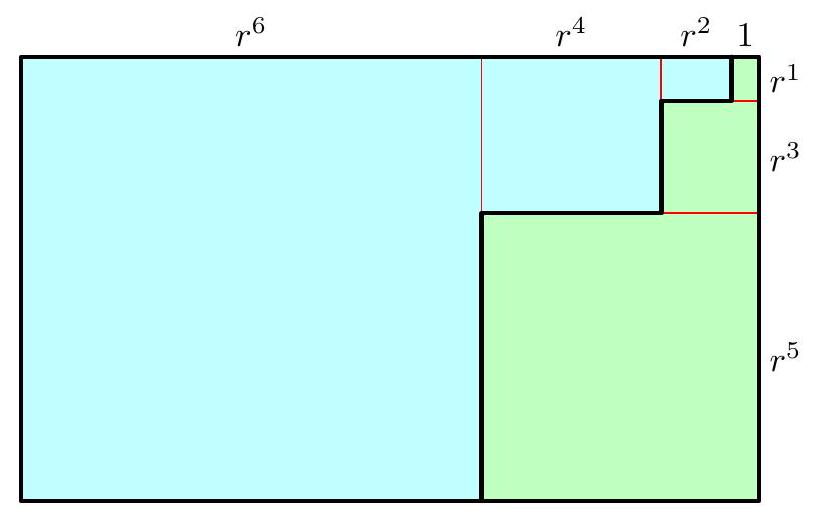 Observe that by construction, the entire shape $\\mathcal{R}(n, r)$ is a rectangle which consists of two similar \"staircase\" polygons (which are not congruent, since $r>1$ ). Note that $\\mathcal{R}(n, r)$ is similar to a $1 \\times f_{n}(r)$ rectangle where $f_{n}(r)$ is the aspect ratio of $\\mathcal{R}(n, r)$, defined by $$ f_{n}(r)=\\frac{1+r^{2}+\\cdots+r^{2 n}}{r+r^{3}+\\cdots+r^{2 n-1}}=r+\\frac{1}{r+r^{3}+\\cdots+r^{2 n-1}} $$ We claim that this is enough. Indeed for each fixed $n$, note that $$ \\lim _{r \\rightarrow 1^{+}} f_{n}(r)=1+\\frac{1}{n} \\text { and } \\lim _{r \\rightarrow \\infty} f_{n}(r)=\\infty $$ Since $f_{n}$ is continuous, it achieves all values greater than $1+\\frac{1}{n}$. Thus by taking sufficiently large $n$ (such that $k>1+\\frac{1}{n}$ ), we obtain a valid construction for any $k>1$. $\\Gamma$ be their common boundary. By counting the number of sides of $\\mathcal{P}$ and $\\mathcal{Q}$ we see $\\Gamma$ must run from one side of the square to an opposite side (possibly ending at a corner of the square). We orient the figure so $\\Gamma$ runs from north to south, with $\\mathcal{P}$ to the west and $\\mathcal{Q}$ to the east. 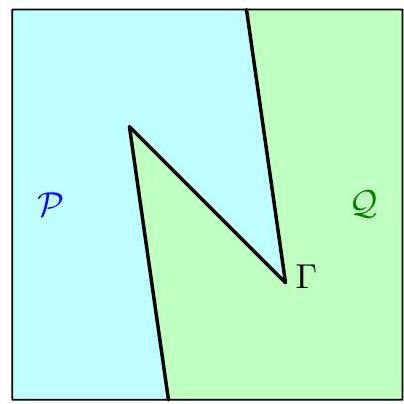 Let $s$ be the longest length of a segment in $\\Gamma$. Claim - The longest side length of $\\mathcal{P}$ is $\\max (s, 1)$. Similarly, the longest side length of $\\mathcal{Q}$ is $\\max (s, 1)$ as well. It follows the longest sides of $\\mathcal{P}$ and $\\mathcal{Q}$ have the same length! Hence the two polygons are in fact congruent, ending the proof.", "metadata": {"resource_path": "USAMO/segmented/en-USAMO-2004-notes.jsonl"}} |
| {"year": "2004", "tier": "T1", "problem_label": "4", "problem_type": null, "exam": "USAMO", "problem": "Alice and Bob play a game on a 6 by 6 grid. On his turn, a player chooses a rational number not yet appearing in the grid and writes it in an empty square of the grid. Alice goes first and then the players alternate. When all squares have numbers written in them, in each row, the square with the greatest number in that row is colored black. Alice wins if he can then draw a line from the top of the grid to the bottom of the grid that stays in black squares, and Bob wins if he can't. (If two squares share a vertex, Alice can draw a line from one to the other that stays in those two squares.) Find, with proof, a winning strategy for one of the players.", "solution": " Bob can win. Label the first two rows as follows: $$ \\left[\\begin{array}{cccccc} a & b & c & d & e & f \\\\ d^{\\prime} & e^{\\prime} & f^{\\prime} & a^{\\prime} & b^{\\prime} & c^{\\prime} \\end{array}\\right] $$ These twelve boxes thus come in six pairs, $\\left(a, a^{\\prime}\\right),\\left(b, b^{\\prime}\\right)$ and so on. Claim - Bob can ensure that the order relation of the labels is the same between the two rows, meaning that $a<b$ if and only if $a^{\\prime}<b^{\\prime}$, and so on. When Alice writes a number in any other row, Bob writes anywhere in rows 3 to 6 . Under this strategy the black squares in the first two rows will be a pair and therefore will not touch, so Bob wins.", "metadata": {"resource_path": "USAMO/segmented/en-USAMO-2004-notes.jsonl"}} |
| {"year": "2004", "tier": "T1", "problem_label": "5", "problem_type": null, "exam": "USAMO", "problem": "Let $a, b, c$ be positive reals. Prove that $$ \\left(a^{5}-a^{2}+3\\right)\\left(b^{5}-b^{2}+3\\right)\\left(c^{5}-c^{2}+3\\right) \\geq(a+b+c)^{3} . $$", "solution": null, "metadata": {"resource_path": "USAMO/segmented/en-USAMO-2004-notes.jsonl"}} |
| {"year": "2004", "tier": "T1", "problem_label": "6", "problem_type": null, "exam": "USAMO", "problem": "A circle $\\omega$ is inscribed in a quadrilateral $A B C D$. Let $I$ be the center of $\\omega$. Suppose that $$ (A I+D I)^{2}+(B I+C I)^{2}=(A B+C D)^{2} $$ Prove that $A B C D$ is an isosceles trapezoid.", "solution": " $$ a+b+c+d=a b c+b c d+c d a+d a b $$ which can be proved by, say tan-addition formula. Then, the content of the problem is to show that $$ \\left(\\sqrt{a^{2}+1}+\\sqrt{d^{2}+1}\\right)^{2}+\\left(\\sqrt{b^{2}+1}+\\sqrt{c^{2}+1}\\right)^{2} \\leq(a+b+c+d)^{2} $$ subject to $(\\star)$, with equality only when $a=d=\\frac{1}{b}=\\frac{1}{c}$. Let $S=a b+b c+c d+d a+a c+b d$. Then the inequality is $$ \\sqrt{\\left(a^{2}+1\\right)\\left(d^{2}+1\\right)}+\\sqrt{\\left(b^{2}+1\\right)\\left(c^{2}+1\\right)} \\leq S-2 . $$ Now, by USAMO 2014 Problem 1 and the condition $(\\star)$, we have that $\\left(a^{2}+1\\right)\\left(b^{2}+\\right.$ 1) $\\left(c^{2}+1\\right)\\left(d^{2}+1\\right)=(S-a b c d-1)^{2}$. So squaring both sides, the inequality becomes $$ (a d)^{2}+(b c)^{2}+a^{2}+b^{2}+c^{2}+d^{2} \\leq S^{2}-6 S+2 a b c d+4 $$ To simplify this, we use the identities $$ \\begin{aligned} S^{2} & =6 a b c d+\\sum_{\\mathrm{sym}} a^{2} b c+\\frac{1}{4} \\sum_{\\mathrm{sym}} a^{2} b^{2} \\\\ (a+b+c+d)^{2} & =(a b c+b c d+c d a+d a b)(a+b+c+d) \\\\ & =4 a b c d+\\frac{1}{2} \\sum_{\\mathrm{sym}} a^{2} b c \\end{aligned} $$ So $S^{2}+2 a b c d=\\frac{1}{4} \\sum_{\\text {sym }} a^{2} b^{2}+2\\left(a^{2}+b^{2}+c^{2}+d^{2}\\right)+4 S$ and the inequality we want to prove reduces to $$ 2 S \\leq(a b)^{2}+(a c)^{2}+(b d)^{2}+(c d)^{2}+4+a^{2}+b^{2}+c^{2}+d^{2} $$ This follows by AM-GM since $$ \\begin{aligned} (a b)^{2}+1 & \\geq 2 a b \\\\ (a c)^{2}+1 & \\geq 2 a c \\\\ (b d)^{2}+1 & \\geq 2 b d \\\\ (c d)^{2}+1 & \\geq 2 c d \\\\ a^{2}+d^{2} & \\geq 2 a d \\\\ b^{2}+c^{2} & \\geq 2 b c \\end{aligned} $$ The equality case is when $a b=a c=b d=c d=1, a=d, b=c$, as needed to imply an isosceles trapezoid. Remark. Note that a priori one expects an inequality. Indeed, - Quadrilaterals with incircles have four degrees of freedom. - There is one condition imposed. - Isosceles trapezoid with incircles have two degrees of freedom.", "metadata": {"resource_path": "USAMO/segmented/en-USAMO-2004-notes.jsonl"}} |
|
|


