| {"year": "2006", "tier": "T1", "problem_label": "1", "problem_type": null, "exam": "USAMO", "problem": "Let $p$ be a prime number and let $s$ be an integer with $0<s<p$. Prove that there exist integers $m$ and $n$ with $0<m<n<p$ and $$ \\left\\{\\frac{s m}{p}\\right\\}<\\left\\{\\frac{s n}{p}\\right\\}<\\frac{s}{p} $$ if and only if $s$ is not a divisor of $p-1$.", "solution": " It's equivalent to $m s \\bmod p<n s \\bmod p<s$, where $x \\bmod p$ means the remainder when $x$ is divided by $p$, by slight abuse of notation. We will assume $s \\geq 2$ for simplicity, since the case $s=1$ is clear. For any $x \\in\\{1,2, \\ldots, s-1\\}$ we define $f(x)$ to be the unique number in $\\{1, \\ldots, p-1\\}$ such that $s \\cdot f(x) \\bmod p=x$. Then, $m$ and $n$ fail to exist exactly when $$ f(s-1)<f(s-2)<\\cdots<f(1) $$ We give the following explicit description of $f$ : choose $t \\equiv-s^{-1}(\\bmod p), 0<t<p$. Then $f(x)=1+(s-x) \\cdot t \\bmod p$. So our displayed inequality is equivalent to $$ (1+t) \\bmod p<(1+2 t) \\bmod p<(1+3 t) \\bmod p<\\cdots<(1+(s-1) t) \\bmod p $$ This just means that the sequence $1+k t$ never \"wraps around\" modulo $p$ as we take $k=1,2, \\ldots, s-1$. Since we assumed $s \\neq 1$, we have $0<1+t<p$. Now since $1+k t$ never wraps around as $k=1,2, \\ldots, s-1$, and increases in increments of $t$, it follows that $1+k t<p$ for all $k=1,2, \\ldots, s-1$. Finally, as $1+s t \\equiv 0(\\bmod p)$ we get $1+s t=p$. In summary, $m, n$ fail to exist precisely when $1+s t=p$. That is of course equivalent to $s \\mid p-1$.", "metadata": {"resource_path": "USAMO/segmented/en-USAMO-2006-notes.jsonl"}} |
| {"year": "2006", "tier": "T1", "problem_label": "2", "problem_type": null, "exam": "USAMO", "problem": "Let $k>0$ be a fixed integer. Compute the minimum integer $N$ (in terms of $k$ ) for which there exists a set of $2 k+1$ distinct positive integers that has sum greater than $N$, but for which every subset of size $k$ has sum at most $N / 2$.", "solution": " The answer is $N=k\\left(2 k^{2}+3 k+3\\right)$ given by $$ S=\\left\\{k^{2}+1, k^{2}+2, \\ldots, k^{2}+2 k+1\\right\\} . $$ To show this is best possible, let the set be $S=\\left\\{a_{0}<a_{1}<\\cdots<a_{2 k}\\right\\}$ so that the hypothesis becomes $$ \\begin{aligned} N+1 & \\leq a_{0}+a_{1}+\\cdots+a_{2 k} \\\\ N / 2 & \\geq a_{k+1}+\\cdots+a_{2 k} \\end{aligned} $$ Subtracting twice the latter from the former gives $$ \\begin{aligned} a_{0} & \\geq 1+\\left(a_{k+1}-a_{1}\\right)+\\left(a_{k+2}-a_{2}\\right)+\\cdots+\\left(a_{2 k}-a_{k}\\right) \\\\ & \\geq 1+\\underbrace{k+k+\\cdots+k}_{k \\text { terms }}=1+k^{2} . \\end{aligned} $$ Now, we have $$ \\begin{aligned} N / 2 & \\geq a_{k+1}+\\cdots+a_{2 k} \\\\ & \\geq\\left(a_{0}+(k+1)\\right)+\\left(a_{0}+(k+2)\\right)+\\cdots+\\left(a_{0}+2 k\\right) \\\\ & =k \\cdot a_{0}+((k+1)+\\cdots+2 k) \\\\ & \\geq k\\left(k^{2}+1\\right)+k \\cdot \\frac{3 k+1}{2} \\end{aligned} $$ so $N \\geq k\\left(2 k^{2}+3 k+3\\right)$. Remark. The exact value of $N$ is therefore very superficial. From playing with these concrete examples we find out we are essentially just trying to find an increasing set $S$ obeying $$ a_{0}+a_{1}+\\cdots+a_{k}>a_{k+1}+\\cdots+a_{2 k} $$ and indeed given a sequence satisfying these properties one simply sets $N=2\\left(a_{k+1}+\\cdots+a_{2 k}\\right)$. Therefore we can focus almost entirely on $a_{i}$ and not $N$. Remark. It is relatively straightforward to figure out what is going on based on the small cases. For example, one can work out by hand that - $\\{2,3,4\\}$ is optimal for $k=1$ - $\\{5,6,7,8,9\\}$ is optimal for $k=2$, - $\\{10,11,12,13,14,15,16\\}$ is optimal for $k=3$. In all the examples, the $a_{i}$ are an arithmetic progression of difference 1 , so that $a_{j}-a_{i} \\geq j-i$ is a sharp for all $i<j$, and thus this estimate may be used freely without loss of sharpness; applying it in $(\\star)$ gives a lower bound on $a_{0}$ which is then good enough to get a lower bound on $N$ matching the equality cases we found empirically.", "metadata": {"resource_path": "USAMO/segmented/en-USAMO-2006-notes.jsonl"}} |
| {"year": "2006", "tier": "T1", "problem_label": "3", "problem_type": null, "exam": "USAMO", "problem": "For integral $m$, let $p(m)$ be the greatest prime divisor of $m$. By convention, we set $p( \\pm 1)=1$ and $p(0)=\\infty$. Find all polynomials $f$ with integer coefficients such that the sequence $$ \\left\\{p\\left(f\\left(n^{2}\\right)\\right)-2 n\\right\\}_{n \\geq 0} $$ is bounded above. (In particular, this requires $f\\left(n^{2}\\right) \\neq 0$ for $n \\geq 0$.)", "solution": " If $f$ is the (possibly empty) product of linear factors of the form $4 n-a^{2}$, then it satisfies the condition. We will prove no other polynomials work. In what follows, assume $f$ is irreducible and nonconstant. It suffices to show for every positive integer $c$, there exists a prime $p$ and a nonnegative integer $n$ such that $n \\leq \\frac{p-1}{2}-c$ and $p$ divides $f\\left(n^{2}\\right)$. Firstly, recall there are infinitely many odd primes $p$, with $p>c$, such that $p$ divides some $f\\left(n^{2}\\right)$, by Schur's Theorem. Looking mod such a $p$ we can find $n$ between 0 and $\\frac{p-1}{2}\\left(\\right.$ since $\\left.n^{2} \\equiv(-n)^{2}(\\bmod p)\\right)$. We claim that only finitely many $p$ from this set can fail now. For if a $p$ fails, then its $n$ must be between $\\frac{p-1}{2}-c$ and $\\frac{p-1}{2}$. That means for some $0 \\leq k \\leq c$ we have $$ 0 \\equiv f\\left(\\left(\\frac{p-1}{2}-k\\right)^{2}\\right) \\equiv f\\left(\\left(k+\\frac{1}{2}\\right)^{2}\\right) \\quad(\\bmod p) $$ There are only finitely many $p$ dividing $$ \\prod_{k=1}^{c} f\\left(\\left(k+\\frac{1}{2}\\right)^{2}\\right) $$ unless one of the terms in the product is zero; this means that $4 n-(2 k+1)^{2}$ divides $f(n)$. This establishes the claim and finishes the problem.", "metadata": {"resource_path": "USAMO/segmented/en-USAMO-2006-notes.jsonl"}} |
| {"year": "2006", "tier": "T1", "problem_label": "4", "problem_type": null, "exam": "USAMO", "problem": "Find all positive integers $n$ for which there exist an integer $k \\geq 2$ and positive rational numbers $a_{1}, \\ldots, a_{k}$ satisfying $a_{1}+a_{2}+\\cdots+a_{k}=a_{1} a_{2} \\ldots a_{k}=n$.", "solution": " The answer is all $n$ other than $1,2,3,5$. We now contend that $k>2$. Indeed, if $a_{1}+a_{2}=a_{1} a_{2}=n$ then $\\left(a_{1}-a_{2}\\right)^{2}=$ $\\left(a_{1}+a_{2}\\right)^{2}-4 a_{1} a_{2}=n^{2}-4 n=(n-2)^{2}-4$ is a rational integer square, hence a perfect square. This happens only when $n=4$. Now by AM-GM, $$ \\frac{n}{k}=\\frac{a_{1}+\\cdots+a_{k}}{k} \\geq \\sqrt[k]{a_{1} \\ldots a_{k}}=n^{1 / k} $$ and so $n \\geq k^{\\frac{1}{1-1 / k}}=k^{\\frac{k}{k-1}}$. This last quantity is always greater than 5 , since $$ \\begin{aligned} 3^{3 / 2} & =3 \\sqrt{3}>5 \\\\ 4^{4 / 3} & =4 \\sqrt[3]{4}>5 \\\\ k^{\\frac{k}{k-1}} & >k \\geq 5 \\quad \\forall k \\geq 5 \\end{aligned} $$ Now, in general: - If $n \\geq 6$ is even, we may take $\\left(a_{1}, \\ldots, a_{n / 2}\\right)=(n / 2,2,1, \\ldots, 1)$. - If $n \\geq 9$ is odd, we may take $\\left(a_{1}, \\ldots, a_{(n-3) / 2}\\right)=(n / 2,1 / 2,4,1, \\ldots, 1)$. - A special case $n=7$ : one example is $(4 / 3,7 / 6,9 / 2)$. (Another is $(7 / 6,4 / 3,3 / 2,3)$.) Remark. The main hurdle in the problem is the $n=7$ case. One good reason to believe a construction exists is that it seems quite difficult to prove that $n=7$ fails.", "metadata": {"resource_path": "USAMO/segmented/en-USAMO-2006-notes.jsonl"}} |
| {"year": "2006", "tier": "T1", "problem_label": "5", "problem_type": null, "exam": "USAMO", "problem": "A mathematical frog jumps along the number line. The frog starts at 1 , and jumps according to the following rule: if the frog is at integer $n$, then it can jump either to $n+1$ or to $n+2^{m_{n}+1}$ where $2^{m_{n}}$ is the largest power of 2 that is a factor of $n$. Show that if $k \\geq 2$ is a positive integer and $i$ is a nonnegative integer, then the minimum number of jumps needed to reach $2^{i} k$ is greater than the minimum number of jumps needed to reach $2^{i}$.", "solution": " We will think about the problem in terms of finite sequences of jumps $\\left(s_{1}, s_{2}, \\ldots, s_{\\ell}\\right)$, which we draw as $$ 1=x_{0} \\xrightarrow{s_{1}} x_{1} \\xrightarrow{s_{2}} x_{2} \\xrightarrow{s_{3}} \\ldots \\xrightarrow{s_{\\ell}} x_{\\ell} $$ where $s_{k}=x_{k}-x_{k-1}$ is the length of some hop. We say the sequence is valid if it has the property required by the problem: for each $k$, either $s_{k}=1$ or $s_{k}=2^{m_{x_{k-1}}+1}$. An example is shown below. ## Lemma Let $\\left(s_{1}, \\ldots, s_{\\ell}\\right)$ be a sequence of jumps. Suppose we delete pick an index $k$ and exponent $e>0$, and delete any jumps after the $k$ th one which are divisible by $2^{e}$. The resulting sequence is still valid. But since $s<2^{e}$, we have $\\nu_{2}\\left(x^{\\prime}\\right)<e$ and hence $\\nu_{2}(x)=\\nu_{2}\\left(x^{\\prime}\\right)$ so the jump is valid. 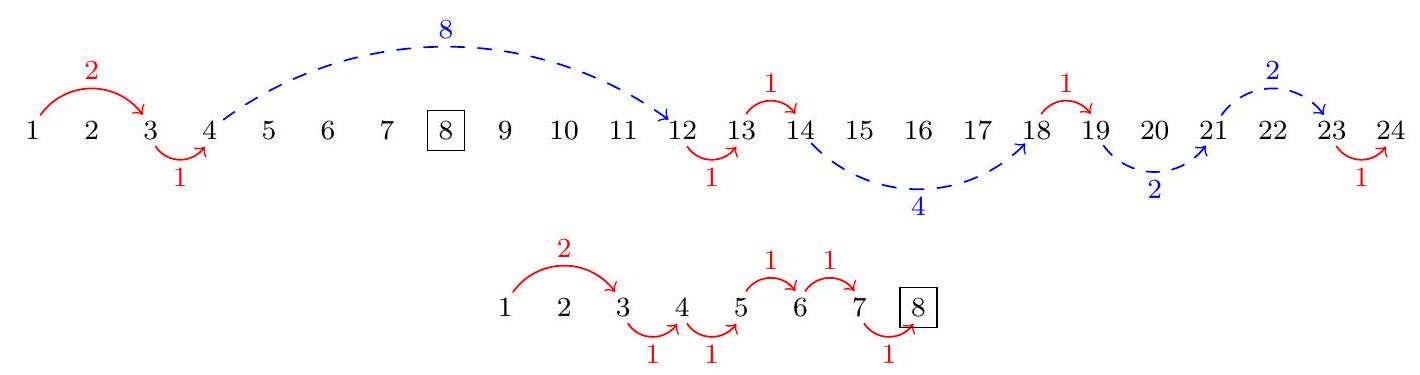 Now let's consider a valid path to $2^{i} k$ with $\\ell$ steps, say $$ 1=x_{0} \\xrightarrow{s_{1}} x_{1} \\xrightarrow{s_{2}} x_{2} \\xrightarrow{s_{3}} \\ldots \\xrightarrow{s_{\\ell}} x_{\\ell}=2^{i} \\cdot k $$ where $s_{i}=x_{i}-x_{i-1}$ is the distance jumped. We delete jumps in the following way: starting from the largest $e$ and going downwards until $e=0$, we delete all the jumps of length $2^{e}$ which end at a point exceeding the target $2^{i}$. By the lemma, at each stage, the path remains valid. We claim more: Claim - Let $e \\geq 0$. After the jumps of length greater than $2^{e}$ are deleted, the resulting end-point is at least $2^{i}$, and divisible by $2^{\\min (i, e)}$. It is also divisible by $2^{\\min (i, e)}$ by induction hypothesis, since we are changing the end-point by multiples of $2^{e}$. And the smallest multiple of $2^{\\min (i, e)}$ exceeding $x$ is $2^{i}$. On the other hand by construction when the process ends the reduced path ends at a point at most $2^{i}$, so it is $2^{i}$ as desired. Therefore we have taken a path to $2^{i} k$ and reduced it to one to $2^{i}$ by deleting some jumps. This proves the result.", "metadata": {"resource_path": "USAMO/segmented/en-USAMO-2006-notes.jsonl"}} |
| {"year": "2006", "tier": "T1", "problem_label": "6", "problem_type": null, "exam": "USAMO", "problem": "Let $A B C D$ be a quadrilateral, and let $E$ and $F$ be points on sides $A D$ and $B C$, respectively, such that $\\frac{A E}{E D}=\\frac{B F}{F C}$. Ray $F E$ meets rays $B A$ and $C D$ at $S$ and $T$, respectively. Prove that the circumcircles of triangles $S A E, S B F, T C F$, and $T D E$ pass through a common point.", "solution": " 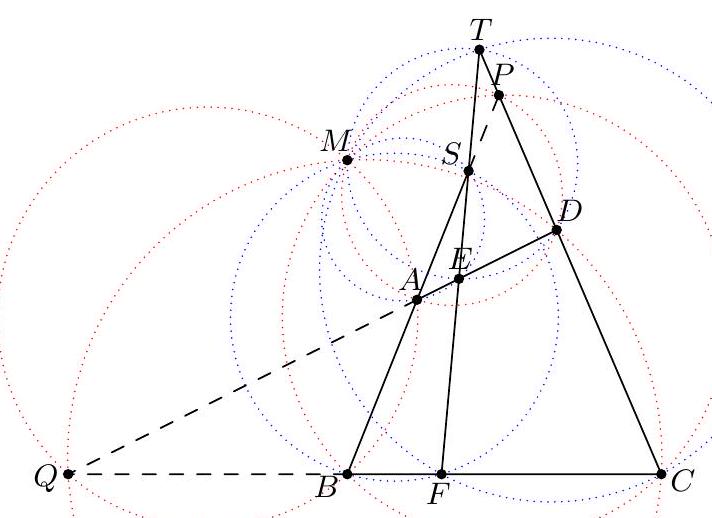 Let $M$ be the Miquel point of $A B C D$. Then $M$ is the center of a spiral similarity taking $A D$ to $B C$. The condition guarantees that it also takes $E$ to $F$. Hence, we see that $M$ is the center of a spiral similarity taking $\\overline{A B}$ to $\\overline{E F}$, and consequently the circumcircles of $Q A B, Q E F, S A E, S B F$ concur at point $M$. In other words, the Miquel point of $A B C D$ is also the Miquel point of $A B F E$. Similarly, $M$ is also the Miquel point of $E D C F$, so all four circles concur at $M$.", "metadata": {"resource_path": "USAMO/segmented/en-USAMO-2006-notes.jsonl"}} |
|
|


