| {"year": "2012", "tier": "T1", "problem_label": "1", "problem_type": null, "exam": "USAMO", "problem": "Find all integers $n \\geq 3$ such that among any $n$ positive real numbers $a_{1}, a_{2}, \\ldots$, $a_{n}$ with $$ \\max \\left(a_{1}, a_{2}, \\ldots, a_{n}\\right) \\leq n \\cdot \\min \\left(a_{1}, a_{2}, \\ldots, a_{n}\\right), $$ there exist three that are the side lengths of an acute triangle.", "solution": " The answer is all $n \\geq 13$. Define $\\left(F_{n}\\right)$ as the sequence of Fibonacci numbers, by $F_{1}=F_{2}=1$ and $F_{n+1}=$ $F_{n}+F_{n-1}$. We will find that Fibonacci numbers show up naturally when we work through the main proof, so we will isolate the following calculation now to make the subsequent solution easier to read. Claim - For positive integers $m$, we have $F_{m} \\leq m^{2}$ if and only if $m \\leq 12$. $$ \\begin{array}{rrrrrrrrrrrrrr} F_{1} & F_{2} & F_{3} & F_{4} & F_{5} & F_{6} & F_{7} & F_{8} & F_{9} & F_{10} & F_{11} & F_{12} & F_{13} & F_{14} \\\\ \\hline 1 & 1 & 2 & 3 & 5 & 8 & 13 & 21 & 34 & 55 & 89 & 144 & 233 & 377 \\end{array} $$ By examining the table, we see that $F_{m} \\leq m^{2}$ is true for $m=1,2, \\ldots 12$, and in fact $F_{12}=12^{2}=144$. However, $F_{m}>m^{2}$ for $m=13$ and $m=14$. Now it remains to prove that $F_{m}>m^{2}$ for $m \\geq 15$. The proof is by induction with base cases $m=13$ and $m=14$ being checked already. For the inductive step, if $m \\geq 15$ then we have $$ \\begin{aligned} F_{m} & =F_{m-1}+F_{m-2}>(m-1)^{2}+(m-2)^{2} \\\\ & =2 m^{2}-6 m+5=m^{2}+(m-1)(m-5)>m^{2} \\end{aligned} $$ as desired. We now proceed to the main problem. The hypothesis $\\max \\left(a_{1}, a_{2}, \\ldots, a_{n}\\right) \\leq n$. $\\min \\left(a_{1}, a_{2}, \\ldots, a_{n}\\right)$ will be denoted by $(\\dagger)$. $$ \\begin{aligned} & a_{3}^{2} \\geq a_{2}^{2}+a_{1}^{2} \\geq 2 a_{1}^{2} \\\\ & a_{4}^{2} \\geq a_{3}^{2}+a_{2}^{2} \\geq 2 a_{1}^{2}+a_{1}^{2}=3 a_{1}^{2} \\\\ & a_{5}^{2} \\geq a_{4}^{2}+a_{3}^{2} \\geq 3 a_{1}^{2}+2 a_{1}^{2}=5 a_{1}^{2} \\\\ & a_{6}^{2} \\geq a_{5}^{2}+a_{4}^{2} \\geq 5 a_{1}^{2}+3 a_{1}^{2}=8 a_{1}^{2} \\end{aligned} $$ and so on. The Fibonacci numbers appear naturally and by induction, we conclude that $a_{i}^{2} \\geq F_{i} a_{1}^{2}$. In particular, $a_{n}^{2} \\geq F_{n} a_{1}^{2}$. However, we know $\\max \\left(a_{1}, \\ldots, a_{n}\\right)=a_{n}$ and $\\min \\left(a_{1}, \\ldots, a_{n}\\right)=a_{1}$, so ( $\\dagger$ ) reads $a_{n} \\leq n \\cdot a_{1}$. Therefore we have $F_{n} \\leq n^{2}$, and so $n \\leq 12$, contradiction!", "metadata": {"resource_path": "USAMO/segmented/en-USAMO-2012-notes.jsonl"}} |
| {"year": "2012", "tier": "T1", "problem_label": "2", "problem_type": null, "exam": "USAMO", "problem": "A circle is divided into congruent arcs by 432 points. The points are colored in four colors such that some 108 points are colored red, some 108 points are colored green, some 108 points are colored blue, and the remaining 108 points are colored yellow. Prove that one can choose three points of each color in such a way that the four triangles formed by the chosen points of the same color are congruent.", "solution": " First, consider the 431 possible non-identity rotations of the red points, and count overlaps with green points. If we select a rotation randomly, then each red point lies over a green point with probability $\\frac{108}{431}$; hence the expected number of red-green incidences is $$ \\frac{108}{431} \\cdot 108>27 $$ and so by pigeonhole, we can find a red 28 -gon and a green 28 -gon which are rotations of each other. Now, look at the 430 rotations of this 28 -gon (that do not give the all-red or all-green configuration) and compare it with the blue points. The same approach gives $$ \\frac{108}{430} \\cdot 28>7 $$ incidences, so we can find red, green, blue 8 -gons which are similar under rotation. Finally, the 429 nontrivial rotations of this 8 -gon expect $$ \\frac{108}{429} \\cdot 8>2 $$ incidences with yellow. So finally we have four monochromatic 3 -gons, one of each color, which are rotations of each other.", "metadata": {"resource_path": "USAMO/segmented/en-USAMO-2012-notes.jsonl"}} |
| {"year": "2012", "tier": "T1", "problem_label": "3", "problem_type": null, "exam": "USAMO", "problem": "Determine which integers $n>1$ have the property that there exists an infinite sequence $a_{1}, a_{2}, a_{3}, \\ldots$ of nonzero integers such that the equality $$ a_{k}+2 a_{2 k}+\\cdots+n a_{n k}=0 $$ holds for every positive integer $k$.", "solution": " Answer: all $n>2$. For $n=2$, we have $a_{k}+2 a_{2 k}=0$, which is clearly not possible, since it implies $a_{2^{k}}=\\frac{a_{1}}{2^{k-1}}$ for all $k \\geq 1$. For $n \\geq 3$ we will construct a completely multiplicative sequence (meaning $a_{i j}=a_{i} a_{j}$ for all $i$ and $j$ ). Thus $\\left(a_{i}\\right)$ is determined by its value on primes, and satisfies the condition as long as $a_{1}+2 a_{2}+\\cdots+n a_{n}=0$. The idea is to take two large primes and use Bezout's theorem, but the details require significant care. We start by solving the case where $n \\geq 9$. In that case, by Bertrand postulate there exists primes $p$ and $q$ such that $$ \\lceil n / 2\\rceil<q<2\\lceil n / 2\\rceil \\quad \\text { and } \\quad \\frac{1}{2}(q-1)<p<q-1 $$ Clearly $p \\neq q$, and $q \\geq 7$, so $p>3$. Also, $p<q<n$ but $2 q>n$, and $4 p \\geq 4\\left(\\frac{1}{2}(q+1)\\right)>$ $n$. We now stipulate that $a_{r}=1$ for any prime $r \\neq p, q$ (in particular including $r=2$ and $r=3$ ). There are now three cases, identical in substance. - If $p, 2 p, 3 p \\in[1, n]$ then we would like to choose nonzero $a_{p}$ and $a_{q}$ such that $$ 6 p \\cdot a_{p}+q \\cdot a_{q}=6 p+q-\\frac{1}{2} n(n+1) $$ which is possible by Bézout lemma, since $\\operatorname{gcd}(6 p, q)=1$. - Else if $p, 2 p \\in[1, n]$ then we would like to choose nonzero $a_{p}$ and $a_{q}$ such that $$ 3 p \\cdot a_{p}+q \\cdot a_{q}=3 p+q-\\frac{1}{2} n(n+1) $$ which is possible by Bézout lemma, since $\\operatorname{gcd}(3 p, q)=1$. - Else if $p \\in[1, n]$ then we would like to choose nonzero $a_{p}$ and $a_{q}$ such that $$ p \\cdot a_{p}+q \\cdot a_{q}=p+q-\\frac{1}{2} n(n+1) $$ which is possible by Bézout lemma, since $\\operatorname{gcd}(p, q)=1$. (This case is actually possible in a few edge cases, for example when $n=9, q=7, p=5$.) It remains to resolve the cases where $3 \\leq n \\leq 8$. We enumerate these cases manually: - For $n=3$, let $a_{n}=(-1)^{\\nu_{3}(n)}$. - For $n=4$, let $a_{n}=(-1)^{\\nu_{2}(n)+\\nu_{3}(n)}$. - For $n=5$, let $a_{n}=(-2)^{\\nu_{5}(n)}$. - For $n=6$, let $a_{n}=5^{\\nu_{2}(n)} \\cdot 3^{\\nu_{3}(n)} \\cdot(-42)^{\\nu_{5}(n)}$. - For $n=7$, let $a_{n}=(-3)^{\\nu_{7}(n)}$. - For $n=8$, we can choose $(p, q)=(5,7)$ in the prior construction. This completes the constructions for all $n>2$.", "metadata": {"resource_path": "USAMO/segmented/en-USAMO-2012-notes.jsonl"}} |
| {"year": "2012", "tier": "T1", "problem_label": "4", "problem_type": null, "exam": "USAMO", "problem": "Find all functions $f: \\mathbb{N} \\rightarrow \\mathbb{N}$ such that $f(n!)=f(n)$ ! for all positive integers $n$ and such that $m-n$ divides $f(m)-f(n)$ for all distinct positive integers $m, n$.", "solution": " Answer: $f \\equiv 1, f \\equiv 2$, and $f$ the identity. As these obviously work, we prove these are the only ones. By putting $n=1$ and $n=2$ we give $f(1), f(2) \\in\\{1,2\\}$. Also, we will use the condition $$ m!-n!\\text { divides } f(m)!-f(n)! $$ We consider four cases on $f(1)$ and $f(2)$, and dispense with three of them. - If $f(2)=1$ then for all $m \\geq 3$ we have $m!$ - 2 divides $f(m)!-1$, so $f(m)=1$ for modulo 2 reasons. Then clearly $f(1)=1$. - If $f(1)=f(2)=2$ we first obtain $3!-1 \\mid f(3)!-2$, which implies $f(3)=2$. Then $m!-3 \\mid f(m)!-2$ for $m \\geq 4$ implies $f(m)=2$ for modulo 3 reasons. Hence we are left with the case where $f(1)=1$ and $f(2)=2$. Continuing, we have $$ 3!-1 \\mid f(3)!-1 \\quad \\text { and } \\quad 3!-2 \\mid f(3)!-2 \\Longrightarrow f(3)=3 $$ Continuing by induction, suppose $f(1)=1, \\ldots, f(k)=k$. $$ k!\\cdot k=(k+1)!-k!\\mid f(k+1)!-k! $$ and thus we deduce that $f(k+1) \\geq k$, and hence $$ k \\left\\lvert\\, \\frac{f(k+1)!}{k!}-1\\right. $$ Then plainly $f(k+1) \\leq 2 k$ for $\\bmod k$ reasons, but also $f(k+1) \\equiv 1(\\bmod k)$ so we conclude $f(k+1)=k+1$. Remark. Shankar Padmanabhan gives the following way to finish after verifying that $f(3)=3$. Note that if $$ M=((((3!)!)!)!\\ldots)! $$ for any number of iterated factorials then $f(M)=M$. Thus for any $n$, we have $$ M-n|f(M)-f(n)=M-f(n) \\Longrightarrow M-n| n-f(n) $$ and so taking $M$ large enough implies $f(n)=n$.", "metadata": {"resource_path": "USAMO/segmented/en-USAMO-2012-notes.jsonl"}} |
| {"year": "2012", "tier": "T1", "problem_label": "5", "problem_type": null, "exam": "USAMO", "problem": "Let $P$ be a point in the plane of $\\triangle A B C$, and $\\gamma$ a line through $P$. Let $A^{\\prime}, B^{\\prime}, C^{\\prime}$ be the points where the reflections of lines $P A, P B, P C$ with respect to $\\gamma$ intersect lines $B C, C A, A B$ respectively. Prove that $A^{\\prime}, B^{\\prime}, C^{\\prime}$ are collinear.", "solution": " 【 First solution (complex numbers). Let $p=0$ and set $\\gamma$ as the real line. Then $A^{\\prime}$ is the intersection of $b c$ and $p \\bar{a}$. So, we get $$ a^{\\prime}=\\frac{\\bar{a}(\\bar{b} c-b \\bar{c})}{(\\bar{b}-\\bar{c}) \\bar{a}-(b-c) a} . $$ 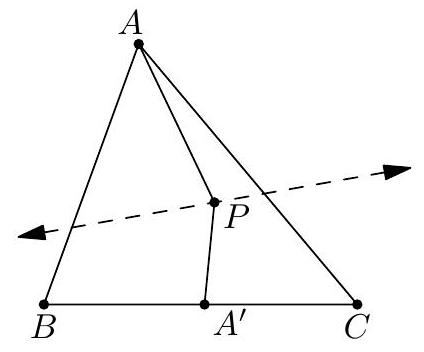 Note that $$ \\bar{a}^{\\prime}=\\frac{a(b \\bar{c}-\\bar{b} c)}{(b-c) a-(\\bar{b}-\\bar{c}) \\bar{a}} . $$ Thus it suffices to prove This is equivalent to $$ 0=\\operatorname{det}\\left[\\begin{array}{lll} \\bar{a}(\\bar{b} c-b \\bar{c}) & a(\\bar{b} c-b \\bar{c}) & (\\bar{b}-\\bar{c}) \\bar{a}-(b-c) a \\\\ \\bar{b}(\\bar{c} a-c \\bar{a}) & b(\\bar{c} a-c \\bar{a}) & (\\bar{c}-\\bar{a}) \\bar{b}-(c-a) b \\\\ \\bar{c}(\\bar{a} b-a \\bar{b}) & c(\\bar{a} b-a \\bar{b}) & (\\bar{a}-\\bar{b}) \\bar{c}-(a-b) c \\end{array}\\right] . $$ This determinant has the property that the rows sum to zero, and we're done. Remark. Alternatively, if you don't notice that you could just blindly expand: $$ \\begin{aligned} & \\sum_{\\mathrm{cyc}}((\\bar{b}-\\bar{c}) \\bar{a}-(b-c) a) \\cdot-\\operatorname{det}\\left[\\begin{array}{ll} b & \\bar{b} \\\\ c & \\bar{c} \\end{array}\\right](\\bar{c} a-c \\bar{a})(\\bar{a} b-a \\bar{b}) \\\\ = & (\\bar{b} c-c \\bar{b})(\\bar{c} a-c \\bar{a})(\\bar{a} b-a \\bar{b}) \\sum_{\\mathrm{cyc}}(a b-a c+\\overline{c a}-\\bar{b} \\bar{a})=0 . \\end{aligned} $$", "metadata": {"resource_path": "USAMO/segmented/en-USAMO-2012-notes.jsonl"}} |
| {"year": "2012", "tier": "T1", "problem_label": "5", "problem_type": null, "exam": "USAMO", "problem": "Let $P$ be a point in the plane of $\\triangle A B C$, and $\\gamma$ a line through $P$. Let $A^{\\prime}, B^{\\prime}, C^{\\prime}$ be the points where the reflections of lines $P A, P B, P C$ with respect to $\\gamma$ intersect lines $B C, C A, A B$ respectively. Prove that $A^{\\prime}, B^{\\prime}, C^{\\prime}$ are collinear.", "solution": " \\I Second solution (Desargues involution). We let $C^{\\prime \\prime}=\\overline{A^{\\prime} B^{\\prime}} \\cap \\overline{A B}$. Consider complete quadrilateral $A B C A^{\\prime} B^{\\prime} C^{\\prime \\prime} C$. We see that there is an involutive pairing $\\tau$ at $P$ swapping $\\left(P A, P A^{\\prime}\\right),\\left(P B, P B^{\\prime}\\right),\\left(P C, P C^{\\prime \\prime}\\right)$. From the first two, we see $\\tau$ coincides with reflection about $\\ell$, hence conclude $C^{\\prime \\prime}=C$.", "metadata": {"resource_path": "USAMO/segmented/en-USAMO-2012-notes.jsonl"}} |
| {"year": "2012", "tier": "T1", "problem_label": "5", "problem_type": null, "exam": "USAMO", "problem": "Let $P$ be a point in the plane of $\\triangle A B C$, and $\\gamma$ a line through $P$. Let $A^{\\prime}, B^{\\prime}, C^{\\prime}$ be the points where the reflections of lines $P A, P B, P C$ with respect to $\\gamma$ intersect lines $B C, C A, A B$ respectively. Prove that $A^{\\prime}, B^{\\prime}, C^{\\prime}$ are collinear.", "solution": " ब Third solution (barycentric), by Catherine $\\mathbf{X u}$. We will perform barycentric coordinates on the triangle $P C C^{\\prime}$, with $P=(1,0,0), C^{\\prime}=(0,1,0)$, and $C=(0,0,1)$. Set $a=C C^{\\prime}, b=C P, c=C^{\\prime} P$ as usual. Since $A, B, C^{\\prime}$ are collinear, we will define $A=(p: k: q)$ and $B=(p: \\ell: q)$. Claim - Line $\\gamma$ is the angle bisector of $\\angle A P A^{\\prime}, \\angle B P B^{\\prime}$, and $\\angle C P C^{\\prime}$. Thus $B^{\\prime}$ is the intersection of the isogonal of $B$ with respect to $\\angle P$ with the line $C A$; that is, $$ B^{\\prime}=\\left(\\frac{p}{k} \\frac{b^{2}}{\\ell}: \\frac{b^{2}}{\\ell}: \\frac{c^{2}}{q}\\right) $$ Analogously, $A^{\\prime}$ is the intersection of the isogonal of $A$ with respect to $\\angle P$ with the line $C B$; that is, $$ A^{\\prime}=\\left(\\frac{p}{\\ell} \\frac{b^{2}}{k}: \\frac{b^{2}}{k}: \\frac{c^{2}}{q}\\right) . $$ The ratio of the first to third coordinate in these two points is both $b^{2} p q: c^{2} k \\ell$, so it follows $A^{\\prime}, B^{\\prime}$, and $C^{\\prime}$ are collinear. Remark (Problem reference). The converse of this problem appears as problem 1052 attributed S. V. Markelov in the book Geometriya: 9-11 Klassy: Ot Uchebnoy Zadachi k Tvorcheskoy, 1996, by I. F. Sharygin.", "metadata": {"resource_path": "USAMO/segmented/en-USAMO-2012-notes.jsonl"}} |
| {"year": "2012", "tier": "T1", "problem_label": "6", "problem_type": null, "exam": "USAMO", "problem": "For integer $n \\geq 2$, let $x_{1}, x_{2}, \\ldots, x_{n}$ be real numbers satisfying $$ x_{1}+x_{2}+\\cdots+x_{n}=0 \\quad \\text { and } \\quad x_{1}^{2}+x_{2}^{2}+\\cdots+x_{n}^{2}=1 $$ For each subset $A \\subseteq\\{1,2, \\ldots, n\\}$, define $S_{A}=\\sum_{i \\in A} x_{i}$. (If $A$ is the empty set, then $S_{A}=0$.) Prove that for any positive number $\\lambda$, the number of sets $A$ satisfying $S_{A} \\geq \\lambda$ is at most $2^{n-3} / \\lambda^{2}$. For which choices of $x_{1}, x_{2}, \\ldots, x_{n}, \\lambda$ does equality hold?", "solution": " Let $\\varepsilon_{i}$ be a coin flip of 0 or 1 . Then we have $$ \\begin{aligned} \\mathbb{E}\\left[S_{A}^{2}\\right] & =\\mathbb{E}\\left[\\left(\\sum \\varepsilon_{i} x_{i}\\right)^{2}\\right]=\\sum_{i} \\mathbb{E}\\left[\\varepsilon_{i}^{2}\\right] x_{i}^{2}+\\sum_{i<j} \\mathbb{E}\\left[\\varepsilon_{i} \\varepsilon_{j}\\right] 2 x_{i} x_{j} \\\\ & =\\frac{1}{2} \\sum x_{i}^{2}+\\frac{1}{2} \\sum x_{i} x_{j}=\\frac{1}{2}+\\frac{1}{2} \\sum_{i<j} x_{i} x_{j}=\\frac{1}{2}+\\frac{1}{2}\\left(-\\frac{1}{2}\\right)=\\frac{1}{4} \\end{aligned} $$ In other words, $\\sum_{A} S_{A}^{2}=2^{n-2}$. Since can always pair $A$ with its complement, we conclude $$ \\sum_{S_{A}>0} S_{A}^{2}=2^{n-3} $$ Equality holds iff $S_{A} \\in\\{ \\pm \\lambda, 0\\}$ for every $A$. This occurs when $x_{1}=1 / \\sqrt{2}, x_{2}=-1 / \\sqrt{2}$, $x_{3}=\\cdots=0$ (or permutations), and $\\lambda=1 / \\sqrt{2}$.", "metadata": {"resource_path": "USAMO/segmented/en-USAMO-2012-notes.jsonl"}} |
| |


