| {"year": "2015", "tier": "T1", "problem_label": "1", "problem_type": null, "exam": "USAMO", "problem": "Solve in integers the equation $$ x^{2}+x y+y^{2}=\\left(\\frac{x+y}{3}+1\\right)^{3} $$", "solution": " We do the trick of setting $a=x+y$ and $b=x-y$. This rewrites the equation as $$ \\frac{1}{4}\\left((a+b)^{2}+(a+b)(a-b)+(a-b)^{2}\\right)=\\left(\\frac{a}{3}+1\\right)^{3} $$ where $a, b \\in \\mathbb{Z}$ have the same parity. This becomes $$ 3 a^{2}+b^{2}=4\\left(\\frac{a}{3}+1\\right)^{3} $$ which is enough to imply $3 \\mid a$, so let $a=3 c$. Miraculously, this becomes $$ b^{2}=(c-2)^{2}(4 c+1) $$ $$ x=\\frac{1}{8}\\left(3\\left(m^{2}-1\\right) \\pm\\left(m^{3}-9 m\\right)\\right) \\quad \\text { and } \\quad y=\\frac{1}{8}\\left(3\\left(m^{2}-1\\right) \\mp\\left(m^{3}-9 m\\right)\\right) . $$ For mod 8 reasons, this always generates a valid integer solution, so this is the complete curve of solutions. Actually, putting $m=2 n+1$ gives the much nicer curve $$ x=n^{3}+3 n^{2}-1 \\quad \\text { and } \\quad y=-n^{3}+3 n+1 $$ and permutations.", "metadata": {"resource_path": "USAMO/segmented/en-USAMO-2015-notes.jsonl"}} |
| {"year": "2015", "tier": "T1", "problem_label": "2", "problem_type": null, "exam": "USAMO", "problem": "Quadrilateral $A P B Q$ is inscribed in circle $\\omega$ with $\\angle P=\\angle Q=90^{\\circ}$ and $A P=$ $A Q<B P$. Let $X$ be a variable point on segment $\\overline{P Q}$. Line $A X$ meets $\\omega$ again at $S$ (other than $A$ ). Point $T$ lies on $\\operatorname{arc} A Q B$ of $\\omega$ such that $\\overline{X T}$ is perpendicular to $\\overline{A X}$. Let $M$ denote the midpoint of chord $\\overline{S T}$. As $X$ varies on segment $\\overline{P Q}$, show that $M$ moves along a circle.", "solution": " - $X$ at the midpoint of $\\overline{P Q}$ (giving the midpoint of $\\overline{B Q}$ ) which determines the circle; this circle then passes through $P$ by symmetry and we can find the center by taking the intersection of two perpendicular bisectors (which two?). 【 Complex solution (Evan Chen). Toss on the complex unit circle with $a=-1, b=1$, $z=-\\frac{1}{2}$. Let $s$ and $t$ be on the unit circle. We claim $Z$ is the center. It follows from standard formulas that $$ x=\\frac{1}{2}(s+t-1+s / t) $$ thus $$ 4 \\operatorname{Re} x+2=s+t+\\frac{1}{s}+\\frac{1}{t}+\\frac{s}{t}+\\frac{t}{s} $$ which depends only on $P$ and $Q$, and not on $X$. Thus $$ 4\\left|z-\\frac{s+t}{2}\\right|^{2}=|s+t+1|^{2}=3+(4 \\operatorname{Re} x+2) $$ does not depend on $X$, done. 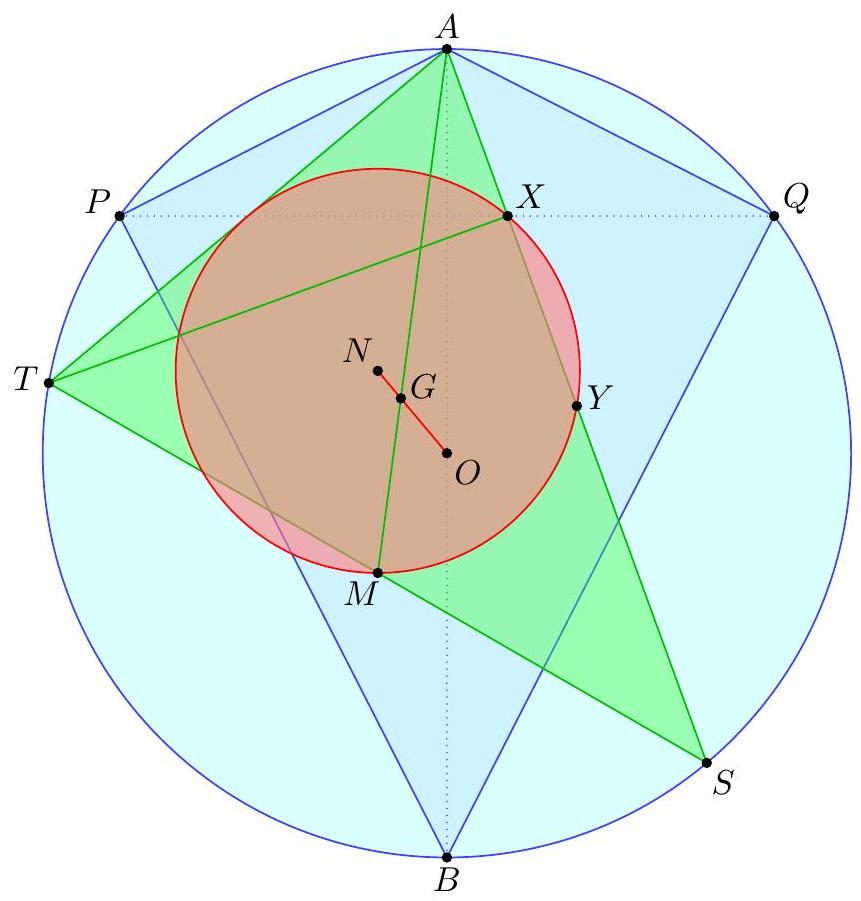 Let $R$ denote the radius of $\\omega$. Note that the nine-point circle of $\\triangle A S T$ has radius equal to $\\frac{1}{2} R$, and hence is independent of $S$ and $T$. Then the power of $A$ with respect to the nine-point circle equals $$ A N^{2}-\\left(\\frac{1}{2} R\\right)^{2}=A X \\cdot A Y=\\frac{1}{2} A X \\cdot A S=\\frac{1}{2} A Q^{2} $$ and hence $$ A N^{2}=\\left(\\frac{1}{2} R\\right)^{2}+\\frac{1}{2} A Q^{2} $$ which does not depend on the choice of $X$. So $N$ moves along a circle centered at $A$. Since the points $O, G, N$ are collinear on the Euler line of $\\triangle A S T$ with $$ G O=\\frac{2}{3} N O $$ it follows by homothety that $G$ moves along a circle as well, whose center is situated one-third of the way from $A$ to $O$. Finally, since $A, G, M$ are collinear with $$ A M=\\frac{3}{2} A G $$ it follows that $M$ moves along a circle centered at the midpoint of $\\overline{A O}$. 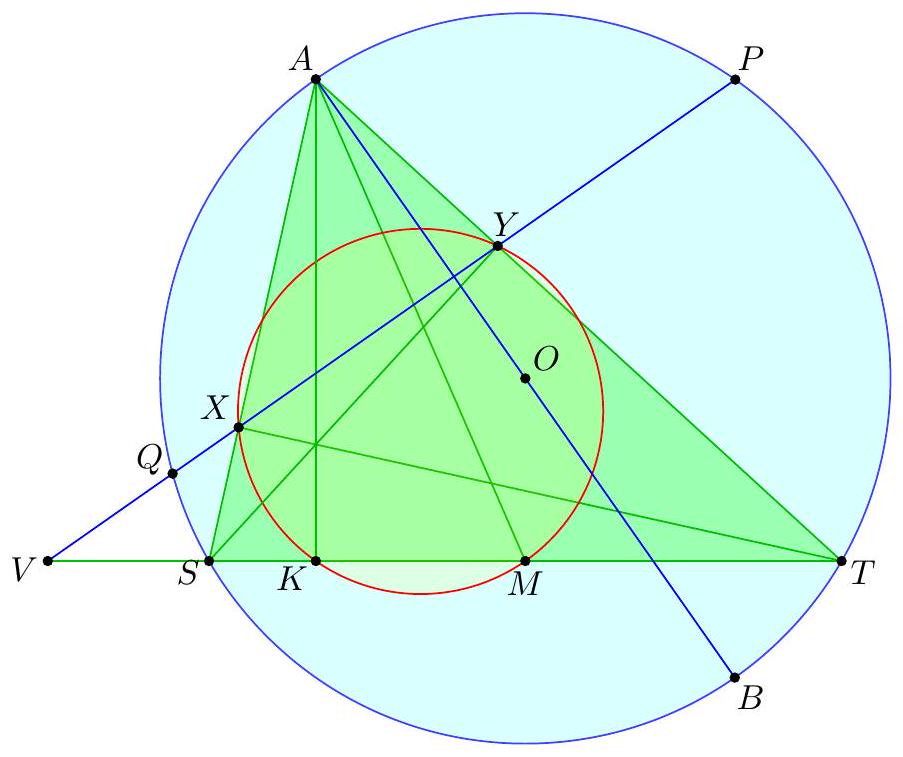 The main claim is: Claim - Quadrilateral $P Q K M$ is cyclic. $$ V Q \\cdot V P=V S \\cdot V T=V X \\cdot V Y=V K \\cdot V M $$ using the nine-point circle, and the circle with diameter $\\overline{S T}$. But the circumcenter of $P Q K M$, is the midpoint of $\\overline{A O}$, since it lies on the perpendicular bisectors of $\\overline{K M}$ and $\\overline{P Q}$. So it is fixed, the end.", "metadata": {"resource_path": "USAMO/segmented/en-USAMO-2015-notes.jsonl"}} |
| {"year": "2015", "tier": "T1", "problem_label": "3", "problem_type": null, "exam": "USAMO", "problem": "Let $S=\\{1,2, \\ldots, n\\}$, where $n \\geq 1$. Each of the $2^{n}$ subsets of $S$ is to be colored red or blue. (The subset itself is assigned a color and not its individual elements.) For any set $T \\subseteq S$, we then write $f(T)$ for the number of subsets of $T$ that are blue. Determine the number of colorings that satisfy the following condition: for any subsets $T_{1}$ and $T_{2}$ of $S$, $$ f\\left(T_{1}\\right) f\\left(T_{2}\\right)=f\\left(T_{1} \\cup T_{2}\\right) f\\left(T_{1} \\cap T_{2}\\right) $$", "solution": " For an $n$-coloring $\\mathcal{C}$ (by which we mean a coloring of the subsets of $\\{1, \\ldots, n\\}$ ), define the support of $\\mathcal{C}$ as $$ \\operatorname{supp}(\\mathcal{C})=\\{T \\mid f(T) \\neq 0\\} $$ Call a coloring nontrivial if $\\operatorname{supp}(\\mathcal{C}) \\neq \\varnothing$ (equivalently, the coloring is not all red). In that case, notice that - the support is closed under unions and intersections: since if $f\\left(T_{1}\\right) f\\left(T_{2}\\right) \\neq 0$ then necessarily both $f\\left(T_{1} \\cap T_{2}\\right)$ and $f\\left(T_{1} \\cup T_{2}\\right)$ are nonzero; and - the support is obviously upwards closed. Thus, the support must take the form $$ \\operatorname{supp}(\\mathcal{C})=[X, S] \\stackrel{\\text { def }}{=}\\{T \\mid X \\subseteq T \\subseteq S\\} $$ for some set $X$ (for example by letting $X$ be the minimal (by size) element of the support). Say $\\mathcal{C}$ has full support if $X=\\varnothing$ (equivalently, $\\varnothing$ is blue). ## Lemma For a given $n$ and $B \\subseteq\\{1, \\ldots, n\\}$, there is exactly one $n$-coloring with full support in which the singletons colored blue are exactly those in $B$. Therefore there are exactly $2^{n} n$-colorings with full support. $$ f(T)=2^{|T \\cap B|} $$ which satisfies the condition by Inclusion-Exclusion. To see this extension is unique, note that $f(\\{b\\})$ is determined for each $b$ and we can then determine $f(T)$ inductively on $|T|$; hence there is at most one way to complete a coloring of the singletons, which completes the proof. For a general nontrivial $n$-coloring $\\mathcal{C}$, note that if $\\operatorname{supp}(\\mathcal{C})=[X, S]$, then we can think of it as an $(n-|X|)$-coloring with full support. For $|X|=k$, there are $\\binom{n}{k}$ possible choices of $X \\subseteq S$. Adding back in the trivial coloring, the final answer is $$ 1+\\sum_{k=0}^{n}\\binom{n}{k} 2^{k}=1+3^{n} $$ Remark. To be more explicit, the possible nontrivial colorings are exactly described by specifying two sets $X$ and $Y$ with $X \\subseteq Y$, and coloring blue only the sets $T$ with $X \\subseteq T \\subseteq Y$. In particular, one deduces that in a working coloring, $f(T)$ is always either zero or a power of two. If one manages to notice this while working on the problem, it is quite helpful for motivating the solution, as it leads one to suspect that the working colorings have good structure.", "metadata": {"resource_path": "USAMO/segmented/en-USAMO-2015-notes.jsonl"}} |
| {"year": "2015", "tier": "T1", "problem_label": "4", "problem_type": null, "exam": "USAMO", "problem": "Steve is piling $m \\geq 1$ indistinguishable stones on the squares of an $n \\times n$ grid. Each square can have an arbitrarily high pile of stones. After he finished piling his stones in some manner, he can then perform stone moves, defined as follows. Consider any four grid squares, which are corners of a rectangle, i.e. in positions $(i, k),(i, l)$, $(j, k),(j, l)$ for some $1 \\leq i, j, k, l \\leq n$, such that $i<j$ and $k<l$. A stone move consists of either removing one stone from each of $(i, k)$ and $(j, l)$ and moving them to $(i, l)$ and $(j, k)$ respectively, or removing one stone from each of $(i, l)$ and $(j, k)$ and moving them to $(i, k)$ and $(j, l)$ respectively. Two ways of piling the stones are equivalent if they can be obtained from one another by a sequence of stone moves. How many different non-equivalent ways can Steve pile the stones on the grid?", "solution": " The answer is $\\binom{m+n-1}{n-1}^{2}$. The main observation is that the ordered sequence of column counts (i.e. the number of stones in the first, second, etc. column) is invariant under stone moves, as does the analogous sequence of row counts. \\ Definitions. Call these numbers $\\left(c_{1}, c_{2}, \\ldots, c_{n}\\right)$ and $\\left(r_{1}, r_{2}, \\ldots, r_{n}\\right)$ respectively, with $\\sum c_{i}=\\sum r_{i}=m$. We say that the sequence $\\left(c_{1}, \\ldots, c_{n}, r_{1}, \\ldots, r_{n}\\right)$ is the signature of the configuration. These are the $2 m$ blue and red numbers shown in the example below (in this example we have $m=8$ and $n=3$ ).  Signature: $(5,2,1 ; 3,3,2)$ By stars-and-bars, the number of possible values $\\left(c_{1}, \\ldots, c_{n}\\right)$ is $\\binom{m+n-1}{n-1}$. The same is true for $\\left(r_{1}, \\ldots, r_{m}\\right)$. So if we're just counting signatures, the total number of possible signatures is $\\binom{m+n-1}{n-1}^{2}$. 【 Outline and setup. We are far from done. To show that the number of non-equivalent ways is also this number, we need to show that signatures correspond to pilings. In other words, we need to prove: 1. Check that signatures are invariant around moves (trivial; we did this already); 2. Check conversely that two configurations are equivalent if they have the same signatures (the hard part of the problem); and 3. Show that each signature is realized by at least one configuration (not immediate, but pretty easy). Most procedures to the second step are algorithmic in nature, but Ankan Bhattacharya gives the following far cleaner approach. Rather than having a grid of stones, we simply consider the multiset of ordered pairs $(x, y)$ corresponding to the stones. Then: - a stone move corresponds to switching two $y$-coordinates in two different pairs. - we redefine the signature to be the multiset $(X, Y)$ of $x$ and $y$ coordinates which appear. Explicitly, $X$ is the multiset that contains $c_{i}$ copies of the number $i$ for each $i$. For example, consider the earlier example which had - Two stones each at $(1,1),(1,2)$. - One stone each at $(1,3),(2,1),(2,3),(3,2)$. Its signature can then be reinterpreted as $$ (5,2,1 ; 3,3,2) \\longleftrightarrow\\left\\{\\begin{array}{l} X=\\{1,1,1,1,1,2,2,3\\} \\\\ Y=\\{1,1,1,2,2,2,3,3\\} \\end{array}\\right. $$ In that sense, the entire grid is quite misleading! For example, if $$ \\begin{aligned} X & =\\{1,1,1,1,1,2,2,3\\} \\\\ Y & =\\{1,1,1,2,2,2,3,3\\} \\end{aligned} $$ then placing stones at $(1,1),(1,1),(1,1),(1,2),(1,2),(2,2),(2,3),(3,3)$ gives a valid piling with this signature.", "metadata": {"resource_path": "USAMO/segmented/en-USAMO-2015-notes.jsonl"}} |
| {"year": "2015", "tier": "T1", "problem_label": "5", "problem_type": null, "exam": "USAMO", "problem": "Let $a, b, c, d, e$ be distinct positive integers such that $a^{4}+b^{4}=c^{4}+d^{4}=e^{5}$. Show that $a c+b d$ is a composite number.", "solution": " Assume to the contrary that $p=a c+b d$, so that $$ \\begin{aligned} a c & \\equiv-b d \\quad(\\bmod p) \\\\ \\Longrightarrow a^{4} c^{4} & \\equiv b^{4} d^{4} \\quad(\\bmod p) \\\\ \\Longrightarrow a^{4}\\left(e^{5}-d^{4}\\right) & \\equiv\\left(e^{5}-a^{4}\\right) d^{4} \\quad(\\bmod p) \\\\ \\Longrightarrow a^{4} e^{5} & \\equiv d^{4} e^{5} \\quad(\\bmod p) \\\\ \\Longrightarrow e^{5}\\left(a^{4}-d^{4}\\right) & \\equiv 0 \\quad(\\bmod p) \\end{aligned} $$ and hence $$ p \\mid e^{5}(a-d)(a+d)\\left(a^{2}+d^{2}\\right) $$ Claim - We should have $p>e$. Thus the above equation implies $p \\leq \\max \\left(a-d, a+d, a^{2}+d^{2}\\right)=a^{2}+d^{2}$. Similarly, $p \\leq b^{2}+c^{2}$. So $$ a c+b d=p \\leq \\min \\left\\{a^{2}+d^{2}, b^{2}+c^{2}\\right\\} $$ or by subtraction $$ 0 \\leq \\min \\{a(a-c)+d(d-b), b(b-d)+c(c-a)\\} . $$ But since $a^{4}+b^{4}=c^{4}+d^{4}$ the numbers $a-c$ and $d-b$ should have the same sign, and so this is an obvious contradiction.", "metadata": {"resource_path": "USAMO/segmented/en-USAMO-2015-notes.jsonl"}} |
| {"year": "2015", "tier": "T1", "problem_label": "6", "problem_type": null, "exam": "USAMO", "problem": "Consider $0<\\lambda<1$, and let $A$ be a multiset of positive integers. Let $A_{n}=\\{a \\in$ $A: a \\leq n\\}$. Assume that for every $n \\in \\mathbb{N}$, the multiset $A_{n}$ contains at most $n \\lambda$ numbers. Show that there are infinitely many $n \\in \\mathbb{N}$ for which the sum of the elements in $A_{n}$ is at most $\\frac{n(n+1)}{2} \\lambda$.", "solution": " For brevity, $\\# S$ denotes $|S|$. Let $x_{n}=n \\lambda-\\# A_{n} \\geq 0$. We now proceed by contradiction by assuming the conclusion fails for $n$ large enough; that is, $$ \\begin{aligned} \\frac{n(n+1)}{2} \\lambda & <\\sum_{a \\in A_{n}} a \\\\ & =1\\left(\\# A_{1}-\\# A_{0}\\right)+2\\left(\\# A_{2}-\\# A_{1}\\right)+\\cdots+n\\left(\\# A_{n}-\\# A_{n-1}\\right) \\\\ & =n \\# A_{n}-\\left(\\# A_{1}+\\cdots+\\# A_{n-1}\\right) \\\\ & =n\\left(n \\lambda-x_{n}\\right)-\\left[\\left(\\lambda-x_{1}\\right)+\\left(2 \\lambda-x_{2}\\right)+\\cdots+\\left((n-1) \\lambda-x_{n-1}\\right)\\right] \\\\ & =\\frac{n(n+1)}{2} \\lambda-n x_{n}+\\left(x_{1}+\\cdots+x_{n-1}\\right) . \\end{aligned} $$ This means that for all sufficiently large $n$, say $n \\geq N_{0}$, we have $$ x_{n}<\\frac{x_{1}+\\cdots+x_{n-1}}{n} \\quad \\forall n \\geq N_{0} $$ In particular, each $x_{n}$ is the less than the average of all preceding terms. Intuitively this means $x_{n}$ should become close to each other, since they are also nonnegative. However, we have a second condition we haven't used yet: the \"integer\" condition implies $$ \\left|x_{n+1}-x_{n}\\right|=|\\lambda-\\#\\{n \\in A\\}|>\\varepsilon $$ for some fixed $\\varepsilon>0$, namely $\\varepsilon=\\min \\{\\lambda, 1-\\lambda\\}$. Using the fact that consecutive terms differ by some fixed $\\varepsilon$, we will derive a contradiction. If we let $M$ be the average of $x_{1}, \\ldots, x_{N_{0}}$, then we ought to have $$ x_{n}<M \\quad \\forall n>N_{0} . $$ Hence for $n>N_{0}$ we have $x_{n}+x_{n+1}<2 M-\\varepsilon$, and so for large enough $n$ the average must drop to just above $M-\\frac{1}{2} \\varepsilon$. Thus for some large $N_{1}>N_{0}$, we will have $$ x_{n}<M-\\frac{1}{3} \\varepsilon \\quad \\forall n>N_{1} . $$ If we repeat this argument then with a large $N_{2}>N_{1}$, we obtain $$ x_{n}<M-\\frac{2}{3} \\varepsilon \\quad \\forall n>N_{2} $$ and so on and so forth. This is a clear contradiction. Remark. Note that if $A=\\{2,2,3,4,5, \\ldots\\}$ and $\\lambda=1$ then contradiction. So the condition that $0<\\lambda<1$ cannot be dropped, and (by scaling) neither can the condition that $A \\subseteq \\mathbb{Z}$. Remark (Suggested by Zhao Ting-wei). Despite the relation $$ x_{n}<\\frac{x_{1}+\\cdots+x_{n-1}}{n} \\quad \\forall n \\geq N_{0} $$ implying that $x_{n}$ is bounded, it does not alone imply that $x_{n}$ converges, not even to some nonzero value. Zhao Ting-Wei showed me that one can have a sequence which is zero \"every so often\" yet where the average is nonzero. A counterexample is given explicitly by $$ x_{n}= \\begin{cases}1000 & n=1 \\\\ 0 & n \\text { is a power of } 10 \\\\ 1+\\frac{1}{n} & \\text { otherwise }\\end{cases} $$ which does not have a limit. For completeness, let's check this - let $H_{n}$ denote the $n$ 'th harmonic number, and compute $$ \\begin{aligned} \\sum_{1}^{n-1} x_{n} & =1000+(n-1)+H_{n-1}-\\sum_{k=1}^{\\left\\lfloor\\log _{10} n\\right\\rfloor}\\left(1+\\frac{1}{10^{k}}\\right) \\\\ & >n+999+H_{n-1}-\\log _{10} n-\\left(1+\\frac{1}{10}+\\ldots\\right) \\\\ & >n+997+H_{n-1}-\\log _{10} n>n+1 \\end{aligned} $$ so $1+\\frac{1}{n}<\\frac{1}{n} \\sum_{1}^{n-1} x_{n}$ as needed.", "metadata": {"resource_path": "USAMO/segmented/en-USAMO-2015-notes.jsonl"}} |
|
|


