| {"year": "2016", "tier": "T1", "problem_label": "1", "problem_type": null, "exam": "USAMO", "problem": "Let $X_{1}, X_{2}, \\ldots, X_{100}$ be a sequence of mutually distinct nonempty subsets of a set $S$. Any two sets $X_{i}$ and $X_{i+1}$ are disjoint and their union is not the whole set $S$, that is, $X_{i} \\cap X_{i+1}=\\emptyset$ and $X_{i} \\cup X_{i+1} \\neq S$, for all $i \\in\\{1, \\ldots, 99\\}$. Find the smallest possible number of elements in $S$.", "solution": " Solution with Danielle Wang: the answer is that $|S| \\geq 8$. To see that $|S|=8$ is the minimum possible size, consider a chain on the set $S=$ $\\{1,2, \\ldots, 7\\}$ satisfying $X_{i} \\cap X_{i+1}=\\emptyset$ and $X_{i} \\cup X_{i+1} \\neq S$. Because of these requirements any subset of size 4 or more can only be neighbored by sets of size 2 or less, of which there are $\\binom{7}{1}+\\binom{7}{2}=28$ available. Thus, the chain can contain no more than 29 sets of size 4 or more and no more than 28 sets of size 2 or less. Finally, since there are only $\\binom{7}{3}=35$ sets of size 3 available, the total number of sets in such a chain can be at most $29+28+35=92<100$, contradiction. 【 Construction. We will provide an inductive construction for a chain of subsets $X_{1}, X_{2}, \\ldots, X_{2^{n-1}+1}$ of $S=\\{1, \\ldots, n\\}$ satisfying $X_{i} \\cap X_{i+1}=\\varnothing$ and $X_{i} \\cup X_{i+1} \\neq S$ for each $n \\geq 4$. For $S=\\{1,2,3,4\\}$, the following chain of length $2^{3}+1=9$ will work: $$ \\begin{array}{lllllllll} 34 & 1 & 23 & 4 & 12 & 3 & 14 & 2 & 13 . \\end{array} $$ Now, given a chain of subsets of $\\{1,2, \\ldots, n\\}$ the following procedure produces a chain of subsets of $\\{1,2, \\ldots, n+1\\}$ : 1. take the original chain, delete any element, and make two copies of this chain, which now has even length; 2. glue the two copies together, joined by $\\varnothing$ in between; and then 3. insert the element $n+1$ into the sets in alternating positions of the chain starting with the first. For example, the first iteration of this construction gives: | 345 | 1 | 235 | 4 | 125 | 3 | 145 | 2 | 5 | | :---: | :---: | :---: | :---: | :---: | :---: | :---: | :---: | :---: | | 34 | 15 | 23 | 45 | 12 | 35 | 14 | 25 | | It can be easily checked that if the original chain satisfies the requirements, then so does the new chain, and if the original chain has length $2^{n-1}+1$, then the new chain has length $2^{n}+1$, as desired. This construction yields a chain of length 129 when $S=\\{1,2, \\ldots, 8\\}$. Remark. Here is the construction for $n=8$ in its full glory. | 345678 | 1 | 235678 | 4 | 125678 | 3 | 145678 | 2 | 5678 | | :---: | :---: | :---: | :---: | :---: | :---: | :---: | :---: | :---: | | 34 | 15678 | 23 | 45678 | 12 | 35678 | 14 | 678 | | | 345 | 1678 | 235 | 4678 | 125 | 3678 | 145 | 2678 | 5 | | 34678 | 15 | 23678 | 45 | 12678 | 35 | 78 | | | | 3456 | 178 | 2356 | 478 | 1256 | 378 | 1456 | 278 | 56 | | 3478 | 156 | 2378 | 456 | 1278 | 356 | 1478 | 6 | | | 34578 | 16 | 23578 | 46 | 12578 | 36 | 14578 | 26 | 578 | | 346 | 1578 | 236 | 4578 | 126 | 8 | | | | | 34567 | 18 | 23567 | 48 | 12567 | 38 | 14567 | 28 | 567 | | 348 | 1567 | 238 | 4567 | 128 | 3567 | 148 | 67 | | | 3458 | 167 | 2358 | 467 | 1258 | 367 | 1458 | 267 | 58 | | 3467 | 158 | 2367 | 458 | 1267 | 358 | 7 | | | | 34568 | 17 | 23568 | 47 | 12568 | 37 | 14568 | 27 | 568 | | 347 | 1568 | 237 | 4568 | 127 | 3568 | 147 | 68 | | | 3457 | 168 | 2357 | 468 | 1257 | 368 | 1457 | 268 | 57 | | 3468 | 157 | 2368 | 457 | 1268 | | | | |", "metadata": {"resource_path": "USAMO/segmented/en-USAMO-2016-notes.jsonl"}} |
| {"year": "2016", "tier": "T1", "problem_label": "2", "problem_type": null, "exam": "USAMO", "problem": "Prove that for any positive integer $k$, $$ \\left(k^{2}\\right)!\\cdot \\prod_{j=0}^{k-1} \\frac{j!}{(j+k)!} $$ is an integer.", "solution": " We show the exponent of any given prime $p$ is nonnegative in the expression. Recall that the exponent of $p$ in $n!$ is equal to $\\sum_{i \\geq 1}\\left\\lfloor n / p^{i}\\right\\rfloor$. In light of this, it suffices to show that for any prime power $q$, we have $$ \\left\\lfloor\\frac{k^{2}}{q}\\right\\rfloor+\\sum_{j=0}^{k-1}\\left\\lfloor\\frac{j}{q}\\right\\rfloor \\geq \\sum_{j=0}^{k-1}\\left\\lfloor\\frac{j+k}{q}\\right\\rfloor $$ Since both sides are integers, we show $$ \\left\\lfloor\\frac{k^{2}}{q}\\right\\rfloor+\\sum_{j=0}^{k-1}\\left\\lfloor\\frac{j}{q}\\right\\rfloor>-1+\\sum_{j=0}^{k-1}\\left\\lfloor\\frac{j+k}{q}\\right\\rfloor . $$ If we denote by $\\{x\\}$ the fractional part of $x$, then $\\lfloor x\\rfloor=x-\\{x\\}$ so it's equivalent to $$ \\left\\{\\frac{k^{2}}{q}\\right\\}+\\sum_{j=0}^{k-1}\\left\\{\\frac{j}{q}\\right\\}<1+\\sum_{j=0}^{k-1}\\left\\{\\frac{j+k}{q}\\right\\} . $$ However, the sum of remainders when $0,1, \\ldots, k-1$ are taken modulo $q$ is easily seen to be less than the sum of remainders when $k, k+1, \\ldots, 2 k-1$ are taken modulo $q$. So $$ \\sum_{j=0}^{k-1}\\left\\{\\frac{j}{q}\\right\\} \\leq \\sum_{j=0}^{k-1}\\left\\{\\frac{j+k}{q}\\right\\} $$ follows, and we are done upon noting $\\left\\{k^{2} / q\\right\\}<1$.", "metadata": {"resource_path": "USAMO/segmented/en-USAMO-2016-notes.jsonl"}} |
| {"year": "2016", "tier": "T1", "problem_label": "3", "problem_type": null, "exam": "USAMO", "problem": "Let $A B C$ be an acute triangle and let $I_{B}, I_{C}$, and $O$ denote its $B$-excenter, $C$ excenter, and circumcenter, respectively. Points $E$ and $Y$ are selected on $\\overline{A C}$ such that $\\angle A B Y=\\angle C B Y$ and $\\overline{B E} \\perp \\overline{A C}$. Similarly, points $F$ and $Z$ are selected on $\\overline{A B}$ such that $\\angle A C Z=\\angle B C Z$ and $\\overline{C F} \\perp \\overline{A B}$. Lines $I_{B} F$ and $I_{C} E$ meet at $P$. Prove that $\\overline{P O}$ and $\\overline{Y Z}$ are perpendicular.", "solution": " \\ First solution. Let $I_{A}$ denote the $A$-excenter and $I$ the incenter. Then let $D$ denote the foot of the altitude from $A$. Suppose the $A$-excircle is tangent to $\\overline{B C}, \\overline{A B}, \\overline{A C}$ at $A_{1}, B_{1}, C_{1}$ and let $A_{2}, B_{2}, C_{2}$ denote the reflections of $I_{A}$ across these points. Let $S$ denote the circumcenter of $\\triangle I I_{B} I_{C}$. 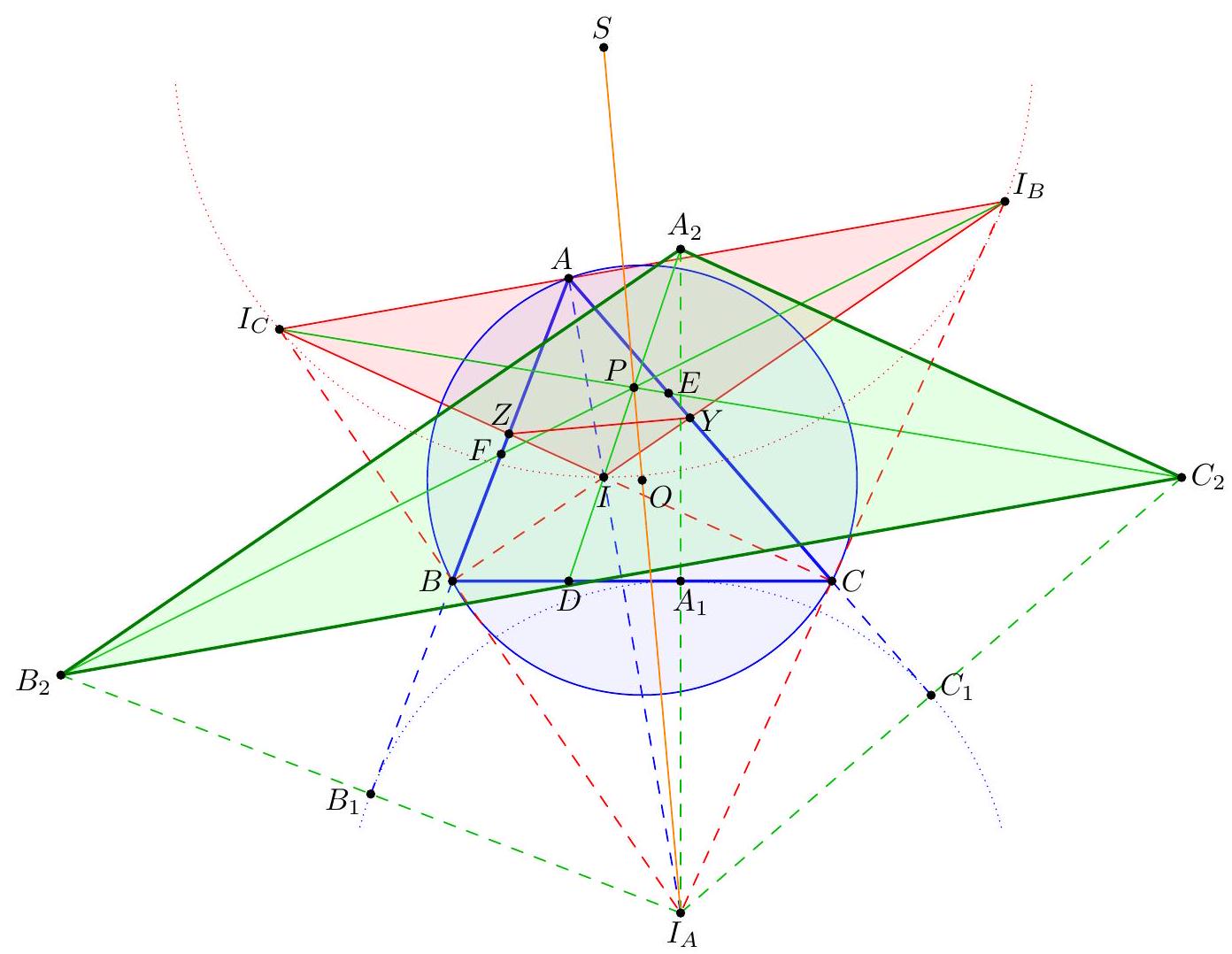 We begin with the following observation: Claim - Points $D, I, A_{2}$ are collinear, as are points $E, I_{C}, C_{2}$ are collinear and points $F, I_{B}, B_{2}$ are collinear. 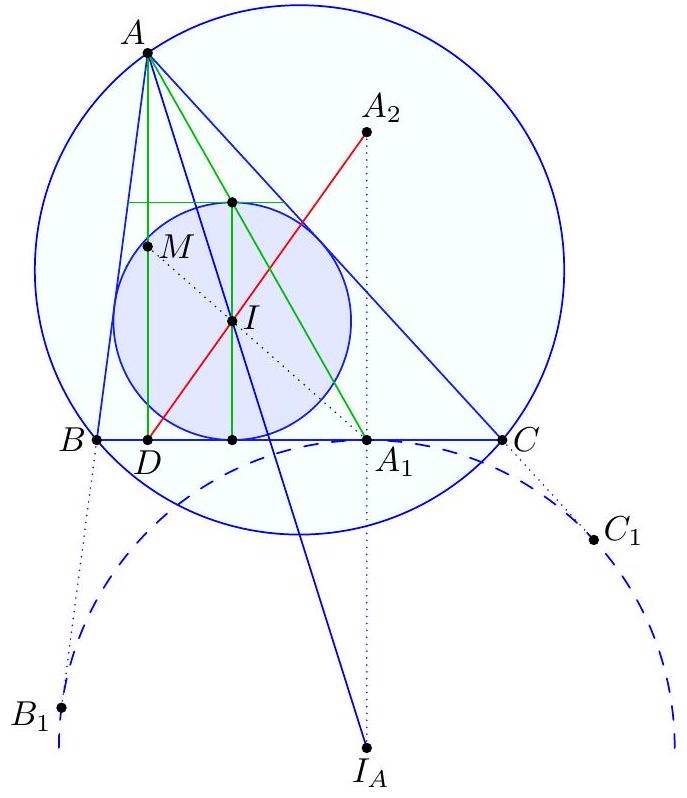 Now since $\\overline{A D} \\| \\overline{I_{A} A_{2}}$, and $M$ and $A_{1}$ are the midpoints of $\\overline{A D}$ and $\\overline{I_{A} A_{2}}$, it follows from the collinearity of $A, I, I_{A}$ that $D, I, A_{2}$ are collinear as well. The other two claims follow in a dual fashion. For example, using the homothety taking the $A$ to $C$-excircle, we find that $\\overline{C_{1} I_{C}}$ bisects the altitude $\\overline{B E}$, and since $I_{C}, B$, $I_{A}$ are collinear the same argument now gives $I_{C}, E, C_{2}$ are collinear. The fact that $I_{B}$, $F, B_{2}$ are collinear is symmetric. Observe that $\\overline{B_{2} C_{2}}\\left\\|\\overline{B_{1} C_{1}}\\right\\| \\overline{I_{B} I_{C}}$. Proceeding similarly on the other sides, we discover $\\triangle I I_{B} I_{C}$ and $\\triangle A_{2} B_{2} C_{2}$ are homothetic. Hence $P$ is the center of this homothety (in particular, $D, I, P, A_{2}$ are collinear). Moreover, $P$ lies on the line joining $I_{A}$ to $S$, which is the Euler line of $\\triangle I I_{B} I_{C}$, so it passes through the nine-point center of $\\triangle I I_{B} I_{C}$, which is $O$. Consequently, $P, O, I_{A}$ are collinear as well. To finish, we need only prove that $\\overline{O S} \\perp \\overline{Y Z}$. In fact, we claim that $\\overline{Y Z}$ is the radical axis of the circumcircles of $\\triangle A B C$ and $\\triangle I I_{B} I_{C}$. Actually, $Y$ is the radical center of these two circumcircles and the circle with diameter $\\overline{I I_{B}}$ (which passes through $A$ and $C)$. Analogously $Z$ is the radical center of the circumcircles and the circle with diameter $\\overline{I I_{C}}$, and the proof is complete.", "metadata": {"resource_path": "USAMO/segmented/en-USAMO-2016-notes.jsonl"}} |
| {"year": "2016", "tier": "T1", "problem_label": "3", "problem_type": null, "exam": "USAMO", "problem": "Let $A B C$ be an acute triangle and let $I_{B}, I_{C}$, and $O$ denote its $B$-excenter, $C$ excenter, and circumcenter, respectively. Points $E$ and $Y$ are selected on $\\overline{A C}$ such that $\\angle A B Y=\\angle C B Y$ and $\\overline{B E} \\perp \\overline{A C}$. Similarly, points $F$ and $Z$ are selected on $\\overline{A B}$ such that $\\angle A C Z=\\angle B C Z$ and $\\overline{C F} \\perp \\overline{A B}$. Lines $I_{B} F$ and $I_{C} E$ meet at $P$. Prove that $\\overline{P O}$ and $\\overline{Y Z}$ are perpendicular.", "solution": " I Second solution (barycentric, outline, Colin Tang). we are going to use barycentric coordinates to show that the line through $O$ perpendicular to $\\overline{Y Z}$ is concurrent with $\\overline{I_{B} F}$ and $\\overline{I_{C} E}$. The displacement vector $\\overrightarrow{Y Z}$ is proportional to $(a(b-c):-b(a+c): c(a+b))$, and so by strong perpendicularity criterion and doing a calculation gives the line $$ x(b-c) b c(a+b+c)+y(a+c) a c(a+b-c)+z(a+b) a b(-a+b-c)=0 . $$ On the other hand, line $I_{C} E$ has equation $$ 0=\\operatorname{det}\\left[\\begin{array}{ccc} a & b & -c \\\\ S_{C} & 0 & S_{A} \\\\ x & y & z \\end{array}\\right]=b S_{a} \\cdot x+\\left(-c S_{C}-a S_{A}\\right) \\cdot y+\\left(-b S_{C}\\right) \\cdot z $$ and similarly for $I_{B} F$. Consequently, concurrence of these lines is equivalent to $$ \\operatorname{det}\\left[\\begin{array}{ccc} b S_{A} & -c S_{C}-a S_{A} & -b S_{C} \\\\ c S_{A} & -c S_{B} & -a S_{A}-b S_{B} \\\\ (b-c) b c(a+b+c) & (a+c) a c(a+b-c) & (a+b) a b(-a+b-c) \\end{array}\\right]=0 $$ which is a computation. \\ Authorship comments. I was intrigued by a Taiwan TST problem which implied that, in the configuration above, $\\angle I_{B} D I_{C}$ was bisected by $\\overline{D A}$. This motivated me to draw all three properties above where $I_{A}$ and $P$ were isogonal conjugates with respect to $D E F$. After playing around with this picture for a long time, I finally noticed that $O$ was on line $P I_{A}$. (So the original was to show that $I_{B} F, I_{C} E, D A_{2}$ concurrent). Eventually I finally noticed in the picture that $P I_{A}$ actually passed through the circumcenter of $A B C$ as well. This took me many hours to prove. The final restatement (which follows quickly from $P, O, I_{A}$ collinear) was discovered by Telv Cohl when I showed him the problem.", "metadata": {"resource_path": "USAMO/segmented/en-USAMO-2016-notes.jsonl"}} |
| {"year": "2016", "tier": "T1", "problem_label": "4", "problem_type": null, "exam": "USAMO", "problem": "Find all functions $f: \\mathbb{R} \\rightarrow \\mathbb{R}$ such that for all real numbers $x$ and $y$, $$ (f(x)+x y) \\cdot f(x-3 y)+(f(y)+x y) \\cdot f(3 x-y)=(f(x+y))^{2} $$", "solution": " We claim that the only two functions satisfying the requirements are $f(x) \\equiv 0$ and $f(x) \\equiv x^{2}$. These work. First, taking $x=y=0$ in the given yields $f(0)=0$, and then taking $x=0$ gives $f(y) f(-y)=f(y)^{2}$. So also $f(-y)^{2}=f(y) f(-y)$, from which we conclude $f$ is even. Then taking $x=-y$ gives $$ \\forall x \\in \\mathbb{R}: \\quad f(x)=x^{2} \\quad \\text { or } \\quad f(4 x)=0 \\quad(\\star) $$ for all $x$. Remark. Note that an example of a function satisfying $(\\boldsymbol{\\star})$ is $$ f(x)= \\begin{cases}x^{2} & \\text { if }|x|<1 \\\\ 1-\\cos \\left(\\frac{\\pi}{2} \\cdot x^{1337}\\right) & \\text { if } 1 \\leq|x|<4 \\\\ 0 & \\text { if }|x| \\geq 4\\end{cases} $$ So, yes, we are currently in a world of trouble, still. (This function is even continuous; I bring this up to emphasize that \"continuity\" is completely unrelated to the issue at hand.) Now we claim $$ \\text { Claim - } f(z)=0 \\Longleftrightarrow f(2 z)=0 $$ $$ \\left(f(t)+3 t^{2}\\right) f(8 t)=f(4 t)^{2} $$ Now if $f(4 t) \\neq 0$ (in particular, $t \\neq 0$ ), then $f(8 t) \\neq 0$. Thus we have $(\\boldsymbol{\\phi})$ in the reverse direction. Then $f(4 t) \\neq 0 \\stackrel{(\\star)}{\\Longrightarrow} f(t)=t^{2} \\neq 0 \\stackrel{(\\boldsymbol{\\bullet})}{\\Longrightarrow} f(2 t) \\neq 0$ implies the forwards direction, the last step being the reverse direction $(\\boldsymbol{\\phi})$. By putting together $(\\boldsymbol{\\star})$ and $(\\boldsymbol{\\oplus})$ we finally get $$ \\forall x \\in \\mathbb{R}: \\quad f(x)=x^{2} \\quad \\text { or } \\quad f(x)=0 $$ Let $b \\in \\mathbb{R}$ be given. Since $f$ is even, we can assume without loss of generality that $a, b>0$. Also, note that $f(x) \\geq 0$ for all $x$ by ( $\\Omega$ ). By using ( $\\boldsymbol{\\uparrow}$ ) we can generate $c>b$ such that $f(c)=0$ by taking $c=2^{n} a$ for a large enough integer $n$. Now, select $x, y>0$ such that $x-3 y=b$ and $x+y=c$. That is, $$ (x, y)=\\left(\\frac{3 c+b}{4}, \\frac{c-b}{4}\\right) . $$ Substitution into the original equation gives $$ 0=(f(x)+x y) f(b)+(f(y)+x y) f(3 x-y) \\geq(f(x)+x y) f(b) $$ But since $f(b) \\geq 0$, it follows $f(b)=0$, as desired.", "metadata": {"resource_path": "USAMO/segmented/en-USAMO-2016-notes.jsonl"}} |
| {"year": "2016", "tier": "T1", "problem_label": "5", "problem_type": null, "exam": "USAMO", "problem": "An equilateral pentagon $A M N P Q$ is inscribed in triangle $A B C$ such that $M \\in \\overline{A B}$, $Q \\in \\overline{A C}$, and $N, P \\in \\overline{B C}$. Let $S$ be the intersection of $\\overline{M N}$ and $\\overline{P Q}$. Denote by $\\ell$ the angle bisector of $\\angle M S Q$. Prove that $\\overline{O I}$ is parallel to $\\ell$, where $O$ is the circumcenter of triangle $A B C$, and $I$ is the incenter of triangle $A B C$.", "solution": " 【 First solution (complex). In fact, we only need $A M=A Q=N P$ and $M N=Q P$. We use complex numbers with $A B C$ the unit circle, assuming WLOG that $A, B, C$ are labeled counterclockwise. Let $x, y, z$ be the complex numbers corresponding to the arc midpoints of $B C, C A, A B$, respectively; thus $x+y+z$ is the incenter of $\\triangle A B C$. Finally, let $s>0$ be the side length of $A M=A Q=N P$. Then, since $M A=s$ and $M A \\perp O Z$, it follows that $$ m-a=i \\cdot s z $$ Similarly, $p-n=i \\cdot s y$ and $a-q=i \\cdot s x$, so summing these up gives $$ i \\cdot s(x+y+z)=(p-q)+(m-n)=(m-n)-(q-p) $$ Since $M N=P Q$, the argument of $(m-n)-(q-p)$ is along the external angle bisector of the angle formed, which is perpendicular to $\\ell$. On the other hand, $x+y+z$ is oriented in the same direction as $O I$, as desired.", "metadata": {"resource_path": "USAMO/segmented/en-USAMO-2016-notes.jsonl"}} |
| {"year": "2016", "tier": "T1", "problem_label": "5", "problem_type": null, "exam": "USAMO", "problem": "An equilateral pentagon $A M N P Q$ is inscribed in triangle $A B C$ such that $M \\in \\overline{A B}$, $Q \\in \\overline{A C}$, and $N, P \\in \\overline{B C}$. Let $S$ be the intersection of $\\overline{M N}$ and $\\overline{P Q}$. Denote by $\\ell$ the angle bisector of $\\angle M S Q$. Prove that $\\overline{O I}$ is parallel to $\\ell$, where $O$ is the circumcenter of triangle $A B C$, and $I$ is the incenter of triangle $A B C$.", "solution": " ๆI Second solution (trig, Danielle Wang). Let $\\delta$ and $\\epsilon$ denote $\\angle M N B$ and $\\angle C P Q$. Also, assume $A M N P Q$ has side length 1. In what follows, assume $A B<A C$. First, we note that $$ \\begin{aligned} B N & =(c-1) \\cos B+\\cos \\delta \\\\ C P & =(b-1) \\cos C+\\cos \\epsilon, \\text { and } \\\\ a & =1+B N+C P \\end{aligned} $$ from which it follows that $$ \\cos \\delta+\\cos \\epsilon=\\cos B+\\cos C-1 $$ Also, by the Law of Sines, we have $\\frac{c-1}{\\sin \\delta}=\\frac{1}{\\sin B}$ and similarly on triangle $C P Q$, and from this we deduce $$ \\sin \\epsilon-\\sin \\delta=\\sin B-\\sin C $$ The sum-to-product formulas $$ \\begin{aligned} & \\sin \\epsilon-\\sin \\delta=2 \\cos \\left(\\frac{\\epsilon+\\delta}{2}\\right) \\sin \\left(\\frac{\\epsilon-\\delta}{2}\\right) \\\\ & \\cos \\epsilon-\\cos \\delta=2 \\cos \\left(\\frac{\\epsilon+\\delta}{2}\\right) \\cos \\left(\\frac{\\epsilon-\\delta}{2}\\right) \\end{aligned} $$ give us $$ \\tan \\left(\\frac{\\epsilon-\\delta}{2}\\right)=\\frac{\\sin \\epsilon-\\sin \\delta}{\\cos \\epsilon-\\cos \\delta}=\\frac{\\sin B-\\sin C}{\\cos B+\\cos C-1} $$ Now note that $\\ell$ makes an angle of $\\frac{1}{2}(\\pi+\\epsilon-\\delta)$ with line $B C$. Moreover, if line $O I$ intersects line $B C$ with angle $\\varphi$ then $$ \\tan \\varphi=\\frac{r-R \\cos A}{\\frac{1}{2}(b-c)} $$ So in order to prove the result, we only need to check that $$ \\frac{r-R \\cos A}{\\frac{1}{2}(b-c)}=\\frac{\\cos B+\\cos C+1}{\\sin B-\\sin C} $$ Using the fact that $b=2 R \\sin B, c=2 R \\sin C$, this reduces to the fact that $r / R+1=$ $\\cos A+\\cos B+\\cos C$, which is the so-called Carnot theorem.", "metadata": {"resource_path": "USAMO/segmented/en-USAMO-2016-notes.jsonl"}} |
| {"year": "2016", "tier": "T1", "problem_label": "6", "problem_type": null, "exam": "USAMO", "problem": "Integers $n$ and $k$ are given, with $n \\geq k \\geq 2$. You play the following game against an evil wizard. The wizard has $2 n$ cards; for each $i=1, \\ldots, n$, there are two cards labeled $i$. Initially, the wizard places all cards face down in a row, in unknown order. You may repeatedly make moves of the following form: you point to any $k$ of the cards. The wizard then turns those cards face up. If any two of the cards match, the game is over and you win. Otherwise, you must look away, while the wizard arbitrarily permutes the $k$ chosen cards and then turns them back face-down. Then, it is your turn again. We say this game is winnable if there exist some positive integer $m$ and some strategy that is guaranteed to win in at most $m$ moves, no matter how the wizard responds. For which values of $n$ and $k$ is the game winnable?", "solution": " The game is winnable if and only if $k<n$. First, suppose $2 \\leq k<n$. Query the cards in positions $\\{1, \\ldots, k\\}$, then $\\{2, \\ldots, k+1\\}$, and so on, up to $\\{2 n-k+1,2 n\\}$. Indeed, by taking the difference of the $i$ th and $(i+1)$ st query, we can deduce the value of the $i$ th card, for $1 \\leq i \\leq 2 n-k$. (This is possible because the cards are flipped face up before they are re-shuffled, so even if two adjacent queries return the same set, one can still determine the $i$ th card. It is possible to solve the problem even without the flipped information, though.) If $k \\leq n$, this is more than $n$ cards, so we can find a matching pair. For $k=n$ we remark the following: at each turn after the first, assuming one has not won, there are $n$ cards representing each of the $n$ values exactly once, such that the player has no information about the order of those $n$ cards. We claim that consequently the player cannot guarantee victory. Indeed, let $S$ denote this set of $n$ cards, and $\\bar{S}$ the other $n$ cards. The player will never win by picking only cards in $S$ or $\\bar{S}$. Also, if the player selects some cards in $S$ and some cards in $\\bar{S}$, then it is possible that the choice of cards in $S$ is exactly the complement of those selected from $\\bar{S}$; the strategy cannot prevent this since the player has no information on $S$. This implies the result.", "metadata": {"resource_path": "USAMO/segmented/en-USAMO-2016-notes.jsonl"}} |
|
|