---
license: cc0-1.0
language:
- en
pretty_name: POPSICLE
tags:
- cryoET
- cryo-electron-tomography
- segmentation
- object-detection
- particle-picking
- localization
- structural-biology
- benchmark
- 3d
task_categories:
- object-detection
- image-segmentation
size_categories:
- n<1K
configs:
- config_name: phantom
data_files: phantom/Croissant/runs.csv
- config_name: bacterial
data_files: bacterial/Croissant/runs.csv
- config_name: yeast
data_files: yeast/Croissant/runs.csv
- config_name: motorbench
data_files: motorbench/Croissant/runs.csv
---
# Dataset Card for POPSICLE
POPSICLE (**P**article/**O**bject **P**icking & **S**egmentation **I**n
**C**ryoET **L**earning & **E**valuation) is a benchmark suite for
cryo-electron tomography (cryoET) covering both dense voxel-wise
segmentation of cellular structures and sparse localization of
macromolecular complexes. The suite is built directly on the
[CryoET Data Portal](https://cryoetdataportal.czscience.com): each
sub-benchmark in this repository is a thin
[mlcroissant](https://docs.mlcommons.org/croissant/docs/croissant-spec.html)
manifest plus CSV indices over data that already lives on the portal. Tools that speak the
copick/Croissant interface stream the raw data straight from the portal.
## Quickstart
Load and visualize each sub-benchmark in one click — `demos.ipynb` lives
at the root of this repo.
[](https://colab.research.google.com/#fileId=https://huggingface.co/datasets/biohub/popsicle/blob/main/demos.ipynb)
---
## Dataset Details
### Dataset Description
POPSICLE bundles four sub-benchmarks chosen to span the main design axes
of cryoET evaluation: eukaryotic and prokaryotic systems, controlled and
fully *in situ* imaging settings, and both dense voxel-wise segmentation
and sparse macromolecular localization. Each sub-benchmark inherits its
splits, annotations, and licensing from the underlying CryoET Data Portal
deposition; this repository contributes the **unified manifest layer**
(splits, canonical class names, ground-truth filtering, evaluation
protocol) so models can be trained and compared under one roof.
| Sub-benchmark | Task | Organism / sample | # train | # test |
|---------------|---------------|-----------------------------------------------------|--------:|-------:|
| **Phantom** | Localization | Lysate | 7 | 485 |
| **Yeast** | Segmentation | *S. pombe* | 16 | 4 |
| **Bacterial** | Segmentation | Prokaryote (8 genera) | 68 | 12 |
| **MotorBench**| Localization | *V. cholerae* (test) + multi-genus prokaryotes (train) | 1,559 | 843 |
- **Curated by:** Authors of the POPSICLE benchmark paper (NeurIPS 2026, under review).
- **Shared by:** Biohub Dynamic Structural Biology / CryoET Data Portal community.
- **License:** **CC0-1.0** (Public Domain Dedication) — covers both the
manifests + CSVs in this repo and the underlying tomograms and
annotations on the CryoET Data Portal depositions linked above. No
attribution requirement; we still appreciate citation of the POPSICLE
paper and the benchmark publication.
### Dataset Sources
- **Repository:** https://huggingface.co/datasets/biohub/popsicle
- **Paper:** POPSICLE (NeurIPS 2026 submission).
- **Underlying datasets:**
- [DS-10440](https://cryoetdataportal.czscience.com/datasets/10440) (Phantom train),
- [DS-10445](https://cryoetdataportal.czscience.com/datasets/10445) (Phantom public test),
- [DS-10446](https://cryoetdataportal.czscience.com/datasets/10446) (Phantom private test),
- [CZCDP-10350](https://cryoetdataportal.czscience.com/depositions/10350) (Bacterial),
- [CZCDP-10351](https://cryoetdataportal.czscience.com/depositions/10351) (Yeast; underlying tomograms in [DS-10000](https://cryoetdataportal.czscience.com/datasets/10000) / [DS-10001](https://cryoetdataportal.czscience.com/datasets/10001)),
- [CZCDP-10332](https://cryoetdataportal.czscience.com/depositions/10332)/[CZCDP-10347](https://cryoetdataportal.czscience.com/depositions/10347) (MotorBench train/test).
- **Data Portal:** https://cryoetdataportal.czscience.com (Ermel et al.,
*Nature Methods* 21:2200–2202, 2024).
- **Tooling:** [copick](https://github.com/copick/copick) reads each
Croissant manifest and resolves data URLs against the portal.
## Uses
### Direct Use
- Training and evaluating 3D segmentation networks (nnU-Net, MedNeXt,
SwinUNETR, Octopi, …) on cellular cryoET tomograms.
- Training and evaluating particle-picking / localization methods
(DeepFinder, DeepETPicker, Octopi, segmentation-as-localization
approaches, …) on multi-class macromolecular detection problems.
- Benchmarking foundation / promptable / multi-task models that must
generalize across both segmentation and localization regimes — model
rankings on POPSICLE differ substantially across tasks, exposing
inductive-bias trade-offs that single-task evaluations miss.
### Out-of-Scope Use
- POPSICLE is **not** a structure-determination dataset: per-particle
picks are coordinates suitable for downstream subtomogram averaging,
but no aligned 3D maps or refined orientations are released here.
- The Phantom training split is intentionally tiny (7 tomograms,
reflecting realistic annotation budgets). It should not be used to
estimate large-model scaling behavior.
- The benchmark is designed for *evaluation*; using the test/val splits
to tune hyperparameters defeats its purpose.
---
## Dataset Structure
Each sub-benchmark lives in its own subdirectory and is self-contained:
```
popsicle/
phantom/
Croissant/
metadata.json # Croissant 1.1 JSON-LD
runs.csv # name, portal_run_id, split
voxel_spacings.csv # run, voxel_size
tomograms.csv # run, voxel_size, tomo_type, url, ...
features.csv
picks.csv # run, user_id, session_id, object_name, url, sha256, ...
meshes.csv
segmentations.csv # run, voxel_size, user_id, session_id, name, is_multilabel, url, ...
objects.csv
bacterial/ # segmentation across 8 bacterial genera
yeast/ # segmentation in *S. pombe*
motorbench/ # flagellar-motor localization
```
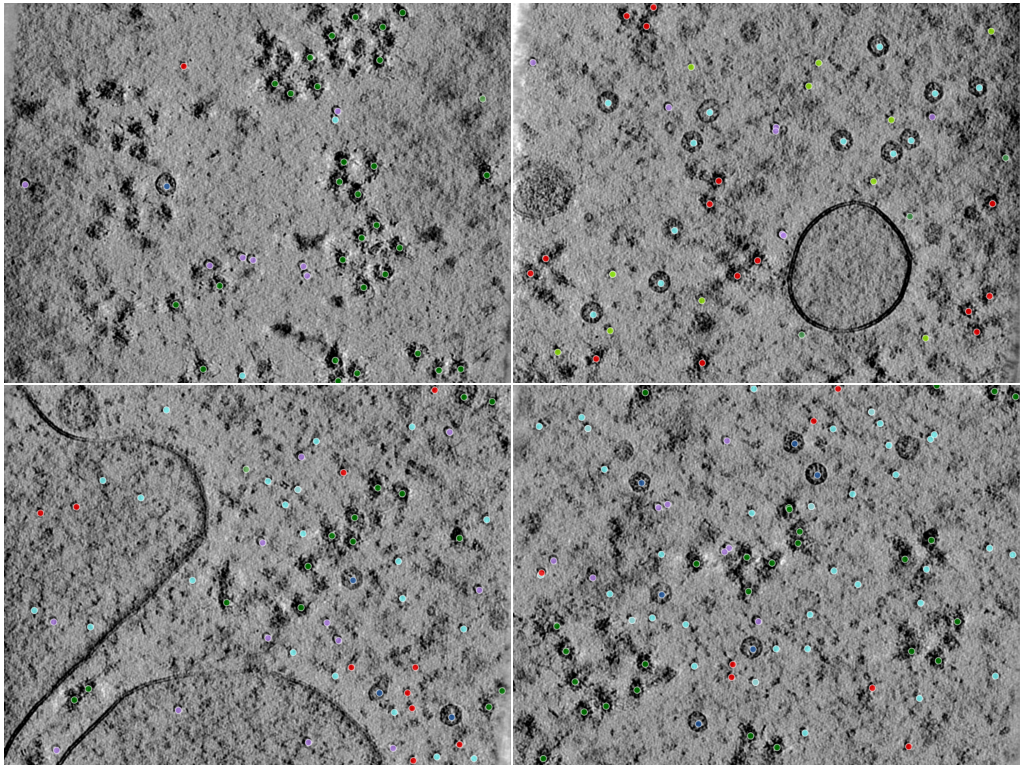
### Phantom — multi-class macromolecular localization
Phantom is built from an experimentally acquired lysate sample enriched
for lysosomal components, with additional purified targets introduced to
control object diversity and class balance (Peck et al. 2025). The six
particle classes span over an order of magnitude in molecular weight
(~268–4300 kDa) and have visibly distinct shapes, encouraging detection
methods that generalize across particle scale and morphology.
The dataset is the basis of the [CZII — CryoET Object Identification
Kaggle challenge](https://www.kaggle.com/competitions/czii-cryo-et-object-identification);
splits and the F4 evaluation protocol below mirror that challenge.
| Class | Approx. MW | Portal aliases |
|-------------------------|------------:|----------------------|
| `apo-ferritin` | ~480 kDa | `ferritin-complex` |
| `beta-amylase` | ~268 kDa | — |
| `beta-galactosidase` | ~470 kDa | — |
| `ribosome` | ~3300 kDa | `cytosolic-ribosome` |
| `thyroglobulin` | ~660 kDa | — |
| `virus-like-particle` | ~4300 kDa | `virus-like-capsid` |
#### Splits
| Split | CDP dataset | # tomograms | Notes |
|---------|-------------|------------:|---------------------------------|
| `train` | DS-10440 | 7 | Public training set |
| `val` | DS-10445 | 121 | CZII Kaggle "public test" set |
| `test` | DS-10446 | 364 | CZII Kaggle "private test" set |
Picks are **restricted to the original ground-truth annotations**. Community-derived submissions hosted on the same
CDP datasets, including Kaggle challenge entries, are intentionally
excluded so the benchmark scores against the canonical reference labels.
Loading with copick
(click to expand)
```python
import copick
import numpy as np
import matplotlib.pyplot as plt
root = copick.from_croissant(
"https://huggingface.co/datasets/biohub/popsicle/resolve/main/phantom/Croissant/metadata.json",
overlay_root="/tmp/popsicle-overlay",
static_fs_args={"anon": True}, # public portal bucket
)
# Loop over every split and every run
for split, run_names in root.splits.items():
print(f"{split}: {len(run_names)} runs")
for run in root.get_runs_in_split(split):
for pick_set in run.picks:
print(f" {run.name} {pick_set.pickable_object_name}: {len(pick_set.points)} pts")
# Visualize: midplane slice of one tomogram with picks overlaid as scatter
run = root.get_runs_in_split("train")[0]
vs = run.voxel_spacings[0] # 10 Å for Phantom
tomo = vs.tomograms[0] # any tomo_type at this voxel spacing
arr = tomo.numpy() # (Z, Y, X) — streams from portal S3
z_mid = arr.shape[0] // 2
fig, ax = plt.subplots(figsize=(8, 8))
ax.imshow(arr[z_mid], cmap="gray")
for pick_set in run.picks:
# CopickPoint locations are in physical units (Å); convert to voxel indices.
pts = np.array(
[(p.location.x, p.location.y, p.location.z) for p in pick_set.points]
) / vs.voxel_size
near = pts[np.abs(pts[:, 2] - z_mid) < 5] # within ±5 voxels of the slice
ax.scatter(near[:, 0], near[:, 1], s=24, label=pick_set.pickable_object_name)
ax.legend(loc="upper right", fontsize=8)
ax.set_title(f"{run.name} z={z_mid}")
plt.show()
```
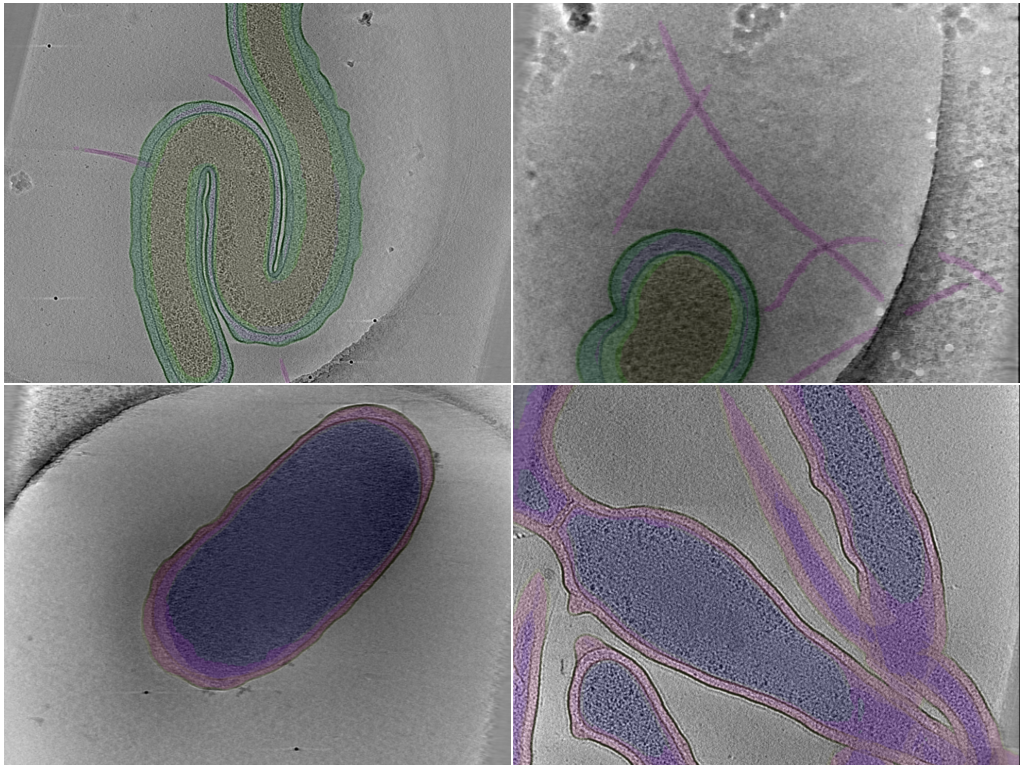
### Bacterial — multi-class compartment segmentation
Dense voxel-wise segmentation of cellular compartments in *in situ*
bacterial cryoET tomograms. 80 tomograms total, drawn from 13 underlying
portal datasets that span **8 bacterial genera** (bdellovibrio, coxiella,
hylemonella, hyphomonas, legionella, pseudomonas, salmonella, vibrio),
each annotated with up to five compartment classes. Annotations are
sourced from the POPSICLE Bacterial Segmentation Dataset deposition
([CZCDP-10350](https://cryoetdataportal.czscience.com/depositions/10350)).
| Class | Portal `object_name` |
|-------------------------|------------------------------|
| `cytosole` | `cytoplasm` |
| `flagellum` | `bacterial-type flagellum` |
| `inclusion` | `dense body` |
| `intermembrane-space` | `periplasmic space` |
| `membrane` | `membrane` |
#### Splits
| Split | # tomograms | Notes |
|---------|------------:|--------------------------------|
| `train` | 68 | 8 genera, ≤19 tomograms each |
| `test` | 12 | held out from training |
Class incidence (number of runs containing each class) is non-uniform —
`cytosole`, `intermembrane-space`, and `membrane` are present in every
run; `flagellum` and `inclusion` appear in subsets:
| Class | Train | Test |
|-------------------------|------:|-----:|
| `cytosole` | 68 | 12 |
| `membrane` | 68 | 12 |
| `intermembrane-space` | 68 | 12 |
| `flagellum` | 34 | 8 |
| `inclusion` | 29 | 6 |
Segmentations are scoped to deposition `CZCDP-10350` so that other
annotation collections living on the same underlying tomograms do not
leak into the benchmark.
Loading with copick
(click to expand)
```python
import copick
import numpy as np
import matplotlib.pyplot as plt
root = copick.from_croissant(
"https://huggingface.co/datasets/biohub/popsicle/resolve/main/bacterial/Croissant/metadata.json",
overlay_root="/tmp/popsicle-overlay",
static_fs_args={"anon": True}, # public portal bucket
)
# Loop over every split and every run
for split, run_names in root.splits.items():
print(f"{split}: {len(run_names)} runs")
for run in root.get_runs_in_split(split):
seg_names = sorted({s.name for s in run.segmentations})
print(f" {run.name}: {seg_names}")
# Visualize: midplane slice of one tomogram with segmentation masks overlaid
run = root.get_runs_in_split("train")[0]
vs = run.voxel_spacings[0]
tomo = vs.tomograms[0]
arr = tomo.numpy() # (Z, Y, X) — streams from portal S3
z_mid = arr.shape[0] // 2
fig, ax = plt.subplots(figsize=(8, 8))
ax.imshow(arr[z_mid], cmap="gray")
cmap = plt.get_cmap("tab10")
for i, seg in enumerate(run.segmentations):
mask = seg.numpy()[z_mid] # (Y, X) — same shape as the tomo slice
layer = np.ma.masked_where(mask == 0, np.full_like(mask, i, dtype=np.int8))
ax.imshow(layer, cmap=cmap, vmin=0, vmax=10, alpha=0.4, interpolation="none")
# one-line legend hack: scatter a single point off-image with the class color
ax.scatter([], [], color=cmap(i), label=seg.name)
ax.legend(loc="upper right", fontsize=8)
ax.set_title(f"{run.name} z={z_mid}")
plt.show()
```
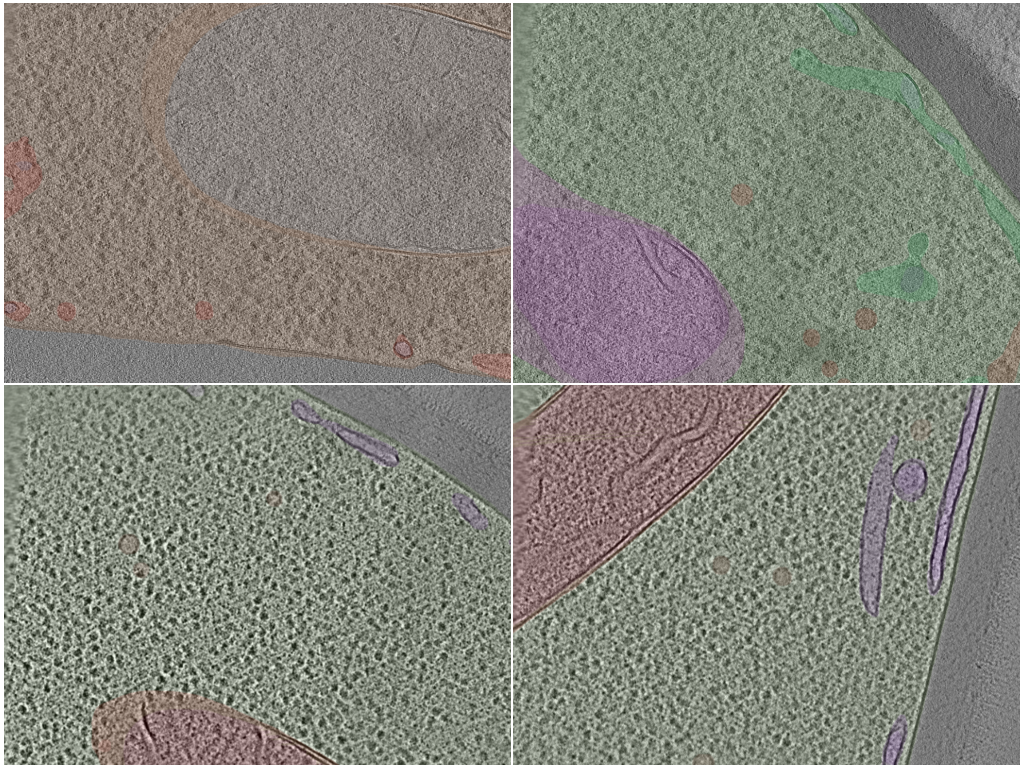
### Yeast — multi-class organelle segmentation
Dense voxel-wise segmentation of organelles in cryoET tomograms of
*Schizosaccharomyces pombe* (fission yeast) — a low-data, high-variance
eukaryotic counterpart to the well-sampled bacterial setting. 20
tomograms from the two CryoET Data Portal *S. pombe* datasets
([DS-10000](https://cryoetdataportal.czscience.com/datasets/10000),
[DS-10001](https://cryoetdataportal.czscience.com/datasets/10001)),
annotated with up to six organelle classes per run. Annotations are
sourced from the POPSICLE Yeast Segmentation Dataset deposition
([CZCDP-10351](https://cryoetdataportal.czscience.com/depositions/10351)).
| Class | Portal `object_name` |
|----------------------|-----------------------------|
| `cytoplasm` | `cytoplasm` |
| `nucleus` | `nucleus` |
| `nuclear-envelope` | `nuclear envelope` |
| `vesicle` | `vesicle` |
| `membrane-tubule` | `membrane-enclosed lumen` |
| `mitochondrion` | `mitochondrion` |
#### Splits
| Split | # tomograms | Notes |
|---------|------------:|-----------------------------------|
| `train` | 16 | All 16 from the user-supplied list|
| `test` | 4 | Held out from training |
Class distribution is uneven — large structures like `cytoplasm` are
present in nearly every run, while small organelles (`vesicle`,
`membrane-tubule`) are sparse and `mitochondrion` / `nucleus` are present
in only a subset:
| Class | Total runs |
|---------------------|-----------:|
| `cytoplasm` | 19 |
| `membrane-tubule` | 18 |
| `vesicle` | 18 |
| `mitochondrion` | 9 |
| `nuclear-envelope` | 8 |
| `nucleus` | 8 |
This unevenness — together with the small total tomogram count — makes
yeast a challenging low-data, class-imbalanced regime, complementary to
the better-sampled bacterial benchmark (paper §4, §6, Table 2).
Loading with copick
(click to expand)
```python
import copick
import numpy as np
import matplotlib.pyplot as plt
root = copick.from_croissant(
"https://huggingface.co/datasets/biohub/popsicle/resolve/main/yeast/Croissant/metadata.json",
overlay_root="/tmp/popsicle-overlay",
static_fs_args={"anon": True}, # public portal bucket
)
# Loop over every split and every run
for split, run_names in root.splits.items():
print(f"{split}: {len(run_names)} runs")
for run in root.get_runs_in_split(split):
seg_names = sorted({s.name for s in run.segmentations})
print(f" {run.name}: {seg_names}")
# Visualize: midplane slice of one tomogram with organelle segmentations overlaid
run = root.get_runs_in_split("train")[0]
vs = run.voxel_spacings[0]
tomo = vs.tomograms[0]
arr = tomo.numpy() # (Z, Y, X) — streams from portal S3
z_mid = arr.shape[0] // 2
fig, ax = plt.subplots(figsize=(8, 8))
ax.imshow(arr[z_mid], cmap="gray")
cmap = plt.get_cmap("tab10")
for i, seg in enumerate(run.segmentations):
mask = seg.numpy()[z_mid]
layer = np.ma.masked_where(mask == 0, np.full_like(mask, i, dtype=np.int8))
ax.imshow(layer, cmap=cmap, vmin=0, vmax=10, alpha=0.4, interpolation="none")
ax.scatter([], [], color=cmap(i), label=seg.name)
ax.legend(loc="upper right", fontsize=8)
ax.set_title(f"{run.name} z={z_mid}")
plt.show()
```
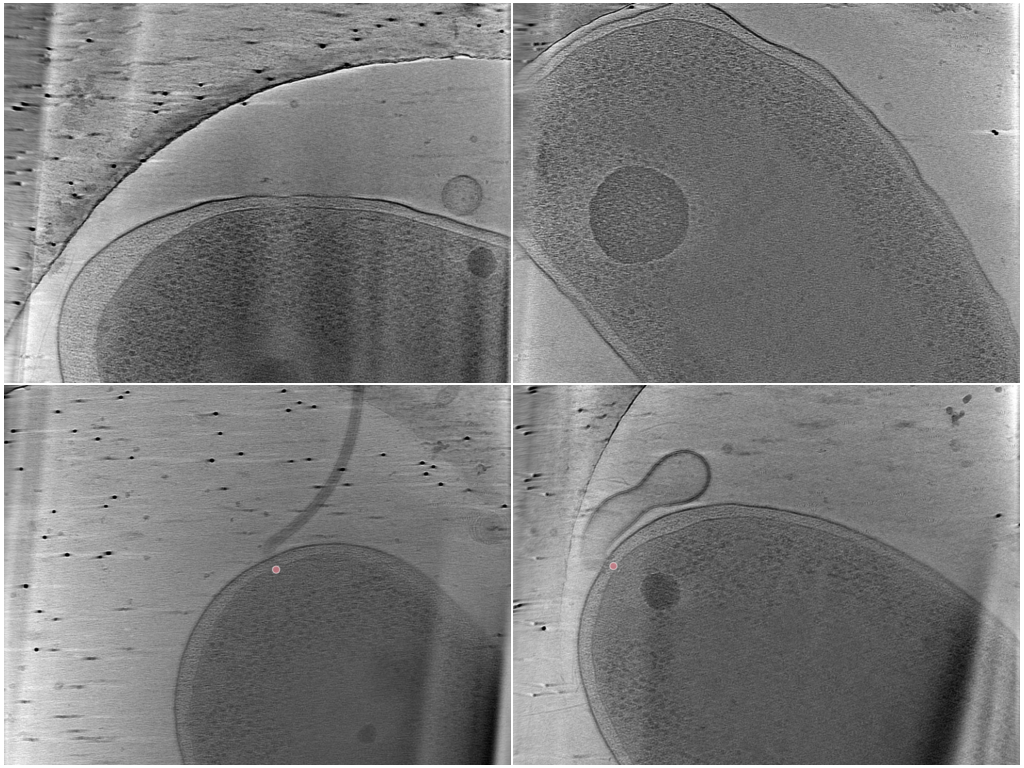
### MotorBench — single-class flagellar motor localization
Sparse 3D point localization of bacterial flagellar motors in whole-cell
cryoET tomograms. The benchmark is derived from the
[BYU — Locating Bacterial Flagellar Motors 2025 Kaggle challenge](https://www.kaggle.com/c/byu-locating-bacterial-flagellar-motors-2025)
([CZCDP-10332](https://cryoetdataportal.czscience.com/depositions/10332)
train, [CZCDP-10347](https://cryoetdataportal.czscience.com/depositions/10347)
test). The training side is **annotation-only** on the portal — its
1,559 motor picks are scattered across **92 host datasets** spanning
many bacterial and archaeal genera, contributed by the BYU competition
authors plus the first-place (Brenden Artley) and MIC-DKFZ (Isensee
et al.) follow-up releases. The held-out test side is a complete
deposition: 5 *Vibrio cholerae* datasets (DS-10485…10489) authored by
Owens et al. 2025.
| Class | Portal `object_name` |
|-------------------|----------------------------------|
| `flagellar-motor` | `bacterial-type-flagellum-motor` |
#### Splits
| Split | CDP source(s) | # tomograms | # motor picks | Notes |
|---------|-------------------------------------|------------:|--------------:|------------------------------------------|
| `train` | CZCDP-10332 → 92 host datasets | 1,559 | 1,559 | One or more motor picks per training run |
| `test` | CZCDP-10347 (DS-10485…10489) | 843 | 275 | Includes pickless negative samples |
The train slice was filtered down from the 3,528 host-dataset runs to
only those that carry a CZCDP-10332 motor annotation — runs without
a motor pick belong to unrelated experiments and are not part of the
benchmark. The test slice keeps all 843 *V. cholerae* runs (motor and
no-motor) because negative samples are an explicit part of the held-out
evaluation per Owens et al. 2025.
Loading with copick
(click to expand)
```python
import copick
import numpy as np
import matplotlib.pyplot as plt
root = copick.from_croissant(
"https://huggingface.co/datasets/biohub/popsicle/resolve/main/motorbench/Croissant/metadata.json",
overlay_root="/tmp/popsicle-overlay",
static_fs_args={"anon": True}, # public portal bucket
)
# Loop over every split and every run; report runs that carry motor picks
for split, run_names in root.splits.items():
runs_with = [r for r in root.get_runs_in_split(split) if r.picks]
print(f"{split}: {len(run_names)} runs ({len(runs_with)} with motor picks)")
# Visualize: midplane slice of one *V. cholerae* test tomogram with motor
# centers overlaid as crosses.
run = root.get_run("33914")
vs = run.voxel_spacings[0]
tomo = vs.tomograms[0]
arr = tomo.numpy() # (Z, Y, X) — streams from portal S3
z_mid = arr.shape[0] // 2
fig, ax = plt.subplots(figsize=(8, 8))
ax.imshow(arr[z_mid], cmap="gray")
for pick_set in run.picks:
pts = np.array(
[(p.location.x, p.location.y, p.location.z) for p in pick_set.points]
) / vs.voxel_size
near = pts[np.abs(pts[:, 2] - z_mid) < 5]
ax.scatter(near[:, 0], near[:, 1], marker="x", s=80, c="red",
label=pick_set.pickable_object_name)
ax.legend(loc="upper right", fontsize=8)
ax.set_title(f"{run.name} z={z_mid}")
plt.show()
```
---
## Dataset Creation
### Curation Rationale
Existing cryoET evaluations are typically small, task-specific, and
assembled in isolation, which makes cross-method comparison unreliable
(paper §1, §2). POPSICLE provides one consistent evaluation surface that
spans:
- **Both task regimes**: dense voxel-wise segmentation of cellular
structures *and* sparse localization of macromolecular complexes.
- **Both biological regimes**: eukaryotic *S. pombe* and prokaryotic
bacterial cells, plus a controlled lysate phantom.
- **Heterogeneous data scales**: from 7-tomogram low-supervision regimes
to 1,000+ tomogram well-sampled regimes, exposing whether model
rankings are stable across data abundance.
Because the underlying CryoET Data Portal is a continuously growing,
ML-ready resource, POPSICLE is designed to evolve as new datasets and
annotations become available rather than being a static challenge release
(paper §1, §7).
### Source Data
#### Data Collection and Processing
All source tomograms were acquired by tilt-series cryoET on vitrified
biological samples and reconstructed via standard pipelines
described on the CryoET Data Portal (paper §C). Biohub DSB uses
[AreTomo3](https://doi.org/10.1101/2025.03.11.642690) for motion
correction, tilt-series alignment, CTF correction, and weighted
back-projection, with optional self-supervised denoising via DenoisET.
Phantom tomograms are reconstructed by the original Peck et al. 2025
pipeline and ingested into the portal as DS-10440/10445/10446.
#### Who are the source data producers?
Provenance differs per sub-benchmark and is summarized below. Authoritative
credits live on each portal deposition page linked under
[Dataset Sources](#dataset-sources).
| Sub-benchmark | Tomogram source | Annotation source |
|---------------|-----------------------------------------------------|----------------------------------------------------|
| **Phantom** | Acquired and reconstructed by Biohub DSB. | Created by Biohub DSB (Peck et al. 2025). |
| **Bacterial** | Contributed by external labs (8 bacterial genera). | **Created by the POPSICLE authors.** |
| **Yeast** | Acquired by external labs (de Teresa-Trueba et al.).| Curated/refined by Biohub DSB from prior releases. |
| **MotorBench**| Contributed by external labs (BYU + collaborators). | Contributed by the BYU Kaggle community . |
In short: POPSICLE produces some new annotations (Bacterial), curates
others (Yeast), and indexes the rest (Phantom, MotorBench) — none of
the underlying tomograms are re-acquired by this project.
### Annotations
#### Annotation process
- **Phantom**: a sample of recombinantly expressed and purified
macromolecules was prepared in lysate-like conditions and imaged by
cryoET; Biohub DSB annotators identified the 3D centers of all six
target classes per tomogram (Peck et al. 2025). Annotations are stored
on the portal as point picks.
- **Bacterial**: POPSICLE authors generated dense voxel-wise
segmentations across five compartment classes (cytosole, flagellum,
inclusion, intermembrane-space, membrane) on 80 cellular tomograms
from 8 bacterial genera, deposited as
[CZCDP-10350](https://cryoetdataportal.czscience.com/depositions/10350).
- **Yeast**: organelle segmentations originally produced by
de Teresa-Trueba et al. 2023; curated and standardized by Biohub DSB
for inclusion in POPSICLE.
- **MotorBench**: bacterial flagellar motor centers picked
by the BYU Kaggle competition contributors (training corpus
CZCDP-10332, expanded by the first-place team and MIC-DKFZ); the
held-out test set (CZCDP-10347, V. cholerae) was authored by Owens
et al. 2025.
#### Who are the annotators?
- **Phantom**: Ariana Peck and Biohub DSB co-authors of Peck et al.
2025 (point picks restricted in this release
to exclude community Kaggle submissions hosted on the same datasets).
- **Bacterial**: POPSICLE author team (CZCDP-10350 contributors).
- **Yeast**: de Teresa-Trueba et al. 2023, with curatorial
refinement by Biohub DSB.
- **MotorBench**: BYU competition + first-place team
(Brenden Artley) + MIC-DKFZ (Fabian Isensee et al.) for the training
corpus; Owens et al. 2025 (V. cholerae) for the held-out test set.
#### Personal and Sensitive Information
None. The dataset contains 3D microscopy images of *in vitro* and
cellular biological samples; no human-subject data is present.
## Bias, Risks, and Limitations
- **Annotation completeness.** Even expert ground truth for cryoET data
may miss particles that are heavily distorted, edge-of-field, or
occluded. Phantom's evaluation protocol uses a recall-weighted F4
precisely because false negatives are more costly than false positives
in downstream subtomogram averaging (paper §3.2).
- **Class imbalance.** The Phantom β-amylase class (~268 kDa) is the
smallest, lowest-contrast target; its reference labels carry lower
confidence and the class is **excluded from the aggregate F̄₄ score**
in the official evaluation protocol (paper §B.6, following the CZII
Kaggle challenge). β-amylase is preserved in the dataset and reported
per-class so methods can still attempt it.
- **Imaging artifacts.** All cryoET data carries the missing-wedge
artifact and anisotropic resolution; performance is sensitive to both
biological variation and reconstruction choices (paper §D).
- **Living dataset.** POPSICLE is built on a continuously expanding data
resource. Future revisions will add sub-benchmarks and may refine
annotations; pin the dataset revision when reproducing results.
### Recommendations
- Train per sub-benchmark using the official `train` (and, where
applicable, `val`) splits; reserve `test` for held-out evaluation.
- Report per-class scores in addition to aggregates — Phantom rankings
shift substantially when β-amylase weighting changes (paper §6,
Table 4).
- When comparing to prior in-field work or Kaggle reference points,
follow the original challenge protocol exactly (recall-weighted Fβ,
class weights, β-amylase exclusion).
---
## Citation
**BibTeX:**
```bibtex
@inproceedings{popsicle2026,
title = {POPSICLE: Benchmark Datasets for Segmentation and Localization in CryoET},
author = {Anonymous},
booktitle = {Advances in Neural Information Processing Systems},
year = {2026},
note = {Under review}
}
```
The Phantom sub-benchmark inherits its tomograms and reference picks
from:
```bibtex
@article{peck2025phantom,
title = {A realistic phantom dataset for benchmarking cryo-{ET} data annotation},
author = {Peck, Ariana and Yu, Yue and Schwartz, Jonathan and Cheng, Anchi
and Ermel, Utz Heinrich and Hutchings, Joshua and Kandel, Saugat
and Kimanius, Dari and Montabana, Elizabeth A. and Serwas, Daniel
and Siems, Hannah and Wang, Feng and Zhao, Zhuowen and Zheng, Shawn
and Haury, Matthias and Agard, David A. and Potter, Clinton S.
and Carragher, Bridget and Harrington, Kyle and Paraan, Mohammadreza},
journal = {Nature Methods},
volume = {22},
pages = {1819--1823},
year = {2025},
doi = {10.1038/s41592-025-02800-5}
}
```
The MotorBench held-out test set is sourced from:
```bibtex
@article{owens2025motorbench,
title = {MotorBench: A cryo-electron tomography dataset of bacterial flagellar motors for testing detection algorithms},
author = {Owens, C. Braxton and Webb, Rachel and Hart, T. J. and Ward, Matthew M.
and Darley, Andrew J. and Maggi, Stefano and Morse, Bryan S.
and Jensen, Grant J. and Reade, Walter C. and Kaplan, Mohammed
and Hart, Gus L. W.},
journal = {bioRxiv},
year = {2025},
doi = {10.1101/2025.04.23.650258}
}
```
The Yeast sub-benchmark re-curates the upstream organelle segmentations
introduced by DeePiCt:
```bibtex
@article{deteresa2023deepict,
title = {Convolutional networks for supervised mining of molecular patterns within cellular context},
author = {de Teresa-Trueba, Irene and Goetz, Sara K. and Mattausch, Alexander
and Stojanovska, Frosina and Zimmerli, Christian E. and Toro-Nahuelpan, Mauricio
and Cheng, Dorothy W. C. and Tollervey, Fergus and Pape, Constantin
and Beck, Martin and Diz-Mu{\~n}oz, Alba and Kreshuk, Anna
and Mahamid, Julia and Zaugg, Judith B.},
journal = {Nature Methods},
volume = {20},
pages = {284--294},
year = {2023},
doi = {10.1038/s41592-022-01746-2}
}
```
CryoET Data Portal:
```bibtex
@article{ermel2024dataportal,
title = {A data portal for providing standardized annotations for cryo-electron tomography},
author = {Ermel, Utz and others},
journal = {Nature Methods},
volume = {21},
number = {12},
pages = {2200--2202},
year = {2024}
}
```
copick toolkit:
```bibtex
@article{ermel2026copick,
title = {copick: An open dataset interface and toolkit for collaborative annotation and analysis of cryo-electron tomography data},
author = {Ermel, Utz Heinrich and Schwartz, Jonathan and Zhao, Zhuowen and Ji, Daniel
and Peck, Ariana and Yu, Yue and Paraan, Mohammadreza and Carragher, Bridget
and Frangakis, Achilleas S. and Harrington, Kyle I. S.},
journal = {Protein Science},
volume = {35},
number = {5},
pages = {e70578},
year = {2026},
doi = {10.1002/pro.70578}
}
```
## References
Works cited inline in this dataset card. Author-year ordering.
- **POPSICLE 2026** — POPSICLE: Benchmark Datasets for Segmentation and
Localization in CryoET. *NeurIPS 2026 (under review)*.
*(Anonymous during review; this dataset card.)*
- **de Teresa-Trueba et al. 2023** — Convolutional networks for
supervised mining of molecular patterns within cellular context.
*Nature Methods* **20**, 284–294 (2023).
[doi:10.1038/s41592-022-01746-2](https://doi.org/10.1038/s41592-022-01746-2)
- **Ermel et al. 2024** — A data portal for providing standardized
annotations for cryo-electron tomography. *Nature Methods* **21**,
2200–2202 (2024).
[doi:10.1038/s41592-024-02475-4](https://doi.org/10.1038/s41592-024-02475-4)
- **Ermel et al. 2026** — copick: An open dataset interface and toolkit
for collaborative annotation and analysis of cryo-electron tomography
data. *Protein Science* **35**, e70578 (2026).
[doi:10.1002/pro.70578](https://doi.org/10.1002/pro.70578)
- **Owens et al. 2025** — MotorBench: A cryo-electron tomography
dataset of bacterial flagellar motors for testing detection
algorithms. *bioRxiv* (2025).
[doi:10.1101/2025.04.23.650258](https://doi.org/10.1101/2025.04.23.650258)
- **Peck et al. 2025** — A realistic phantom dataset for benchmarking
cryo-ET data annotation. *Nature Methods* **22**, 1819–1823 (2025).
[doi:10.1038/s41592-025-02800-5](https://doi.org/10.1038/s41592-025-02800-5)
- **Peck et al. 2025 (AreTomo3)** — AreTomoLive: Automated
reconstruction of comprehensively-corrected and denoised
cryo-electron tomograms in real-time and at high throughput.
*bioRxiv* (2025).
[doi:10.1101/2025.03.11.642690](https://doi.org/10.1101/2025.03.11.642690)
## Glossary
- **Tomogram** — a 3D reconstruction of a vitrified biological sample
computed from a tilt series of 2D projections.
- **Pick** — a 3D coordinate identifying the center of a target
macromolecule within a tomogram.
- **Segmentation** — a voxel-wise label volume assigning each voxel to
one of a fixed set of classes (membrane, organelle, cytoplasm, …).
- **Run** *(CryoET Data Portal)* — all data acquired and derived from
imaging a single location in a sample: the original tilt series,
motion-corrected frames, one or more reconstructed tomograms (often at
multiple voxel spacings), and any annotations attached to those
tomograms. A run belongs to exactly one dataset and is identified by
a unique numeric Run ID. Copick exposes this as `run.name` (a string
cast of the Run ID for portal-backed projects).
- **Dataset** *(CryoET Data Portal, "DS-XXXXX")* — a collection of runs
that share a common sample and acquisition context (organism, strain,
preparation, microscope session). Datasets carry their own metadata
(sample type, growth conditions, instrument, contributing lab) and
belong to exactly one deposition. The CDP "DS-10440" notation refers
to a Dataset row.
- **Deposition** *(CryoET Data Portal, "CZCDP-XXXXX")* — a higher-level
grouping under which one or more datasets and/or annotations are
contributed to the portal as a single submission, typically tied to
a publication or a community release (e.g. CZCDP-10350 for the
POPSICLE Bacterial deposition). A deposition can be **full** (it
carries new datasets + their tomograms + annotations) or
**annotation-only** (it carries new annotations attached to runs that
already exist in datasets contributed earlier under different
depositions — used by POPSICLE for the Bacterial annotations and by
the BYU MotorBench train deposition).
- **Missing wedge** — the cone of unmeasured Fourier-space data caused
by the limited tilt range during cryoET acquisition; produces
anisotropic resolution and characteristic elongation artifacts.
- **F4 / F2 score** — recall-weighted Fβ scores used in localization
evaluation; β=4 (Phantom) and β=2 (MotorBench) emphasize recall over
precision because missed targets are more costly downstream than
filterable false positives.
## More Information
- copick documentation: https://github.com/copick/copick
- CryoET Data Portal: https://cryoetdataportal.czscience.com
## Dataset Card Authors
POPSICLE benchmark authors (NeurIPS 2026 submission, anonymous during
review).
## Dataset Card Contact
Open an issue at the [dataset repository](https://huggingface.co/datasets/biohub/popsicle/discussions).