
source stringclasses 1
value | problem stringlengths 66 1.41k | solution stringlengths 687 5.01k | messages listlengths 2 2 |
|---|---|---|---|
olympiads |
In a city, there are 10 parallel streets running from north to south, and 10 streets running from west to east, forming a $9 \times 9$ grid. There is a square at each intersection, totaling 100 squares. The distance between any two adjacent squares along a street is 1 km. A walking distance pharmacy is defined as a ph... |
1. **Setup the Problem**:
- We have a grid of $9 \times 9$ formed by $10$ parallel streets running north-south and $10$ parallel streets running west-east.
- Each intersection on the grid corresponds to one of the $100$ squares (intersections) formed.
- The distance between two adjacent intersections is $1... | [
{
"content": "\nIn a city, there are 10 parallel streets running from north to south, and 10 streets running from west to east, forming a $9 \\times 9$ grid. There is a square at each intersection, totaling 100 squares. The distance between any two adjacent squares along a street is 1 km. A walking distance pha... |
olympiads | In the diagram, a newly built city's roads form a neat grid. There are $n+1$ east-west roads and $m+1$ north-south roads. A person lives at point $A$ in the southwest corner and rides a bicycle to work at point $B$ in the northeast corner every day. To sightsee along the way, this person often changes their route, with... |
To solve the problem, we need to show that the number of different routes from $A$ to $B$, denoted by $f(m, n)$, satisfies the inequality \( f(m, n) \leqslant 2^{mn} \).
1. **Identify Grid Divisions**:
The road system comprises $n+1$ east-west streets and $m+1$ north-south streets, which divide the city into \(... | [
{
"content": "In the diagram, a newly built city's roads form a neat grid. There are $n+1$ east-west roads and $m+1$ north-south roads. A person lives at point $A$ in the southwest corner and rides a bicycle to work at point $B$ in the northeast corner every day. To sightsee along the way, this person often cha... |
olympiads | Let \( n \) be a positive even number. Consider an \( n \times n \) grid. Two distinct cells are called adjacent if they share one common edge. Mark \( m \) cells in this grid so that every cell on the board is adjacent to at least one marked cell. Find the minimum value of \( m \). | ### Problem:
Consider an \(n \times n\) checkerboard where \(n\) is an even number. Two cells in the checkerboard are called adjacent if they share a common edge. We need to mark a minimum number \(m\) of cells on the board such that every cell is adjacent to at least one marked cell. Determine the smallest value for \... | [
{
"content": "Let \\( n \\) be a positive even number. Consider an \\( n \\times n \\) grid. Two distinct cells are called adjacent if they share one common edge. Mark \\( m \\) cells in this grid so that every cell on the board is adjacent to at least one marked cell. Find the minimum value of \\( m \\).",
... |
olympiads | Given a $99 \times 99$ grid where each cell is colored either black or white, you are allowed to recolor all the cells of any column or any row simultaneously to the color that is the majority in that column or row before recoloring. Is it always possible to make all the cells of the grid the same color? |
Given a $99 \times 99$ grid where each cell is either black or white, we are allowed to change the color of all cells in a row or column to either black or white, depending on the majority color of that row or column. The question is whether it is always possible to make all the cells in the grid the same color using ... | [
{
"content": "Given a $99 \\times 99$ grid where each cell is colored either black or white, you are allowed to recolor all the cells of any column or any row simultaneously to the color that is the majority in that column or row before recoloring. Is it always possible to make all the cells of the grid the sam... |
olympiads | From 1812 identical squares with a side length of 1 mm, a rectangular frame was made for a group photo. The boundaries of the photo coincide with the inner boundaries of the frame. Then the photo was cut along the millimeter grid line into two rectangular parts. Now, two frames were needed, which used up 2018 of the sa... |
1. **Understanding the problem**: Given 1812 identical squares of sides 1 mm each, a rectangular frame for a photo was created. The photo was then cut into two rectangular parts vertically, and now two such frames are made using 2018 squares of the same size. We need to find the dimensions of the original photograph.
... | [
{
"content": "From 1812 identical squares with a side length of 1 mm, a rectangular frame was made for a group photo. The boundaries of the photo coincide with the inner boundaries of the frame. Then the photo was cut along the millimeter grid line into two rectangular parts. Now, two frames were needed, which ... |
olympiads | On a grid, we have marked \( n \) lattice points. Let's call a segment defined by these points "good" if its midpoint is also a lattice point. What is the minimum number of "good" segments? |
Let's denote the selected $n$ points on a rectangular grid. Hence, the coordinates of these points are integers. Based on the parity of their coordinates, categorize the points into four classes:
1. Both coordinates are even; the number of such points is $n_{1}$.
2. The first coordinate is even, the second is odd; th... | [
{
"content": "On a grid, we have marked \\( n \\) lattice points. Let's call a segment defined by these points \"good\" if its midpoint is also a lattice point. What is the minimum number of \"good\" segments?",
"role": "user"
},
{
"content": "\nLet's denote the selected $n$ points on a rectangular ... |
olympiads | Find all positive integers \( n \) for which it is possible to color some cells of an infinite grid of unit squares red, such that each rectangle consisting of exactly \( n \) cells (and whose edges lie along the lines of the grid) contains an odd number of red cells. | ```markdown
1. **Statement of Claim**:
We claim that it is possible for all positive integers $n$ to color some cells of an infinite grid of unit squares red, such that each rectangle consisting of exactly $n$ cells (and whose edges lie along the lines of the grid) contains an odd number of red cells. We will call ... | [
{
"content": "Find all positive integers \\( n \\) for which it is possible to color some cells of an infinite grid of unit squares red, such that each rectangle consisting of exactly \\( n \\) cells (and whose edges lie along the lines of the grid) contains an odd number of red cells.",
"role": "user"
},... |
olympiads | Given six grid points \( p_{i}(x_{i}, y_{i}) \) for \( i = 1, 2, 3, 4, 5, 6 \) such that:
(1) \( |x_{i}| \leq 2 \) and \( |y_{i}| \leq 2 \) for \( i = 1, 2, 3, 4, 5, 6 \);
(2) No three points are collinear.
Prove that among all triangles with vertices at \( p_{i} \) (for \( i = 1, 2, 3, 4, 5, 6 \)), there exists at le... |
To prove that among the triangles formed by any three vertices from the six given points $p_{i}\left(x_{i}, y_{i}\right)$, there exists at least one triangle whose area is not greater than $2$, we proceed as follows:
1. **Assumptions and Definitions:**
Suppose there exist 6 points \( p_{1}, p_{2}, \cdots, p_{6} \... | [
{
"content": "Given six grid points \\( p_{i}(x_{i}, y_{i}) \\) for \\( i = 1, 2, 3, 4, 5, 6 \\) such that:\n(1) \\( |x_{i}| \\leq 2 \\) and \\( |y_{i}| \\leq 2 \\) for \\( i = 1, 2, 3, 4, 5, 6 \\);\n(2) No three points are collinear.\n\nProve that among all triangles with vertices at \\( p_{i} \\) (for \\( i =... |
olympiads | In a game, two players take turns removing cells from a $5 \times 7$ grid. To remove a cell, a player selects an uneaten cell, places a piece on that cell, and then all cells in the "first quadrant" (the right-angled region created with the lower-left corner of that cell extending upwards and to the right) are removed.... | 1. The problem requires us to find the maximum number of distinct configurations during a game played on a $5 \times 7$ board. Each player's move removes a square along with all those squares in its "first quadrant".
2. According to the game's rules, if a square on the board is removed, all squares above, to the right,... | [
{
"content": "In a game, two players take turns removing cells from a $5 \\times 7$ grid. To remove a cell, a player selects an uneaten cell, places a piece on that cell, and then all cells in the \"first quadrant\" (the right-angled region created with the lower-left corner of that cell extending upwards and t... |
olympiads | A maze is a 10x10 grid square where some pairs of adjacent nodes are connected by a "wall" segment, such that it is possible to visit all grid cells by moving from one cell to an adjacent cell through the sides and without passing through walls. The boundary of the square is also considered to be surrounded by walls. I... |
To ensure that the robot can visit all cells of the grid regardless of the labyrinth configuration and its starting position, we can follow these steps:
1. **Enumerate Initial States:**
Each initial state of the robot is defined by the specific labyrinth and the initial position within that labyrinth. Since the gr... | [
{
"content": "A maze is a 10x10 grid square where some pairs of adjacent nodes are connected by a \"wall\" segment, such that it is possible to visit all grid cells by moving from one cell to an adjacent cell through the sides and without passing through walls. The boundary of the square is also considered to b... |
olympiads | Does there exist a closed broken line with an odd number of segments of equal length, all vertices of which lie at the nodes of an integer grid? | Suppose there is a closed broken line \(A_1 \ldots A_n\) with an odd number of equally long segments, all vertices of which lie in the nodes of the integer grid.
Let \(a_i\) and \(b_i\) be the coordinates of the projections of the vector \(\overrightarrow{A_i A_{i+1}}\) onto the horizontal and vertical axes. Let the ... | [
{
"content": "Does there exist a closed broken line with an odd number of segments of equal length, all vertices of which lie at the nodes of an integer grid?",
"role": "user"
},
{
"content": "Suppose there is a closed broken line \\(A_1 \\ldots A_n\\) with an odd number of equally long segments, al... |
olympiads | There is a 10x10 grid for a game of "Battleship." In this case, the game is played by unusual rules, and you are only allowed to use ships of size 1x2 which can be placed either horizontally or vertically. What is the maximum number of these ships that can be placed on the grid if the ships must not come into contact w... |
1. Consider the given $10 \times 10$ grid and the constraints that ships of size $1 \times 2$ can be placed either horizontally or vertically but cannot touch each other even at a single point.
2. First, we will place the maximum number of possible ships, keeping in mind the constraints. One of the valid configuratio... | [
{
"content": "There is a 10x10 grid for a game of \"Battleship.\" In this case, the game is played by unusual rules, and you are only allowed to use ships of size 1x2 which can be placed either horizontally or vertically. What is the maximum number of these ships that can be placed on the grid if the ships must... |
olympiads | Gabrielle has a $3 \times 3$ grid and L-shaped pieces that cover three squares each, as shown below. Can she cover her grid using these pieces?
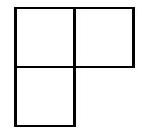 |
1. **Understand the $3 \times 3$ grid and the L-shaped piece:**
- The L-shaped piece covers exactly 3 squares on the grid.
- The grid itself is a $3 \times 3$ matrix, meaning it has a total of $3 \times 3 = 9$ squares.
2. **Consider the full coverage by multiple L-shaped pieces:**
- To cover the entire $3 \t... | [
{
"content": "Gabrielle has a $3 \\times 3$ grid and L-shaped pieces that cover three squares each, as shown below. Can she cover her grid using these pieces?\n\n",
... |
olympiads | Pasha is playing a computer game that takes place on an infinite grid. Each cell of the grid contains either a treasure or a natural number. The number represents the distance to the nearest treasure in terms of cells (if the treasure requires $A$ steps vertically and $B$ steps horizontally, the cell contains the numbe... |
#### Part (a)
To determine the minimum number of additional moves Pasha must make to guarantee finding a treasure when he discovers three cells in a row horizontally, each containing the number 5:
1. **Observation**:
- If Pasha finds any cell with a number \( K \), then all treasure cells must be located on the p... | [
{
"content": "Pasha is playing a computer game that takes place on an infinite grid. Each cell of the grid contains either a treasure or a natural number. The number represents the distance to the nearest treasure in terms of cells (if the treasure requires $A$ steps vertically and $B$ steps horizontally, the c... |
olympiads | On a \(10 \times 10\) grid, a bacterium is located in one of the cells. Each turn, the bacterium moves to an adjacent cell (sharing a side) and divides into two bacteria (both remain in the same cell). After that, one of the bacteria on the board moves to an adjacent cell and divides into two, and so on. Can it happen ... | 1. We begin by coloring the cells of the $10 \times 10$ grid in a checkerboard pattern, alternating between white and black.
2. Let's denote the number of bacteria in white cells at any given time as $B_w$ and those in black cells as $B_b$.
3. Consider the change in the difference $B_w - B_b$ with each move of the... | [
{
"content": "On a \\(10 \\times 10\\) grid, a bacterium is located in one of the cells. Each turn, the bacterium moves to an adjacent cell (sharing a side) and divides into two bacteria (both remain in the same cell). After that, one of the bacteria on the board moves to an adjacent cell and divides into two, ... |
olympiads | In the diagram, the \(5 \times 6\) grid is made out of thirty \(1 \times 1\) squares. What is the total length of the six solid line segments shown?
(A) 6
(B) 12
(C) 16
(D) 18
(E) 20
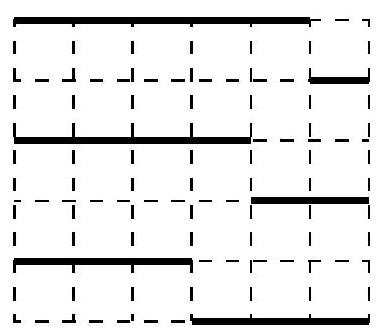 | :
To determine the total length of the six solid line segments shown in the diagram, we follow these steps:
1. **Identify each individual segment length**:
- The lengths of the solid line segments from top to bottom are:
\[
5, 1, 4, 2, 3, \text{and} 3
\]
2. **Sum these lengths**:
\[
5 + 1 + 4... | [
{
"content": "In the diagram, the \\(5 \\times 6\\) grid is made out of thirty \\(1 \\times 1\\) squares. What is the total length of the six solid line segments shown?\n(A) 6\n(B) 12\n(C) 16\n(D) 18\n(E) 20\n\n |
We need to assess the maximum number of trees that can be cut down such that no stump is visible from another tree, given that the trees are arranged in a $2001 \times 2001$ grid.
1. **Group the Trees:**
We can divide the $2001 \times 2001$ grid into smaller groups to simplify the problem. The possible groupings ... | [
{
"content": "$2001 \\times 2001$ trees are arranged in a square grid in a park. What is the largest number of trees that can be cut down so that no stump is visible from another tree?\n\n(The trees should have a diameter of 0)",
"role": "user"
},
{
"content": "\nWe need to assess the maximum number... |
olympiads | As shown in the diagram, divide a $7 \times 7$ grid along the dotted lines into several rectangles such that each rectangle contains exactly one number, and this number equals the area of the rectangle. The seven small squares in the fourth column belong to different rectangles. |
The given problem requires us to divide a \(7 \times 7\) grid along the dashed line such that each resulting rectangle contains exactly one number, and that number should equal the area of the rectangle. Specifically, it asks us to determine to how many different rectangles each of the 7 small squares in the 4th colum... | [
{
"content": "As shown in the diagram, divide a $7 \\times 7$ grid along the dotted lines into several rectangles such that each rectangle contains exactly one number, and this number equals the area of the rectangle. The seven small squares in the fourth column belong to different rectangles.",
"role": "us... |
olympiads | Fill the grid with the numbers $1$, $3$, and $5$ so that each row and each column contains exactly the numbers $1$, $3$, and $5$.
\begin{tabular}{|l|l|l|}
\hline 1 & & \\
\hline & 3 & \\
\hline & & 5 \\
\hline
\end{tabular} |
The requirement is to fill the 3x3 grid so that each row and each column contains precisely the numbers 1, 3, and 5.
Given the initial grid with some partially filled cells:
\[
\begin{tabular}{|l|l|l|}
\hline
1 & \, & \, \\
\hline
\, & 3 & \, \\
\hline
\, & \, & 5 \\
\hline
\end{tabular}
\]
We can follow these steps... | [
{
"content": "Fill the grid with the numbers $1$, $3$, and $5$ so that each row and each column contains exactly the numbers $1$, $3$, and $5$.\n\n\\begin{tabular}{|l|l|l|}\n\\hline 1 & & \\\\\n\\hline & 3 & \\\\\n\\hline & & 5 \\\\\n\\hline\n\\end{tabular}",
"role": "user"
},
{
"content": "\nThe re... |
olympiads | There is a $9 \times 2004$ grid, where each integer from 1 to 2004 is filled in 9 times. Additionally, within each column, the count of each number filled does not exceed 3. Find the minimum possible sum of the numbers in the first row. |
To find the smallest possible sum of the numbers in the first row of a $9 \times 2004$ grid, where each integer from 1 to 2004 is filled into the grid exactly 9 times and no integer appears more than 3 times in any column, we proceed as follows:
1. **Understand the Formulation**:
- We need to sum each integer at ... | [
{
"content": "There is a $9 \\times 2004$ grid, where each integer from 1 to 2004 is filled in 9 times. Additionally, within each column, the count of each number filled does not exceed 3. Find the minimum possible sum of the numbers in the first row.",
"role": "user"
},
{
"content": "\nTo find the ... |
olympiads | Each cell of a \(2 \times 5\) grid of unit squares is to be colored white or black. Compute the number of such colorings for which no \(2 \times 2\) square is a single color. |
To determine how many ways we can color each cell of a $2 \times 5$ grid such that no $2 \times 2$ square is a single color, we define the problem using recursion and distinguish between several cases.
1. **Define Variables:**
- Let \( a_n \) be the number of ways to color a $2 \times n$ grid such that no $2 \time... | [
{
"content": "Each cell of a \\(2 \\times 5\\) grid of unit squares is to be colored white or black. Compute the number of such colorings for which no \\(2 \\times 2\\) square is a single color.",
"role": "user"
},
{
"content": "\nTo determine how many ways we can color each cell of a $2 \\times 5$ ... |
olympiads | Place two $a$s and two $b$s into a $4 \times 4$ grid, with at most one letter per cell, such that no two identical letters are in the same row or column. Determine the number of possible arrangements. |
Consider a \(4 \times 4\) grid where we need to place two letters \(a\) and two letters \(b\), with the condition that each letter appears in distinct rows and columns.
1. **Placing the first letter \(a\):**
- There are 16 cells available initially to place the first \(a\).
2. **Placing the second letter \(a\):*... | [
{
"content": "Place two $a$s and two $b$s into a $4 \\times 4$ grid, with at most one letter per cell, such that no two identical letters are in the same row or column. Determine the number of possible arrangements.",
"role": "user"
},
{
"content": "\nConsider a \\(4 \\times 4\\) grid where we need ... |
olympiads | Cut a $6 \times 6$ square grid into "L-shaped" tiles consisting of three cells each, such that no two tiles form a $2 \times 3$ rectangular block. |
1. **Understanding the problem statement**: We need to partition a \(6 \times 6\) grid into shapes called "corner tetriminoes", which are made of 3 cells that form a right-angled corner. Additionally, no two corner tetriminoes should form a \(2 \times 3\) rectangle.
2. **Analyzing the shape requirement**: A corner te... | [
{
"content": "Cut a $6 \\times 6$ square grid into \"L-shaped\" tiles consisting of three cells each, such that no two tiles form a $2 \\times 3$ rectangular block.",
"role": "user"
},
{
"content": "\n1. **Understanding the problem statement**: We need to partition a \\(6 \\times 6\\) grid into shap... |
olympiads | In a grid with an $m \times n$ rectangular section, what is the largest perimeter of a non-self-intersecting lattice polygon if every side of the polygon is either vertical or horizontal? |
1. **Problem Understanding**:
We need to find the perimeter of the largest, non-self-intersecting, grid polygon in an \( m \times n \) grid-rectangle where each side of the polygon is either vertical or horizontal.
2. **Total Number of Lattice Points**:
The total number of lattice points in an \( m \times n \) ... | [
{
"content": "In a grid with an $m \\times n$ rectangular section, what is the largest perimeter of a non-self-intersecting lattice polygon if every side of the polygon is either vertical or horizontal?",
"role": "user"
},
{
"content": "\n1. **Problem Understanding**:\n We need to find the perimet... |
olympiads |
A grid strip of size \(1 \times 1000000\) is divided into 100 segments. An integer is written in each cell, and the numbers in cells lying within the same segment are the same. A token is placed in each cell. Then, an operation is performed where all tokens are simultaneously moved, each token moving to the right by t... |
1. **Define the Route:**
- For each cell in the first segment, define its route—the consecutive sequence of cells traversed by the token on the cell until it returns to the first segment. The cell of "return" does not enter the route again. Let the length of the route be the number of unique cells in it. This repre... | [
{
"content": "\nA grid strip of size \\(1 \\times 1000000\\) is divided into 100 segments. An integer is written in each cell, and the numbers in cells lying within the same segment are the same. A token is placed in each cell. Then, an operation is performed where all tokens are simultaneously moved, each toke... |
olympiads | The integers 1 to 100 are randomly written in a $10 \times 10$ grid, with one number in each cell. In each operation, two numbers can be swapped. Prove that, with only 35 operations, it is possible to achieve the following condition: the sum of the numbers in any two adjacent cells (sharing an edge) is always a composi... |
1. **Divide the grid into two halves**: By drawing a vertical line $m$ down the center of the $10 \times 10$ grid, we divide the grid into two halves—left and right, each consisting of 50 numbers.
2. **Identify parity distribution in the right half**: In this right half, we identify that there are no more than 25 ev... | [
{
"content": "The integers 1 to 100 are randomly written in a $10 \\times 10$ grid, with one number in each cell. In each operation, two numbers can be swapped. Prove that, with only 35 operations, it is possible to achieve the following condition: the sum of the numbers in any two adjacent cells (sharing an ed... |
olympiads | Let $d, r \geq 2$ be integers satisfying $d \geq r^{2r+2}$, and let $G$ be a graph that contains a collection $\mathcal{H}$ of $r^2 - 1$ pairwise disjoint paths and a collection $\mathcal{V} = \{V_1, \ldots, V_d\}$ of $d$ pairwise disjoint paths. Suppose that every path in $\mathcal{V}$ intersects every path in $\mathc... |
1. **Illustrate the problem and initial conditions:**
- Let $d, r \geq 2$ satisfy $d \geq r^{2r+2}$.
- Let $G$ be a graph containing:
- A collection $\mathcal{H}$ of $r^2 - 1$ mutually disjoint paths.
- A collection $\mathcal{V} = \{V_1, \ldots, V_d\}$ of $d$ mutually disjoint paths.
- Each pat... | [
{
"content": "Let $d, r \\geq 2$ be integers satisfying $d \\geq r^{2r+2}$, and let $G$ be a graph that contains a collection $\\mathcal{H}$ of $r^2 - 1$ pairwise disjoint paths and a collection $\\mathcal{V} = \\{V_1, \\ldots, V_d\\}$ of $d$ pairwise disjoint paths. Suppose that every path in $\\mathcal{V}$ in... |
olympiads | Cells of an infinite grid of paper are colored in black and white in a checkerboard pattern. Let $X$ be a triangle with area $S$ and vertices at the grid points. Show that there exists a similar triangle $X$ with vertices at the grid points such that the area of its white part is equal to the area of its black part, ea... | 1. **Consider the transformation and its properties**:
Let us consider a rotational homothety \( F \) with the center at the origin of the coordinate system, a scaling factor of \( \sqrt{2} \), and a rotation angle of \( 45^\circ \). This transformation can be expressed in coordinates as:
\[
F: (x, y) \rightar... | [
{
"content": "Cells of an infinite grid of paper are colored in black and white in a checkerboard pattern. Let $X$ be a triangle with area $S$ and vertices at the grid points. Show that there exists a similar triangle $X$ with vertices at the grid points such that the area of its white part is equal to the area... |
olympiads | Let \( A \) be a \( 3 \times 9 \) grid, with each cell filled with a positive integer. A subgrid \( m \times n \) (\( 1 \leq m \leq 3, 1 \leq n \leq 9 \)) in \( A \) is called a "good rectangle" if the sum of all numbers in it is a multiple of 10. A \( 1 \times 1 \) cell in \( A \) is called a "bad cell" if it is not c... |
1. **Step 1: Define the Problem Constraints and Objective**
We have a $3 \times 9$ grid $A$ filled with integers. A "good rectangle" within $A$ is defined as an $m \times n$ subgrid ($1 \leq m \leq 3, 1 \leq n \leq 9$) whose sum of all elements is a multiple of 10. A "bad cell" is a $1 \times 1$ cell that is not p... | [
{
"content": "Let \\( A \\) be a \\( 3 \\times 9 \\) grid, with each cell filled with a positive integer. A subgrid \\( m \\times n \\) (\\( 1 \\leq m \\leq 3, 1 \\leq n \\leq 9 \\)) in \\( A \\) is called a \"good rectangle\" if the sum of all numbers in it is a multiple of 10. A \\( 1 \\times 1 \\) cell in \\... |
olympiads | What is the minimum number of colors required to paint all the cells of a 6 by 6 square grid such that each row, column, and diagonal of the square has all cells with different colors? Note: A diagonal of the square is defined as all rows of at least two cells going diagonally from one edge of the square to the other a... | 1. **Introduction and Problem Restatement**:
We are given a $6 \times 6$ square grid and need to determine the minimum number of colors required to color the grid such that no two cells in the same row, column, or diagonal (as defined in the problem, these are diagonal lines at 45° and 135° to the horizontal) have ... | [
{
"content": "What is the minimum number of colors required to paint all the cells of a 6 by 6 square grid such that each row, column, and diagonal of the square has all cells with different colors? Note: A diagonal of the square is defined as all rows of at least two cells going diagonally from one edge of the... |
olympiads | A 'long knight' moves on a square grid. A single move consists of moving three squares in one direction (horizontally or vertically) and then one square at right angles to the first direction. What is the smallest number of moves a long knight requires to go from one corner of an \(8 \times 8\) square board to the diag... |
Let's approach this problem step by step.
1. **Understanding the Move of a Long Knight**:
A "long knight" moves in an extended "L" shape on a grid. The knight moves three squares in one direction (either horizontally or vertically) and then one square at a right angle to the first direction. Hence, each move can... | [
{
"content": "A 'long knight' moves on a square grid. A single move consists of moving three squares in one direction (horizontally or vertically) and then one square at right angles to the first direction. What is the smallest number of moves a long knight requires to go from one corner of an \\(8 \\times 8\\)... |
olympiads |
A field is a $41 \times 41$ grid, and a tank is hidden in one of the cells. A fighter plane fires at one cell at a time. If the shot hits, the tank moves to an adjacent cell (sharing a side); if the shot misses, the tank remains in place. After each shot, the pilot does not know if the shot was a hit or miss. To destr... | The problem asks us to find the least number of shots required to guarantee the destruction of a tank hidden on a $41 \times 41$ grid, where a tank hides in one cell and moves to an adjacent cell after being hit once. To destroy the tank, it must be hit twice. Let's go through the solution step by step in detail.
1. *... | [
{
"content": "\nA field is a $41 \\times 41$ grid, and a tank is hidden in one of the cells. A fighter plane fires at one cell at a time. If the shot hits, the tank moves to an adjacent cell (sharing a side); if the shot misses, the tank remains in place. After each shot, the pilot does not know if the shot was... |
olympiads | From a $12 \times 12$ grid, a $4 \times 4$ square is cut out, located at the intersection of the horizontals from the third to the sixth and the same verticals. What is the maximum number of non-attacking rooks that can be placed on this grid, considering that rooks do not attack through the cut-out squares? |
1. We start with a $12 \times 12$ chessboard.
2. A $4 \times 4$ square is cut out from the section intersecting rows 3 to 6 and columns 3 to 6.
3. This leaves the board divided into four separate rectangular regions due to the removed square:
- Top-left: $2 \times 12$ (rows 1-2, columns 1-12)
- Top-right: $2 \... | [
{
"content": "From a $12 \\times 12$ grid, a $4 \\times 4$ square is cut out, located at the intersection of the horizontals from the third to the sixth and the same verticals. What is the maximum number of non-attacking rooks that can be placed on this grid, considering that rooks do not attack through the cut... |
olympiads | What is the minimum number of cells that need to be marked in a $15 \times 15$ grid so that in each vertical or horizontal $1 \times 10$ strip, there is at least one marked cell? |
1. **Understanding the Problem**:
- We need to determine the minimum number of cells that need to be marked in a $15 \times 15$ grid.
- The requirement is that in every vertical or horizontal strip of size $1 \times 10$, at least one cell is marked.
2. **Strategic Division**:
- We can think of the $15 \times... | [
{
"content": "What is the minimum number of cells that need to be marked in a $15 \\times 15$ grid so that in each vertical or horizontal $1 \\times 10$ strip, there is at least one marked cell?",
"role": "user"
},
{
"content": "\n1. **Understanding the Problem**:\n - We need to determine the mini... |
olympiads | In the given $6 \times 6$ grid, each cell must be filled with one of the letters $A, B, C, D, E, F$. The letters in each row, column, and each $2 \times 3$ rectangle defined by bold lines must not repeat. What are the letters in the middle four cells of the third row, in left-to-right order?
Choices:
(A) $E, C, D, F$
... |
1. **Understanding the Problem:**
In the given $6\times6$ grid, each cell must be filled with one of the letters $A, B, C, D, E, F$ such that:
- Every row and every column must contain each letter exactly once.
- Each $2\times3$ rectangle (outlined with bold lines) within the grid must also have each letter... | [
{
"content": "In the given $6 \\times 6$ grid, each cell must be filled with one of the letters $A, B, C, D, E, F$. The letters in each row, column, and each $2 \\times 3$ rectangle defined by bold lines must not repeat. What are the letters in the middle four cells of the third row, in left-to-right order?\n\n... |
olympiads | From a \(55 \times 55\) grid square, 400 three-cell corner pieces (oriented in any direction) and 500 additional cells were cut out along the cell boundaries.
Prove that some two of the cut-out figures share a boundary segment. |
To prove that some two cut-out pieces have a common segment of the boundary, follow these steps:
### First method:
1. **Assumption**: Assume that none of the cut-out shapes share any sides.
2. **Adding Border**: Add a border around each cut-out figure as shown in the illustration. The border consists of points with... | [
{
"content": "From a \\(55 \\times 55\\) grid square, 400 three-cell corner pieces (oriented in any direction) and 500 additional cells were cut out along the cell boundaries.\n\nProve that some two of the cut-out figures share a boundary segment.",
"role": "user"
},
{
"content": "\nTo prove that so... |
olympiads | In the grid composed of squares each of size $1 \times 1$, the number 2015 written using four squares (shaded regions) includes lines that can be horizontal, vertical, segments connecting midpoints of adjacent square sides, or diagonals of the $1 \times 1$ squares. What is the area of the shaded parts showing 2015?
A.... |
1. **Understanding the Problem**:
We are given a grid composed of \(1 \times 1\) squares. Within this grid, there are 2015 shaded regions. These shaded regions can consist of line segments that are either horizontal, vertical, or diagonal (connecting either midpoints or corners of the squares). We are tasked with ... | [
{
"content": "In the grid composed of squares each of size $1 \\times 1$, the number 2015 written using four squares (shaded regions) includes lines that can be horizontal, vertical, segments connecting midpoints of adjacent square sides, or diagonals of the $1 \\times 1$ squares. What is the area of the shaded... |
olympiads | Consider an \( n \)-by-\( n \) board of unit squares for some odd positive integer \( n \). We say that a collection \( C \) of identical dominoes is a maximal grid-aligned configuration on the board if \( C \) consists of \(\left(\frac{n^2 - 1}{2}\right)\) dominoes where each domino covers exactly two neighboring squa... |
Given an $n$-by-$n$ board of unit squares where $n$ is an odd positive integer, we consider configurations of dominoes covering all but one square. The goal is to find the maximum possible value of $k(C)$, the number of distinct maximal grid-aligned configurations obtainable from an initial configuration $C$ by slidin... | [
{
"content": "Consider an \\( n \\)-by-\\( n \\) board of unit squares for some odd positive integer \\( n \\). We say that a collection \\( C \\) of identical dominoes is a maximal grid-aligned configuration on the board if \\( C \\) consists of \\(\\left(\\frac{n^2 - 1}{2}\\right)\\) dominoes where each domin... |
olympiads | In an $8 \times 8$ grid, stones are placed on certain squares such that there are exactly 3 stones in each row and each column. Show that there exists a set of $n$ stones such that no two of the stones are in the same row or column. |
To demonstrate that there exists a set of $n$ stones such that no two of them are on the same row or column in an $8 \times 8$ grid where each row and each column contains exactly 3 stones, we will apply Hall's Marriage Theorem.
1. **Setup and Definitions**:
- Think of the grid as a bipartite graph where the rows... | [
{
"content": "In an $8 \\times 8$ grid, stones are placed on certain squares such that there are exactly 3 stones in each row and each column. Show that there exists a set of $n$ stones such that no two of the stones are in the same row or column.",
"role": "user"
},
{
"content": "\nTo demonstrate t... |
olympiads | On a squared sheet of paper of size \(100 \times 100\), several pairwise non-overlapping cardboard isosceles right triangles with a leg of length 1 are placed; each triangle occupies exactly half of one of the grid squares. It turns out that each unit segment of the grid (including the boundary ones) is covered by exac... |
1. **Understanding the Problem**: We have a $100 \times 100$ grid. Several non-overlapping isosceles right triangles with a leg length of 1 are placed such that each unit line segment of the grid is exactly covered by one leg of a triangle. Each triangle occupies half of a grid cell.
2. **Optimization Goal**: We need... | [
{
"content": "On a squared sheet of paper of size \\(100 \\times 100\\), several pairwise non-overlapping cardboard isosceles right triangles with a leg of length 1 are placed; each triangle occupies exactly half of one of the grid squares. It turns out that each unit segment of the grid (including the boundary... |
olympiads |
There is a grid plane. At the grid nodes, that is, at points with integer coordinates, there are a finite number of lamps. A lamp located at the point \((m, n)\) illuminates a right-angle region consisting of points \((x, y)\) where \(x \geq m\) and \(y \geq n\). How many lamps are on the plane if the following cells ... | 1. **Define the problem setting**:
- We have a grid with a finite number of lamps, each located at lattice points \((m, n)\) with integer coordinates.
- A lamp at point \((m, n)\) illuminates points \((x, y)\) where \(x \geq m\) and \(y \geq n\).
- We need to find the number of lamps on the grid when exactl... | [
{
"content": "\nThere is a grid plane. At the grid nodes, that is, at points with integer coordinates, there are a finite number of lamps. A lamp located at the point \\((m, n)\\) illuminates a right-angle region consisting of points \\((x, y)\\) where \\(x \\geq m\\) and \\(y \\geq n\\). How many lamps are on ... |
olympiads | In how many ways can each square of a $4 \times 2011$ grid be colored red, blue, or yellow such that no two squares that are diagonally adjacent are the same color? |
1. **Understanding the Problem**:
- We are given a $4 \times 2011$ grid.
- Each square in this grid can be colored red, blue, or yellow.
- No two squares that are diagonally adjacent can be the same color.
2. **Checkerboard Pattern**:
- Consider the grid as a checkerboard pattern.
- In this pa... | [
{
"content": "In how many ways can each square of a $4 \\times 2011$ grid be colored red, blue, or yellow such that no two squares that are diagonally adjacent are the same color?",
"role": "user"
},
{
"content": "\n1. **Understanding the Problem**:\n - We are given a $4 \\times 2011$ grid.\n ... |
olympiads |
A square grid of 16 dots contains the corners of nine \( 1 \times 1 \) squares, four \( 2 \times 2 \) squares, and one \( 3 \times 3 \) square, for a total of 14 squares whose sides are parallel to the sides of the grid. What is the smallest possible number of dots you can remove so that, after removing those dots, ea... |
To solve the problem, we need to identify the smallest number of dots that need to be removed so that each of the 14 squares in the grid is missing at least one corner. Here's a step-by-step breakdown:
1. **Analyzing the Grid and Squares:**
- The grid consists of 16 dots arranged in a \(4 \times 4\) pattern.
- ... | [
{
"content": "\nA square grid of 16 dots contains the corners of nine \\( 1 \\times 1 \\) squares, four \\( 2 \\times 2 \\) squares, and one \\( 3 \\times 3 \\) square, for a total of 14 squares whose sides are parallel to the sides of the grid. What is the smallest possible number of dots you can remove so tha... |
olympiads | In a $100 \times 100$ grid, each cell contains a plus sign. It is allowed to simultaneously change the signs in all cells of a single row or in all cells of a single column. Using only these operations, is it possible to achieve exactly 1970 minus signs? |
1. **Define the Problem**: We start with a $100 \times 100$ table in which all cells initially contain the plus sign ($+$). We're allowed to simultaneously change the signs of all cells in a single row or in a single column.
2. **Number of Sign Changes**: Let $x_i$ denote the number of times the signs in the $i$-th r... | [
{
"content": "In a $100 \\times 100$ grid, each cell contains a plus sign. It is allowed to simultaneously change the signs in all cells of a single row or in all cells of a single column. Using only these operations, is it possible to achieve exactly 1970 minus signs?",
"role": "user"
},
{
"content... |
olympiads | On a unit square grid, points $A$, $B$, $C$, and $D$ are the vertices of a $10 \times 10$ square. There are pieces at points $A$, $B$, and $C$. These pieces are moved by a sequence of steps to the points $B$, $A$, and $D$ respectively; in each step, one of the pieces is moved to an adjacent grid point, but they never l... |
Given a \(10 \times 10\) lattice square with vertices \(A\), \(B\), \(C\), and \(D\) as lattice points, the problem states that we have three pieces initially at points \(A\), \(B\), and \(C\) which need to be moved to points \(B\), \(A\), and \(D\), respectively. At every state, the area of the triangle formed by the... | [
{
"content": "On a unit square grid, points $A$, $B$, $C$, and $D$ are the vertices of a $10 \\times 10$ square. There are pieces at points $A$, $B$, and $C$. These pieces are moved by a sequence of steps to the points $B$, $A$, and $D$ respectively; in each step, one of the pieces is moved to an adjacent grid ... |
olympiads | In a $6 \times 6$ grid labeled with natural numbers 1 to 36, is it possible for the sum of the numbers in any shape within the grid to be divisible by 2? | :
To determine whether any configuration of numbers in a \(6 \times 6\) grid, filled with natural numbers from 1 to 36, can have any subset whose sum is even, we proceed as follows:
1. **Initial Assumption**:
Assume that such a configuration exists.
2. **Consider a Specific Shape**:
Analyze the "cross" shape,... | [
{
"content": "In a $6 \\times 6$ grid labeled with natural numbers 1 to 36, is it possible for the sum of the numbers in any shape within the grid to be divisible by 2?",
"role": "user"
},
{
"content": ": \n\nTo determine whether any configuration of numbers in a \\(6 \\times 6\\) grid, filled with ... |
olympiads | In a $5 \times 5$ square, some cells have been painted black as shown in the figure. Consider all possible squares whose sides follow the grid lines. How many of them have an equal number of black and white cells? |
1. **Understanding the Problem:**
We are given a $5 \times 5$ grid where certain cells are colored black. We need to find the number of sub-square grids within this $5 \times 5$ grid that have an equal number of black and white cells. Possible sub-square sizes include $2 \times 2$ and $4 \times 4$, as only these si... | [
{
"content": "In a $5 \\times 5$ square, some cells have been painted black as shown in the figure. Consider all possible squares whose sides follow the grid lines. How many of them have an equal number of black and white cells?",
"role": "user"
},
{
"content": "\n1. **Understanding the Problem:**\n... |
olympiads | On graph paper, a convex polygon is drawn such that all its vertices are located at the vertices of the grid, and none of its sides are horizontal or vertical. Prove that the sum of the lengths of the vertical line segments of the grid contained within the polygon equals the sum of the lengths of the horizontal line se... |
To prove that the sum of the lengths of vertical segments of the grid lines contained within the convex polygon is equal to the sum of the lengths of horizontal segments of the grid lines contained within the polygon, we proceed as follows:
1. **Notation and Setup**:
Let's denote the lengths of the corresponding h... | [
{
"content": "On graph paper, a convex polygon is drawn such that all its vertices are located at the vertices of the grid, and none of its sides are horizontal or vertical. Prove that the sum of the lengths of the vertical line segments of the grid contained within the polygon equals the sum of the lengths of ... |
olympiads | Given the set \( S = \{(i, j) \mid i, j = 1, 2, \ldots, 100\} \) composed of \( 100 \times 100 \) grid points on the Cartesian plane, each point in \( S \) is colored with one of four given colors. Find the maximum possible number of rectangles whose vertices are four points in \( S \) that all have different colors an... |
1. **Define the Setup:**
Let the set \( S \) be defined as follows:
\[
S = \{(i, j) \mid i, j = 1, 2, \ldots, 100\}
\]
This set represents the integer lattice points on a \(100 \times 100\) grid.
There are four given colors, which we denote as \( A, B, C, \) and \( D \).
2. **Define Rows and Co... | [
{
"content": "Given the set \\( S = \\{(i, j) \\mid i, j = 1, 2, \\ldots, 100\\} \\) composed of \\( 100 \\times 100 \\) grid points on the Cartesian plane, each point in \\( S \\) is colored with one of four given colors. Find the maximum possible number of rectangles whose vertices are four points in \\( S \\... |
olympiads | How many rectangles with sides along the grid lines are there in the given picture? (A square is also considered to be a rectangle.) |
1. **Analyzing Horizontal Strips**:
- Consider a horizontal strip of size \(1 \times 5\).
- Let's calculate the number of rectangles that can be formed:
1. 1 five-cell rectangle (\(1 \times 5\)).
2. 2 four-cell rectangles (\(1 \times 4\)).
3. 3 three-cell rectangles (\(1 \times 3\)).
... | [
{
"content": "How many rectangles with sides along the grid lines are there in the given picture? (A square is also considered to be a rectangle.)",
"role": "user"
},
{
"content": "\n1. **Analyzing Horizontal Strips**:\n - Consider a horizontal strip of size \\(1 \\times 5\\).\n - Let's calcul... |
olympiads | A board of size \(2022 \times 2022\) is given. Egor and Matvey take turns coloring \(2 \times 2\) squares along the lines of the grid with red and yellow colors. They agreed that each cell can be painted no more than once in red and no more than once in yellow. Cells painted yellow first and then red (or vice versa) tu... |
To solve this problem, we need to analyze the process of coloring a $2022 \times 2022$ board with $2 \times 2$ squares and determine the combinations and counts of orange squares at the end.
#### Step-by-Step Process:
1. **Initial Setup and Coloring Rules:**
- We have a $2022 \times 2022$ board.
- Egor and Mat... | [
{
"content": "A board of size \\(2022 \\times 2022\\) is given. Egor and Matvey take turns coloring \\(2 \\times 2\\) squares along the lines of the grid with red and yellow colors. They agreed that each cell can be painted no more than once in red and no more than once in yellow. Cells painted yellow first and... |
olympiads | Connect the top edge and bottom edge of a $100 \times 100$ grid, and the left edge and right edge to form a "torus" (similar to a tire). Is it possible to select 50 squares on this torus grid and place one piece in each square, with the pieces being either red, blue, or green, such that:
- Each red piece can attack at ... |
1. Let us denote the number of red, blue, and green chess pieces by $a$, $b$, and $c$, respectively.
2. Denote the number of adjacent red-blue, blue-green, and green-red chess pieces by $x$, $y$, and $z$, respectively.
3. According to the problem conditions, each red piece can attack at least two blue pieces. The... | [
{
"content": "Connect the top edge and bottom edge of a $100 \\times 100$ grid, and the left edge and right edge to form a \"torus\" (similar to a tire). Is it possible to select 50 squares on this torus grid and place one piece in each square, with the pieces being either red, blue, or green, such that:\n- Eac... |
olympiads | Select 8 different digits from the numbers 1-9 and fill them into the grid on the right to make a valid arithmetic equation. What is the largest possible four-digit number that can be formed? | Let us solve the problem by determining the largest possible 4-digit number that can be created from the numbers \(1-9\) such that the sum of the three digits comprising the thousands, hundreds, and tens place digits results in a number whose final unit digit is zero (necessary for divisibility by 10). Follow these ste... | [
{
"content": "Select 8 different digits from the numbers 1-9 and fill them into the grid on the right to make a valid arithmetic equation. What is the largest possible four-digit number that can be formed?",
"role": "user"
},
{
"content": "Let us solve the problem by determining the largest possible... |
olympiads | In a $3 \times 3$ grid, if each of the 9 cells is colored in one of four colors: red, yellow, blue, or purple, and any two cells that share a common edge have different colors, and exactly 2 cells in the grid are colored blue, how many possible ways are there to color the grid? (Answer with a specific number.) | Let the $3 \times 3$ grid be indexed as follows:
\[
\begin{array}{|c|c|c|}
\hline
1 & 2 & 3 \\
\hline
4 & 5 & 6 \\
\hline
7 & 8 & 9 \\
\hline
\end{array}
\]
We know:
1. Each of the 9 squares is colored with one of four colors: red, yellow, blue, or purple.
2. Adjacent squares (those sharing a side) must have different... | [
{
"content": "In a $3 \\times 3$ grid, if each of the 9 cells is colored in one of four colors: red, yellow, blue, or purple, and any two cells that share a common edge have different colors, and exactly 2 cells in the grid are colored blue, how many possible ways are there to color the grid? (Answer with a spe... |
olympiads | In a $4030 \times 4030$ grid, select any 2017 horizontal lines and 2017 vertical lines, and color the intersections of these lines red. Prove that there exist six distinct red points $A, B, C, D, E,$ and $F$ such that the centroid of $\triangle ABC$ and the centroid of $\triangle DEF$ both coincide with the center of t... | :
1. We will start by proving an auxiliary lemma.
Let $m \in \mathbb{N}_{+}$. Consider the set:
$$
M_{m} = \{n \in \mathbb{Z} \mid -(2m-1) \leqslant n \leqslant 2m-1\}
$$
2. We need to show that in any selection of $2m+1$ distinct elements from $M_{m}$, there must exist three numbers whose sum is zer... | [
{
"content": "In a $4030 \\times 4030$ grid, select any 2017 horizontal lines and 2017 vertical lines, and color the intersections of these lines red. Prove that there exist six distinct red points $A, B, C, D, E,$ and $F$ such that the centroid of $\\triangle ABC$ and the centroid of $\\triangle DEF$ both coin... |
olympiads | Given a grid square of size \( n \times n \), an original set of cells is defined as a set of \( n-1 \) cells such that no two cells are in the same row or column. For which values of \( n \) can you choose \( n+1 \) non-overlapping original sets from this square? |
To solve the problem of finding when it is possible to choose \( n+1 \) non-overlapping original sets on an \( n \times n \) chessboard, we can utilize the following steps.
#### 1. Coloring the Chessboard:
First, let's color the \( n \times n \) grid such that each cell on the same diagonal gets the same color. We'l... | [
{
"content": "Given a grid square of size \\( n \\times n \\), an original set of cells is defined as a set of \\( n-1 \\) cells such that no two cells are in the same row or column. For which values of \\( n \\) can you choose \\( n+1 \\) non-overlapping original sets from this square?",
"role": "user"
}... |
olympiads | Given natural numbers \( a \) and \( b \), where \( a < b < 2a \), some cells are marked on a grid such that in each grid rectangle of size \( a \times b \) or \( b \times a \), at least one cell is marked. What is the maximum \( \alpha \) for which it can be asserted that for any natural number \( N \), there exists a... |
1. Let's introduce a coordinate system on the plane such that the centers of the cells (and only they) have integer coordinates. We will denote a cell by the coordinates of its center.
2. Define \( D = a^2 + (b-a)^2 = 2a^2 - 2ab + b^2 \). Mark the cell \((0,0)\) and all cells obtained from it by integer multiples of ... | [
{
"content": "Given natural numbers \\( a \\) and \\( b \\), where \\( a < b < 2a \\), some cells are marked on a grid such that in each grid rectangle of size \\( a \\times b \\) or \\( b \\times a \\), at least one cell is marked. What is the maximum \\( \\alpha \\) for which it can be asserted that for any n... |
olympiads | We move on a grid by taking only one-unit steps to the right or upward. What is the number of ways to go from point \((0,0)\) to point \((m, n)\)? |
1. **Understand the Problem**:
- We begin on a grid at point $(0, 0)$.
- We must reach point $(m, n)$ by making steps of one unit either to the right (denoted by "D") or upward (denoted by "H").
2. **Determine the Total Number of Steps**:
- To reach $(m, n)$ from $(0, 0)$, the total number of steps required ... | [
{
"content": "We move on a grid by taking only one-unit steps to the right or upward. What is the number of ways to go from point \\((0,0)\\) to point \\((m, n)\\)?",
"role": "user"
},
{
"content": "\n1. **Understand the Problem**:\n - We begin on a grid at point $(0, 0)$.\n - We must reach poin... |
olympiads | Move the eight pieces with letters along the vertical and horizontal lines to form the word "АНЖЕЛИКА" in the following grid with the smallest number of moves:
$$
\begin{array}{ccc}
\mathrm{A} & \mathrm{H} & \mathcal{H}^{\mathrm{E}} \\
\mathrm{E} & \mathrm{J} & \mathrm{K} \\
\mathrm{K} & \mathrm{A} & .
\end{array}
$$ | 1. **Initial Configuration:**
\[
\begin{array}{ccc}
\mathrm{A} & \mathrm{H} & \mathrm{Z} \\
\mathrm{E} & \mathrm{J} & \mathrm{K} \\
\mathrm{K} & \mathrm{A} & .
\end{array}
\]
2. **First Move (Move A from bottom left corner):**
- Move 'A' from position (3,1) to position (3,3).
\[
\begin{a... | [
{
"content": "Move the eight pieces with letters along the vertical and horizontal lines to form the word \"АНЖЕЛИКА\" in the following grid with the smallest number of moves:\n\n$$\n\\begin{array}{ccc}\n\\mathrm{A} & \\mathrm{H} & \\mathcal{H}^{\\mathrm{E}} \\\\\n\\mathrm{E} & \\mathrm{J} & \\mathrm{K} \\\\\n\... |
olympiads | A fly starts at the origin on a coordinate grid and moves only to the right or up along the grid lines (monotone walk). At each grid point, the fly randomly chooses its next direction: up or right. Find the probability that at some point:
a) The fly will be at the point $(8, 10)$;
b) The fly will be at the point $(8,... |
#### Part (a)
1. The fly can only move right or up. To reach the point \((8, 10)\), the fly must make exactly 18 steps: 8 steps to the right and 10 steps up.
2. The total number of possible paths (18 steps, each either right or up) is \(2^{18}\).
3. The number of distinct paths to \((8, 10)\) is the number of ways to ... | [
{
"content": "A fly starts at the origin on a coordinate grid and moves only to the right or up along the grid lines (monotone walk). At each grid point, the fly randomly chooses its next direction: up or right. Find the probability that at some point:\n\na) The fly will be at the point $(8, 10)$;\n\nb) The fly... |
olympiads | Cut the figure, which consists of identical cells, along the grid lines into 4 equal parts. | ### Problem:
Разрежьте по линиям сетки фигуру, состоящую из одинаковых клеток, на 4 равные части.
1. **Identify the Total Number of Cells:**
We are given a figure made up of identical cells. Assume that the figure is a grid of cells. For simplicity, let's consider the figure as a rectangle or square grid.
2. **D... | [
{
"content": "Cut the figure, which consists of identical cells, along the grid lines into 4 equal parts.",
"role": "user"
},
{
"content": "### Problem:\nРазрежьте по линиям сетки фигуру, состоящую из одинаковых клеток, на 4 равные части.\n\n1. **Identify the Total Number of Cells:**\n\n We are g... |
olympiads | Fill in the integers \(1, 2, 3, \ldots, 2016^2\) into a \(2016 \times 2016\) grid, with each cell containing a unique number. Draw a vector from the center of one cell to the center of another if the number in the first cell is smaller than the number in the second cell. If the sum of the numbers in each row and each c... | Given the problem, we need to find the detailed step-by-step solution for the given setup and calculations.
1. Consider the following trigonometric expression:
\[
\tan 25^\circ \left(\tan 60^\circ + \cot 185^\circ + \frac{\cos 10^\circ - \sin 10^\circ}{\cos 10^\circ + \sin 10^\circ}\right)
\]
2. Note that:
\[
... | [
{
"content": "Fill in the integers \\(1, 2, 3, \\ldots, 2016^2\\) into a \\(2016 \\times 2016\\) grid, with each cell containing a unique number. Draw a vector from the center of one cell to the center of another if the number in the first cell is smaller than the number in the second cell. If the sum of the nu... |
olympiads | It is known that a grid square can be cut into \( n \) identical pieces, each consisting of \( k \) cells. Prove that it can also be cut into \( k \) identical pieces, each consisting of \( n \) cells. |
1. Let's denote the side of the square as \( m \). According to the problem's condition, we know that the area of the square (which is \( m^2 \)) can be divided into \( n \) identical shapes, each containing \( k \) cells:
\[
m^2 = n \cdot k.
\]
2. Let \( d = \gcd(m, n) \) (the greatest common divisor of \(... | [
{
"content": "It is known that a grid square can be cut into \\( n \\) identical pieces, each consisting of \\( k \\) cells. Prove that it can also be cut into \\( k \\) identical pieces, each consisting of \\( n \\) cells.",
"role": "user"
},
{
"content": "\n1. Let's denote the side of the square a... |
olympiads |
A \(100 \times 100\) grid is colored black and white. All cells on the boundary are colored black, and there is no \(2 \times 2\) monochromatic subgrid. Prove that there exists a \(2 \times 2\) subgrid in which the two cells on one diagonal are the same color and the two cells on the other diagonal are the same color,... |
1. **Assume the Conclusion Does Not Hold:**
Suppose the given statement does not hold, i.e., there does not exist a \(2 \times 2\) sub-grid in which one diagonal pair of cells has the same color, and the other diagonal pair of cells also has the same color, with the two diagonal pairs having different colors.
2... | [
{
"content": "\nA \\(100 \\times 100\\) grid is colored black and white. All cells on the boundary are colored black, and there is no \\(2 \\times 2\\) monochromatic subgrid. Prove that there exists a \\(2 \\times 2\\) subgrid in which the two cells on one diagonal are the same color and the two cells on the ot... |
olympiads | A rectangular grid of size \( 7 \times 14 \) is cut along the grid lines into \( 2 \times 2 \) squares and corner shapes consisting of three cells. Could the number of squares be:
a) the same as the number of corners;
b) more than the number of corners? |
First, let us analyze both parts of the problem individually.
#### Part (a): Determining if the rectangles can be divided into an equal number of $2 \times 2$ squares and "corners" made up of three cells.
1. A $7 \times 14$ rectangle consists of $7 \cdot 14 = 98$ cells.
2. Let $x$ represent the number of $2 \times 2... | [
{
"content": "A rectangular grid of size \\( 7 \\times 14 \\) is cut along the grid lines into \\( 2 \\times 2 \\) squares and corner shapes consisting of three cells. Could the number of squares be:\n\na) the same as the number of corners;\n\nb) more than the number of corners?",
"role": "user"
},
{
... |
olympiads | Is it possible to fill each cell of a $100 \times 100$ grid with one of the numbers 0, 1, or 2, such that in any $3 \times 4$ rectangle of the grid, there are 3 zeros, 4 ones, and 5 twos? | 1. Assume it is possible to fill a $100 \times 100$ grid such that every $3 \times 4$ subgrid contains exactly 3 zeros, 4 ones, and 5 twos.
2. By the pigeonhole principle, we need to ensure uniformity in the arrangements to meet the given conditions.
3. Consider any $3 \times 4$ subgrid on the larger grid, label the t... | [
{
"content": "Is it possible to fill each cell of a $100 \\times 100$ grid with one of the numbers 0, 1, or 2, such that in any $3 \\times 4$ rectangle of the grid, there are 3 zeros, 4 ones, and 5 twos?",
"role": "user"
},
{
"content": "1. Assume it is possible to fill a $100 \\times 100$ grid such... |
olympiads | A shape obtained by removing one unit square from a $2 \times 2$ square grid is called an "L-shape." In an $8 \times 8$ square grid, $k$ L-shapes are placed where each L-shape can be rotated but must exactly cover three unit squares, and any two L-shapes must not overlap. Additionally, no other L-shapes can be placed o... | ```markdown
1. **Divide the $8 \times 8$ grid:**
To efficiently analyze the usage of $\mathrm{L}$-shapes, we begin by subdividing the $8 \times 8$ grid into smaller $2 \times 2$ squares. This results in $16$ smaller $2 \times 2$ grids.
2. **Calculate the minimum number of grids covered:**
Each $\mathrm{L}$-sh... | [
{
"content": "A shape obtained by removing one unit square from a $2 \\times 2$ square grid is called an \"L-shape.\" In an $8 \\times 8$ square grid, $k$ L-shapes are placed where each L-shape can be rotated but must exactly cover three unit squares, and any two L-shapes must not overlap. Additionally, no othe... |
olympiads | A fly crawls from the origin on an integer grid, moving only in a monotonic fashion (either to the right or upward). At each lattice point, the fly randomly decides whether to move up or right. Find the probability that at some point:
a) the fly reaches the point (8, 10);
b) the fly reaches the point (8, 10) after pa... | ### Problem:
A fly is crawling from the origin on a grid, where it can only move up or right at each step. Each possible move, up or right, is chosen randomly with equal probability. Let's find the probability that at some moment:
a) The fly reaches the point $(8, 10)$;
b) The fly reaches the point $(8, 10)$ passing... | [
{
"content": "A fly crawls from the origin on an integer grid, moving only in a monotonic fashion (either to the right or upward). At each lattice point, the fly randomly decides whether to move up or right. Find the probability that at some point:\n\na) the fly reaches the point (8, 10);\n\nb) the fly reaches ... |
olympiads | As shown in the figure, there are four small squares with a side length of 1. The diagram contains a total of 9 grid points (grid points are the vertices of the small squares). If we use these grid points as the vertices, how many isosceles triangles can be formed in total? | ```markdown
### Problem:
如图是由四个边长为 \(1\) 的小正方形组成的图形, 图中共有 9 个格点 (格点即为小正方形的顶点). 如果以这些格点为顶点, 那么一共可组成多少个等腰三角形.
为了计算一共有多少个等腰三角形, 我们可以按照等脚边的长度进行分类.
1. **第一种**:
考虑同一个小正方形内的三角形. 每个小正方形有两个等腰三角形, 其中两条等长的边分别为小正方形的边. 由于图中有 4 个小正方形:
\[
4 \text{ 个正方形} \times 4 \text{ 个等腰三角形} = 16 \text{ 个}
\]
2. **第二种**:
考虑跨越两个相... | [
{
"content": "As shown in the figure, there are four small squares with a side length of 1. The diagram contains a total of 9 grid points (grid points are the vertices of the small squares). If we use these grid points as the vertices, how many isosceles triangles can be formed in total?",
"role": "user"
... |
olympiads | An \(11 \cdot 60\) board is divided into \(n \times n\) squares on a grid, which forms \(n^2\) small squares. A \(k \times l\) sub-board where \(k\) rows and \(l\) columns intersect is called a \(k \times l\) subgrid of the board. The half-perimeter of this subgrid is defined as \(k + l\). Given that several subgrids w... |
1. Consider each $i$, where $1 \leqslant i \leqslant n$.
2. Examine the $i$-th small square on the diagonal of the $n \times n$ grid. By hypothesis, this square is covered by some $k_i \times l_i$ sub-form.
3. This $k_i \times l_i$ sub-form overlaps the $i$-th small square when it covers $k_i$ rows and $l_i$ columns, ... | [
{
"content": "An \\(11 \\cdot 60\\) board is divided into \\(n \\times n\\) squares on a grid, which forms \\(n^2\\) small squares. A \\(k \\times l\\) sub-board where \\(k\\) rows and \\(l\\) columns intersect is called a \\(k \\times l\\) subgrid of the board. The half-perimeter of this subgrid is defined as ... |
olympiads | Consider writing the natural numbers from 100 to 999 in ascending order into the cells of a rectangular grid paper, one digit per cell, without skipping any cells. The paper has 25 cells per row, so if necessary, it is allowed to split the digits of a number at the end of a row.
- How many rows contain no occurrence o... | :
We will break the solution into smaller parts to answer each sub-question step-by-step.
### Part (a): Number of rows without digit 0
#### Step 1: Calculate the total number of digits required.
- The natural numbers from 100 to 999 are to be written, so the total number of such numbers is \( 999 - 99 = 900 \).
- ... | [
{
"content": "Consider writing the natural numbers from 100 to 999 in ascending order into the cells of a rectangular grid paper, one digit per cell, without skipping any cells. The paper has 25 cells per row, so if necessary, it is allowed to split the digits of a number at the end of a row. \n- How many rows ... |
olympiads | A farmer fenced an outside plot of land and divided it into triangles with sides measuring 50 meters. In some of the triangles, he planted cabbage, while in others, he allowed goats to graze. Help the farmer to build additional fences along the grid lines with the shortest total length possible to protect all the cabba... | 1. **Objective Clarification**
The problem requires us to construct fences along the lines of a triangular grid to protect cabbage from goats. The goal is to use the minimum total fence length. The triangular grid consists of triangles with sides of 50 meters each.
2. **Initial Observation**
The solution illus... | [
{
"content": "A farmer fenced an outside plot of land and divided it into triangles with sides measuring 50 meters. In some of the triangles, he planted cabbage, while in others, he allowed goats to graze. Help the farmer to build additional fences along the grid lines with the shortest total length possible to... |
olympiads | The $5 \times 4$ grid is divided into blocks. Each block is a square or a rectangle and contains the number of cells indicated by the integer within it. Which integer will be in the same block as the shaded cell?
A 2
B 3
C 4
D 5
E 6 |
1. **Identify grid constraints**:
The grid is \(5 \times 4\), and we start by noting the required block arrangements based on the given integers within the grid cells.
2. **Analyze the '5' block**:
To satisfy the requirement, the '5' must form a \(5 \times 1\) block (a block made of 5 cells).
\[
\b... | [
{
"content": "The $5 \\times 4$ grid is divided into blocks. Each block is a square or a rectangle and contains the number of cells indicated by the integer within it. Which integer will be in the same block as the shaded cell? \nA 2 \nB 3 \nC 4 \nD 5 \nE 6",
"role": "user"
},
{
"content": "\n1... |
olympiads | There are exactly 120 ways to color five cells in a \(5 \times 5\) grid such that each row and each column has exactly one colored cell.
There are exactly 96 ways to color five cells in a \(5 \times 5\) grid, excluding a corner cell, such that each row and each column has exactly one colored cell.
How many ways are t... | 1. **Understand the Problem:**
We need to count the ways to color five cells in a $5 \times 5$ grid such that each row and column has exactly one colored cell, given two scenarios:
- First, without any corner cells removed.
- Second, without one specific corner cell.
- Third, without two specific corner ce... | [
{
"content": "There are exactly 120 ways to color five cells in a \\(5 \\times 5\\) grid such that each row and each column has exactly one colored cell.\n\nThere are exactly 96 ways to color five cells in a \\(5 \\times 5\\) grid, excluding a corner cell, such that each row and each column has exactly one colo... |
olympiads | Consider a grid point $(x, y)$ in a plane Cartesian coordinate system, where $x$ and $y$ are integers subject to $1 \leqslant x \leqslant 12$ and $1 \leqslant y \leqslant 12$. These 144 grid points are each colored either red, white, or blue. Prove that there exists a rectangle whose sides are parallel to the coordinat... |
Given point \((x, y)\) in a Cartesian coordinate system where both \(x\) and \(y\) are integers and satisfy \(1 \leq x \leq 12\) and \(1 \leq y \leq 12\). There are 144 such points, which are to be colored either red, white, or blue.
1. **Initial Assumption**:
There are three colors, thus at least one of the color... | [
{
"content": "Consider a grid point $(x, y)$ in a plane Cartesian coordinate system, where $x$ and $y$ are integers subject to $1 \\leqslant x \\leqslant 12$ and $1 \\leqslant y \\leqslant 12$. These 144 grid points are each colored either red, white, or blue. Prove that there exists a rectangle whose sides are... |
olympiads | (Leningrad Olympiad 1989). Let \( k > 1 \) be an integer. Prove that it is impossible to place the numbers \( 1, \ldots, k^2 \) in the cells of a \( k \times k \) square grid such that the sums of all the numbers in any row or column are always powers of 2 (not necessarily the same power). |
1. We start with the assumption for proof by contradiction: Suppose it is possible to place the numbers \(1, 2, \ldots, k^2\) in a \(k \times k\) square table in such a way that the sum of the numbers in any row or column is always a power of 2 (though not necessarily the same power of 2 for all rows and columns).
2.... | [
{
"content": "(Leningrad Olympiad 1989). Let \\( k > 1 \\) be an integer. Prove that it is impossible to place the numbers \\( 1, \\ldots, k^2 \\) in the cells of a \\( k \\times k \\) square grid such that the sums of all the numbers in any row or column are always powers of 2 (not necessarily the same power).... |
olympiads | In a park there are 10,000 trees planted in a square grid pattern (100 rows and 100 trees per row). What is the maximum number of trees that can be cut down such that if you stand on any stump, no other stump is visible? (You can assume the trees are sufficiently thin.) |
1. **Grid Configuration**:
The park has 10,000 trees arranged in a $100 \times 100$ square grid. Each row and each column contain 100 trees. To visualize the problem, think of each tree occupying a unique position in the grid.
2. **Divide into Smaller Squares**:
We will segment the park into smaller $2 \times 2... | [
{
"content": "In a park there are 10,000 trees planted in a square grid pattern (100 rows and 100 trees per row). What is the maximum number of trees that can be cut down such that if you stand on any stump, no other stump is visible? (You can assume the trees are sufficiently thin.)",
"role": "user"
},
... |
olympiads | We place 201 points on a 10 cm × 10 cm grid. Show that we can find 3 points that form a triangle with an area less than 0.5 cm². |
1. **Partition of the Square**:
Consider dividing the $10 \text{ cm} \times 10 \text{ cm}$ grid into 100 smaller squares, each of size $1 \text{ cm} \times 1 \text{ cm}$.
2. **Pigeonhole Principle**:
Given there are 201 points distributed on the $10 \text{ cm} \times 10 \text{ cm}$ grid and there are only 100... | [
{
"content": "We place 201 points on a 10 cm × 10 cm grid. Show that we can find 3 points that form a triangle with an area less than 0.5 cm².",
"role": "user"
},
{
"content": "\n1. **Partition of the Square**:\n Consider dividing the $10 \\text{ cm} \\times 10 \\text{ cm}$ grid into 100 smaller ... |
olympiads | In a certain two-player game, you start with a rectangular \(m \times n\) grid of squares. On each turn, a player either makes a horizontal cut and takes away the portion of the rectangle above the cut, or makes a vertical cut and takes away the portion to the right. Whichever player takes the last square (in the botto... |
The problem involves a two-player game on an $m \times n$ rectangular grid where players alternately make cuts and the goal is to force the other player to take the last square. The key to solving the problem is to understand the implications of making each cut and predicting the outcome of the game when both players ... | [
{
"content": "In a certain two-player game, you start with a rectangular \\(m \\times n\\) grid of squares. On each turn, a player either makes a horizontal cut and takes away the portion of the rectangle above the cut, or makes a vertical cut and takes away the portion to the right. Whichever player takes the ... |
olympiads | Fill a 5x5 grid with twenty-five numbers using five 1's, five 2's, five 3's, five 4's, and five 5's (one number per cell) such that the absolute difference between any two numbers in the same column does not exceed 2. Considering the sums of the numbers in each column, let the minimum value of these sums be $M$. Find t... |
1. **Understanding the Problem:**
- We need to fill a 5x5 grid with numbers such that each row and column contains 1, 2, 3, 4, and 5 exactly once.
- The condition is that the absolute difference between any two numbers in the same column is at most 2.
- We need to determine the maximum possible value of $M$, ... | [
{
"content": "Fill a 5x5 grid with twenty-five numbers using five 1's, five 2's, five 3's, five 4's, and five 5's (one number per cell) such that the absolute difference between any two numbers in the same column does not exceed 2. Considering the sums of the numbers in each column, let the minimum value of the... |
olympiads | A field is represented as a $41 \times 41$ grid, and a tank is hidden in one of the cells. A fighter plane can target one cell with each shot. If the shot hits the tank, the tank moves to an adjacent (side-sharing) cell; if it misses, the tank stays in place. After the shot, the pilot does not know whether it was a hit... | 1. Consider a grid of size $41 \times 41$ cells.
2. Each cell can be targeted by a fighter jet.
3. The problem states that the tank, upon being hit, will move to an adjacent cell (if any). After two hits, the tank will be destroyed.
4. To ensure the tank is destroyed, we need to hit every cell at least once, because th... | [
{
"content": "A field is represented as a $41 \\times 41$ grid, and a tank is hidden in one of the cells. A fighter plane can target one cell with each shot. If the shot hits the tank, the tank moves to an adjacent (side-sharing) cell; if it misses, the tank stays in place. After the shot, the pilot does not kn... |
olympiads | In an 8 by 8 grid with centers marked for each square, totaling 64 points, can you draw 13 straight lines that do not pass through any of these points and completely separate all these points from each other? |
1. **Understanding the Problem:**
- We have an $8 \times 8$ grid with a total of $64$ squares.
- Each square has a center point, and we have $64$ such points.
- The goal is to determine if it is possible to draw $13$ straight lines that do not pass through any of these $64$ center points, such that all poi... | [
{
"content": "In an 8 by 8 grid with centers marked for each square, totaling 64 points, can you draw 13 straight lines that do not pass through any of these points and completely separate all these points from each other?",
"role": "user"
},
{
"content": "\n1. **Understanding the Problem:**\n - ... |
olympiads | Given a $100 \times 100$ grid where the cells are colored in black and white such that every column has an equal number of black cells, while each row has a different number of black cells. What is the maximum possible number of adjacent pairs of differently colored cells? | 1. Number the rows from top to bottom and the columns from left to right with numbers from 1 to 100.
2. Let each row have a distinct number of black cells ranging from 0 to 99. We can denote the number of black cells in the rows as follows: $a_i$ for the $i$-th row, where $a_i$ can be any integer from 0 to 99 inclusiv... | [
{
"content": "Given a $100 \\times 100$ grid where the cells are colored in black and white such that every column has an equal number of black cells, while each row has a different number of black cells. What is the maximum possible number of adjacent pairs of differently colored cells?",
"role": "user"
... |
olympiads | A $100 \times 100$ grid sheet on a 2k desktop has been divided into $1 \times 2$ domino rectangular paper pieces. Two players play a game in which they take turns performing the following action: The player pastes two adjacent yet-to-be-pasted squares along their common edge. If a player, after their move, creates a co... |
In this problem, we are given a $100 \times 100$ square grid paper which is divided into $1 \times 2$ rectangular strips known as dominoes. Two players take turns to place these dominoes. The goal is to avoid completing a connected piece that can cover the entire square grid. We need to determine whether the first or ... | [
{
"content": "A $100 \\times 100$ grid sheet on a 2k desktop has been divided into $1 \\times 2$ domino rectangular paper pieces. Two players play a game in which they take turns performing the following action: The player pastes two adjacent yet-to-be-pasted squares along their common edge. If a player, after ... |
olympiads | In a $2000 \times 2000$ grid, each cell is filled with either 1 or -1. Given that the sum of all the numbers on the grid is non-negative, prove that it is possible to find 1000 rows and 1000 columns such that the sum of the numbers at their intersections is at least 1000. |
1. **Initial Condition**:
- We are given a $2000 \times 2000$ table where each cell is filled with either 1 or -1.
- The sum of all numbers in the table is non-negative.
2. **Claim**:
- We need to demonstrate the existence of 1000 rows and 1000 columns such that the sum of the numbers at their intersectio... | [
{
"content": "In a $2000 \\times 2000$ grid, each cell is filled with either 1 or -1. Given that the sum of all the numbers on the grid is non-negative, prove that it is possible to find 1000 rows and 1000 columns such that the sum of the numbers at their intersections is at least 1000.",
"role": "user"
}... |
olympiads | a) On a $2012 \times 2012$ grid of entirely white cells, and Alice and Bob play the following game: Alice starts by blackening the top left cell. Bob must then blacken an unblackened cell adjacent (i.e., sharing a common side) to the one Alice just blackened. Next, it is Alice's turn to play, and she must blacken a whi... |
#### Partie a):
1. **Observons le tableau de taille $2012 \times 2012$**:
- Ce tableau contient en tout $2012 \times 2012 = 4048144$ cases.
- Le nombre de cases est pair.
2. **Pavage possible en dominos**:
- Puisque le nombre de cases est pair, on peut paver ce tableau avec des dominos de $1 \times 2$ sans ... | [
{
"content": "a) On a $2012 \\times 2012$ grid of entirely white cells, and Alice and Bob play the following game: Alice starts by blackening the top left cell. Bob must then blacken an unblackened cell adjacent (i.e., sharing a common side) to the one Alice just blackened. Next, it is Alice's turn to play, and... |
olympiads | Is it possible to place the digits 0, 1, and 2 in the cells of a $100 \times 100$ grid of squared paper in such a way that each $3 \times 4$ rectangle, whose sides align with the cell edges, contains exactly three zeros, four ones, and five twos? |
We are asked whether it is possible to arrange the digits 0, 1, and 2 in the cells of a grid sized \(100 \times 100\) such that each \(3 \times 4\) rectangle contains exactly three 0s, four 1s, and five 2s. We will determine whether this configuration is feasible by breaking the problem into smaller cases and using lo... | [
{
"content": "Is it possible to place the digits 0, 1, and 2 in the cells of a $100 \\times 100$ grid of squared paper in such a way that each $3 \\times 4$ rectangle, whose sides align with the cell edges, contains exactly three zeros, four ones, and five twos?",
"role": "user"
},
{
"content": "\nW... |
olympiads | Given a $2021 \times 2021$ grid, Petya and Vasya play the following game: they take turns placing pieces in empty cells of the grid. The player who makes a move such that every $3 \times 5$ and $5 \times 3$ rectangle contains a piece wins. Petya goes first. Which player can ensure their victory regardless of the oppone... | 1. Given a rectangular board of size $2021 \times 2021$.
2. Two players, Petya and Vasya, take turns placing chips in any empty cell on the board.
3. The goal is to win by making sure that after one’s turn, every $3 \times 5$ and $5 \times 3$ rectangle contains at least one chip.
4. Petya goes first.
**Analysis and St... | [
{
"content": "Given a $2021 \\times 2021$ grid, Petya and Vasya play the following game: they take turns placing pieces in empty cells of the grid. The player who makes a move such that every $3 \\times 5$ and $5 \\times 3$ rectangle contains a piece wins. Petya goes first. Which player can ensure their victory... |
olympiads | Cut the figure shown in the drawing along the grid lines into three non-disjoint parts so that they can be rearranged to form a square (the pieces can be rotated but not flipped). | 1. Identify the given shape on the grid.
2. Analyze the shape to determine points for cutting the shape into three parts such that they can form a square.
Let's assume the given shape is a specific geometric figure plotted on a grid. The figure will be divided based on where cuts are made.
3. On the grid:
... | [
{
"content": "Cut the figure shown in the drawing along the grid lines into three non-disjoint parts so that they can be rearranged to form a square (the pieces can be rotated but not flipped).",
"role": "user"
},
{
"content": "1. Identify the given shape on the grid.\n2. Analyze the shape to determ... |
olympiads |
On an infinite grid of white cells, $n$ cells are painted black. At times $t=1, 2, 3, \ldots$, all the cells on the grid are simultaneously repainted according to the following rule: each cell $k$ takes the color that the majority of three cells — the cell $k$ itself, and its neighbors to the right and above it — had ... |
Let $\mathcal{B}$ be some set of black cells. We denote by $\Gamma$ (from the word "vote") the operator of repainting, i.e., $\Gamma(\mathcal{B})$ will denote the set of cells that will be obtained from $\mathcal{B}$ after one step of the repainting process. Similarly, $\Gamma^2(\mathcal{B}) = \Gamma(\Gamma(\mathcal{B... | [
{
"content": "\nOn an infinite grid of white cells, $n$ cells are painted black. At times $t=1, 2, 3, \\ldots$, all the cells on the grid are simultaneously repainted according to the following rule: each cell $k$ takes the color that the majority of three cells — the cell $k$ itself, and its neighbors to the r... |
olympiads | The plane is divided into unit squares by two families of mutually perpendicular parallel lines, forming an infinite grid. Consider an $n \times n$ square formed by these unit squares. The union of all unit squares, at least one of whose edges lies on the boundary of the $n \times n$ square, is referred to as the frame... |
To prove that for a $100 \times 100$ square grid decomposed into $1 \times 1$ unit squares, there is exactly one way to cover it with 50 non-overlapping rectangular frames (or "border squares"), we proceed as follows:
1. **Decomposition of the Square**:
- Start with the $100 \times 100$ square, whose perimeter or... | [
{
"content": "The plane is divided into unit squares by two families of mutually perpendicular parallel lines, forming an infinite grid. Consider an $n \\times n$ square formed by these unit squares. The union of all unit squares, at least one of whose edges lies on the boundary of the $n \\times n$ square, is ... |
olympiads | Fill the digits 1 through 9 into the grid below. Each digit can only be used once. What is the maximum possible sum?
(Note: The grid mentioned in the problem is not provided here. However, it is assumed to be a 3x3 grid or some other specific arrangement based on context.) |
1. **Identify the largest digit for the hundreds place:**
- The maximum digit for the hundreds place to achieve the largest sum is 9.
2. **Consider the sum of three-digit numbers:**
- By placing a digit, let's assume the hundreds place of the resulting sum is 700.
- Therefore, the sum should not exc... | [
{
"content": "Fill the digits 1 through 9 into the grid below. Each digit can only be used once. What is the maximum possible sum?\n\n(Note: The grid mentioned in the problem is not provided here. However, it is assumed to be a 3x3 grid or some other specific arrangement based on context.)",
"role": "user"
... |
olympiads | A \(2^{2014}+1\) by \(2^{2014}+1\) grid has some black squares filled. The filled black squares form one or more snakes on the plane, each of whose heads splits at some points but never comes back together. In other words, for every positive integer \(n\) greater than 2, there do not exist pairwise distinct black squar... |
Given: A \( (2^{2014} + 1) \times (2^{2014} + 1) \) grid with some black squares forming one or more non-cyclic snakes.
We aim to find the maximum possible number of filled black squares.
First, let's denote the dimension of the grid by \( n \). Thus:
\[ n = 2^{2014} + 1 \]
To solve this problem, we'll use double-... | [
{
"content": "A \\(2^{2014}+1\\) by \\(2^{2014}+1\\) grid has some black squares filled. The filled black squares form one or more snakes on the plane, each of whose heads splits at some points but never comes back together. In other words, for every positive integer \\(n\\) greater than 2, there do not exist p... |
olympiads | Six points \( A, B, C, D, E, \) and \( F \) are placed on a square grid, as shown. How many triangles that are not right-angled can be drawn by using 3 of these 6 points as vertices?
(A) 2
(B) 1
(C) 6
(D) 0
(E) 4
.
2. **Classify Triangles with Edges on $DEF$**:
List all possible triangles formed that have at least one edge from $D E, D F,$ or $E F$:
\[
\... | [
{
"content": "Six points \\( A, B, C, D, E, \\) and \\( F \\) are placed on a square grid, as shown. How many triangles that are not right-angled can be drawn by using 3 of these 6 points as vertices?\n(A) 2 \n(B) 1 \n(C) 6 \n(D) 0 \n(E) 4\n\n are to be placed into an $8 \times 14$ large rectangular grid, with the condition that no two shapes share a common point. What is the maximum number of these shapes that can be placed into the $8 \times 14$ rectangular grid? |
1. **Step 1: Calculate the number of grid points in the $8 \times 14$ rectangle:**
- The total number of grid points in an $m \times n$ rectangle is given by $(m+1) \times (n+1)$.
- Therefore, for an $8 \times 14$ rectangle, the total number of grid points is:
\[
(8+1) \times (14+1) = 9 \times 15 = 13... | [
{
"content": "Two types of shapes formed by unit squares (each with an area of 3) are to be placed into an $8 \\times 14$ large rectangular grid, with the condition that no two shapes share a common point. What is the maximum number of these shapes that can be placed into the $8 \\times 14$ rectangular grid?",
... |
olympiads | A web is in the form of a grid with $100 \times 100$ nodes (in other words, this is a grid with $99 \times 99$ cells). A spider sits in one corner, and flies are stuck to the web at some 100 nodes. In one move, the spider can move to any adjacent node. Can the spider guarantee to eat all the flies in no more than
a) ... |
Let's analyze whether the spider can eat all 100 flies in no more than 2000 moves. We'll divide the problem into a structured approach step by step:
1. **Grid Division**:
- The grid is a $100 \times 100$ node grid, equivalent to $99 \times 99$ cells.
- We divide this grid into 10 horizontal strips. Each strip... | [
{
"content": "A web is in the form of a grid with $100 \\times 100$ nodes (in other words, this is a grid with $99 \\times 99$ cells). A spider sits in one corner, and flies are stuck to the web at some 100 nodes. In one move, the spider can move to any adjacent node. Can the spider guarantee to eat all the fli... |
olympiads |
A rectangular grid $m \times n$ is connected by strings of unit length. Two players take turns. During a turn, a player can cut (in the middle) a previously uncut unit string. If no closed string loops remain after a cut, the player who made the last move loses. Which player will win with optimal play, and how should ... |
1. **Count the initial number of unit length ropes:**
- The grid is composed of horizontal and vertical unit ropes. Each grid line segment can be counted.
- For a grid of dimensions $m \times n$, the number of horizontal unit ropes is \( m(n+1) \). This is because there are $m$ rows of horizontal ropes, and e... | [
{
"content": "\nA rectangular grid $m \\times n$ is connected by strings of unit length. Two players take turns. During a turn, a player can cut (in the middle) a previously uncut unit string. If no closed string loops remain after a cut, the player who made the last move loses. Which player will win with optim... |
olympiads | As shown in the figure, an ant is crawling on a grid. Each step it takes moves from one point to an adjacent point (two points connected by a dashed line are considered adjacent). The ant is to crawl a total of four steps. If it starts crawling from point $A$, there are $m$ different routes it can take. If it starts fr... |
1. Let's first understand the scenario: An ant is crawling on a grid, starting from point \(A\) or point \(B\). It has to crawl exactly 4 steps. The number of ways it can crawl these 4 steps from point \(A\) is \(m\), and the number of ways it can crawl these 4 steps from point \(B\) is \(n\).
2. From the problem des... | [
{
"content": "As shown in the figure, an ant is crawling on a grid. Each step it takes moves from one point to an adjacent point (two points connected by a dashed line are considered adjacent). The ant is to crawl a total of four steps. If it starts crawling from point $A$, there are $m$ different routes it can... |
olympiads | In a $7 \times 7$ grid square, mark the centers of $k$ cells such that no four marked points form the vertices of a rectangle with sides parallel to the grid lines. Determine the maximum value of $k$.
For a $13 \times 13$ grid square, solve the same problem. |
#### Part (1)
We are given a $7 \times 7$ grid of squares, and we need to find the maximum number $k$ of center-marked squares such that no four points among the marked squares form the vertices of a rectangle whose sides are parallel to the grid lines.
1. **Define Variables:**
Let $x_i$ denote the number of mark... | [
{
"content": "In a $7 \\times 7$ grid square, mark the centers of $k$ cells such that no four marked points form the vertices of a rectangle with sides parallel to the grid lines. Determine the maximum value of $k$.\n\nFor a $13 \\times 13$ grid square, solve the same problem.",
"role": "user"
},
{
... |
olympiads |
In the cells of an infinite grid sheet of graph paper, real numbers are recorded. Two figures are considered, each consisting of a finite number of cells. It is allowed to move the figures parallel to the grid lines by an integer number of cells. It is known that for any position of the first figure, the sum of the nu... |
1. **Set Up the Coordinate System**
Choose an arbitrary cell and denote its center by \( O \). Introduce a Cartesian coordinate system with origin \( O \), axes parallel to the lines of the grid, and unit length equal to the side of a cell.
2. **Specify Cell Centers**
Fix some positions of the two fi... | [
{
"content": "\nIn the cells of an infinite grid sheet of graph paper, real numbers are recorded. Two figures are considered, each consisting of a finite number of cells. It is allowed to move the figures parallel to the grid lines by an integer number of cells. It is known that for any position of the first fi... |
Subsets and Splits
No community queries yet
The top public SQL queries from the community will appear here once available.