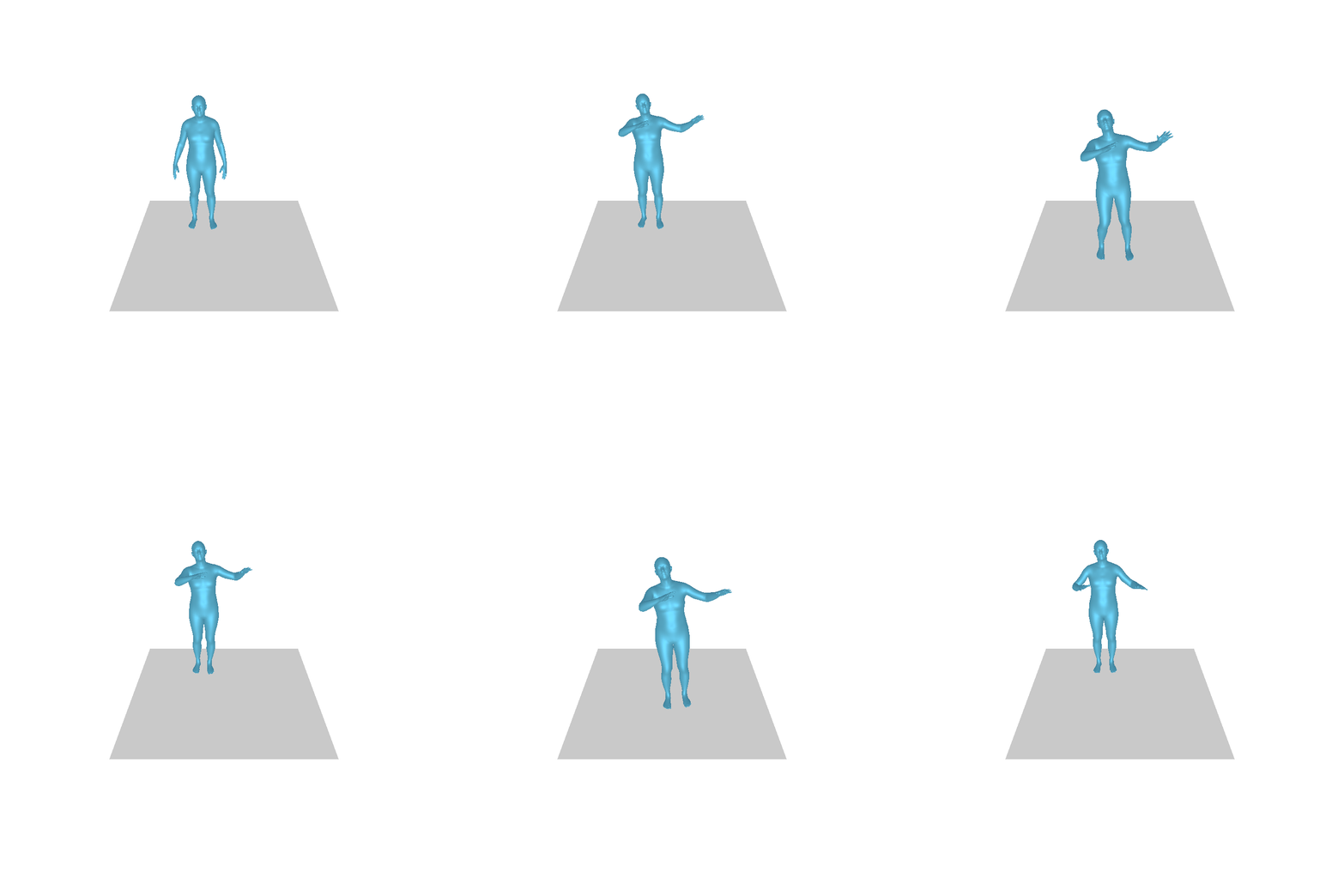
import sys import os import OpenGL.GL as gl # os.environ["PYOPENGL_PLATFORM"] = "egl" os.environ["MESA_GL_VERSION_OVERRIDE"] = "4.1" # os.system('pip install /home/user/app/pyrender') sys.argv = ['VQ-Trans/GPT_eval_multi.py'] os.chdir('VQ-Trans') sys.path.append('./VQ-Trans') sys.path.append('./pyrender') import options.option_transformer as option_trans from huggingface_hub import snapshot_download model_path = snapshot_download(repo_id="vumichien/T2M-GPT") args = option_trans.get_args_parser() args.dataname = 't2m' args.resume_pth = f'{model_path}/VQVAE/net_last.pth' args.resume_trans = f'{model_path}/VQTransformer_corruption05/net_best_fid.pth' args.down_t = 2 args.depth = 3 args.block_size = 51 import clip import torch import numpy as np import models.vqvae as vqvae import models.t2m_trans as trans from utils.motion_process import recover_from_ric import visualization.plot_3d_global as plot_3d from models.rotation2xyz import Rotation2xyz import numpy as np from trimesh import Trimesh import gc import torch from visualize.simplify_loc2rot import joints2smpl import pyrender # import matplotlib.pyplot as plt import io import imageio from shapely import geometry import trimesh from pyrender.constants import RenderFlags import math # import ffmpeg # from PIL import Image import hashlib import gradio as gr import moviepy.editor as mp from datetime import datetime ## load clip model and datasets is_cuda = torch.cuda.is_available() device = torch.device("cuda" if is_cuda else "cpu") print(device) clip_model, clip_preprocess = clip.load("ViT-B/32", device=device, jit=False, download_root='./') # Must set jit=False for training if is_cuda: clip.model.convert_weights(clip_model) clip_model.eval() for p in clip_model.parameters(): p.requires_grad = False net = vqvae.HumanVQVAE(args, ## use args to define different parameters in different quantizers args.nb_code, args.code_dim, args.output_emb_width, args.down_t, args.stride_t, args.width, args.depth, args.dilation_growth_rate) trans_encoder = trans.Text2Motion_Transformer(num_vq=args.nb_code, embed_dim=1024, clip_dim=args.clip_dim, block_size=args.block_size, num_layers=9, n_head=16, drop_out_rate=args.drop_out_rate, fc_rate=args.ff_rate) print('loading checkpoint from {}'.format(args.resume_pth)) ckpt = torch.load(args.resume_pth, map_location='cpu') net.load_state_dict(ckpt['net'], strict=True) net.eval() print('loading transformer checkpoint from {}'.format(args.resume_trans)) ckpt = torch.load(args.resume_trans, map_location='cpu') trans_encoder.load_state_dict(ckpt['trans'], strict=True) trans_encoder.eval() mean = torch.from_numpy(np.load(f'{model_path}/meta/mean.npy')) std = torch.from_numpy(np.load(f'{model_path}/meta/std.npy')) if is_cuda: net.cuda() trans_encoder.cuda() mean = mean.cuda() std = std.cuda() def ensure_directory(path): """Tạo thư mục nếu chưa tồn tại""" if not os.path.exists(path): os.makedirs(path) print(f"Created directory: {path}") def get_output_path(output_dir, filename, extension): """Tạo đường dẫn đầy đủ cho file output""" ensure_directory(output_dir) if not filename.endswith(extension): filename += extension return os.path.join(output_dir, filename) def render(motions, output_dir='output', filename='results', device_id=0): """ Render motion với tùy chọn thư mục và tên file Args: motions: Motion data output_dir: Thư mục lưu kết quả (mặc định: 'output') filename: Tên file không có extension (mặc định: 'results') device_id: GPU device ID """ try: frames, njoints, nfeats = motions.shape MINS = motions.min(axis=0).min(axis=0) MAXS = motions.max(axis=0).max(axis=0) height_offset = MINS[1] motions[:, :, 1] -= height_offset trajec = motions[:, 0, [0, 2]] is_cuda = torch.cuda.is_available() j2s = joints2smpl(num_frames=frames, device_id=0, cuda=is_cuda) rot2xyz = Rotation2xyz(device=device) faces = rot2xyz.smpl_model.faces # Tạo đường dẫn cho file .pt pt_path = get_output_path(output_dir, f'{filename}_pred', '.pt') if not os.path.exists(pt_path): print(f'Running SMPLify, it may take a few minutes.') motion_tensor, opt_dict = j2s.joint2smpl(motions) vertices = rot2xyz(torch.tensor(motion_tensor).clone(), mask=None, pose_rep='rot6d', translation=True, glob=True, jointstype='vertices', vertstrans=True) vertices = vertices.detach().cpu() torch.save(vertices, pt_path) else: vertices = torch.load(pt_path) frames = vertices.shape[3] print(f"Vertices shape: {vertices.shape}") MINS = torch.min(torch.min(vertices[0], axis=0)[0], axis=1)[0] MAXS = torch.max(torch.max(vertices[0], axis=0)[0], axis=1)[0] out_list = [] minx = MINS[0] - 0.5 maxx = MAXS[0] + 0.5 minz = MINS[2] - 0.5 maxz = MAXS[2] + 0.5 polygon = geometry.Polygon([[minx, minz], [minx, maxz], [maxx, maxz], [maxx, minz]]) polygon_mesh = trimesh.creation.extrude_polygon(polygon, 1e-5) vid = [] for i in range(frames): if i % 10 == 0: print(f"Processing frame {i}/{frames}") try: mesh = Trimesh(vertices=vertices[0, :, :, i].squeeze().tolist(), faces=faces) base_color = (0.11, 0.53, 0.8, 0.5) material = pyrender.MetallicRoughnessMaterial( metallicFactor=0.7, alphaMode='OPAQUE', baseColorFactor=base_color ) mesh = pyrender.Mesh.from_trimesh(mesh, material=material) polygon_mesh.visual.face_colors = [0, 0, 0, 0.21] polygon_render = pyrender.Mesh.from_trimesh(polygon_mesh, smooth=False) bg_color = [1, 1, 1, 0.8] scene = pyrender.Scene(bg_color=bg_color, ambient_light=(0.4, 0.4, 0.4)) sx, sy, tx, ty = [0.75, 0.75, 0, 0.10] camera = pyrender.PerspectiveCamera(yfov=(np.pi / 3.0)) light = pyrender.DirectionalLight(color=[1,1,1], intensity=300) scene.add(mesh) c = np.pi / 2 scene.add(polygon_render, pose=np.array([ [1, 0, 0, 0], [0, np.cos(c), -np.sin(c), MINS[1].cpu().numpy()], [0, np.sin(c), np.cos(c), 0], [0, 0, 0, 1] ])) light_pose = np.eye(4) light_pose[:3, 3] = [0, -1, 1] scene.add(light, pose=light_pose.copy()) light_pose[:3, 3] = [0, 1, 1] scene.add(light, pose=light_pose.copy()) light_pose[:3, 3] = [1, 1, 2] scene.add(light, pose=light_pose.copy()) c = -np.pi / 6 scene.add(camera, pose=np.array([ [1, 0, 0, (minx+maxx).cpu().numpy()/2], [0, np.cos(c), -np.sin(c), 1.5], [0, np.sin(c), np.cos(c), max(4, minz.cpu().numpy()+(1.5-MINS[1].cpu().numpy())*2, (maxx-minx).cpu().numpy())], [0, 0, 0, 1] ])) r = pyrender.OffscreenRenderer(960, 960) color, _ = r.render(scene, flags=RenderFlags.RGBA) vid.append(color) r.delete() except Exception as e: print(f"Error processing frame {i}: {str(e)}") continue if not vid: raise Exception("No frames were successfully processed") out = np.stack(vid, axis=0) # Tạo đường dẫn cho file GIF và MP4 gif_path = get_output_path(output_dir, filename, '.gif') mp4_path = get_output_path(output_dir, filename, '.mp4') imageio.mimwrite(gif_path, out, duration=50) out_video = mp.VideoFileClip(gif_path) out_video.write_videofile(mp4_path) # Set file permissions để đảm bảo file có thể được truy cập try: os.chmod(gif_path, 0o644) os.chmod(mp4_path, 0o644) except Exception as e: print(f"Warning: Could not set file permissions: {str(e)}") print(f"Results saved to: {mp4_path}") del out, vertices return mp4_path except Exception as e: print(f"Error in render function: {str(e)}") # Fallback to fast rendering if slow rendering fails print("Falling back to fast rendering...") return None def predict(clip_text, method='fast', output_dir='output', filename=''): """ Predict motion with custom output settings Args: clip_text: Text prompt method: 'fast' or 'slow' output_dir: Output directory filename: Custom filename (if empty, will use hash or timestamp) Returns: tuple: (video_path, download_path) để hiển thị và download """ gc.collect() print('prompt text instruction: {}'.format(clip_text)) # Đảm bảo output_dir là absolute path và trong thư mục hiện tại if not os.path.isabs(output_dir): output_dir = os.path.abspath(output_dir) # Tạo tên file nếu không được cung cấp if not filename.strip(): if method == 'fast': timestamp = datetime.now().strftime("%Y%m%d_%H%M%S") filename = f"motion_{timestamp}" else: filename = hashlib.md5(clip_text.encode()).hexdigest() # Xử lý text với CLIP if torch.cuda.is_available(): text = clip.tokenize([clip_text], truncate=True).cuda() else: text = clip.tokenize([clip_text], truncate=True) feat_clip_text = clip_model.encode_text(text).float() index_motion = trans_encoder.sample(feat_clip_text[0:1], False) pred_pose = net.forward_decoder(index_motion) pred_xyz = recover_from_ric((pred_pose*std+mean).float(), 22) if method == 'fast': xyz = pred_xyz.reshape(1, -1, 22, 3) # Tạo đường dẫn cho fast method gif_path = get_output_path(output_dir, filename, '.gif') mp4_path = get_output_path(output_dir, filename, '.mp4') pose_vis = plot_3d.draw_to_batch(xyz.detach().cpu().numpy(), title_batch=None, outname=[gif_path]) out_video = mp.VideoFileClip(gif_path) out_video.write_videofile(mp4_path) # Set file permissions để đảm bảo file có thể được truy cập os.chmod(mp4_path, 0o644) print(f"Fast render results saved to: {mp4_path}") return mp4_path, mp4_path # Return both for display and download elif method == 'slow': try: output_path = render(pred_xyz.detach().cpu().numpy().squeeze(axis=0), output_dir=output_dir, filename=filename, device_id=0) if output_path is None: # Fallback to fast rendering if slow rendering fails print("Slow rendering failed, using fast rendering instead...") xyz = pred_xyz.reshape(1, -1, 22, 3) gif_path = get_output_path(output_dir, filename, '.gif') mp4_path = get_output_path(output_dir, filename, '.mp4') pose_vis = plot_3d.draw_to_batch(xyz.detach().cpu().numpy(), title_batch=None, outname=[gif_path]) out_video = mp.VideoFileClip(gif_path) out_video.write_videofile(mp4_path) # Set file permissions try: os.chmod(mp4_path, 0o644) except: pass return mp4_path, mp4_path # Set file permissions để đảm bảo file có thể được truy cập try: os.chmod(output_path, 0o644) except Exception as e: print(f"Warning: Could not set file permissions: {str(e)}") return output_path, output_path # Return both for display and download except Exception as e: print(f"Error in slow rendering: {str(e)}") # Fallback to fast rendering print("Falling back to fast rendering...") xyz = pred_xyz.reshape(1, -1, 22, 3) gif_path = get_output_path(output_dir, filename, '.gif') mp4_path = get_output_path(output_dir, filename, '.mp4') pose_vis = plot_3d.draw_to_batch(xyz.detach().cpu().numpy(), title_batch=None, outname=[gif_path]) out_video = mp.VideoFileClip(gif_path) out_video.write_videofile(mp4_path) # Set file permissions try: os.chmod(mp4_path, 0o644) except: pass return mp4_path, mp4_path # ---- Gradio Layout ----- video_out = gr.Video(label="Motion", mirror_webcam=False, interactive=False) download_file = gr.File(label="Download Video", visible=False) demo = gr.Blocks() demo.encrypt = False with demo: gr.Markdown('''

Generating Human Motion from Textual Descriptions (T2M-GPT)

This space uses T2M-GPT models based on Vector Quantised-Variational AutoEncoder (VQ-VAE) and Generative Pre-trained Transformer (GPT) for human motion generation from textural descriptions🤗
''') with gr.Row(): with gr.Column(): gr.Markdown('''

Demo Slow
a man starts off in an up right position with botg arms extended out by his sides, he then brings his arms down to his body and claps his hands together. after this he wals down amd the the left where he proceeds to sit on a seat
''') with gr.Column(): gr.Markdown('''
Demo Slow 2
a person puts their hands together, leans forwards slightly then swings the arms from right to left
''') with gr.Column(): gr.Markdown('''
Demo Slow 3
a man is practicing the waltz with a partner
''') with gr.Row(): with gr.Column(): gr.Markdown(''' ### Generate human motion by **T2M-GPT** ##### Step 1. Give prompt text describing human motion ##### Step 2. Choose method to render output (Fast: Sketch skeleton; Slow: SMPL mesh) ##### Step 3. Specify output directory and filename (optional) ##### Step 4. Generate output and enjoy ##### Step 5. Download your video using the download button below ''') with gr.Column(): with gr.Row(): text_prompt = gr.Textbox(label="Text prompt", lines=1, interactive=True) method = gr.Dropdown(["slow", "fast"], label="Method", value="slow") with gr.Row(): output_dir = gr.Textbox(label="Output Directory", value="output", interactive=True) filename = gr.Textbox(label="Filename (without extension)", placeholder="Leave empty for auto-generated name", interactive=True) with gr.Row(): generate_btn = gr.Button("Generate") with gr.Row(): video_out.render() with gr.Row(): download_file.render() # Kết nối button với function và output generate_btn.click( predict, [text_prompt, method, output_dir, filename], [video_out, download_file], api_name="generate" ) with gr.Row(): gr.Markdown(''' ### You can test by following examples: ''') examples = gr.Examples( examples=[ ["a person jogs in place, slowly at first, then increases speed. they then back up and squat down.", "slow", "output", "jogging_motion"], ["a man steps forward and does a handstand", "slow", "output", "handstand_motion"], ["a man rises from the ground, walks in a circle and sits back down on the ground", "slow", "output", "circle_walk"], ["a man starts off in an up right position with botg arms extended out by his sides, he then brings his arms down to his body and claps his hands together. after this he wals down amd the the left where he proceeds to sit on a seat", "slow", "output", "clap_and_sit"], ["a person puts their hands together, leans forwards slightly then swings the arms from right to left","slow", "output", "swing_arms"], ["a man is practicing the waltz with a partner","slow", "output", "waltz_dance"], ], label="Examples", inputs=[text_prompt, method, output_dir, filename], outputs=[video_out, download_file], fn=predict, cache_examples=True, ) demo.launch(debug=True, server_name="0.0.0.0", server_port=8000, inbrowser=True, share=True, allowed_paths=[os.path.abspath("output"), os.path.abspath("./")])