

File size: 17,922 Bytes
54176f4 f48eab3 29768ce 01e1f6b f34ec5d 01e1f6b 7652e65 490d5ef 6c4c126 691d64c 490d5ef | 1 2 3 4 5 6 7 8 9 10 11 12 13 14 15 16 17 18 19 20 21 22 23 24 25 26 27 28 29 30 31 32 33 34 35 36 37 38 39 40 41 42 43 44 45 46 47 48 49 50 51 52 53 54 55 56 57 58 59 60 61 62 63 64 65 66 67 68 69 70 71 72 73 74 75 76 77 78 79 80 81 82 83 84 85 86 87 88 89 90 91 92 93 94 95 96 97 98 99 100 101 102 103 104 105 106 107 108 109 110 111 112 113 114 115 116 117 118 119 120 121 122 123 124 125 126 127 128 129 130 131 132 133 134 135 136 137 138 139 140 141 142 143 144 145 146 147 148 149 150 151 152 153 154 155 156 157 158 159 160 161 162 163 164 165 166 167 168 169 170 171 172 173 174 175 176 177 178 179 180 181 182 183 184 185 186 187 188 189 190 191 192 193 194 195 196 197 198 199 200 201 202 203 204 205 206 207 208 209 210 211 212 213 214 215 216 217 218 219 220 221 222 223 224 225 226 227 228 229 230 231 232 233 234 235 236 237 238 239 240 241 242 243 244 245 246 247 248 249 250 251 252 253 254 255 256 257 258 259 260 261 262 263 264 265 266 267 268 269 270 271 272 273 274 275 276 277 278 279 280 281 282 283 284 285 286 287 288 289 290 291 292 293 294 295 296 297 298 299 300 301 302 303 304 305 306 307 308 309 310 311 312 313 314 315 316 317 318 319 320 321 322 323 324 325 326 327 328 329 330 331 332 333 334 335 336 337 338 339 340 341 342 343 344 345 346 347 348 349 350 351 352 353 354 355 356 357 358 359 360 361 362 363 364 365 366 367 368 369 370 371 372 373 374 375 376 377 378 379 380 381 382 383 384 385 386 | ---
license: cc-by-nc-sa-4.0
datasets:
- ylecun/mnist
metrics:
- accuracy
pipeline_tag: image-classification
model-index:
- name: febrifahmi/NoD (mnist_nod2_model10.keras)
metadata:
parameters:
total: 116714
trainable: 116714
results:
- task:
type: image-classification
name: Image Classification
dataset:
name: MNIST Test Set
type: ylecun/mnist
split: test
metrics:
- name: Accuracy
type: accuracy
value: 0.9883
tags:
- biologically-inspired
- neuromorphic
- dendritic-computing
- green-ai
- small-parameters-footprint
---
# Model Summary
(directly go to the [demo page here](https://huggingface.co/spaces/febrifahmi/NoD-1-1D))
## Background motivation
The development of the latest neural network/deep learning model architectures (State-of-the-Art/SOTA) over the past two decades has seen a trend toward increasingly large-scale model development (in terms of the number of parameters, reaching billions, especially in LLM models), heavy computational burdens/requirement of capable hardware and infrastructure, large energy footprints, and large model sizes, as well as high and unsustainable memory and execution footprints. This may not be immediately apparent to end users, but it actually poses a real environmental threat.
With the current trend of climate change, it is unwise to continue the paradigm and practice of developing and using neural network products that leave a high environmental footprint (energy footprint, memory footprint, inefficient use of resources during execution/inference).
I propose a general neural network model architecture that is more sustainable (GreenAI) and has the potential to be applied to various NN tasks, namely the Network-of-Dendrites (NoD) model architecture.
This model architecture is not specific to a specific domain, but rather represents a core architectural paradigm that is fundamentally different from the model architectures currently being developed. The architecture is fundamentally a computation and routing paradigm (a lean, modular "thinking core") rather than a standalone end-to-end sensor pipeline.
The core paradigm of the NoD model architecture is minimizing the number of parameters by applying the principle of shared parameters, rather than increasing the number to billions.
NoD was developed by emulating the basic idea of how the brain's neurons learn and function biologically. Brain components, modeled as dendrites, go through two main phases:
1) the initial phase when the nervous system begins to learn and form new neural networks that become stronger over time after successfully learning from data (myelination); and
2) the phase when the nervous system is fully formed and the training and dynamic processing can be stopped and "locked in."
In the context of the NN model architecture, this is achieved by dividing the model architecture into two phases:
a. first phase: statistically searching/matching which data can be processed by which archetype/subMLP (gating/routing);
after that, the data is fed into a shared-base of parameters before being fed to the selected archetype. This occurs in the first phase during training, where the most appropriate probability for dividing the data into each archetype is still being sought;
c. Phase two: the locked-in phase, where the transition from soft probabilistic to deterministic occurs after the optimal routing probability to K other archetypes for processing the data is obtained from Phase one.
### Model Provenance & Lineage
* **Base Architecture:** None (Built completely from scratch).
* **Pre-trained Weights:** None (Trained with randomly initialized weights).
* **Training Dataset:** Standard MNIST Handwritten Digit Dataset.
### Origin Statement
This model is a custom-designed architecture developed independently. It is not a fork, fine-tuned variant, or distillation of any existing pre-trained model. All weights were trained from scratch exclusively on the attached MNIST dataset.
## Usage
## Create NoDClassificationLayer class
```
import tensorflow as tf
from tensorflow.keras import layers, Model, initializers, datasets
from tensorflow.keras.models import load_model
from tensorflow.keras.utils import plot_model
import numpy as np
import export_nod
import monitor
# Reuse the NetworkOfDendritesLayer implementation with Multi-Class Output adjustment
@tf.keras.utils.register_keras_serializable(package='Custom', name='NoDClassificationLayer')
class NoDClassificationLayer(layers.Layer):
def __init__(self, num_inputs, num_classes, num_archetypes, archetype_configs, embedding_dim=16, **kwargs):
super(NoDClassificationLayer, self).__init__(**kwargs)
self.num_inputs = num_inputs
self.num_classes = num_classes
self.num_archetypes = num_archetypes
self.archetype_configs = archetype_configs
self.embedding_dim = embedding_dim
self.is_locked = False
self.temperature = 1.0
self.hard_assignments = None
def build(self, input_shape):
# Discovery parameters
self.input_keys = self.add_weight(
name="input_keys", shape=(self.num_inputs, self.embedding_dim),
initializer=initializers.RandomNormal(stddev=0.1), trainable=True
)
self.archetype_prototypes = self.add_weight(
name="archetype_prototypes", shape=(self.num_archetypes, self.embedding_dim),
initializer=initializers.RandomNormal(stddev=0.1), trainable=True
)
# Bounded Bank of Archetype NPUs
self.archetype_mlps = []
for cfg in self.archetype_configs:
# Output of each mini-MLP now projects to `num_classes` so each pixel
# contributes a non-linear vote to every class score.
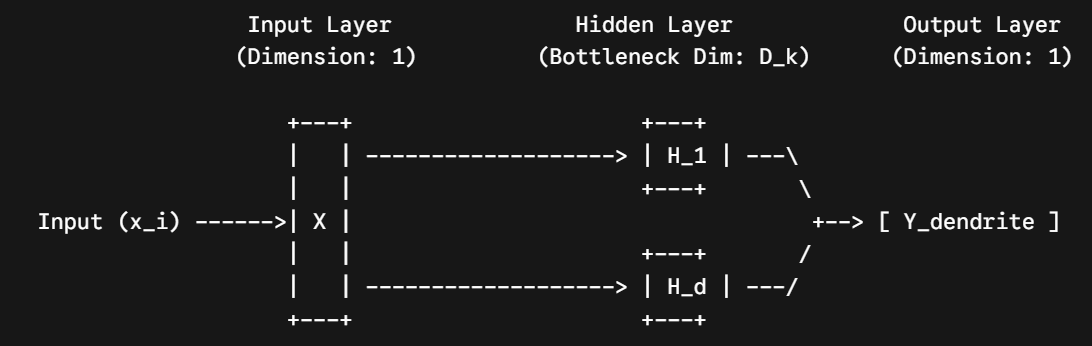
# input_shape(1,) is used to ensure the MLPs can process single pixel inputs and stick to 472 params/enforce True 472-params scale in Keras for this NoD arch.
mlp = tf.keras.Sequential([
layers.Dense(cfg["hidden_dim"], activation=cfg["activation"],
kernel_initializer=initializers.VarianceScaling(scale=cfg["init_scale"], mode='fan_in', distribution='normal'), input_shape=(1,)),
layers.Dense(self.num_classes, kernel_initializer=initializers.RandomNormal(stddev=0.1))
])
self.archetype_mlps.append(mlp)
super(NoDClassificationLayer, self).build(input_shape)
def lock_routing(self):
similarity = tf.matmul(self.input_keys, self.archetype_prototypes, transpose_b=True)
self.hard_assignments = tf.argmax(similarity, axis=-1).numpy()
self.is_locked = True
self.input_keys.trainable = False
self.archetype_prototypes.trainable = False
print(f"\n[SYSTEM] Routing Locked. Archetype distribution: {np.bincount(self.hard_assignments)}")
def call(self, inputs):
batch_size = tf.shape(inputs)[0]
if not self.is_locked:
# Phase 1: Soft Dynamic Routing
similarity = tf.matmul(self.input_keys, self.archetype_prototypes, transpose_b=True)
soft_routing = tf.nn.softmax(similarity / self.temperature, axis=-1)
expanded_inputs = tf.expand_dims(inputs, axis=-1) # (Batch, 784, 1)
all_npu_outputs = []
for k in range(self.num_archetypes):
flat_in = tf.reshape(expanded_inputs, [-1, 1])
flat_out = self.archetype_mlps[k](flat_in) # (Batch*784, 10)
npu_out = tf.reshape(flat_out, [batch_size, self.num_inputs, self.num_classes])
all_npu_outputs.append(npu_out)
stacked_outputs = tf.stack(all_npu_outputs, axis=-1) # (Batch, 784, 10, Num_Arch)
routing_expanded = tf.reshape(soft_routing, [1, self.num_inputs, 1, self.num_archetypes])
dendritic_outputs = tf.reduce_sum(stacked_outputs * routing_expanded, axis=-1) # (Batch, 784, 10)
else:
# Phase 2: Fully Vectorized Structural Execution Loop
# self.hard_assignments contains the winning archetype index for each of the 784 inputs (Shape: [784])
# We map each input to its assigned archetype without breaking tensor flow.
expanded_inputs = tf.expand_dims(inputs, axis=-1) # (Batch, 784, 1)
flat_in = tf.reshape(expanded_inputs, [-1, 1]) # (Batch * 784, 1)
# Compute outputs for all archetypes across all inputs first
all_npu_outputs = []
for k in range(self.num_archetypes):
flat_out = self.archetype_mlps[k](flat_in) # (Batch * 784, 10)
npu_out = tf.reshape(flat_out, [batch_size, self.num_inputs, self.num_classes])
all_npu_outputs.append(npu_out)
stacked_outputs = tf.stack(all_npu_outputs, axis=-1) # (Batch, 784, 10, Num_Arch)
# Create a hard one-hot mask from self.hard_assignments: shape (784, Num_Arch)
hard_mask = tf.one_hot(self.hard_assignments, depth=self.num_archetypes, dtype=tf.float32)
# Reshape mask to broadcast correctly: (1, 784, 1, Num_Arch)
routing_expanded = tf.reshape(hard_mask, [1, self.num_inputs, 1, self.num_archetypes])
# Select only the winning archetype's output for each input index deterministically
dendritic_outputs = tf.reduce_sum(stacked_outputs * routing_expanded, axis=-1) # (Batch, 784, 10)
# RMS Normalization over dendritic outputs
rms = tf.math.sqrt(tf.reduce_mean(tf.math.square(dendritic_outputs), axis=1, keepdims=True) + 1e-8)
normalized_outputs = dendritic_outputs / rms
# Macro Neuron Aggregation Sum
macro_sum = tf.reduce_sum(normalized_outputs, axis=1) # (Batch, 10)
return macro_sum
def get_config(self):
"""Serialization support for saving/loading the layer."""
config = super().get_config()
config.update({
"num_inputs": self.num_inputs,
"num_classes": self.num_classes,
"num_archetypes": self.num_archetypes,
"archetype_configs": self.archetype_configs,
"embedding_dim": self.embedding_dim
})
return config
@classmethod
def from_config(cls, config):
"""Deserialization support for loading the layer from a config."""
# config_copy = config.copy()
return cls(**config)
```
## Create the load balaced layer class
```
import tensorflow as tf
from tensorflow.keras import layers
class BalancedNoDClassificationLayer(layers.Layer):
"""
1D Network-of-Dendrites (NoD) Classification Layer with
Shared-Parameter Core and Load-Balancing Auxiliary Loss.
"""
def __init__(self, num_archetypes=8, archetype_dim=16, balance_weight=0.01, **kwargs):
super(BalancedNoDClassificationLayer, self).__init__(**kwargs)
self.num_archetypes = num_archetypes
self.archetype_dim = archetype_dim
self.balance_weight = balance_weight
def build(self, input_shape):
# 1D Shared-Parameter Core: Shape (num_archetypes, archetype_dim)
self.archetype_core = self.add_weight(
shape=(self.num_archetypes, self.archetype_dim),
initializer='variance_scaling',
trainable=True,
name='nod_1d_shared_core'
)
# Router network to compute soft routing gates across archetypes
self.router_weights = self.add_weight(
shape=(input_shape[-1], self.num_archetypes),
initializer='glorot_uniform',
trainable=True,
name='nod_router_weights'
)
super(BalancedNoDClassificationLayer, self).build(input_shape)
def call(self, inputs):
batch_size = tf.shape(inputs)[0]
# 1. Compute routing probabilities via Softmax
router_logits = tf.matmul(inputs, self.router_weights)
routing_gates = tf.nn.softmax(router_logits, axis=-1) # Shape: (Batch, num_archetypes)
# 2. Load-Balancing Auxiliary Loss (Prevents routing collapse)
mean_gate_per_archetype = tf.reduce_mean(routing_gates, axis=0)
uniform_target = 1.0 / float(self.num_archetypes)
load_balance_loss = self.balance_weight * tf.reduce_sum(
tf.square(mean_gate_per_archetype - uniform_target)
)
self.add_loss(load_balance_loss)
# 3. Weighted combination of the 1D shared archetype core parameters
# routing_gates: (Batch, num_archetypes, 1) x archetype_core: (1, num_archetypes, archetype_dim)
gates_expanded = tf.expand_dims(routing_gates, axis=-1)
core_expanded = tf.expand_dims(self.archetype_core, axis=0)
modulated_archetypes = gates_expanded * core_expanded
output_features = tf.reduce_sum(modulated_archetypes, axis=1) # Shape: (Batch, archetype_dim)
return output_features
def compute_output_shape(self, input_shape):
return (input_shape[0], self.archetype_dim)
def get_config(self):
config = super(BalancedNoDClassificationLayer, self).get_config()
config.update({
"num_archetypes": self.num_archetypes,
"archetype_dim": self.archetype_dim,
"balance_weight": self.balance_weight,
})
return config
@classmethod
def from_config(cls, config):
return cls(**config)
```
## Load and evaluate saved model
```
def evaluate_saved_model(model_path):
print(f"[INFO] Loading model from '{model_path}'...")
# 1. Load the model safely with compile=False
loaded_model = load_model(
model_path,
custom_objects={"NoDClassificationLayer": NoDClassificationLayer},
compile=False
)
print("[SUCCESS] Model loaded.")
# 2. Load the official MNIST test dataset
print("[INFO] Loading MNIST test dataset...")
(_, _), (x_test, y_test) = tf.keras.datasets.mnist.load_data()
# 3. Apply the exact same preprocessing used during training (Flatten & Normalize)
x_test_processed = x_test.astype(np.float32) / 255.0
x_test_processed = x_test_processed.reshape(-1, 784) # Flatten to (10000, 784)
print(f"[INFO] Running inference on {len(x_test_processed)} test samples...")
# 4. Perform batch prediction
# (If memory is tight, you can batch this, but for 784-dim tiny models, direct prediction is fine)
predictions = loaded_model.predict(x_test_processed, batch_size=1024, verbose=1)
# 5. Extract predicted classes
predicted_labels = np.argmax(predictions, axis=1)
# 6. Calculate True Accuracy
correct_predictions = np.sum(predicted_labels == y_test)
total_samples = len(y_test)
test_accuracy = (correct_predictions / total_samples) * 100.0
print("\n" + "="*40)
print(f" FINAL EVALUATION REPORT")
print("="*40)
print(f" Total Test Samples : {total_samples}")
print(f" Correct Predictions: {correct_predictions}")
print(f" True Test Accuracy : {test_accuracy:.2f}%")
print("="*40)
return test_accuracy
# Test your custom images right away
# batch_test("mnist_test_img")
if __name__ == "__main__":
# Point to your saved model file
model_file = "mnist_nod_model.keras"
evaluate_saved_model(model_file)
```
## Implementation requirements
The model was trained in a standard consumer laptop with no CUDA capable GPU.
# Model Characteristics
## Illustration
### Data flow
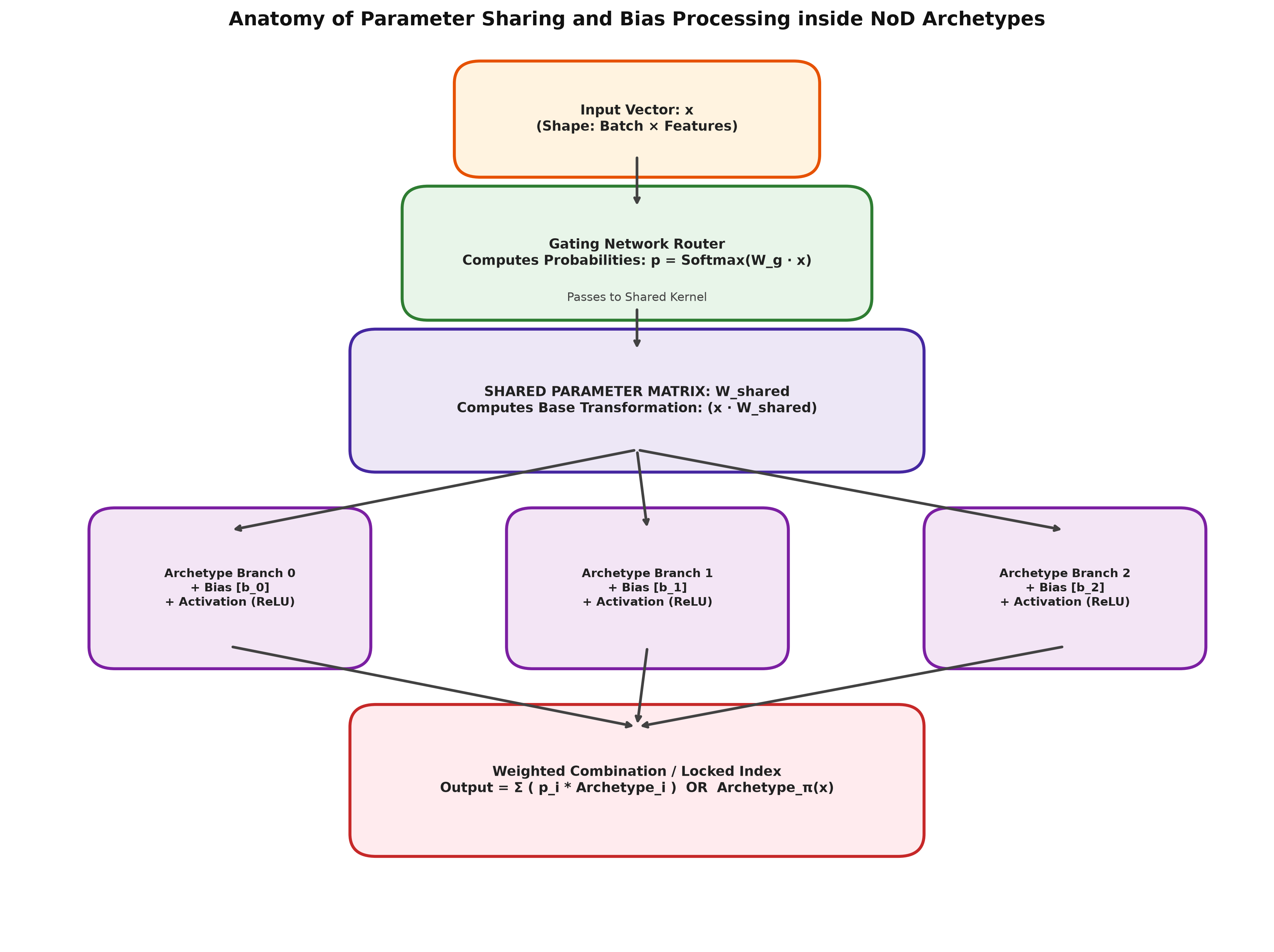
### Model architecture

### Inside the archetype
## Model initialization
The model was trained from scratch on MNIST dataset.
## Model stats
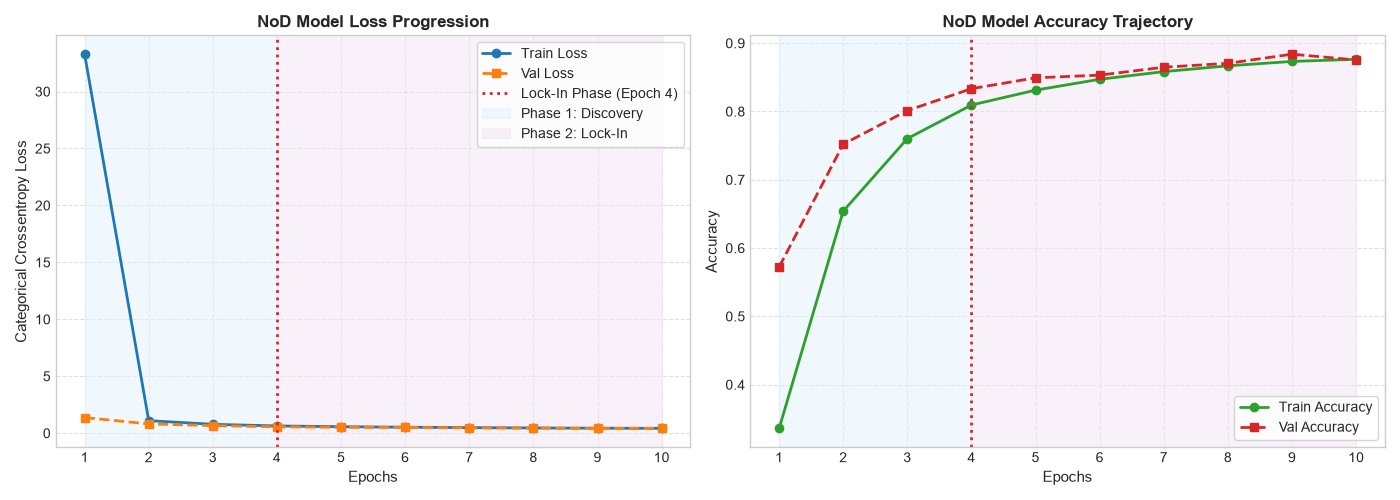
### NoD 1 (1D base shared parameters)
Trainable Parameters: 13.080
File size: 218 Kbytes
Architecture: NoD (dendritic non-linear routing and archetype sharing)
Nr.of training epoch: 10 epoch
True accuracy: 88.18%
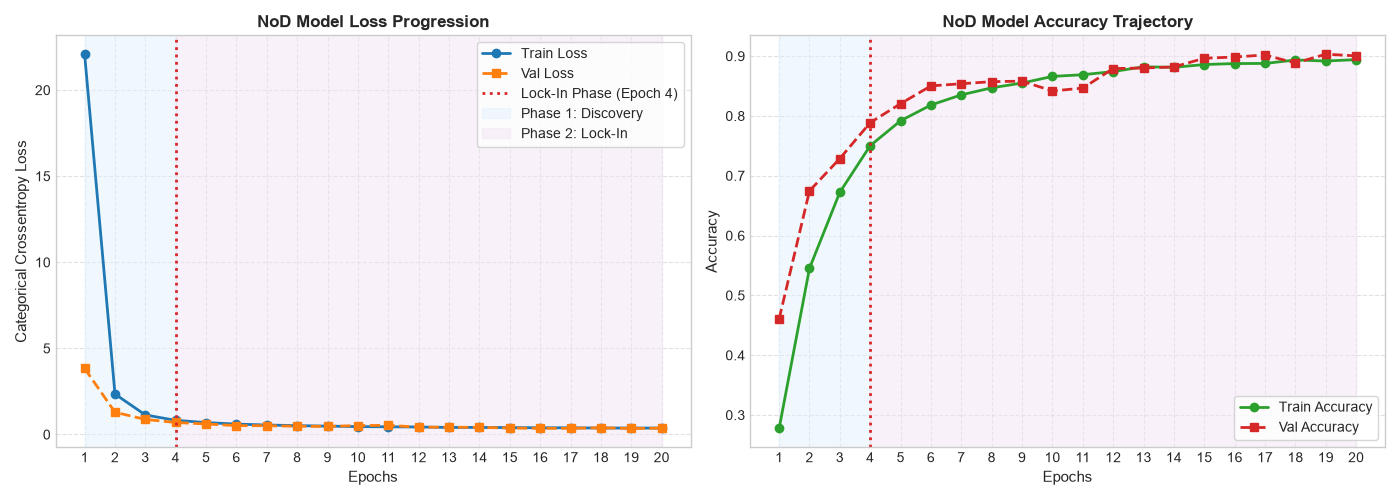
Trainable Parameters: 13.080
File size: 218 Kbytes
Architecture: NoD (dendritic non-linear routing and archetype sharing)
Nr.of training epoch: 20 epoch
True accuracy: 90.04%
### NoD 2 (2D base shared parameters)
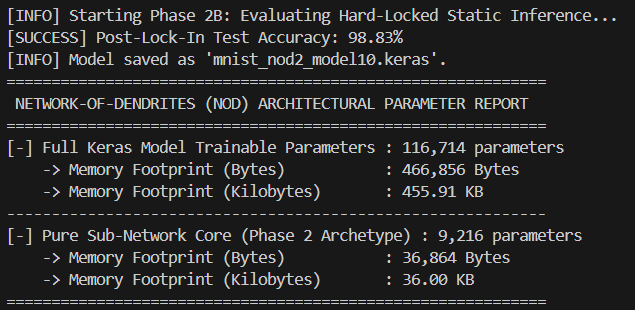
Trainable Parameters: 116,714 parameters
File size: 455.91 KB (the actual model .keras file size uploaded is 1.4 MB)
Architecture: NoD (dendritic non-linear routing and archetype sharing)
Nr.of training epoch: 10 epoch
True accuracy: 98.83%
## Other details
The model is not pruned nor quantized.
# Data Overview
The model trained and evaluated using MNIST dataset and standard method to split train/val/test data.
# Evaluation Results
True accuracy on MNIST test set: 88.18% (10 epoch)
True accuracy on MNIST test set: 90.04% (20 epoch) |