---
license: other
---
# OpenFLAM




### Joint Audio and Text Embeddings via Framewise Language-Audio Modeling (FLAM)
FLAM is a cutting-edge language–audio model that supports both zero-shot sound even detection and large-scale audio retrieval via free-form text.
This code accompanies the following ICML 2025 publication:
```
@inproceedings{flam2025,
title={{FLAM}: Frame-Wise Language-Audio Modeling},
author={Yusong Wu and Christos Tsirigotis and Ke Chen and Cheng-Zhi Anna Huang and Aaron Courville and Oriol Nieto and Prem Seetharaman and Justin Salamon},
booktitle={Forty-second International Conference on Machine Learning (ICML)},
year={2025},
url={https://openreview.net/forum?id=7fQohcFrxG}
}
```
## Architecture
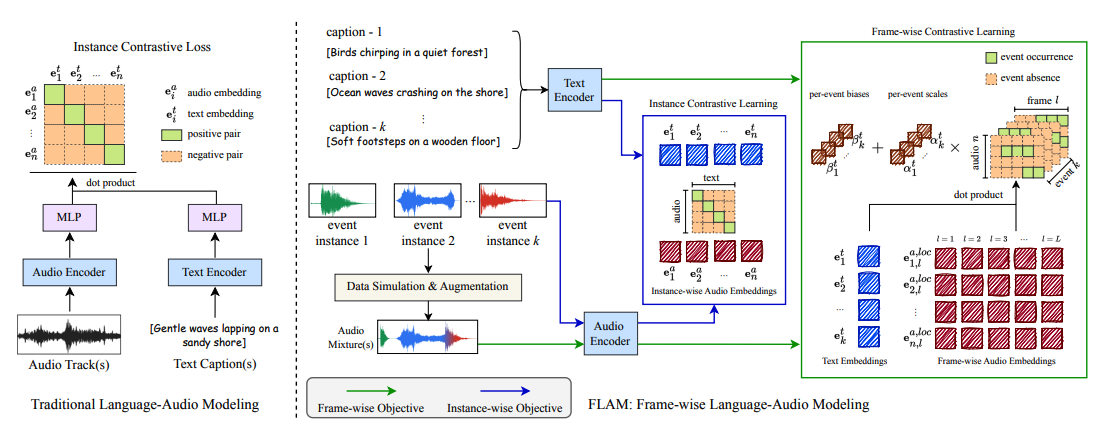
FLAM is based on contrastive language-audio pretraining, known as CLAP, and improve its capability by supporting the frame-wise event localization via learnable text and audio biases and scales.
## Quick Start
Install FLAM via PyPi:
```bash
pip install openflam
```
Two examples are provided:
1. [global_example.py](./test/global_example.py): to obtain audio and text embeddings and do clip-wise similarity.
2. [local_example.py](./test/local_example.py) to do sound event localization and plot the results.
For the API documentation, please refer to [hook.py](./src/openflam/hook.py).
### Global Example: To obtain clip-wise similarity between audio and text embeddings
Please refer to [global_example.py](./test/global_example.py):
```python
import librosa
import torch
import openflam
DEVICE = "cuda" if torch.cuda.is_available() else "cpu"
SR = 48000 # Sampling Rate (FLAM requires 48kHz)
flam = openflam.OpenFLAM(model_name="v1-base", default_ckpt_path="/tmp/openflam").to(
DEVICE
)
# Sanity Check (Optional)
flam.sanity_check()
# load audio
audio, sr = librosa.load("test/test_data/test_example.wav", sr=SR)
audio = audio[: int(10 * sr)]
audio_samples = torch.tensor(audio).unsqueeze(0).to(DEVICE) # [B, 480000 = 10 sec]
# Define text
text_samples = [
"breaking bones",
"metallic creak",
"tennis ball",
"troll scream",
"female speaker",
]
# Get Global Audio Features (10sec = 0.1Hz embeddings)
audio_global_feature = flam.get_global_audio_features(audio_samples) # [B, 512]
# Get Text Features
text_feature = flam.get_text_features(text_samples) # [B, 512]
# Calculate similarity (dot product)
global_similarities = (text_feature @ audio_global_feature.T).squeeze(1)
print("\nGlobal Cosine Similarities:")
for text, score in zip(text_samples, global_similarities):
print(f"{text}: {score.item():.4f}")
```
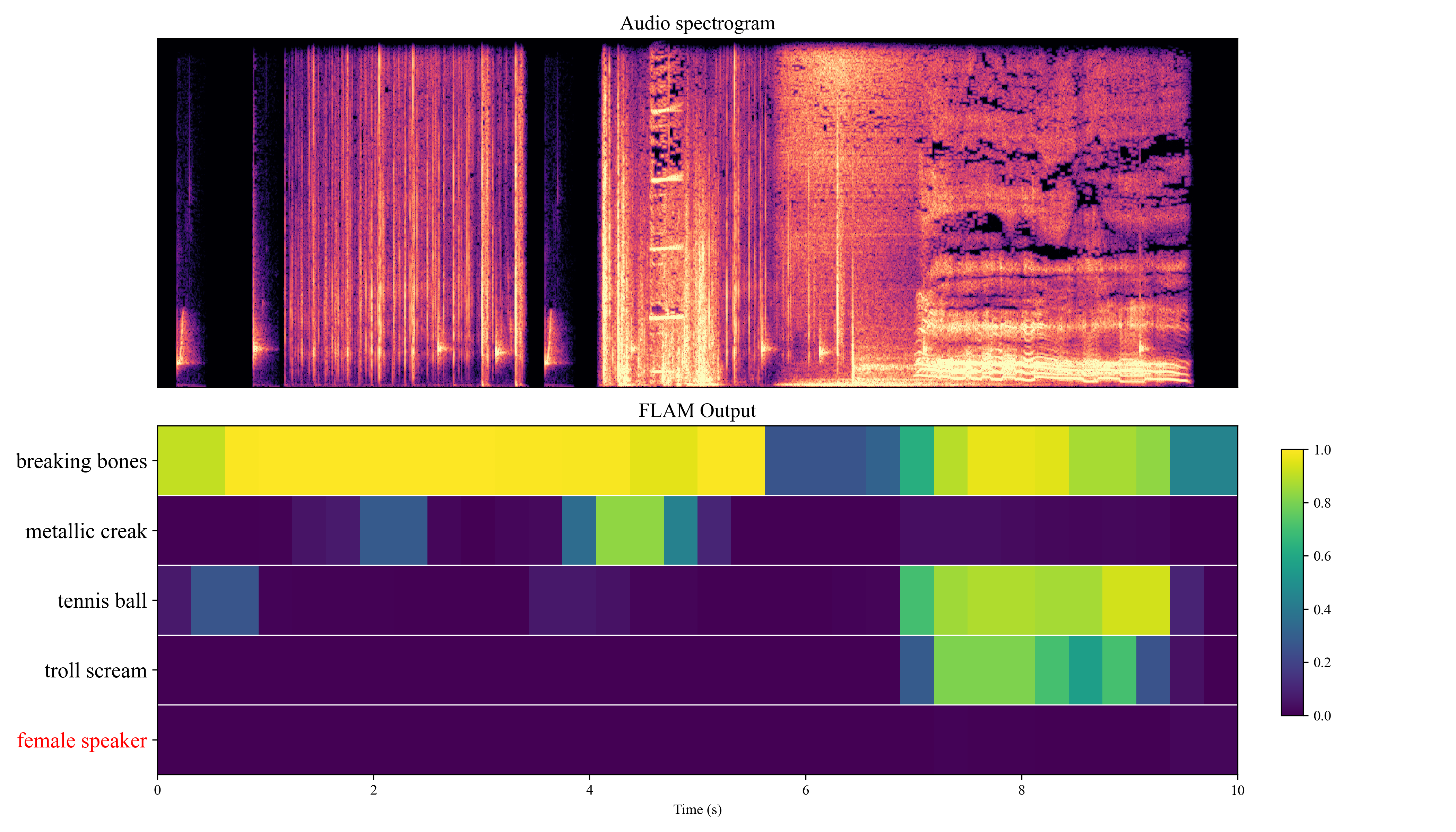
### Local Example: To perform sound event localization and plot the diagram
Please refer to [local_example.py](./test/local_example.py).
The following plot will be generated by running the code below:
```python
from pathlib import Path
import librosa
import numpy as np
import scipy
import torch
import openflam
from openflam.module.plot_utils import plot_sed_heatmap
# Configuration
OUTPUT_DIR = Path("sed_output") # Directory to save output figures
# Define target sound events
TEXTS = [
"breaking bones",
"metallic creak",
"tennis ball",
"troll scream",
"female speaker",
]
# Define negative class (sounds that shouldn't be in the audio)
NEGATIVE_CLASS = [
"female speaker"
]
SR = 48000
DEVICE = "cuda" if torch.cuda.is_available() else "cpu"
flam = openflam.OpenFLAM(model_name="v1-base", default_ckpt_path="/tmp/openflam")
flam.to(DEVICE)
# Load and prepare audio
audio, sr = librosa.load("test/test_data/test_example.wav", sr=SR)
audio = audio[: int(10 * sr)]
# Convert to tensor and move to device
audio_tensor = torch.tensor(audio).unsqueeze(0).to(DEVICE)
# Run inference
with torch.no_grad():
# Get local similarity using the wrapper's built-in method
# This uses the unbiased method (Eq. 9 in the paper)
act_map_cross = (
flam.get_local_similarity(
audio_tensor,
TEXTS,
method="unbiased",
cross_product=True,
)
.cpu()
.numpy()
)
# Apply median filtering for smoother results
act_map_filter = []
for i in range(act_map_cross.shape[0]):
act_map_filter.append(scipy.ndimage.median_filter(act_map_cross[i], (1, 3)))
act_map_filter = np.array(act_map_filter)
# Prepare similarity dictionary for plotting
similarity = {f"{TEXTS[i]}": act_map_filter[0][i] for i in range(len(TEXTS))}
# Prepare audio for plotting (resample to 32kHz)
target_sr = 32000
audio_plot = librosa.resample(audio, orig_sr=SR, target_sr=target_sr)
# Create output directory if it doesn't exist
OUTPUT_DIR.mkdir(exist_ok=True)
# Generate and save visualization
output_path = OUTPUT_DIR / "sed_heatmap.png"
plot_sed_heatmap(
audio_plot,
target_sr,
post_similarity=similarity,
duration=10.0,
negative_class=NEGATIVE_CLASS,
figsize=(14, 8),
save_path=output_path,
)
print(f"Plot saved: {output_path}")
```
## License
Both **code** and **models** for OpenFLAM are released under a non-commercial [Adobe Research License](./LICENSE). Please, review it carefully before using this technology.
## Pretrained Models
The pretrained checkpoints can be found [here](https://huggingface.co/kechenadobe/OpenFLAM/blob/main/open_flam_oct17.pth).
OpenFLAM automatically handles the downloading of the checkpoint. Please, refer to the previous section for more details.
## Datasets
The original experimental results reported in [our paper](https://arxiv.org/abs/2505.05335) were obtained by the model trained on internal datasets that are not publicly shareable.
OpenFLAM is trained **on all publicly available datasets**, including:
1. Datasets with coarse (aka, global or weak) labels: AudioSet-ACD (a LLM-based captioning for AudioSet), FreeSound, WavCaps, AudioCaps, Clotho;
2. Datasets with fine-grained (aka, local or strong) labels: AudioSet Strong, UrbanSED, DESED, Maestro, and Simulation data from AudioSet-ACD & FreeSound.
We report a comparison of the OpenFLAM performance to the original paper report (the global retrieval metrics --ie, A2T and T2A-- are R@1 / R@5):

## Citation
If you use OpenFLAM, please cite our main work:
```
@inproceedings{flam2025,
title={{FLAM}: Frame-Wise Language-Audio Modeling},
author={Yusong Wu and Christos Tsirigotis and Ke Chen and Cheng-Zhi Anna Huang and Aaron Courville and Oriol Nieto and Prem Seetharaman and Justin Salamon},
booktitle={Forty-second International Conference on Machine Learning (ICML)},
year={2025},
url={https://openreview.net/forum?id=7fQohcFrxG}
}
```