

File size: 27,033 Bytes
53751b1 | 1 2 3 4 5 6 7 8 9 10 11 12 13 14 15 16 17 18 19 20 21 22 23 24 25 26 27 28 29 30 31 32 33 34 35 36 37 38 39 40 41 42 43 44 45 46 47 48 49 50 51 52 53 54 55 56 57 58 59 60 61 62 63 64 65 66 67 68 69 70 71 72 73 74 75 76 77 78 79 80 81 82 83 84 85 86 87 88 89 90 91 92 93 94 95 96 97 98 99 100 101 102 103 104 105 106 107 108 109 110 111 112 113 114 115 116 117 118 119 120 121 122 123 124 125 126 127 128 129 130 131 132 133 134 135 136 137 138 139 140 141 142 143 144 145 146 147 148 149 150 151 152 153 154 155 156 157 158 159 160 161 162 163 164 165 166 167 168 169 170 171 172 173 174 175 176 177 178 179 180 181 182 183 184 185 186 187 188 189 190 191 192 193 194 195 196 197 198 199 200 201 202 203 204 205 206 207 208 209 210 211 212 213 214 215 216 217 218 219 220 221 222 223 224 225 226 227 228 229 230 231 232 233 234 235 236 237 238 239 240 241 242 243 244 245 246 247 248 249 250 251 252 253 254 255 256 257 258 259 260 261 262 263 264 265 266 267 268 269 270 271 272 273 274 275 276 277 278 279 280 281 282 283 284 285 286 287 288 289 290 291 292 293 294 295 296 297 298 299 300 301 302 303 304 305 306 307 308 309 310 311 312 313 314 315 316 317 318 319 320 321 322 323 324 325 326 327 328 329 330 331 332 333 334 335 336 337 338 339 340 341 342 343 344 345 346 347 348 349 350 351 352 353 354 355 356 357 358 359 360 361 362 363 364 365 366 367 368 369 370 371 372 373 374 375 376 377 378 379 380 381 382 383 384 385 386 387 388 389 390 391 392 393 394 395 396 397 398 399 400 401 402 403 404 405 406 407 408 409 410 411 412 413 414 415 416 417 418 419 420 421 422 423 424 425 426 427 428 429 430 431 432 433 434 435 436 437 438 439 440 441 442 443 444 445 446 447 448 449 450 451 452 453 454 455 456 457 458 459 460 461 462 463 464 465 466 467 468 469 470 471 472 473 474 475 476 477 478 479 480 481 482 483 484 485 486 487 | ---
license: apache-2.0
---
<p align="center"> <h1 align="center">CLIP-VG: Self-paced Curriculum Adapting of CLIP for Visual Grounding</h1>
<p align="center">
<b> IEEE Transaction on Multimedia, 2023 </b>
<br />
<a href="https://scholar.google.com.hk/citations?user=4rTE4ogAAAAJ&hl=zh-CN&oi=sra"><strong> Linhui Xiao </strong></a>
·
<a href="https://yangxs.ac.cn/home"><strong>Xiaoshan Yang </strong></a>
·
<a href="https://scholar.google.com.hk/citations?user=HBZ9plsAAAAJ&hl=zh-CN"><strong>Fang Peng </strong></a>
·
<a href="https://scholar.google.com.hk/citations?user=uIUfGxYAAAAJ&hl=zh-CN"><strong>Ming Yan </strong></a>
·
<a href="https://scholar.google.com.hk/citations?user=o_DllmIAAAAJ&hl=zh-CN"><strong>Yaowei Wang </strong></a>
·
<a href="https://scholar.google.com.hk/citations?user=hI9NRDkAAAAJ&hl=zh-CN"><strong>Changsheng Xu</strong></a>
</p>
<p align="center">
<a href='https://arxiv.org/pdf/2305.08685'>
<img src='https://img.shields.io/badge/arXiv-PDF-green?style=flat&logo=arXiv&logoColor=green' alt='arXiv PDF'>
</a>
<a href='https://ieeexplore.ieee.org/abstract/document/10269126'>
<img src='https://img.shields.io/badge/IEEE TMM-blue' alt='arXiv PDF'>
</a>
<br />
<p align="center"> <img src='docs/model.jpg' align="center" width="70%"> </p>
**<p align="center"> CLIP for Unsupervised and Fully Supervised Visual Grounding. </p>**
This repository is the official Pytorch implementation for the paper [**CLIP-VG: Self-paced Curriculum Adapting of CLIP
for Visual Grounding**](https://ieeexplore.ieee.org/abstract/document/10269126).
If you have any questions, please feel free to open an issue or contact me with emails: <xiaolinhui16@mails.ucas.ac.cn>.
<h3 align="left">
Links: <a href="https://ieeexplore.ieee.org/abstract/document/10269126">IEEE Transaction on Multimedia (2023)</a>,
<a href="https://arxiv.org/abs/2305.08685">ArXiv</a>,
[<a href="https://mp.weixin.qq.com/s/fwbamVr5P5Vcj5XheopQOg">中文解读</a>]
</h3>
**Please leave a <font color='orange'>STAR ⭐</font> if you like this project!**
## News
- 🔥🔥🔥 **Our Grounding survey ([TPAMI](https://doi.org/10.1109/TPAMI.2025.3630635), [Arxiv](https://arxiv.org/abs/2412.20206), [Project](https://github.com/linhuixiao/Awesome-Visual-Grounding)) has been accepted by TPAMI on October 30, 2025 !!!**
- :fire: **Update on 2024/12/28: We conducted a survey of Visual Grounding over the past decade, entitled "Towards Visual Grounding: A Survey" ([Paper](https://arxiv.org/pdf/2412.20206), [Project](https://github.com/linhuixiao/Awesome-Visual-Grounding)), Comments are welcome !!!**
- :fire: **Update on 2024/09/26: Our advanced grounding work OneRef ([Paper](https://openreview.net/pdf?id=siPdcro6uD), [Code](https://github.com/linhuixiao/OneRef)) has acceptance by top conference NeurIPS 2024 in October 2024!**
- :fire: **Update on 2024/07/16: Our advanced grounding work HiVG ([Paper](https://openreview.net/pdf?id=NMMyGy1kKZ), [Code](https://github.com/linhuixiao/HiVG)) has acceptance by top conference ACM MM 2024 in July 2024!**
- **Update on 2024/04/20: We release an advanced version of CLIP-VG, namely HiVG ([paper](https://arxiv.org/abs/2404.13400), [github](https://github.com/linhuixiao/HiVG)).**
- **Update on 2023/12/13: All of the code, models and datasets have been released.**
- **Update on 2023/9/25: Our paper has been accepted by the top journal IEEE Transaction on Multimedia (2023)!**
- Update on 2023/05/18: Release the repository and training code.
## Citation
If you find our work helpful for your research, please consider citing the following BibTeX entry.
```bibtex
@article{xiao2023clip,
title={CLIP-VG: Self-paced Curriculum Adapting of CLIP for Visual Grounding},
author={Xiao, Linhui and Yang, Xiaoshan and Peng, Fang and Yan, Ming and Wang, Yaowei and Xu, Changsheng},
journal={IEEE Transactions on Multimedia},
year={2023},
publisher={IEEE}
}
```
## Contents
1. [Introduction](#introduction)
2. [Usage](#usage)
3. [Results](#results)
4. [Contacts](#contacts)
5. [Acknowledgments](#acknowledgments)
## Highlight
- **CLIP for Visual Grounding.** a state-of-the-art baseline for unsupervised and fully supervised visual grounding with CLIP model.
- **Single-source and Multi-source pseudo-language labels.** The generation and usage of multi-source pseudo-labels.
- **Self-paced Curriculum Adapting Algorithm.** A plugin-like algorithmic idea that can be applied to any pseudo-label scenario.
## TODO
- [x] Release model code and inference code.
- [x] Release unsupervised and fully supervised checkpoints.
- [x] Release the complete multi-source pseudo-language labels and its generation code.
- [x] Release the reliability measurement code.
## Introduction
In order to utilize vision and language pre-trained models to address the grounding problem, and reasonably take
advantage of pseudo-labels, we propose **CLIP-VG**, **a novel method that can conduct self-paced curriculum adapting of CLIP
with pseudo-language labels.**
We propose a simple yet efficient end-to-end network architecture to realize the transfer
of CLIP to the visual grounding. Based on the CLIP-based architecture, we further propose single-source and
multi-source curriculum adapting algorithms, which can progressively find more reliable pseudo-labels to learn an
optimal model, thereby achieving a balance between reliability and diversity for the pseudo-language labels.
Our method outperforms the current state-of-the-art unsupervised method Pseudo-Q, by a significant margin on RefCOCO/+/g datasets in both
single-source and multi-source scenarios. Furthermore, our approach even outperforms existing weakly supervised methods.
In comparison with the fully supervised SOTA model QRNet, we achieve comparable results with only **7.7%** of its
updated parameters, while obtaining significant speedups in both training and inference, up to **26.84×** and **7.41×**, respectively.
In summary, **the contributions of this work are four-fold**:
- As far as we know, **we are the first to adapt CLIP to realize unsupervised visual grounding.** Our method can
transfer the cross-modal learning ability of CLIP to visual grounding with only a small training cost.
- **We first introduce the self-paced curriculum learning in unsupervised visual grounding.** Our proposed reliability measurement and single-source self-paced adapting
can progressively enhance the CLIP-based visual grounding model by utilizing pseudo-labels in an easy-to-hard
learning paradigm.
- **We first propose the multi-source self-paced adapting algorithm to extend our method for accessing multiple
sources of pseudo-labels,** which can flexibly improve the diversity of language taxonomy.
- We conduct extensive experiments to evaluate the effectiveness of our approach. Results show that our method
obtains significant improvements in unsupervised setting and is also competitive in fully supervised setting.
For more details, please refer to [our paper](https://arxiv.org/abs/2305.08685).
## Usage
### Dependencies
- Python 3.9.10
- PyTorch 1.9.0 + cu111 + cp39
- Check [requirements.txt](requirements.txt) for other dependencies.
Our model is **easy to deploy** in a variety of environments and has been successfully tested on multiple pytorch versions.
If you are interested in the pseudo language label generation module, more detailed instructions will be found at [usage instructions](pseudo_label_generation_module/README.md).
### Image Data Preparation
1.You can download the images from the original source and place them in your disk folder, such as `$/path_to_image_data`:
- [MS COCO 2014](download_mscoco2014.sh) (for RefCOCO, RefCOCO+, RefCOCOg dataset, almost 13.0GB)
- [ReferItGame](https://drive.google.com/drive/folders/1D4shieeoKly6FswpdjSpaOrxJQNKTyTv)
- [Flickr30K Entities](http://shannon.cs.illinois.edu/DenotationGraph/#:~:text=make%20face-,Downloads,-Please%20fill%20in)
We provide a script to download the mscoco2014 dataset, you just need to run the script in terminal with the following command:
```
bash download_mscoco2014.sh
```
Or you can also follow the data preparation of TransVG, which can be found in [GETTING_STARTED.md](https://github.com/djiajunustc/TransVG/blob/main/docs/GETTING_STARTED.md).
Only the image data in these datasets is used, and these image data is easily find in similar repositories of visual grounding work, such as [TransVG](https://github.com/linhuixiao/TransVG) etc.
Finally, the `$/path_to_image_data` folder will have the following structure:
```angular2html
|-- image_data
|-- Flickr30k
|-- flickr30k-images
|-- other
|-- images
|-- mscoco
|-- images
|-- train2014
|-- referit
|-- images
```
- ```$/path_to_image_data/image_data/Flickr30k/flickr30k-images/```: Image data for the Flickr30K dataset, please download from this [link](http://shannon.cs.illinois.edu/DenotationGraph/#:~:text=make%20face-,Downloads,-Please%20fill%20in). Fill the form and download the images.
- ```$/path_to_image_data/image_data/other/images/```: Image data for RefCOCO/RefCOCO+/RefCOCOg, i.e., mscoco2014.
- ```$/path_to_image_data/image_data/referit/images/```: Image data for ReferItGame.
## Text-Box Anotations / Pseudo-Labels Prepare
The following are the **pseudo-language labels** generated by the pseudo-language label generation module in an unsupervised setting.
The **single-source scenario** includes a pseudo-template label derived from [Pseudo-Q](https://github.com/LeapLabTHU/Pseudo-Q).
**Multi-source scenario** include pseudo-template labels, pseudo-relation labels, and pseudo-caption labels.
Please refer to [pseudo-language label generation module](pseudo_label_generation_module/README.md) for specific details
on how they are generated if interested.
Additionally, we also provide the pseudo-labels that selected through our single-source self-paced curriculum adapting (SSA)
and multi-source self-paced curriculum adapting (MSA) algorithms, which can be conveniently and directly used by the following researchers.
The labels in the fully supervised scenario is consistent with previous works such as [TransVG](https://github.com/linhuixiao/TransVG).
It is worth noting that the test split in the unsupervised scenario are exactly the same as those used in the fully supervised scenario.
### Unsupervised setting
#### Single-source scenario
<table>
<tr> <!-- line 3 -->
<th style="text-align:center" > Datasets </th>
<th style="text-align:center" > RefCOCO </th>
<th style="text-align:center" > RefCOCO+ </th>
<th style="text-align:center" > RefCOCOg-g </th>
<th style="text-align:center" > RefCOCOg-u </th>
<th style="text-align:center" > ReferIt </th>
<th style="text-align:center" > Flickr </th>
</tr>
<tr> <!-- line 2 -->
<th style="text-align:center" rowspan="1"> original </th> <!-- table head -->
<th style="text-align:center" colspan="6"> <a href="https://drive.google.com/file/d/1G5VK8uNbAepyrQiI_DLQaN_02tYyOQq2/view?usp=drive_link">All of six datasets</a>, 36.7MB </th> <!-- table head -->
</tr>
<tr> <!-- line 2 -->
<th style="text-align:center" rowspan="1"> with curriculum selecting </th> <!-- table head -->
<th style="text-align:center" colspan="6"> <a href="https://drive.google.com/file/d/1ekEWR-gYMMOrWPDB7R8lxZfDJbO8KGQt/view?usp=drive_link">All of six datasets</a>, 31.4MB </th> <!-- table head -->
</tr>
</table>
#### Multi-source scenario
<table>
<tr> <!-- line 3 -->
<th style="text-align:center" > Datasets </th>
<th style="text-align:center" > RefCOCO </th>
<th style="text-align:center" > RefCOCO+ </th>
<th style="text-align:center" > RefCOCOg-g </th>
<th style="text-align:center" > RefCOCOg-u </th>
<th style="text-align:center" > ReferIt </th>
<th style="text-align:center" > Flickr </th>
</tr>
<tr> <!-- line 2 -->
<th style="text-align:center" rowspan="1"> original </th> <!-- table head -->
<th style="text-align:center" colspan="6"> <a href="https://drive.google.com/file/d/1X9F5n7M0Zm4jhOIf1tjHj6bzMh6A1ZkE/view?usp=drive_link">All of six datasets</a>, 144.7MB, each dataset contains 3 sources of pseudo-labels </th> <!-- table head -->
</tr>
<tr> <!-- line 2 -->
<th style="text-align:center" rowspan="1"> with curriculum selecting </th> <!-- table head -->
<th style="text-align:center" colspan="6"> <a href="https://drive.google.com/file/d/1IBReTahxkOdKW_fKvplw3PGlI8PdHPUW/view?usp=drive_link">All of six datasets</a>, 87.3MB, each dataset contains 3 sources of pseudo-labels </th> <!-- table head -->
</tr>
</table>
### Fully supervised setting
<table>
<tr> <!-- line 3 -->
<th style="text-align:center" > Datasets </th>
<th style="text-align:center" > RefCOCO </th>
<th style="text-align:center" > RefCOCO+ </th>
<th style="text-align:center" > RefCOCOg-g </th>
<th style="text-align:center" > RefCOCOg-u </th>
<th style="text-align:center" > ReferIt </th>
<th style="text-align:center" > Flickr </th>
</tr>
<tr> <!-- line 2 -->
<th style="text-align:center" rowspan="1"> url, size </th> <!-- table head -->
<th style="text-align:center" colspan="6"> <a href="https://drive.google.com/file/d/1ituKSxWU5aXsGnXePd7twv7ImJoFiATc/view?usp=drive_link">All of six datasets</a>, 89.0MB </th> <!-- table head -->
</tr>
<tr> <!-- line 3 -->
<th style="text-align:center" > with curriculum selecting </th>
<th style="text-align:center" > - </th>
<th style="text-align:center" > - </th>
<th style="text-align:center" > - </th>
<th style="text-align:center" > <a href="https://drive.google.com/file/d/1eSGr-sTqZ6z_Jy7APnJXNxegt2Q-pbqE/view?usp=drive_link">dataset</a> </th>
<th style="text-align:center" > - </th>
<th style="text-align:center" > - </th>
</tr>
</table>
\* Since we observed a relatively clear performance increase on the RefCOCOg-u dataset in the fully supervised setting,
we provide data for this dataset after applying our SSA algorithm for curriculum selecting. Typically, by using this
filtered data, there is an approximate ~1.0 increase in performance on both val-u and test-u.
Download the above annotations to a disk directory such as `$/path_to_split`; then will have the following similar directory structure:
```angular2html
|-- /unsup_single_source/unsup_single_source_ssa/
|-- unsup_multi_source/unsup_multi_source_msa/full_sup_data
├── flickr
│ ├── flickr_test.pth
│ ├── flickr_train_pseudo.pth
│ └── flickr_val.pth
├── gref
│ ├── gref_train_pseudo.pth
│ └── gref_val.pth
├── gref_umd
│ ├── gref_umd_test.pth
│ ├── gref_umd_train_pseudo.pth
│ └── gref_umd_val.pth
├── referit
│ ├── referit_test.pth
│ ├── referit_train_pseudo.pth
│ └── referit_val.pth
├── unc
│ ├── unc_testA.pth
│ ├── unc_testB.pth
│ ├── unc_train_pseudo.pth
│ └── unc_val.pth
└── unc+
├── unc+_testA.pth
├── unc+_testB.pth
├── unc+_train_pseudo.pth
└── unc+_val.pth
In multi-source, it have a additional train_separate directory for further research purpose.
├── train_separate
├── 1_unc+_train_pseudo_template_0_5.pth
│── 2_unc+_train_pseudo_relation_0_5.pth
└── 3_unc+_train_pseudo_caption_0_5.pth
```
\* The number at the end of the filename in train_separate directory represents the reliability threshold as defined in the paper.
## Pre-trained Checkpoints
### Unsupervised setting
#### Single-source scenario
<table>
<tr> <!-- line 3 -->
<th style="text-align:center" > Datasets </th>
<th style="text-align:center" > RefCOCO </th>
<th style="text-align:center" > RefCOCO+ </th>
<th style="text-align:center" > RefCOCOg-g </th>
<th style="text-align:center" > RefCOCOg-u </th>
<th style="text-align:center" > ReferIt </th>
<th style="text-align:center" > Flickr </th>
</tr>
<tr> <!-- line 2 -->
<th style="text-align:center" rowspan="1"> url, size </th> <!-- table head -->
<th style="text-align:center" colspan="6"> <a href="https://drive.google.com/file/d/14b-lc7zNniy4EEcJoBdXY9gNv2d20yxU/view?usp=drive_link">All of six models</a>, 3.0GB </th> <!-- table head -->
</tr>
</table>
\* Note that the performance of our provided model on the refcocog-val-g dataset in the unsupervised single-source scenario is approximately higher ~2.0
than reported in the paper, i.e., (54.16) --> (56.46).
#### Multi-source scenario
<table>
<tr> <!-- line 3 -->
<th style="text-align:center" > Datasets </th>
<th style="text-align:center" > RefCOCO </th>
<th style="text-align:center" > RefCOCO+ </th>
<th style="text-align:center" > RefCOCOg-g </th>
<th style="text-align:center" > RefCOCOg-u </th>
<th style="text-align:center" > ReferIt </th>
<th style="text-align:center" > Flickr </th>
</tr>
<tr> <!-- line 2 -->
<th style="text-align:center" rowspan="1"> url, size </th> <!-- table head -->
<th style="text-align:center" colspan="6"> <a href="https://drive.google.com/file/d/1NU35UhAqx2YLehG5ni59rG4sWWaAaXGm/view?usp=drive_link">All of six models</a>, 3.0GB </th> <!-- table head -->
</tr>
</table>
### Fully supervised setting
<table>
<tr> <!-- line 3 -->
<th style="text-align:center" > Datasets </th>
<th style="text-align:center" > RefCOCO </th>
<th style="text-align:center" > RefCOCO+ </th>
<th style="text-align:center" > RefCOCOg-g </th>
<th style="text-align:center" > RefCOCOg-u </th>
<th style="text-align:center" > ReferIt </th>
<th style="text-align:center" > Flickr </th>
</tr>
<tr> <!-- line 3 -->
<th style="text-align:center" > separate </th>
<th style="text-align:center" > <a href="https://drive.google.com/file/d/1ZyQkPDBG33FPVlyVmzcCf5wD_Ct2hLr8/view?usp=drive_link">model</a> </th>
<th style="text-align:center" > <a href="https://drive.google.com/file/d/18M-Mmu_TaMLKrpdxksoroe3DIeHmmguN/view?usp=drive_link">model</a> </th>
<th style="text-align:center" > <a href="https://drive.google.com/file/d/1E80T3nz6YETqYU8ZZImCuX76TM1OOxNp/view?usp=drive_link">model</a> </th>
<th style="text-align:center" > <a href="https://drive.google.com/file/d/1bR5WIwaNiu0ShgEafw10BwC3boT-bLRW/view?usp=drive_link">model</a> </th>
<th style="text-align:center" > <a href="https://drive.google.com/file/d/1g8U5Q-KUcGPVq1iKMyFui65lXn9Dwfws/view?usp=drive_link">model</a> </th>
<th style="text-align:center" > <a href="https://drive.google.com/file/d/1Zm98Bf7ulKxXsi-UhoEGkyUtF8-v-Ohp/view?usp=drive_link">model</a> </th>
</tr>
<tr> <!-- line 2 -->
<th style="text-align:center" rowspan="1"> url, size </th> <!-- table head -->
<th style="text-align:center" colspan="6"> <a href="https://drive.google.com/file/d/1vUC4swZM3ho_5olO--Y3PdKzMBW_iBJG/view?usp=drive_link">All of six models</a>, 3.0GB </th> <!-- table head -->
</tr>
</table>
\* Note that the performance of our provided model on the refcoco+ dataset in the fully supervised setting is approximately higher ~2.0
than reported in the paper, i.e., (69.55, 77.33, 57.62) --> (71.08, 79.17, 59.40).
## Training and Evaluation
You just only need to change ```$/path_to_split```, ``` $/path_to_image_data```, ``` $/path_to_output``` to your own file directory to execute the following command.
The first time we run the command below, it will take some time for the repository to download the CLIP model.
1. Training on RefCOCO with unsupervised setting.
```
CUDA_VISIBLE_DEVICES=2,3,4,5,6,7 python -m torch.distributed.launch --nproc_per_node=6 --master_port 28887 --use_env train_clip_vg.py --num_workers 2 --epochs 110 --batch_size 64 --lr 0.00025 --lr_scheduler cosine --aug_crop --aug_scale --aug_translate --imsize 224 --max_query_len 77 --dataset unc --data_root $/path_to_image_data --split_root $/path_to_split --output_dir $/path_to_output/output_v01/unc;
```
Please refer to [train_and_eval_script/train_and_eval_unsup.sh](train_and_eval_script/train_and_eval_unsup.sh) for training commands on other datasets.
2. Training on RefCOCO with fully supervised setting.
The only difference is an additional control flag: ```--sup_type full```
```
CUDA_VISIBLE_DEVICES=3,4,5,6,7 python -m torch.distributed.launch --nproc_per_node=5 --master_port 28887 --use_env train_clip_vg.py --num_workers 32 --epochs 120 --batch_size 64 --lr 0.00025 --lr_scheduler cosine --aug_crop --aug_scale --aug_translate --imsize 224 --max_query_len 77 --sup_type full --dataset unc --data_root $/path_to_image_data --split_root $/path_to_split --output_dir $/path_to_output/output_v01/unc;
```
Please refer to [train_and_eval_script/train_and_eval_full_sup.sh](train_and_eval_script/train_and_eval_full_sup.sh) for training commands on other datasets.
3. Evaluation on RefCOCO. The instructions are the same for the unsupervised and fully supervised Settings.
```
CUDA_VISIBLE_DEVICES=2,3,4,5,6,7 python -m torch.distributed.launch --nproc_per_node=6 --master_port 28888 --use_env eval.py --num_workers 2 --batch_size 128 --dataset unc --imsize 224 --max_query_len 77 --data_root $/path_to_image_data --split_root $/path_to_split --eval_model $/path_to_output/output_v01/unc/best_checkpoint.pth --eval_set val --output_dir $/path_to_output/output_v01/unc;
```
Please refer to [train_and_eval_script/train_and_eval_unsup.sh](train_and_eval_script/train_and_eval_unsup.sh) for evaluation commands on other splits or datasets.
4. We strongly recommend to use the following commands to training or testing with different datasets and splits,
which will significant reduce the training workforce.
```
bash train_and_eval_script/train_and_eval_unsup.sh
bash train_and_eval_script/train_and_eval_full_sup.sh
```
5. Curriculum reliability measurement or scoring for the pseudo-language labels:
It is only needs to change ```eval.py``` to ```eval_for_reliability_distribution.py``` and rename the training pseudo labels as ```test.pth```
in the corresponding datasets during Evaluation:
```
CUDA_VISIBLE_DEVICES=2,3,4,5,6,7 python -m torch.distributed.launch --nproc_per_node=6 --master_port 28888 --use_env eval_for_reliability_distribution.py --num_workers 2 --batch_size 128 --dataset unc --imsize 224 --max_query_len 77 --data_root $/path_to_image_data --split_root $/path_to_split --eval_model $/path_to_output/output_v01/unc/best_checkpoint.pth --eval_set val --output_dir $/path_to_output/output_v01/unc;
```
Besides, if you need to merge the pseudo train splits for further research, just running the following command:
```
python ./pseudo_label_generation_module/utils/merge_file.py $/path_to_split/unsup_multi_source/unc/train_separate unc;
cp $/path_to_split/full_sup_data/unc/unc_val.pth $/path_to_split/unsup_multi_source/unc/train_separate/unc/unc_val.pth
```
Then, you can construct a new pseudo-label training split.
## Results
<details open>
<summary><font size="4">
RefCOCO, RefCOCO+, and RefCOCOg datasets
</font></summary>
<img src="docs/refcoco.png" alt="COCO" width="100%">
</details>
<details open>
<summary><font size="4">
ReferIt and Flickr datasets
</font></summary>
<div align=center>
<img src="docs/referit.png" alt="COCO" width="50%"></div>
</details>
<details open>
<summary><font size="4">
Our model also has significant energy efficiency advantages.
</font></summary>
<div align=center>
<img src="docs/efficiency.jpg" alt="COCO" width="85%"></div>
</details>
Compared to QRNet, we updated **only 7.7%** of its parameters and achieved impressive training and inference speedups,
up to **26.84×** and **7.41×**, respectively, while also obtaining competitive results.
## Methods
<p align="center"> <img src='docs/algorithm.jpg' align="center" width="100%"> </p>
## Visualization
<p align="center"> <img src='docs/fig5.jpg' align="center" width="100%"> </p>
The figure presents the histograms of Single-Source Reliability (SR) and Cross-source Reliability (CR) for pseudo-language
labels in the range of (0.0, 1.0] with 1000 bins, where each bin represents the number of samples. The figure illustrates
that different sources exhibit distinct distributions due to their specific quality and language taxonomy of pseudo-language
labels (e.g., Fig.5-(a1)-(b2)-(c3)), while different reliability measures have varying discrimination abilities on the
same source (e.g., Fig.5-(a1)-(b1)-(c1)).
<p align="center"> <img src='docs/fig6.jpg' align="center" width="100%"> </p>
Before the execution of MSA, the distribution of the pseudo-language labels and the ground-truth query labels is quite
different, but after the execution of MSA, the distribution discrepancy significantly becomes smaller. This shows that
MSA can effectively select pseudo-labels that are more reliable or closer to the distribution of ground-truth query labels.
<p align="center"> <img src='docs/sample1.jpg' align="center" width="100%"> </p>
<p align="center"> <img src='docs/sample2.jpg' align="center" width="100%"> </p>
<p align="center"> <img src='docs/sample3.jpg' align="center" width="100%"> </p>
Among the various types of unreliable pseudo-language labels, referring to ambiguity is more frequent, particularly in
images with similar classification objects. If future research aims to further enhance model performance, addressing
ambiguity is a critical issue.
## Contacts
Email: <xiaolinhui16@mails.ucas.ac.cn>.
Any kind discussions are welcomed!
## Acknowledgement
Our model is related to [CLIP](https://github.com/openai/CLIP), [Pseudo-Q](https://github.com/LeapLabTHU/Pseudo-Q), [TransVG](https://github.com/linhuixiao/TransVG). Thanks for their great work!
We also thank the great previous work including [DETR](https://github.com/facebookresearch/detr), [QRNet](https://github.com/LukeForeverYoung/QRNet), [M2](https://github.com/aimagelab/meshed-memory-transformer), [CLIPCap](https://github.com/rmokady/CLIP_prefix_caption), [RelTR](https://github.com/yrcong/RelTR), [bottom-up-attention](https://github.com/peteanderson80/bottom-up-attention), [ReSC](https://github.com/zyang-ur/ReSC), etc.
Thanks [OpenAI](https://github.com/openai) for their awesome models.
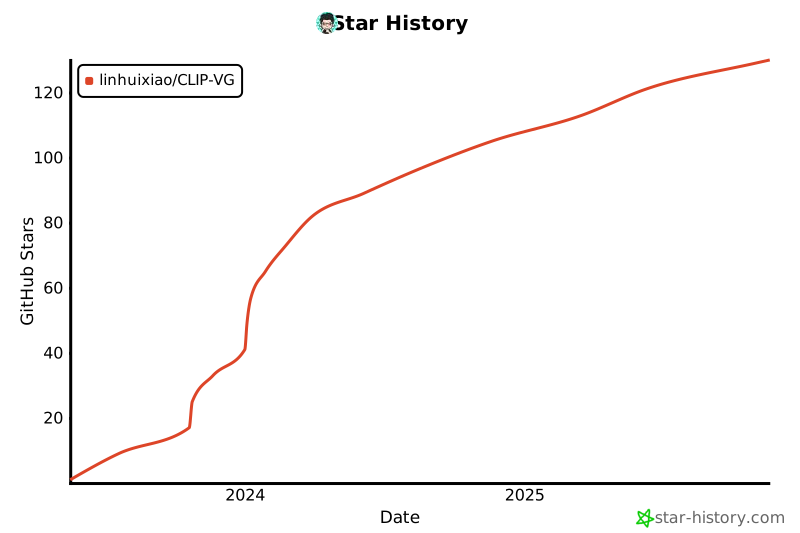
## Star History
[](https://star-history.com/#linhuixiao/CLIP-VG&Date)
|