# HOTFormerLoc: Hierarchical Octree Transformer for Versatile Lidar Place Recognition Across Ground and Aerial Views
### What's new ###
* [2025-07-31] HOTFormerLoc v1.1.0 release, fixing significant memory consumption and batch construction time in certain instances.
* [2025-03-26] Training and evaluation code released. CS-Wild-Places dataset released.
## Description
This is the official repository for the paper:
**HOTFormerLoc: Hierarchical Octree Transformer for Versatile Lidar Place Recognition Across Ground and Aerial Views**, CVPR 2025 by *Ethan Griffiths, Maryam Haghighat, Simon Denman, Clinton Fookes, and Milad Ramezani*\
[[**Website**](https://csiro-robotics.github.io/HOTFormerLoc)] [[**arXiv**](https://arxiv.org/abs/2503.08140)] [[**CS-Wild-Places Dataset**](https://data.csiro.au/collection/csiro:64896)] [[**CS-Wild-Places README**](https://github.com/csiro-robotics/HOTFormerLoc/blob/main/media/CS_Wild_Places_README.pdf)]

*HOTFormerLoc Architecture*
We present **HOTFormerLoc**, a novel and versatile **H**ierarchical **O**ctree-based **T**rans**Former** for large-scale 3D place recognition. We propose an octree-based multi-scale attention mechanism that captures spatial and semantic features across granularities, making it suitable for both ground-to-ground and ground-to-aerial scenarios across urban and forest environments.
In addition, we introduce our novel dataset: [**CS-Wild-Places**](https://data.csiro.au/collection/csiro:64896), a 3D cross-source dataset featuring point cloud data from aerial and ground lidar scans captured in four dense forests. Point clouds in CS-Wild-Places contain representational gaps and distinctive attributes such as varying point densities and noise patterns, making it a challenging benchmark for cross-view localisation in the wild.

*CS-Wild-Places dataset. (Top row) birds eye view of aerial global maps from all four forests.
(Bottom row) sample ground and aerial submap from each forest.*
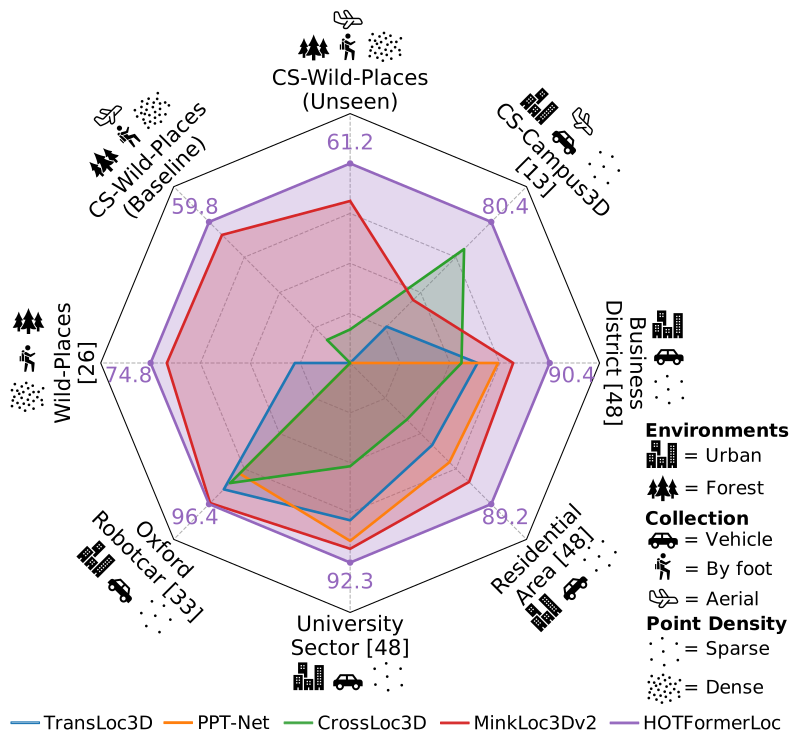
Our results demonstrate that HOTFormerLoc achieves a top-1 average recall improvement of 5.5% – 11.5% on the CS-Wild-Places benchmark. Furthermore, it consistently outperforms SOTA 3D place recognition methods, with an average performance gain of 4.9% on well established urban and forest datasets.
 ### Citation
If you find this work useful, please consider citing:
```
@InProceedings{HOTFormerLoc,
author = {Griffiths, Ethan and Haghighat, Maryam and Denman, Simon and Fookes, Clinton and Ramezani, Milad},
title = {{HOTFormerLoc}: {Hierarchical Octree Transformer} for {Versatile Lidar Place Recognition Across Ground} and {Aerial Views}},
booktitle = {2025 {IEEE}/{CVF Conference} on {Computer Vision} and {Pattern Recognition} ({CVPR})},
year = {2025},
month = {June},
}
```
## Environment and Dependencies
Code was tested using Python 3.11 with PyTorch 2.1.1 and CUDA 12.1 on a Linux system. We use conda to manage dependencies (although we recommend [mamba](https://mamba.readthedocs.io/en/latest/installation/mamba-installation.html) for a much faster install).
### Installation
```
# Note: replace 'mamba' with 'conda' if using a vanilla conda install
mamba create -n hotformerloc python=3.11 -c conda-forge
mamba activate hotformerloc
mamba install 'numpy<2.0' -c conda-forge
mamba install pytorch==2.1.1 torchvision==0.16.1 pytorch-cuda=12.1 -c pytorch -c nvidia -c conda-forge
pip install -r requirements.txt
pip install libs/dwconv
```
Modify the `PYTHONPATH` environment variable to include the absolute path to the repository root folder (ensure this variable is set every time you open a new shell):
```export PYTHONPATH
export PYTHONPATH=$PYTHONPATH:
```
## Datasets
### Wild-Places
We train on the Wild-Places dataset introduced in *Wild-Places: A Large-Scale Dataset for Lidar Place Recognition in Unstructured Natural Environments* ([link](https://arxiv.org/pdf/2211.12732)).
Download the dataset [here](https://csiro-robotics.github.io/Wild-Places/#8-Download), and place or symlink the data in `data/wild_places`.
Run the following to fix the broken timestamps in the poses files:
```
cd datasets/WildPlaces
python fix_broken_timestamps.py \
--root '../../data/wild_places/data/' \
--csv_filename 'poses.csv' \
--csv_savename 'poses_fixed.csv' \
--cloud_folder 'Clouds'
python fix_broken_timestamps.py \
--root '../../data/wild_places/data/' \
--csv_filename 'poses_aligned.csv' \
--csv_savename 'poses_aligned_fixed.csv' \
--cloud_folder 'Clouds_downsampled'
```
Before network training or evaluation, run the below code to generate pickles with positive and negative point clouds for each anchor point cloud:
```
cd datasets/WildPlaces
python generate_training_tuples.py \
--root '../../data/wild_places/data/'
python generate_test_sets.py \
--root '../../data/wild_places/data/'
```
### CS-Wild-Places
We train on our novel CS-Wild-Places dataset, introduced in further detail in our [paper](https://arxiv.org/abs/2503.08140). CS-Wild-Places is built upon the ground traversals introduced by Wild-Places, so it is required to download the Wild-Places dataset alongside our data following the instructions in the above section (generating train/test pickles for Wild-Places is not required for CS-Wild-Places, so this step can be skipped). Note that the full Wild-Places dataset must be downloaded as our post-processing utilises the full resolution submaps.
Download our dataset from [CSIRO's data access portal](https://data.csiro.au/collection/csiro:64896), and place or symlink the data in `data/CS-Wild-Places` (this should point to the top-level directory, with the `data/` and `metadata/` subdirectories). Note that our experiments only require the post-processed submaps (folder `postproc_voxel_0.80m_rmground_normalised`), so you can ignore the raw submaps if space is an issue. Check the [README](./media/CS_Wild_Places_README.pdf) for further information and installation instructions for CS-Wild-Places.
Assuming you have followed the above instructions to setup Wild-Places, you can use the below command to post-process the Wild-Places ground submaps into the format required for CS-Wild-Places (set num_workers to a sensible number for your system). Note that this may take several hours depending on your CPU:
```
cd datasets/CSWildPlaces
python postprocess_wildplaces_ground.py \
--root '../../data/wild_places/data/' \
--cswildplaces_save_dir '../../data/CS-Wild-Places/data/CS-Wild-Places/postproc_voxel_0.80m_rmground_normalised' \
--remove_ground \
--downsample \
--downsample_type 'voxel' \
--voxel_size 0.8 \
--normalise \
--num_workers XX \
--verbose
```
Note that this script will generate the submaps used for the results reported in the paper, i.e. voxel downsampled, ground points removed, and normalised. We also provide a set of unnormalised submaps for convenience, and the corresponding Wild-Places ground submaps can be generated by omitting the `--normalise` option, and by setting `--cswildplaces_save_dir` to `'../../data/CS-Wild-Places/data/CS-Wild-Places/postproc_voxel_0.80m_rmground'`.
Before network training or evaluation, run the below code to generate pickles with positive and negative point clouds for each anchor point cloud:
```
cd datasets/CSWildPlaces
python generate_train_test_tuples.py \
--root '../../data/CS-Wild-Places/data/CS-Wild-Places/postproc_voxel_0.80m_rmground_normalised/' \
--eval_thresh '30' \
--pos_thresh '15' \
--neg_thresh '60' \
--buffer_thresh '30' \
--v2_only
```
Note that training and evaluation pickles are saved to the directory specified in `--root` by default.
### CS-Campus3D
We train on the CS-Campus3D dataset introduced in *CrossLoc3D: Aerial-Ground Cross-Source 3D Place Recognition* ([link](https://arxiv.org/pdf/2303.17778)).
Download the dataset [here](https://drive.google.com/file/d/1yxVicykRMg_HAfZG2EQUl1R3_wxpxStd/view?usp=sharing), and place or symlink the data in `data/benchmark_datasets_cs_campus3d`.
Run the below commands to convert the CS_Campus3D train and test pickles into a suitable format for use with HOTFormerLoc.
```
cd datasets/CSCampus3D
python save_queries_HOTFormerLoc_format.py
```
### Oxford RobotCar
We trained on a subset of Oxford RobotCar and the In-house (U.S., R.A., B.D.) datasets introduced in
*PointNetVLAD: Deep Point Cloud Based Retrieval for Large-Scale Place Recognition* ([link](https://arxiv.org/pdf/1804.03492)).
There are two training datasets:
- Baseline Dataset - consists of a training subset of Oxford RobotCar
- Refined Dataset - consists of training subset of Oxford RobotCar and training subset of In-house
We report results on the Baseline set in the paper.
For dataset description see the PointNetVLAD paper or github repository ([link](https://github.com/mikacuy/pointnetvlad)).
You can download the dataset from
[here](https://drive.google.com/open?id=1rflmyfZ1v9cGGH0RL4qXRrKhg-8A-U9q)
([alternative link](https://drive.google.com/file/d/1-1HA9Etw2PpZ8zHd3cjrfiZa8xzbp41J/view?usp=sharing)), then place or symlink the data in `data/benchmark_datasets`.
Before network training or evaluation, run the below code to generate pickles with positive and negative point clouds for each anchor point cloud.
```generate pickles
cd datasets/pointnetvlad
# Generate training tuples for the Baseline Dataset
python generate_training_tuples_baseline.py --dataset_root '../../data/benchmark_datasets'
# (Optionally) Generate training tuples for the Refined Dataset
python generate_training_tuples_refine.py --dataset_root '../../data/benchmark_datasets'
# Generate evaluation tuples
python generate_test_sets.py --dataset_root '../../data/benchmark_datasets'
```
## Training
To train **HOTFormerLoc**, download the datasets and generate training pickles as described above for any dataset you wish to train on.
The configuration files for each dataset can be found in `config/`.
Set the `dataset_folder` parameter to the dataset root folder (only necessary if you have issues with the default relative path).
If running out of GPU memory, decrease `batch_split_size` and `val_batch_size` parameter value. If running out of RAM, you may need to decrease the `batch_size` parameter or try reducing `num_workers` to 1, but note that a smaller batch size may slightly reduce performance. We use wandb for logging by default, but this can be disabled in the config.
To train the network, run:
```
cd training
# To train HOTFormerLoc on CS-Wild-Places
python train.py --config ../config/config_cs-wild-places.txt --model_config ../models/hotformerloc_cs-wild-places_cfg.txt
# To train HOTFormerLoc on Wild-Places
python train.py --config ../config/config_wild-places.txt --model_config ../models/hotformerloc_wild-places_cfg.txt
# To train HOTFormerLoc on CS-Campus3D
python train.py --config ../config/config_cs-campus3d.txt --model_config ../models/hotformerloc_cs-campus3d_cfg.txt
# To train HOTFormerLoc on Oxford RobotCar
python train.py --config ../config/config_oxford.txt --model_config ../models/hotformerloc_oxford_cfg.txt
```
If training on a SLURM cluster, we provide the `submitit_train_job_single_node.py` script to automate training job submission, with support for automatic checkpointing and resubmission on job timeout. Make sure to set job parameters appropriately for your cluster.
### Pre-trained Weights
Pre-trained weights for HOTFormerLoc and other experiments can be downloaded and placed in the `weights` directory. You can download them individually below, or download and extract all from [this link](https://www.dropbox.com/scl/fi/qjyh966styqlye38a4c37/pretrained_weights.tar.gz?rlkey=qkuhupf3og7mfkfid8dts7xej&st=wx8q2v68&dl=0).
| Model | Dataset | Weights Download |
|--------------|-----------------|--------------------------------------------------------------------------------------------------------------------------------------------------------------------------|
| HOTFormerLoc | CS-Wild-Places | [hotformerloc_cs-wild-places.pth](https://www.dropbox.com/scl/fi/bcgcmbyic591f3bviib64/hotformerloc_cs-wild-places.pth?rlkey=vrw0seq6nfbsihijbhqatll2u&st=d7enawjw&dl=0) |
| HOTFormerLoc | CS-Campus3D | [hotformerloc_cs-campus3D.pth](https://www.dropbox.com/scl/fi/l9jyn5310gjf80zw35v7z/hotformerloc_cs-campus3d.pth?rlkey=s0bpcysyc1xt2357shhclpnlw&st=zhh679b9&dl=0) |
| HOTFormerLoc | Wild-Places | [hotformerloc_wild-places.pth](https://www.dropbox.com/scl/fi/yd94iy9dq6k1m312ifnyx/hotformerloc_wild-places.pth?rlkey=5ndv0p48c7hyjvah90eab1l1e&st=zl1716hh&dl=0) |
| HOTFormerLoc | Oxford RobotCar | [hotformerloc_oxford.pth](https://www.dropbox.com/scl/fi/4r3470zo9zomkyjys5nrm/hotformerloc_oxford.pth?rlkey=eocfo3yvmhuqqgsmjtypgf78s&st=ybhzcj6y&dl=0) |
| MinkLoc3Dv2 | CS-Wild-Places | [minkloc3dv2_cs-wild-places.pth](https://www.dropbox.com/scl/fi/2w4l8gv7qbmp0lh4eztsf/minkloc3dv2_cs-wild-places.pth?rlkey=udxvtkr6yfgdnyizra4gmw0qa&st=p0evrh61&dl=0) |
| CrossLoc3D | CS-Wild-Places | [crossloc3d_cs-wild-places.pth](https://www.dropbox.com/scl/fi/5ikt1jvr2fabiaw8mhqbb/crossloc3d_cs-wild-places.pth?rlkey=lb4gp2n814im3twy4zy5d67bd&st=znup5ewi&dl=0) |
| LoGG3D-Net | CS-Wild-Places | [logg3dnet_cs-wild-places.pth](https://www.dropbox.com/scl/fi/51se5akdyg35xy2dsrosj/logg3dnet_cs-wild-places.pth?rlkey=4nvvp8gw656wdbj3081jzcn0i&st=n5ytpnzc&dl=0) |
## Evaluation
To evaluate the pretrained models run the following commands:
```
cd eval
# To evaluate HOTFormerLoc trained on CS-Wild-Places
python pnv_evaluate.py --config ../config/config_cs-wild-places.txt --model_config ../models/hotformerloc_cs-wild-places_cfg.txt --weights ../weights/hotformerloc_cs-wild-places.pth
# To evaluate HOTFormerLoc trained on Wild-Places
python pnv_evaluate.py --config ../config/config_wild-places.txt --model_config ../models/hotformerloc_wild-places_cfg.txt --weights ../weights/hotformerloc_wild-places.pth
# To evaluate HOTFormerLoc trained on CS-Campus3D
python pnv_evaluate.py --config ../config/config_cs-campus3d.txt --model_config ../models/hotformerloc_cs-campus3d_cfg.txt --weights ../weights/hotformerloc_cs-campus3d.pth
# To evaluate HOTFormerLoc trained on Oxford RobotCar
python pnv_evaluate.py --config ../config/config_oxford.txt --model_config ../models/hotformerloc_oxford_cfg.txt --weights ../weights/hotformerloc_oxford.pth
```
Below are the results for all evaluated models on CS-Wild-Places:

*Comparison of SOTA on CS-Wild-Places Baseline evaluation set.*

*Comparison of SOTA on CS-Wild-Places Unseen evaluation set.*
See the paper for full results and comparison with SOTA on all datasets.
## Acknowledgements
Special thanks to the authors of [MinkLoc3Dv2](https://github.com/jac99/MinkLoc3Dv2) and [OctFormer](https://github.com/octree-nn/octformer) for their excellent code, which formed the foundation of this codebase. We would also like to thank the authors of [Wild-Places](https://csiro-robotics.github.io/Wild-Places/) for their fantastic dataset which serves as the base that CS-Wild-Places is built upon.
### Citation
If you find this work useful, please consider citing:
```
@InProceedings{HOTFormerLoc,
author = {Griffiths, Ethan and Haghighat, Maryam and Denman, Simon and Fookes, Clinton and Ramezani, Milad},
title = {{HOTFormerLoc}: {Hierarchical Octree Transformer} for {Versatile Lidar Place Recognition Across Ground} and {Aerial Views}},
booktitle = {2025 {IEEE}/{CVF Conference} on {Computer Vision} and {Pattern Recognition} ({CVPR})},
year = {2025},
month = {June},
}
```
## Environment and Dependencies
Code was tested using Python 3.11 with PyTorch 2.1.1 and CUDA 12.1 on a Linux system. We use conda to manage dependencies (although we recommend [mamba](https://mamba.readthedocs.io/en/latest/installation/mamba-installation.html) for a much faster install).
### Installation
```
# Note: replace 'mamba' with 'conda' if using a vanilla conda install
mamba create -n hotformerloc python=3.11 -c conda-forge
mamba activate hotformerloc
mamba install 'numpy<2.0' -c conda-forge
mamba install pytorch==2.1.1 torchvision==0.16.1 pytorch-cuda=12.1 -c pytorch -c nvidia -c conda-forge
pip install -r requirements.txt
pip install libs/dwconv
```
Modify the `PYTHONPATH` environment variable to include the absolute path to the repository root folder (ensure this variable is set every time you open a new shell):
```export PYTHONPATH
export PYTHONPATH=$PYTHONPATH:
```
## Datasets
### Wild-Places
We train on the Wild-Places dataset introduced in *Wild-Places: A Large-Scale Dataset for Lidar Place Recognition in Unstructured Natural Environments* ([link](https://arxiv.org/pdf/2211.12732)).
Download the dataset [here](https://csiro-robotics.github.io/Wild-Places/#8-Download), and place or symlink the data in `data/wild_places`.
Run the following to fix the broken timestamps in the poses files:
```
cd datasets/WildPlaces
python fix_broken_timestamps.py \
--root '../../data/wild_places/data/' \
--csv_filename 'poses.csv' \
--csv_savename 'poses_fixed.csv' \
--cloud_folder 'Clouds'
python fix_broken_timestamps.py \
--root '../../data/wild_places/data/' \
--csv_filename 'poses_aligned.csv' \
--csv_savename 'poses_aligned_fixed.csv' \
--cloud_folder 'Clouds_downsampled'
```
Before network training or evaluation, run the below code to generate pickles with positive and negative point clouds for each anchor point cloud:
```
cd datasets/WildPlaces
python generate_training_tuples.py \
--root '../../data/wild_places/data/'
python generate_test_sets.py \
--root '../../data/wild_places/data/'
```
### CS-Wild-Places
We train on our novel CS-Wild-Places dataset, introduced in further detail in our [paper](https://arxiv.org/abs/2503.08140). CS-Wild-Places is built upon the ground traversals introduced by Wild-Places, so it is required to download the Wild-Places dataset alongside our data following the instructions in the above section (generating train/test pickles for Wild-Places is not required for CS-Wild-Places, so this step can be skipped). Note that the full Wild-Places dataset must be downloaded as our post-processing utilises the full resolution submaps.
Download our dataset from [CSIRO's data access portal](https://data.csiro.au/collection/csiro:64896), and place or symlink the data in `data/CS-Wild-Places` (this should point to the top-level directory, with the `data/` and `metadata/` subdirectories). Note that our experiments only require the post-processed submaps (folder `postproc_voxel_0.80m_rmground_normalised`), so you can ignore the raw submaps if space is an issue. Check the [README](./media/CS_Wild_Places_README.pdf) for further information and installation instructions for CS-Wild-Places.
Assuming you have followed the above instructions to setup Wild-Places, you can use the below command to post-process the Wild-Places ground submaps into the format required for CS-Wild-Places (set num_workers to a sensible number for your system). Note that this may take several hours depending on your CPU:
```
cd datasets/CSWildPlaces
python postprocess_wildplaces_ground.py \
--root '../../data/wild_places/data/' \
--cswildplaces_save_dir '../../data/CS-Wild-Places/data/CS-Wild-Places/postproc_voxel_0.80m_rmground_normalised' \
--remove_ground \
--downsample \
--downsample_type 'voxel' \
--voxel_size 0.8 \
--normalise \
--num_workers XX \
--verbose
```
Note that this script will generate the submaps used for the results reported in the paper, i.e. voxel downsampled, ground points removed, and normalised. We also provide a set of unnormalised submaps for convenience, and the corresponding Wild-Places ground submaps can be generated by omitting the `--normalise` option, and by setting `--cswildplaces_save_dir` to `'../../data/CS-Wild-Places/data/CS-Wild-Places/postproc_voxel_0.80m_rmground'`.
Before network training or evaluation, run the below code to generate pickles with positive and negative point clouds for each anchor point cloud:
```
cd datasets/CSWildPlaces
python generate_train_test_tuples.py \
--root '../../data/CS-Wild-Places/data/CS-Wild-Places/postproc_voxel_0.80m_rmground_normalised/' \
--eval_thresh '30' \
--pos_thresh '15' \
--neg_thresh '60' \
--buffer_thresh '30' \
--v2_only
```
Note that training and evaluation pickles are saved to the directory specified in `--root` by default.
### CS-Campus3D
We train on the CS-Campus3D dataset introduced in *CrossLoc3D: Aerial-Ground Cross-Source 3D Place Recognition* ([link](https://arxiv.org/pdf/2303.17778)).
Download the dataset [here](https://drive.google.com/file/d/1yxVicykRMg_HAfZG2EQUl1R3_wxpxStd/view?usp=sharing), and place or symlink the data in `data/benchmark_datasets_cs_campus3d`.
Run the below commands to convert the CS_Campus3D train and test pickles into a suitable format for use with HOTFormerLoc.
```
cd datasets/CSCampus3D
python save_queries_HOTFormerLoc_format.py
```
### Oxford RobotCar
We trained on a subset of Oxford RobotCar and the In-house (U.S., R.A., B.D.) datasets introduced in
*PointNetVLAD: Deep Point Cloud Based Retrieval for Large-Scale Place Recognition* ([link](https://arxiv.org/pdf/1804.03492)).
There are two training datasets:
- Baseline Dataset - consists of a training subset of Oxford RobotCar
- Refined Dataset - consists of training subset of Oxford RobotCar and training subset of In-house
We report results on the Baseline set in the paper.
For dataset description see the PointNetVLAD paper or github repository ([link](https://github.com/mikacuy/pointnetvlad)).
You can download the dataset from
[here](https://drive.google.com/open?id=1rflmyfZ1v9cGGH0RL4qXRrKhg-8A-U9q)
([alternative link](https://drive.google.com/file/d/1-1HA9Etw2PpZ8zHd3cjrfiZa8xzbp41J/view?usp=sharing)), then place or symlink the data in `data/benchmark_datasets`.
Before network training or evaluation, run the below code to generate pickles with positive and negative point clouds for each anchor point cloud.
```generate pickles
cd datasets/pointnetvlad
# Generate training tuples for the Baseline Dataset
python generate_training_tuples_baseline.py --dataset_root '../../data/benchmark_datasets'
# (Optionally) Generate training tuples for the Refined Dataset
python generate_training_tuples_refine.py --dataset_root '../../data/benchmark_datasets'
# Generate evaluation tuples
python generate_test_sets.py --dataset_root '../../data/benchmark_datasets'
```
## Training
To train **HOTFormerLoc**, download the datasets and generate training pickles as described above for any dataset you wish to train on.
The configuration files for each dataset can be found in `config/`.
Set the `dataset_folder` parameter to the dataset root folder (only necessary if you have issues with the default relative path).
If running out of GPU memory, decrease `batch_split_size` and `val_batch_size` parameter value. If running out of RAM, you may need to decrease the `batch_size` parameter or try reducing `num_workers` to 1, but note that a smaller batch size may slightly reduce performance. We use wandb for logging by default, but this can be disabled in the config.
To train the network, run:
```
cd training
# To train HOTFormerLoc on CS-Wild-Places
python train.py --config ../config/config_cs-wild-places.txt --model_config ../models/hotformerloc_cs-wild-places_cfg.txt
# To train HOTFormerLoc on Wild-Places
python train.py --config ../config/config_wild-places.txt --model_config ../models/hotformerloc_wild-places_cfg.txt
# To train HOTFormerLoc on CS-Campus3D
python train.py --config ../config/config_cs-campus3d.txt --model_config ../models/hotformerloc_cs-campus3d_cfg.txt
# To train HOTFormerLoc on Oxford RobotCar
python train.py --config ../config/config_oxford.txt --model_config ../models/hotformerloc_oxford_cfg.txt
```
If training on a SLURM cluster, we provide the `submitit_train_job_single_node.py` script to automate training job submission, with support for automatic checkpointing and resubmission on job timeout. Make sure to set job parameters appropriately for your cluster.
### Pre-trained Weights
Pre-trained weights for HOTFormerLoc and other experiments can be downloaded and placed in the `weights` directory. You can download them individually below, or download and extract all from [this link](https://www.dropbox.com/scl/fi/qjyh966styqlye38a4c37/pretrained_weights.tar.gz?rlkey=qkuhupf3og7mfkfid8dts7xej&st=wx8q2v68&dl=0).
| Model | Dataset | Weights Download |
|--------------|-----------------|--------------------------------------------------------------------------------------------------------------------------------------------------------------------------|
| HOTFormerLoc | CS-Wild-Places | [hotformerloc_cs-wild-places.pth](https://www.dropbox.com/scl/fi/bcgcmbyic591f3bviib64/hotformerloc_cs-wild-places.pth?rlkey=vrw0seq6nfbsihijbhqatll2u&st=d7enawjw&dl=0) |
| HOTFormerLoc | CS-Campus3D | [hotformerloc_cs-campus3D.pth](https://www.dropbox.com/scl/fi/l9jyn5310gjf80zw35v7z/hotformerloc_cs-campus3d.pth?rlkey=s0bpcysyc1xt2357shhclpnlw&st=zhh679b9&dl=0) |
| HOTFormerLoc | Wild-Places | [hotformerloc_wild-places.pth](https://www.dropbox.com/scl/fi/yd94iy9dq6k1m312ifnyx/hotformerloc_wild-places.pth?rlkey=5ndv0p48c7hyjvah90eab1l1e&st=zl1716hh&dl=0) |
| HOTFormerLoc | Oxford RobotCar | [hotformerloc_oxford.pth](https://www.dropbox.com/scl/fi/4r3470zo9zomkyjys5nrm/hotformerloc_oxford.pth?rlkey=eocfo3yvmhuqqgsmjtypgf78s&st=ybhzcj6y&dl=0) |
| MinkLoc3Dv2 | CS-Wild-Places | [minkloc3dv2_cs-wild-places.pth](https://www.dropbox.com/scl/fi/2w4l8gv7qbmp0lh4eztsf/minkloc3dv2_cs-wild-places.pth?rlkey=udxvtkr6yfgdnyizra4gmw0qa&st=p0evrh61&dl=0) |
| CrossLoc3D | CS-Wild-Places | [crossloc3d_cs-wild-places.pth](https://www.dropbox.com/scl/fi/5ikt1jvr2fabiaw8mhqbb/crossloc3d_cs-wild-places.pth?rlkey=lb4gp2n814im3twy4zy5d67bd&st=znup5ewi&dl=0) |
| LoGG3D-Net | CS-Wild-Places | [logg3dnet_cs-wild-places.pth](https://www.dropbox.com/scl/fi/51se5akdyg35xy2dsrosj/logg3dnet_cs-wild-places.pth?rlkey=4nvvp8gw656wdbj3081jzcn0i&st=n5ytpnzc&dl=0) |
## Evaluation
To evaluate the pretrained models run the following commands:
```
cd eval
# To evaluate HOTFormerLoc trained on CS-Wild-Places
python pnv_evaluate.py --config ../config/config_cs-wild-places.txt --model_config ../models/hotformerloc_cs-wild-places_cfg.txt --weights ../weights/hotformerloc_cs-wild-places.pth
# To evaluate HOTFormerLoc trained on Wild-Places
python pnv_evaluate.py --config ../config/config_wild-places.txt --model_config ../models/hotformerloc_wild-places_cfg.txt --weights ../weights/hotformerloc_wild-places.pth
# To evaluate HOTFormerLoc trained on CS-Campus3D
python pnv_evaluate.py --config ../config/config_cs-campus3d.txt --model_config ../models/hotformerloc_cs-campus3d_cfg.txt --weights ../weights/hotformerloc_cs-campus3d.pth
# To evaluate HOTFormerLoc trained on Oxford RobotCar
python pnv_evaluate.py --config ../config/config_oxford.txt --model_config ../models/hotformerloc_oxford_cfg.txt --weights ../weights/hotformerloc_oxford.pth
```
Below are the results for all evaluated models on CS-Wild-Places:

*Comparison of SOTA on CS-Wild-Places Baseline evaluation set.*

*Comparison of SOTA on CS-Wild-Places Unseen evaluation set.*
See the paper for full results and comparison with SOTA on all datasets.
## Acknowledgements
Special thanks to the authors of [MinkLoc3Dv2](https://github.com/jac99/MinkLoc3Dv2) and [OctFormer](https://github.com/octree-nn/octformer) for their excellent code, which formed the foundation of this codebase. We would also like to thank the authors of [Wild-Places](https://csiro-robotics.github.io/Wild-Places/) for their fantastic dataset which serves as the base that CS-Wild-Places is built upon.