

File size: 24,323 Bytes
cd86fef c7396da cd86fef c7396da cd86fef cf11e7b cd86fef cf11e7b cd86fef cf11e7b 3f4c141 cd86fef 3f4c141 cd86fef cf11e7b 3f4c141 cd86fef 3f4c141 cd86fef 3f4c141 cd86fef c7396da cd86fef 3f4c141 cd86fef c7396da cd86fef 3f4c141 cd86fef 3f4c141 cd86fef 3f4c141 cd86fef 3f4c141 cd86fef 3f4c141 cd86fef 3f4c141 cd86fef 3f4c141 c7396da cf11e7b 3f4c141 c7396da cd86fef 3f4c141 cd86fef 3f4c141 cd86fef c7396da cd86fef | 1 2 3 4 5 6 7 8 9 10 11 12 13 14 15 16 17 18 19 20 21 22 23 24 25 26 27 28 29 30 31 32 33 34 35 36 37 38 39 40 41 42 43 44 45 46 47 48 49 50 51 52 53 54 55 56 57 58 59 60 61 62 63 64 65 66 67 68 69 70 71 72 73 74 75 76 77 78 79 80 81 82 83 84 85 86 87 88 89 90 91 92 93 94 95 96 97 98 99 100 101 102 103 104 105 106 107 108 109 110 111 112 113 114 115 116 117 118 119 120 121 122 123 124 125 126 127 128 129 130 131 132 133 134 135 136 137 138 139 140 141 142 143 144 145 146 147 148 149 150 151 152 153 154 155 156 157 158 159 160 161 162 163 164 165 166 167 168 169 170 171 172 173 174 175 176 177 178 179 180 181 182 183 184 185 186 187 188 189 190 191 192 193 194 195 196 197 198 199 200 201 202 203 204 205 206 207 208 209 210 211 212 213 214 215 216 217 218 219 220 221 222 223 224 225 226 227 228 229 230 231 232 233 234 235 236 237 238 239 240 241 242 243 244 245 246 247 248 249 250 251 252 253 254 255 256 257 258 259 260 261 262 263 264 265 266 267 268 269 270 271 272 273 274 275 276 277 278 279 280 281 282 283 284 285 286 287 288 289 290 291 292 293 294 295 296 297 298 299 300 301 302 303 304 305 306 307 308 309 310 311 312 313 314 315 316 317 318 319 320 321 322 323 324 325 326 327 328 329 330 331 332 333 334 335 336 337 338 339 340 341 342 343 344 345 346 347 348 349 350 351 352 353 354 355 356 357 358 359 360 361 362 363 364 365 366 367 368 369 370 371 372 373 374 375 376 377 378 379 380 381 382 383 384 385 386 387 388 389 390 391 392 393 394 395 396 397 398 399 400 401 402 403 404 405 406 407 408 409 410 411 412 413 414 415 416 417 418 419 420 421 422 423 424 425 426 427 428 429 430 431 432 433 434 435 436 437 438 439 440 441 442 443 444 | ---
license: other
license_name: glm-5.3
license_link: https://huggingface.co/orcarouter/GLM-5.3-MLX/blob/main/LICENSE
base_model: zai-org/GLM-5.3
base_model_relation: quantized
pipeline_tag: text-generation
library_name: mlx
language:
- en
- zh
tags:
- glm
- glm-5
- glm_moe_dsa
- mlx
- apple-silicon
- quantized
- 2-8bit
- moe
- orcasaq
- dynamic-quant
- reasoning
- coding
- agentic
---
<div align="center">
<a href="https://www.orcarouter.ai" target="_blank">
<img src="https://www.orcarouter.ai/orca-logo-classic.png" alt="OrcaRouter" width="110">
</a>
<h1>GLM-5.3-MLX</h1>
<p><em>An MLX build of the official GLM-5.3 — 2 / 3 / 4 / 6-bit OrcaSAQ quant for Apple Silicon & the MLX CUDA backend</em></p>
<p>
<a href="https://www.orcarouter.ai"><img src="https://img.shields.io/badge/Website-orcarouter.ai-1E6FEB" alt="Website"></a>
<a href="https://www.orcarouter.ai/models"><img src="https://img.shields.io/badge/OrcaRouter-Model%20Catalog-2EA043" alt="Model Catalog"></a>
<a href="https://www.orcarouter.ai/models/z-ai/glm-5.3"><img src="https://img.shields.io/badge/OrcaRouter-Hosted%20API-6F42C1" alt="Hosted API"></a>
<a href="./LICENSE"><img src="https://img.shields.io/badge/License-GLM--5.3-4C8BF5" alt="License"></a>
<img src="https://img.shields.io/badge/Format-MLX-00A67E" alt="MLX">
<img src="https://img.shields.io/badge/Quants-2%20|%203%20|%204%20|%206--bit-FF8800" alt="Quants">
<img src="https://img.shields.io/badge/Method-OrcaSAQ-E67E22" alt="OrcaSAQ">
<img src="https://img.shields.io/badge/Params-753B%20%2F%20~39B%20active-9B59B6" alt="Params">
<img src="https://img.shields.io/badge/Context-1M-2EA043" alt="Context">
<a href="https://github.com/Continuum-AI-Corp/Orca-Code-Review"><img src="https://img.shields.io/badge/OrcaCode-Review-181717?logo=github" alt="OrcaCode Review"></a>
</p>
<p><strong>One Gateway. Every Model.</strong> — Route Smarter · Ship Safer · Spend Less.<br>
<a href="https://www.orcarouter.ai/models/z-ai/glm-5.3">GLM-5.3 on OrcaRouter →</a></p>
<p>
<a href="https://www.orcarouter.ai">Website</a> ·
<a href="https://www.orcarouter.ai/models">Model Catalog</a> ·
<a href="https://www.orcarouter.ai/models/z-ai/glm-5.3">Model API</a> ·
<a href="https://github.com/Continuum-AI-Corp">GitHub</a> ·
<a href="https://github.com/Continuum-AI-Corp/Orca-Code-Review">OrcaCode Review</a> ·
<a href="https://discord.gg/yAh6Tex6kx">Discord</a> ·
<a href="https://x.com/OrcaRouter">X</a>
</p>
</div>
---
> An **MLX** build of the official [`zai-org/GLM-5.3`](https://huggingface.co/zai-org/GLM-5.3)
> — Z.AI's **753B-total / ~39B-active** MoE flagship for frontier coding and long-horizon
> agentic engineering, built on the **`glm_moe_dsa`** architecture (MLA + DeepSeek-style
> **sparse attention with a shared indexer**, 1M context) — quantized to **MLX** for
> **Apple Silicon** and the MLX CUDA backend. Four precisions (**2 / 3 / 4 / 6-bit**) ship as
> subfolders with the **4-bit build mirrored at the repo root**, produced with **OrcaSAQ
> (Sensitivity-Aware Quantization)**: calibration-free and architecture-aware, giving sensitive
> tensors more bits (shared experts `+2`, `down_proj` `+1`) while **attention stays at 8-bit and
> the DSA indexer stays in BF16** in every build. Browse all models in the
> [OrcaRouter Model Catalog](https://www.orcarouter.ai/models); deployed as API
> [here](https://www.orcarouter.ai/models/z-ai/glm-5.3). Put this model to work reviewing your
> pull requests with **[OrcaCode Review](https://github.com/Continuum-AI-Corp/Orca-Code-Review)**.
---
## Available quantizations
| Folder | Expert base bits | Group size | Size | Min RAM | Quality vs FP8 |
|---|---|---|---:|---:|---|
| `6-bit/` | 6 | 64 | **671 GB** (625 GiB) | ~700 GB | **Near-lossless** — best quality |
| `4-bit/` | 4 | 64 | **459 GB** (427 GiB) | ~480 GB | Very good — **recommended default** |
| `3-bit/` | 3 | 64 | **368 GB** (343 GiB) | ~390 GB | Good — aggressive but usable |
| `2-bit/` | 2 | 32 | **322 GB** (300 GiB) | ~340 GB | Aggressive — best-effort |
The **repository root is a mirror of `4-bit/`**, so `orcarouter/GLM-5.3-MLX` resolves to the recommended default with no subfolder needed.
> Quantized from the official **FP8** release (756 GB, block-wise `e4m3` 128×128, dynamic activation scheme). Bit-widths above are the **expert base** precision; the OrcaSAQ policy below raises sensitive tensors above the base. Group size is 64 everywhere except the `2-bit` routed experts, which use 32 — at two bits the finer grid is what keeps the build usable (see the fidelity table).
**Hardware reality check.** This is a 753B model; even the smallest build is 322 GB. On a **512 GB M3 Ultra Mac Studio**, `2-bit` and `3-bit` leave comfortable KV headroom and `4-bit` fits but runs tight — raise the wired-memory limit and keep the context bounded. `6-bit` does not fit any single Apple Silicon machine today: run it across two 512 GB boxes with `mlx.distributed`, or on a CUDA host (8×H200 = 1128 GB) via the MLX CUDA backend. If the hardware isn't there, the [hosted API](https://www.orcarouter.ai/models/z-ai/glm-5.3) needs no local memory at all.
No 8-bit build was produced: `6-bit` already lands at cosine ≥ 0.9997 against FP8, and 8-bit expert weights would exceed the FP8 source in size.
---
## OrcaSAQ — Sensitivity-Aware Quantization
OrcaSAQ is a **calibration-free, architecture-aware mixed-precision quantization method** designed to preserve model quality while aggressively reducing memory footprint.
Instead of running expensive calibration datasets or per-layer sensitivity searches, OrcaSAQ uses **architectural and tensor-role priors** to determine which weights are most sensitive to quantization. Critical components receive higher precision, while more quantization-tolerant tensors remain at the target base precision.
For MoE architectures, for example, OrcaSAQ can preserve shared experts at **base +2 bits**, `down_proj` at **base +1 bit**, keep `gate_proj` and `up_proj` at the base precision, and retain sensitive non-quantized components at their source dtype.
The result is a **fast, deterministic, zero-calibration quantization pipeline** that can be applied to new architectures without costly dataset-driven optimization.
**Architecture-aware. Calibration-free. Quality-preserving.**
Two properties of this checkpoint drive the whole recipe:
- **Attention is FP8 upstream** (unlike GLM-5.3-Flash, where it shipped BF16), so it *is* quantizable — and it is **pinned to 8-bit in every build**, never dropped to the base tier.
- **The DSA indexer is kept in BF16 everywhere.** It selects which tokens attention attends to, so it sits directly on the long-context path and is left at full precision.
Everything that was *not* FP8 in the base release — the indexer, router `gate` weights, the FP32 `e_score_correction_bias`, every norm, `embed_tokens` and `lm_head` — is carried through at its **original dtype**, never a lossy cast.
### Bit allocation for GLM-5.3
| Component | Tensors | Params | 2-bit | 3-bit | 4-bit | 6-bit | Policy |
|---|---:|---:|---|---|---|---|---|
| Expert `gate_proj` / `up_proj` | 38,400 | 483.2B | 2 `gs32` | 3 | 4 | 6 | base |
| Expert `down_proj` | 19,200 | 241.6B | 3 `gs32` | 4 | 5 | 8 | base **+1** |
| Shared expert `gate` / `up` / `down` | 225 | 2.83B | 4 | 5 | 6 | 8 | base **+2** |
| MLA `q_a` / `q_b` / `kv_a_with_mqa` / `kv_b` / `o_proj` | 390 | 12.87B | **8** | **8** | **8** | **8** | pinned 8-bit |
| Dense-MLP `gate` / `up` / `down` (layers 0–2) | 9 | 0.68B | **6** | **6** | **6** | **6** | pinned 6-bit |
| DSA indexer `wk` / `wq_b` / `weights_proj` | 63 | 0.19B | BF16 | BF16 | BF16 | BF16 | never quantized |
| Router `gate.weight` | 75 | 0.12B | BF16 | BF16 | BF16 | BF16 | never quantized |
| Router `e_score_correction_bias` | 75 | — | FP32 | FP32 | FP32 | FP32 | never quantized |
| Norms (incl. indexer `k_norm`), `embed_tokens`, `lm_head` | 357 | 1.90B | BF16 | BF16 | BF16 | BF16 | never quantized |
**58,224 tensors are quantized** in total (97.5 % of all parameters live in the routed experts). Bits are rounded to the nearest MLX-supported width (`{2,3,4,5,6,8}`), and group size must divide the tensor's last dim — `gs64` on attention is mandatory because `qk_nope_head_dim` is 192 and `gs128` breaks mlx-lm's `kv_b → embed_q` re-quantization.
Effective width on the experts, including the FP16 scales and biases MLX stores per group:
| Build | Expert effective bpw | Experts as share of build |
|---|---:|---:|
| `2-bit` | 3.33 | 93.7 % |
| `3-bit` | 3.83 | 94.4 % |
| `4-bit` | 4.83 | 95.4 % |
| `6-bit` | 7.17 | 96.8 % |
The assignment is recorded in `config.json` → `quantization` (and mirrored to `quantization_config`) as **per-module `{group_size, bits}` overrides keyed by MLX module path** — e.g. `model.layers.3.mlp.switch_mlp.down_proj`. MLX fuses a layer's 256 routed experts into one `switch_mlp`, so **699 entries** cover all 58,224 tensors. This is what the loader reads at load time and it is **required**: the top-level `bits`/`group_size` alone would mis-shape every raised-precision tensor. A full per-tensor record is also shipped as `quantization_map.json`.
The **MTP (multi-token prediction) layer — layer 78 — is dropped**, and `num_nextn_predict_layers` is set to `0`. 791 tensors (~9.95B params) are removed; MLX runtimes drop it at load anyway.
---
## Quality vs FP8
All three tables compare each build against the full **FP8** reference (dequantized to BF16 and run
through the identical `glm_moe_dsa` forward, so the only variable is the quantization). Sizes are
decimal GB, matching the file sizes in this repo.
**Perplexity**
Measured against the **FP8 reference** on wikitext-2 test, 4 chunks × 1024 tokens
(4,092 predicted tokens). Both sides run the identical `glm_moe_dsa` forward on the
same FP8 kernels — each build's actual dequantized bytes are injected back into the
transformers model — so quantization is the only variable.
| Build | Size | PPL | ΔPPL |
|---|---:|---:|---:|
| **FP8 (ref)** | 756 GB | **1.6666** | — |
| **6-bit** | 671 GB | **1.6642** | **−0.14 %** |
| **4-bit** | 459 GB | **1.7015** | **+2.10 %** |
| **3-bit** | 368 GB | **1.8249** | **+9.50 %** |
| **2-bit** | 322 GB | **2.6385** | **+58.3 %** |
`6-bit` lands within noise of the FP8 reference — read it as indistinguishable.
**KL divergence & Top-1 token agreement**
KLD is `KL(ref ‖ quant)` per token against the FP8 reference distribution, Top-1 is how
often the build's argmax matches the reference's. Lower KLD and higher Top-1 = closer to
the original. Same corpus and token budget as the PPL table.
| Build | Size | Mean KLD | KLD p95 | Top-1 agreement |
|---|---:|---:|---:|---:|
| **FP8 (ref)** | 756 GB | — | — | 100 % |
| **6-bit** | 671 GB | **0.0295** | 0.1629 | **96.39 %** |
| **4-bit** | 459 GB | **0.0574** | 0.3049 | **95.46 %** |
| **3-bit** | 368 GB | **0.1668** | 0.9764 | **90.43 %** |
| **2-bit** | 322 GB | **0.5272** | 2.7405 | **80.18 %** |
All three measurements — weight fidelity, perplexity, and KLD/Top-1 — agree on the
ordering: `6-bit` is effectively lossless, `4-bit` costs about **2 % perplexity for 43 %
less memory** and is the recommended default, and `3-bit` holds up well at 40 % under
FP8. `2-bit` is the memory-first option — reach for it when the hardware cannot hold
anything larger.
**Weight-space fidelity** — measured on every quantized tensor at pack time (58,224 per build):
| Build | Size | Cosine sim | SNR (dB) | Rel. error |
|---|---:|---:|---:|---:|
| `6-bit` | 671 GB | **0.9998** | **37.2** | **1.7 %** |
| `4-bit` | 459 GB | **0.9968** | **22.9** | **7.6 %** |
| `3-bit` | 368 GB | **0.9865** | **16.7** | **15.7 %** |
| `2-bit` | 322 GB | **0.9517** | **11.2** | **29.7 %** |
Worst-case per build (`cos_min` / `snr_min`): `6-bit` 0.99972 / 32.5 dB · `4-bit` 0.99509 / 20.1 dB · `3-bit` 0.97869 / 13.7 dB · `2-bit` 0.92718 / 8.3 dB.
> Relative error is the mean of the **per-tensor** relative error `10^(-SNR/20)` over all 58,224 quantized tensors — not a value back-derived from the mean SNR, which would understate it (1.4 / 7.1 / 14.7 / 27.5 %).
Per role — this is where the OrcaSAQ policy shows up:
| Role | bits/gs | 2-bit cos | 3-bit cos | 4-bit cos | 6-bit cos |
|---|---|---:|---:|---:|---:|
| Expert `gate_proj`/`up_proj` | base | 0.93417 | 0.98169 | 0.99570 | 0.99975 |
| Expert `down_proj` | base +1 | 0.98510 | 0.99568 | 0.99898 | 0.99998 |
| Shared expert | base +2 | 0.99561 | 0.99896 | 0.99974 | 0.99998 |
| MLA attention | 8/64 | 0.99998 | 0.99998 | 0.99998 | 0.99998 |
| Dense MLP | 6/64 | 0.99975 | 0.99975 | 0.99975 | 0.99975 |
Cosine distribution across all quantized tensors (tight percentiles = no outlier tensors hiding behind a good mean):
| Build | min | p1 | p5 | median | p95 | max |
|---|---:|---:|---:|---:|---:|---:|
| `2-bit` | 0.92718 | 0.93133 | 0.93390 | 0.93437 | 0.98515 | 0.99999 |
| `3-bit` | 0.97869 | 0.98047 | 0.98157 | 0.98178 | 0.99571 | 0.99999 |
| `4-bit` | 0.99509 | 0.99546 | 0.99566 | 0.99571 | 0.99899 | 0.99999 |
| `6-bit` | 0.99972 | 0.99974 | 0.99975 | 0.99975 | 0.99999 | 0.99999 |
The worst tensors in every build are the same ones — early-layer routed experts (`layers.3–5`, e.g. `layers.4.mlp.experts.168.gate_proj`) — and `6-bit` still holds them above 0.9997.
**Build verification** — every build passed a structural release gate before upload:
- **accounting** — 175,242 tensors on disk, 58,224 quantized modules, `weight`/`scales`/`biases` triplets all paired
- **dtype preservation** — kept tensors byte-identical in their source dtype (FP32 router bias stays FP32; FP8 `keep` goes through a proper block dequant, never a raw cast)
- **index integrity** — `model.safetensors.index.json` resolves every tensor; `total_size` matches the shards on disk
- **config ↔ map reconstruction** — the 699 per-module overrides reproduce the full per-tensor map exactly
- **spot dequant** — randomly sampled tensors per role dequantized and compared against the golden FP8 values
- **runtime skeleton** — mlx-vlm's `glm_moe_dsa` module tree vs the post-sanitize key set: **1497/1497**, zero missing, zero extra
---
---
## Usage
### Hosted API — no download
The full-precision model is live on OrcaRouter as **`z-ai/glm-5.3`** — 1M context, 128K max output, $1.26 / $3.96 per 1M input / output tokens:
```python
import os
from openai import OpenAI
client = OpenAI(
base_url="https://api.orcarouter.ai/v1",
api_key=os.environ["ORCAROUTER_API_KEY"],
)
response = client.chat.completions.create(
model="z-ai/glm-5.3",
messages=[{"role": "user", "content": "Refactor this module and explain the tradeoffs."}],
)
print(response.choices[0].message.content)
```
**https://www.orcarouter.ai/models/z-ai/glm-5.3**
### Run it locally (mlx-vlm)
> **Use `mlx-vlm`, not `mlx-lm`.** GLM-5.3 is a text-only model, but as of **mlx-lm 0.31.3** the `glm_moe_dsa` implementation builds an indexer for *every* layer, while this checkpoint shares one indexer across four layers (`indexer_types`) — 285 tensors come up missing. **mlx-vlm 0.6.17** implements the shared-indexer layout and loads these builds as-is. Check for mlx-lm support before switching back.
```bash
pip install -U "mlx-vlm>=0.6.17"
```
The repo root is the 4-bit build, so the recommended default needs no subfolder — the excludes are what stop `hf download` from also pulling the four variant folders:
```bash
hf download orcarouter/GLM-5.3-MLX --local-dir ./GLM-5.3-MLX \
--exclude "2-bit/*" "3-bit/*" "4-bit/*" "6-bit/*"
python -m mlx_vlm.generate --model ./GLM-5.3-MLX \
--prompt "Write a Rust function that merges overlapping intervals." --max-tokens 512
```
To pick a different precision, download just that subfolder and load it from the local path:
```bash
hf download orcarouter/GLM-5.3-MLX --include "6-bit/*" --local-dir ./GLM-5.3-MLX
python -m mlx_vlm.generate --model ./GLM-5.3-MLX/6-bit \
--prompt "Write a Rust function that merges overlapping intervals." --max-tokens 512
```
Python API:
```python
from mlx_vlm import load, generate
from mlx_vlm.prompt_utils import apply_chat_template
model, processor = load("./GLM-5.3-MLX") # repo root == 4-bit
prompt = apply_chat_template(processor, model.config, "Explain MLA vs GQA in three sentences.")
print(generate(model, processor, prompt, max_tokens=512, verbose=True))
```
**Reasoning effort.** GLM-5.3's chat template takes a `reasoning_effort` variable — `low`, `high`, or `max` (the default when unset) — emitted as a system directive, plus a `clear_thinking` flag that strips prior `<think>` blocks from the history. Both pass straight through `apply_chat_template`:
```python
prompt = apply_chat_template(processor, model.config, "Port this service to async.",
reasoning_effort="low")
```
Tool calling is in the template too (`<tool_call>` / `<arg_key>` blocks, `tools=[...]`).
> **Long context.** `max_position_embeddings` is **1,048,576** (`rope_theta` 8e6). The KV cache, not the weights, is what will bite you at those lengths — budget for it, or cap it with `--max-kv-size` / quantize it with `--kv-bits`.
>
> On Apple Silicon the Metal backend is used automatically. On the Linux **CUDA** backend install `mlx[cuda]` and set `MLX_CUDA_USE_CUDNN_SDPA=0`.
---
## 🐳 Run it with OrcaCode Review
[Website](https://www.orcarouter.ai) · [GitHub](https://github.com/Continuum-AI-Corp/Orca-Code-Review)
**Models are only half the system.**
[**OrcaCode Review**](https://github.com/Continuum-AI-Corp/Orca-Code-Review) turns every model listed on [**OrcaRouter**](https://www.orcarouter.ai) into a production code-review agent:
- reviews every PR
- finds security + correctness issues
- posts inline findings
- P0/P1 can block merges
- swap models anytime
**Open model. Open harness. Open bill.**
- Website — https://www.orcarouter.ai
- GitHub — https://github.com/Continuum-AI-Corp/Orca-Code-Review
---
## Build Provenance
| | |
|---|---|
| Source | `zai-org/GLM-5.3` (FP8, 141 shards, 756 GB) |
| Quantized | 2026-08-28 |
| Toolchain | MLX 0.32.2, safetensors 0.8.0, NumPy 2.5.2 |
| Method | OrcaSAQ — calibration-free, role-based mixed precision |
| Per-build files | 140 shards + `config.json`, `quantization_map.json`, `build_manifest.json`, `fidelity_summary.json`, tokenizer, chat template |
Each folder carries its own `build_manifest.json` (exact recipe, source path, dropped-tensor count, toolchain versions) and `fidelity_summary.json` (per-role cosine/SNR with the five worst tensors named), so any claim in this card can be checked against the build itself.
---
# GLM-5.3
> Available full-precision on the OrcaRouter API as **`z-ai/glm-5.3`** —
> **https://www.orcarouter.ai/models/z-ai/glm-5.3**
---
## GLM-5.3 Highlights
GLM-5.3 uses the same base model as GLM-5.2 — every gain comes from post-training. Compared with GLM-5.2, it is much better at complex coding and long-horizon tasks:
- **Stronger coding:** the most capable open-weights model for coding, with a **50 % improvement over GLM-5.2** on Z.AI's in-house Code Bench, and open-source SOTA on public benchmarks including Terminal Bench 3.0 and Agents' Last Exam.
- **Emergent cyber capability:** state of the art on **CyberGym** for vulnerability discovery, with the largest gains further up the exploitation chain — more than doubling GLM-5.2 on exploitation benchmarks.
<div align="center">
<img src="https://raw.githubusercontent.com/zai-org/GLM-5/refs/heads/main/resources/logo.svg" width="30%" alt="GLM-5" />
</div>
---
## Official benchmarks
Reported by Z.AI for the full-precision model. These are the upstream model's numbers, not measurements of these MLX builds — see [Quality vs FP8](#quality-vs-fp8) above for how each quantization tracks the FP8 release.
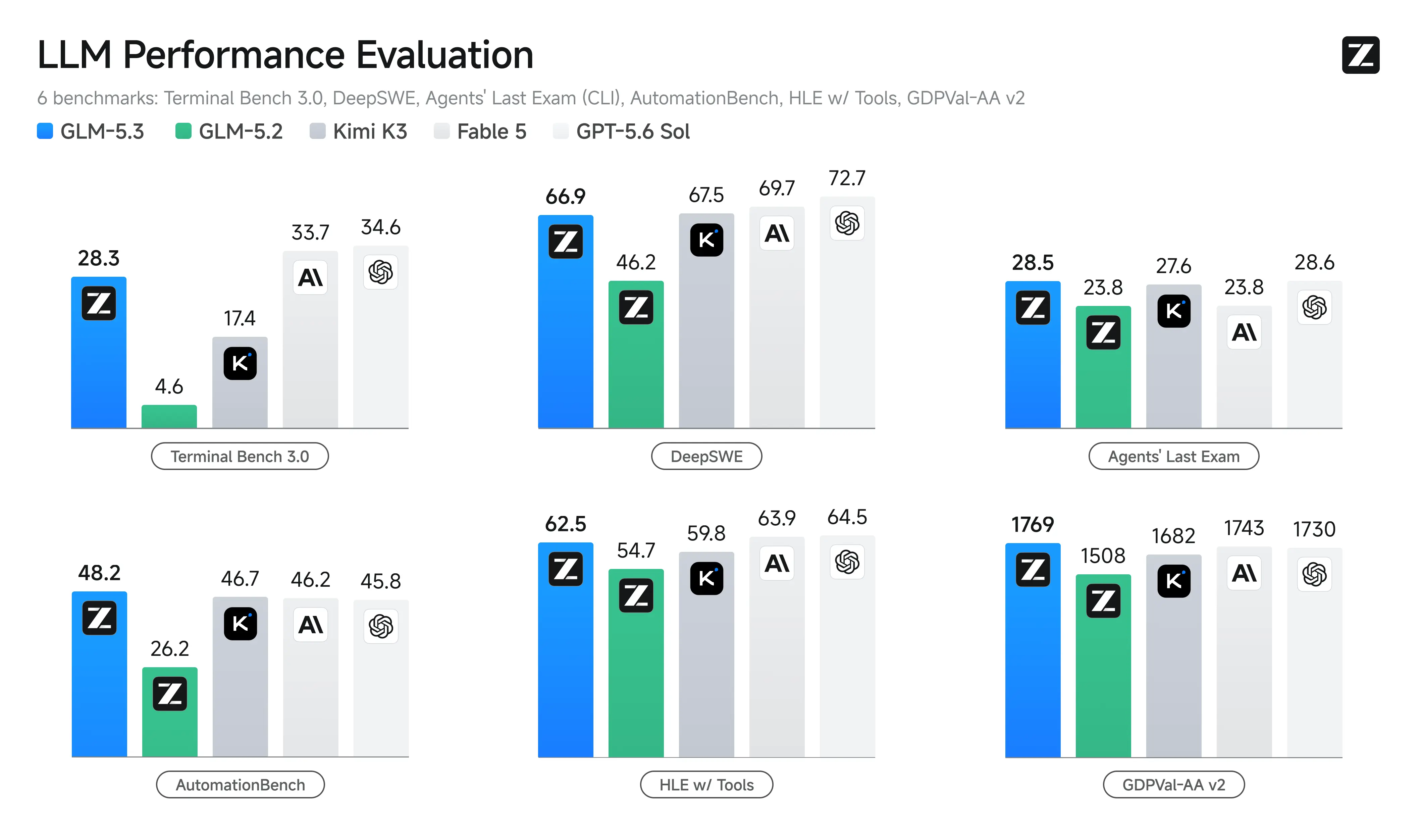
| Benchmark | GLM-5.3 | GLM-5.2 | Kimi K3 | DeepSeek-V4 Pro-0813 | Qwen3.8-Max | Opus 4.8 | Fable 5 (w/ fallback) | GPT-5.6 Sol |
|---|---|---|---|---|---|---|---|---|
| Terminal Bench 2.1 | 88.2 | 81.0 | 88.3 | 87.9 | 86.6 | 85.0 | 88.0 | **88.8** |
| Terminal Bench 3.0 | 28.3 | 4.6 | 17.4 | – | – | 21.1 | 33.7 | **34.6** |
| DeepSWE (v1.1) | 66.9 | 46.2 | 67.5 | 62.7 | 56.6 | 58.0 | 69.7 | **72.7** |
| NL2Repo | 58.0 | 48.9 | 58.0 | 61.1 | 55.9 | **69.7** | – | – |
| ProgramBench (Almost Solved) | 19.0 | 9.5 | 17.5 | – | 10.5 | 15.5 | **33.0** | 23.0 |
| FrontierSWE | 78.1 | 67.5 | – | – | – | 66.5 | **88.2** | – |
| SWE-Marathon (v1.1) | 42.5 | 19.4 | 48.1 | – | – | **48.8** | 33.1 | 42.5 |
| PostTrainBench | 39.8 | 31.7 | 32.0 | – | – | 32.9 | **41.8** | 36.2 |
| CyberGym | **84.5** | 77.2 | 80.0 | 83.3 | 78.5 | 78.1 | 83.8 | 83.6 |
| ExploitGym (2h / 6h) | 105 / 130 | 29 / 39 | 36 / 70 | – | 14 / 26 | 80 / 120 | 181 / 247 | **216 / 293** |
| ExploitBench | 54.4 | 24.4 | 32.2 | – | 28.8 | 40.0 | **78.0** | 76.5 |
| Toolathlon Verified | 73.0 | 59.9 | **76.5** | 74.1 | 72.5 | 76.2 | 74.7 | 74.9 |
| AutomationBench (v1.0.6) | **48.2** | 26.2 | 46.7 | 43.2 | 39.8 | 41.0 | 46.2 | 45.8 |
| Agents' Last Exam (ALE-CLI) | 28.5 | 23.8 | 27.6 | 25.7 | 27.0 | 25.7 | 23.8 | **28.6** |
| HLE w/ Tools | 62.5 | 54.7 | 59.8 | 60.0 | 56.2 | 57.9 | 63.9 | **64.5** |
| GDPval-AA v2 | **1769** | 1508 | 1682 | 1590 | 1739 | 1588 | 1743 | 1730 |
Full evaluation protocols and footnotes are in the [official model card](https://huggingface.co/zai-org/GLM-5.3).
---
## Model Overview
- **Type:** Mixture-of-Experts Causal LM (`glm_moe_dsa`, `GlmMoeDsaForCausalLM`)
- **Parameters:** **753B total** · **~39B active** per token (22.6B routed + 16.7B always-on; 743B after the MTP layer is dropped)
- **Experts:** 256 routed + 1 shared, **top-8** routing, sigmoid scoring with `e_score_correction_bias`, single group, `routed_scaling_factor` 2.5
- **Layers:** 78 (3 dense + 75 MoE), plus 1 MTP layer (dropped in these builds)
- **Attention:** **MLA** — `q_lora_rank` 2048, `kv_lora_rank` 512, 64 heads, `qk_nope` 192 + `qk_rope` 64, `v_head_dim` 256 — with a **DeepSeek-style sparse-attention indexer** (`index_topk` 2048, 32 index heads) built on every 4th layer and shared by the three that follow
- **Precision (base release):** FP8 (block-wise `e4m3`, 128×128), dynamic activation scheme
- **Context:** 1,048,576 tokens · vocab 154,880
- **Modality:** text
---
## Best Practices
- **Pick a precision:** `6-bit` for near-lossless, `4-bit` (repo root) as the everyday default, `3-bit` when memory is the binding constraint, `2-bit` when nothing else fits — the tables above quantify the trade at each step.
- **Sampling:** follow the official GLM-5.3 guidance. The shipped `generation_config.json` is `temperature` 1.0, `top_p` 0.95; long-horizon agentic and coding tasks want generous `max-tokens` headroom.
- **Reasoning effort:** leave it at the default `max` for hard engineering work; drop to `low` for latency-sensitive turns.
- **Long context:** budget KV, not just weights — at 1M tokens the cache dwarfs the difference between two of these builds.
- **Or skip the download:** the unquantized model is served at full precision on the [OrcaRouter API](https://www.orcarouter.ai/models/z-ai/glm-5.3) as `z-ai/glm-5.3`.
---
## Citation
```bibtex
@misc{glm5team2026glm5vibecodingagentic,
title={GLM-5: from Vibe Coding to Agentic Engineering},
author={GLM-5-Team and Aohan Zeng and Xin Lv and Zhenyu Hou and Zhengxiao Du and others},
year={2026},
eprint={2602.15763},
archivePrefix={arXiv},
primaryClass={cs.LG},
url={https://arxiv.org/abs/2602.15763},
}
```
## License
Inherited from [`zai-org/GLM-5.3`](https://huggingface.co/zai-org/GLM-5.3) — an MIT-style grant (use, modify, distribute, fine-tune, sell) with one added condition: operators of a **Model-as-a-Service** business whose aggregate revenue exceeds **US$10B over any 12 consecutive months** must pass a Z.AI security review before commercial use. The full text ships as [`LICENSE`](./LICENSE) in this repo. Quantization does not change the underlying license obligations.
|