

File size: 3,830 Bytes
f76887e 4af6e0d 31a7d44 b0b9a17 4fd2713 4af6e0d b0b9a17 |
1 2 3 4 5 6 7 8 9 10 11 12 13 14 15 16 17 18 19 20 21 22 23 24 25 26 27 28 29 30 31 32 33 34 35 36 37 38 39 40 41 42 43 44 45 46 47 48 49 50 51 52 53 54 55 56 57 58 59 60 61 62 63 64 65 66 67 68 69 70 71 72 73 74 75 76 77 78 79 80 81 82 83 84 85 86 87 88 89 90 91 92 93 94 95 96 97 98 99 100 101 102 103 104 105 106 107 108 109 110 111 112 113 114 115 116 117 118 119 120 121 122 123 124 125 126 127 |
---
license: apache-2.0
datasets:
- nebula/OpenSDI_test
- madebyollin/megalith-10m
language:
- en
base_model:
- google/siglip2-base-patch16-224
pipeline_tag: image-classification
library_name: transformers
tags:
- OpenSDI
- Spotting Diffusion-Generated Images in the Open World
- OpenSDI
- SD3
- AI-vs-Real
- SigLIP2
---

# OpenSDI-SD3-SigLIP2
> OpenSDI-SD3-SigLIP2 is a vision-language encoder model fine-tuned from google/siglip2-base-patch16-224 for binary image classification. It is trained to detect whether an image is a real photograph or generated using Stable Diffusion 3 (SD3), using the SiglipForImageClassification architecture.
> [!note]
*SigLIP 2: Multilingual Vision-Language Encoders with Improved Semantic Understanding, Localization, and Dense Features* https://arxiv.org/pdf/2502.14786
> [!note]
*OpenSDI: Spotting Diffusion-Generated Images in the Open World* https://arxiv.org/pdf/2503.19653, OpenSDI SD3 SigLIP2 works best with crisp and high-quality images. Noisy images are not recommended for validation.
> [!warning]
If the task is based on image content moderation or AI-generated image vs. real image classification, it is recommended to use the OpenSDI-Flux.1-SigLIP2 model.
```py
Classification Report:
precision recall f1-score support
Real_Image 0.8526 0.8916 0.8716 10000
SD3_Generated 0.8864 0.8458 0.8656 10000
accuracy 0.8687 20000
macro avg 0.8695 0.8687 0.8686 20000
weighted avg 0.8695 0.8687 0.8686 20000
```
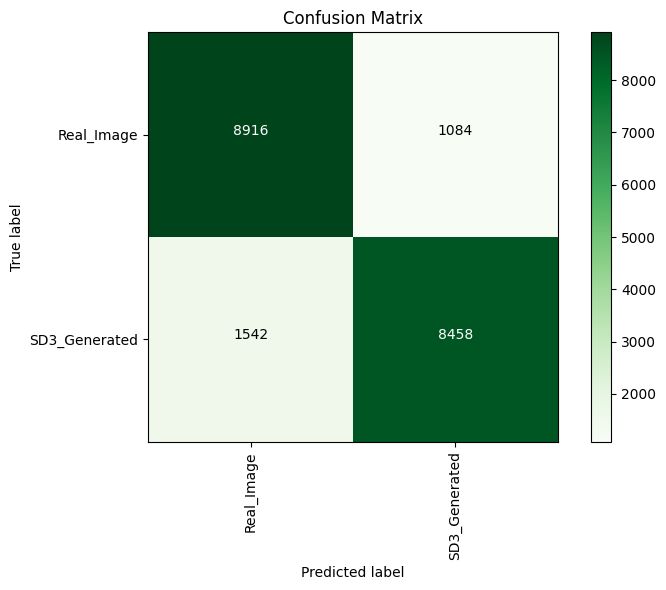
---
## Label Space: 2 Classes
The model classifies an image as either:
```
Class 0: Real_Image
Class 1: SD3_Generated
```
---
## Install Dependencies
```bash
pip install -q transformers torch pillow gradio hf_xet
```
---
## Inference Code
```python
import gradio as gr
from transformers import AutoImageProcessor, SiglipForImageClassification
from PIL import Image
import torch
# Load model and processor
model_name = "prithivMLmods/OpenSDI-SD3-SigLIP2" # Update with the correct model path
model = SiglipForImageClassification.from_pretrained(model_name)
processor = AutoImageProcessor.from_pretrained(model_name)
# Label mapping
id2label = {
"0": "Real_Image",
"1": "SD3_Generated"
}
def classify_image(image):
image = Image.fromarray(image).convert("RGB")
inputs = processor(images=image, return_tensors="pt")
with torch.no_grad():
outputs = model(**inputs)
logits = outputs.logits
probs = torch.nn.functional.softmax(logits, dim=1).squeeze().tolist()
prediction = {
id2label[str(i)]: round(probs[i], 3) for i in range(len(probs))
}
return prediction
# Gradio Interface
iface = gr.Interface(
fn=classify_image,
inputs=gr.Image(type="numpy"),
outputs=gr.Label(num_top_classes=2, label="SD3 Image Detection"),
title="OpenSDI-SD3-SigLIP2",
description="Upload an image to determine whether it is a real photograph or generated by Stable Diffusion 3 (SD3)."
)
if __name__ == "__main__":
iface.launch()
```
---
## Intended Use
OpenSDI-SD3-SigLIP2 is designed for tasks such as:
* Generative Image Analysis – Identify SD3-generated images for benchmarking and quality inspection.
* Dataset Validation – Ensure training or evaluation datasets are free from unintended generative artifacts.
* Content Authenticity – Verify whether visual media originates from real-world photography or AI generation.
* Digital Forensics – Aid in determining the origin of visual content in investigative scenarios. |