1
Certify the questions
The Compositional Conformal Certifier checks agreement with judge feedback at URL-path, host, and global tiers. Reliable questions receive polarity-aware trust weights.
Turn judge feedback into a reusable bank of certified questions that helps web agents learn and choose better trajectories.
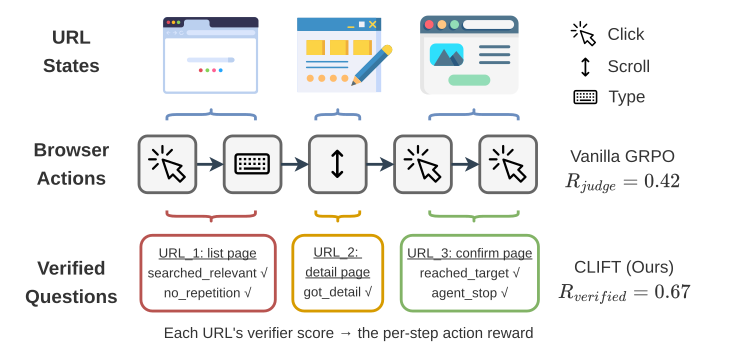
Binary outcomes give sparse training signals. Language-model judges provide richer feedback, but their supervision is costly. CLIFT converts that feedback into URL-scoped verification questions with calibrated trust weights, then reuses the same bank during training and inference.
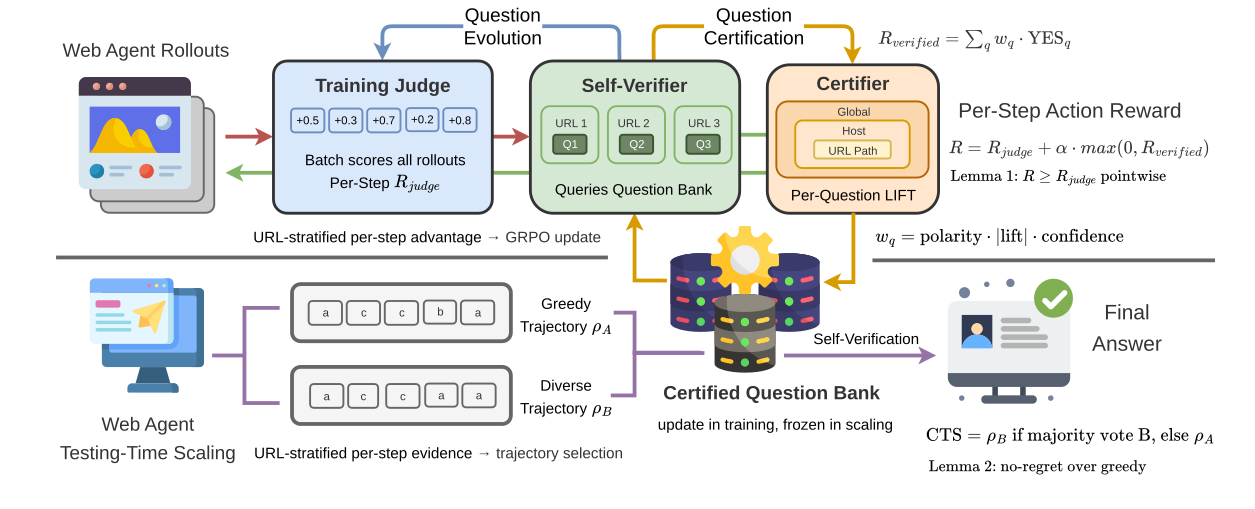
The Compositional Conformal Certifier checks agreement with judge feedback at URL-path, host, and global tiers. Reliable questions receive polarity-aware trust weights.
Certified evidence adds a non-negative bonus to per-step judge rewards. URL-stratified advantages guide the GRPO policy update.
CTS compares completed trajectories using the frozen bank. A retry replaces the incumbent only after a majority of verifier votes supports the swap; ties keep the incumbent.
Train an open web agent, transfer verification knowledge to a closed model, and adapt the bank to live websites. Every CTS result emits one selected trajectory per task; K is the candidate rollout budget.
Task-weighted success rate on the public 9-app comparison set. CLIFT trains Gemma-4 31B with LoRA; CTS adds inference-time selection.
Environment-size-weighted success rate across Classifieds, Shopping, and Reddit. GPT-5.5 weights remain frozen; the bank learned during open-model training is reused at inference.
Realised success on 300 Online Mind2Web tasks. The question bank is translated, expanded, and recalibrated on OM2W rollouts; policy weights receive no OM2W-specific fine-tuning.
CLIFT + CTS improves Gemma-4 over its base WAI success rate. The gain combines stronger policy training with conservative trajectory selection.
A trajectory score is used once. A certified question bank can be inspected, recalibrated, and reused. CLIFT makes that bank the shared interface between expensive judge supervision and an agent’s own rollouts: it supplies dense evidence during reinforcement learning and structured evidence for test-time selection. Across the evaluated settings, the bank supports open-model training, transfer to a frozen closed model, and adaptation to live websites.
@misc{zhang2026clift,
  title={CLIFT: Conformal Self-Verification for Web Agent Training and Test-Time Scaling},
  author={Yifan Zhang and Yutong Dai and Viraj Prabhu and Zhiyuan Hu and Ran Xu and Zeyuan Chen},
  year={2026},
  eprint={2610.06829},
  archivePrefix={arXiv},
  primaryClass={cs.CL},
  url={https://arxiv.org/abs/2610.06829}
}