The human body was built for Earth. Gravity shapes our bones, blood, and balance. But when a rocket launches people into orbit, all of those systems face stress they were never designed to handle. Space travel is often framed in terms of rockets and technology, yet the biggest challenge may be biological: keeping astronauts healthy on journeys that stretch weeks, months, or even years.
To glimpse how spaceflight affects the body, NASA (in conjunction with Space X and Cornell Medical School) released blood chemistry data from the Inspiration4 mission, the first all-civilian orbital flight. By studying biomarkers like liver enzymes, inflammatory proteins, and electrolyte balance, we can see how the body responds to launch, microgravity, and return to Earth. Though the mission lasted only three days, the blood of its four crew members tells a story of stress, adaptation, and recovery that holds lessons for future space exploration.
This post is written for curious readers rather than medical specialists. If you are a student, a space enthusiast, or simply someone fascinated by the limits of the human body, this story is for you. Space exploration is often framed in terms of rockets, propulsion, and engineering breakthroughs, but astronauts remind us that biology is just as central. The future of spaceflight depends not only on how far our machines can travel, but on how well our bodies can endure the journey.
The analysis presented here draws on the Inspiration4 biomarker dataset, released publicly by NASA. It contains blood chemistry and cardiovascular markers collected before, during, and after the three-day orbital mission. These markers include familiar clinical measures, such as liver enzymes, inflammatory proteins, and electrolyte levels, the same kinds of tests a doctor might order on Earth, but taken just before and after the extraordinary context of space.
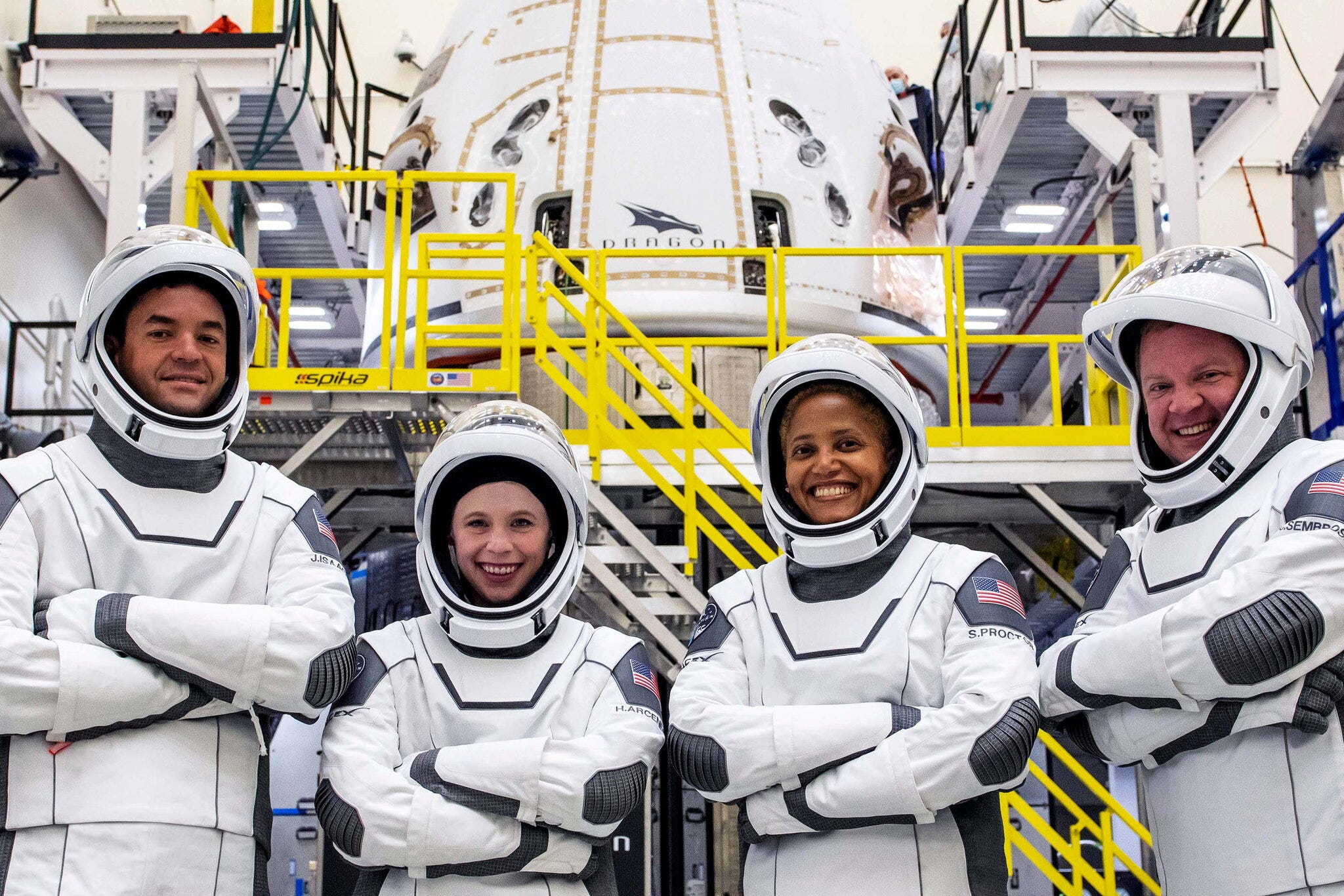
Our astronauts flew aboard a Falcon 9 rocket on the 55th Anniversary of the Gemini Flight. Four specially trained American astronauts, two men and two women: Commander Jared Isaacman, Pilot Sian Proctor, Medical Officer, Hayley Arceneaux, and Payload Specialist Christopher Sembroski flew for three days.
As part of the commercial contract (and SpaceX / NASA’s larger efforts) they offered their biometric data as part of the longitudinal Human Research Program (HRP) at NASA. This means that, while anonymized, their data is shared for the benefit of researchers who wish to conduct independent research.
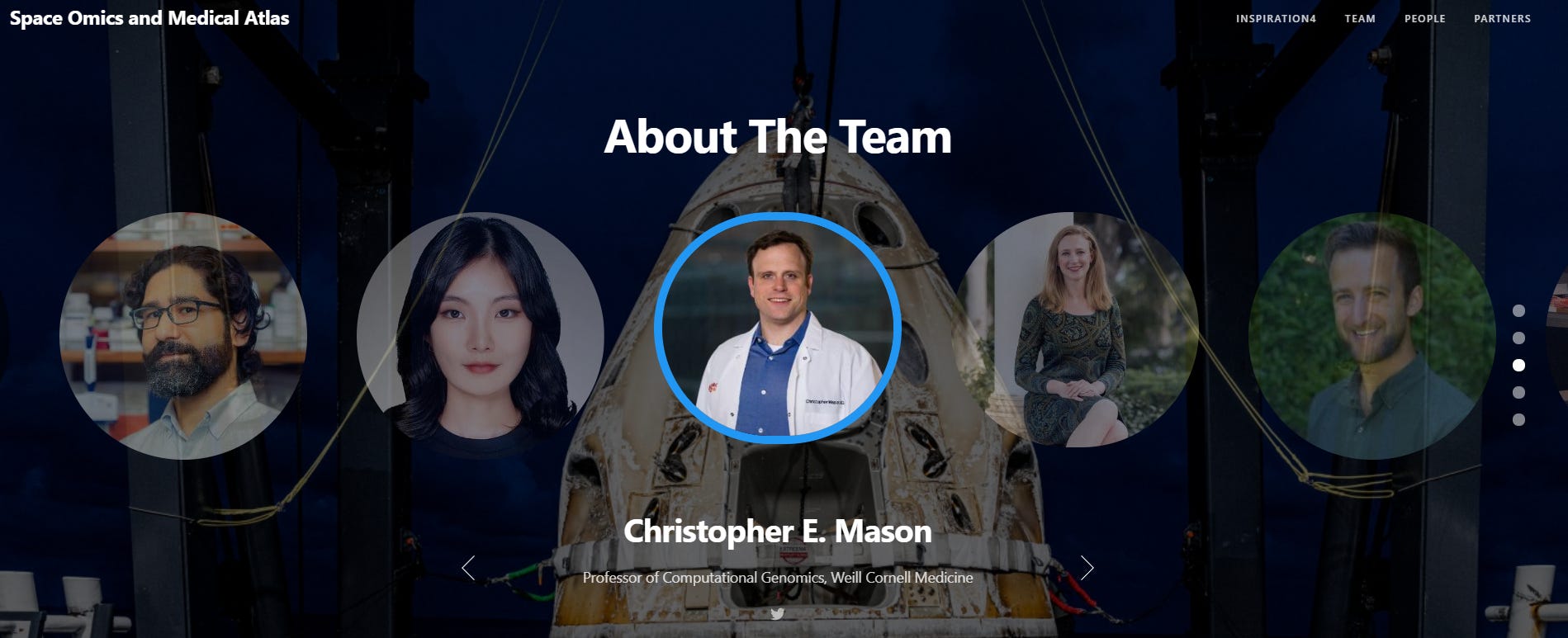
Christopher Mason, manages all of these samples and has worked with Duke to analyze and understand these data in the larger Space Omics and Medical Atlas. These efforts illustrate that humanity is collectively working on open-source and collaborative data exploration to understand just how we might react to space. These samples are incredibly precious and accordingly, must be treated with particular reverence to not hide them away behind closed doors.
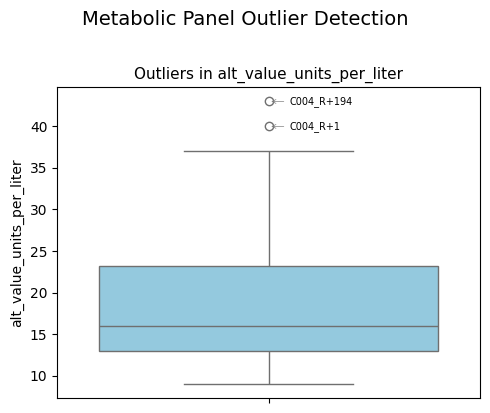
To make sense of the data, several steps were necessary. Not only that you can do it yourself courtesy of our public GitHub and application. First, we cleaned the dataset available on NASA’s website by removing incomplete or inconsistent measures. Importantly we have to find outliers and consider how to interpret them. For example, liver enzymes are quite variable within a person and, accordingly, we have to consider when outliers may occur in our metabolic panel. In one astronaut their liver enzymes immediately post-flight and long after flight are significant outliers from the rest of their baseline data. This is actually exactly what we want to see! That space produced a considerable shift in the healthy functioning of the liver (more activity means the liver is working harder) suggests there is a metabolic insult incurred in space transit.
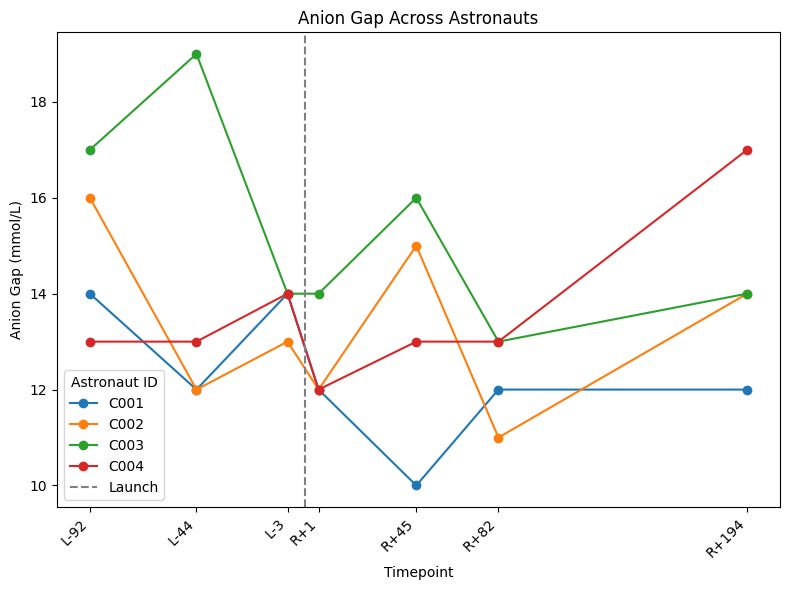
Then, we engineered new features to capture patterns not directly reported. One example is the Anion Gap, a standard clinical calculation that tracks shifts in electrolyte balance. On Earth, doctors use it to monitor conditions like dehydration or metabolic stress. In orbit, it provides a window into how spaceflight affects fluid and chemical balance inside the body. In particular, we could see if changes in sodium, potassium and other electrolytes trended together (no significant shifts) or if some of these changes occurred at different rates indicating troubles with respiration or liver function. Taken in aggregate we can consider the health of our astronauts as if we are a doctor monitoring the vitals of a patient in the hospital.
As with any type of data, we first have to do some preliminary exploration to see what we’re even looking at. This occurred in parallel with the aforementioned pipeline. However, there is a strategy in fine tuning this data. Take fibrinogen for example. This marker detects when blood clots are being formed in the human body and is actually decreased when the liver is working on other projects to keep the body healthy. Accordingly, if we can find a shift from baseline (defined in the time window before flight), we can gain insight into the liver function as well as risk of having a severe blood clot in the astronaut co-hort. And conducting a student’s t-test we found just that in 3 of our four astronauts!
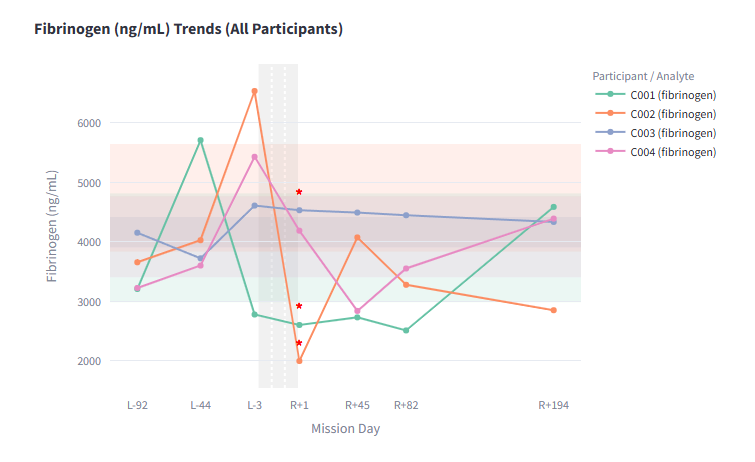
You’ll note that these updated figures look slightly differently. We have our ranges considered normal for each astronaut that stem from our original pre-launch samples. Because the Inspiration4 mission was short and each astronaut’s sampling schedule was slightly different, we created a “stretched” flight timeline. This allowed us to align measurements across individuals, making it easier to compare patterns and visualize how the body changes over the course of a spaceflight. We had to artificially pretend the flight was 30 days to get this effect but the graphs are much cleaner.
For our direct liver enzymes we tested compared our fibrinogen samples against ALT and AST (measures of how hard the liver is working).
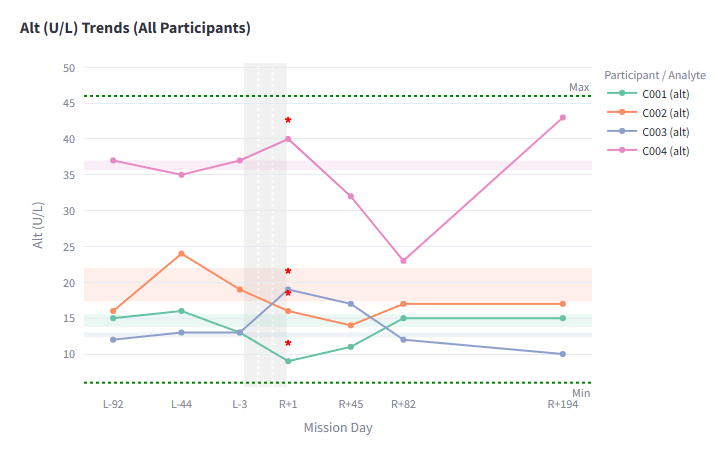
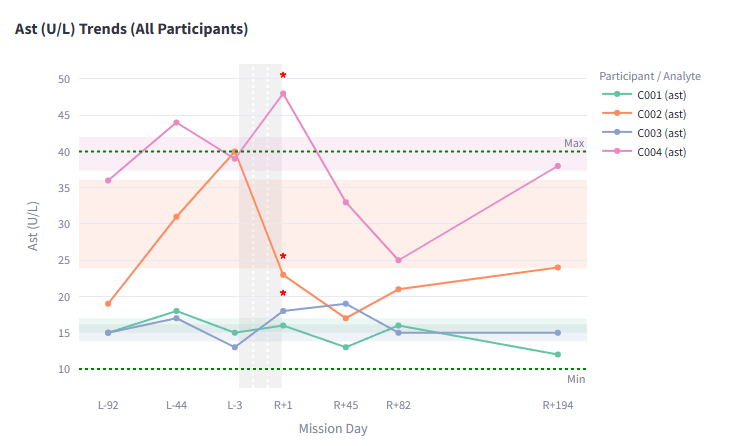
You’ll note that across all four astronauts ALT showed significant deviations while AST did in just three. You’ll note that in one astronaut (C004) the AST ranges shifted outside of what is classically considered the healthy limits of the liver (green dotted line). Eureka, there’s a huge finding. Space is actually harmful to human liver with even just three-days in space showing significant variance.
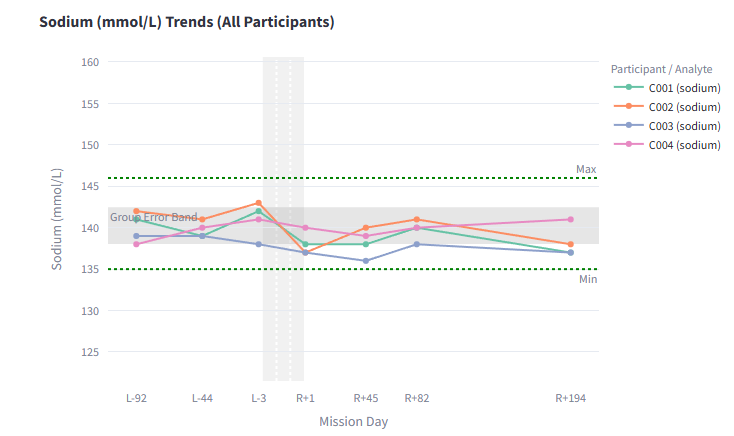
And even in pockets without unique individual differences we can visualize general trends. Sodium in the blood corresponds roughly with levels of hydration. Taken in aggregate we can see that after just three days in space, everyone’s sodium declined. Even if appetites slow down because of space-flight adaptation syndrome the kidneys keep functioning.
Perhaps most interestingly is that our data here allowed us to visualize that potassium levels significantly decreased significantly only in our female astronauts.
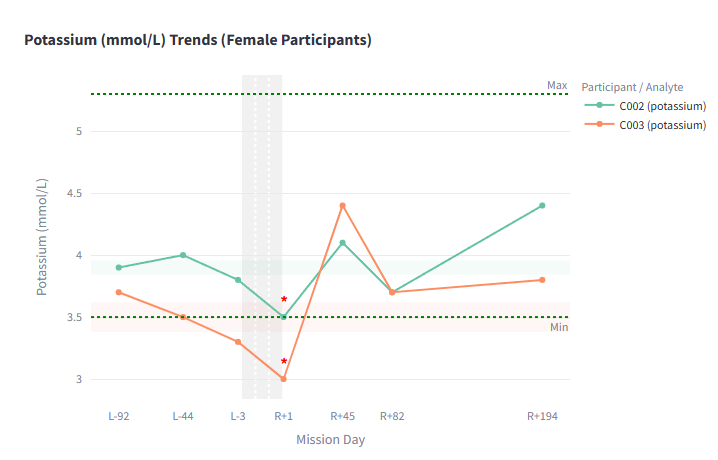
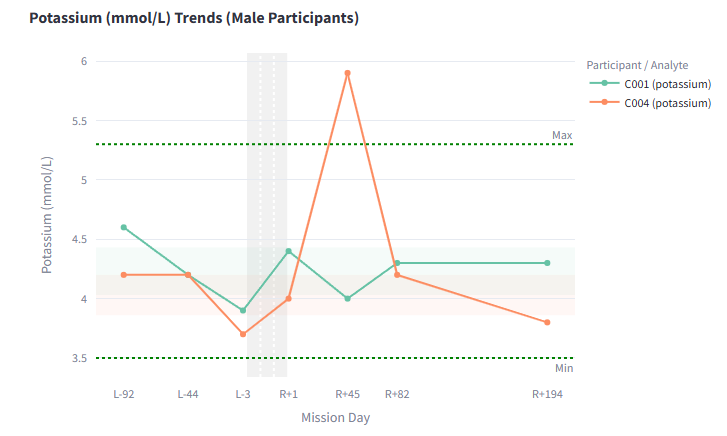
As personalized medicine grows, this raised the question if astronauts should have customized meal plans and diet regimens based on their unique biology.
The use of biomedical data from spaceflight presents a complex set of ethical challenges that extend beyond standard clinical research. Although the dataset from the Inspiration4 mission is anonymized, true anonymity is difficult to preserve given that the identities of the four crew members are public knowledge. This creates a heightened risk of re-identification and underscores the need for careful stewardship of data that cannot be fully disentangled from the individuals who provided it.
Participation in human spaceflight often requires astronauts to relinquish significant aspects of medical privacy. Such consent, while voluntary, is not without ethical tension. Astronauts may feel professional, contractual, or patriotic obligations that complicate the notion of free choice. This context obliges researchers and communicators to treat the resulting data with particular sensitivity, recognizing that its availability is not simply a product of neutral scientific practice but of personal sacrifice.
The value of open science further complicates these issues. Public access to astronaut biomarker data enables independent research, democratizes knowledge production, and fosters innovation. At the same time, openness increases the likelihood that data may be misused, sensationalized, or taken out of context. The ethical imperative, therefore, is not to restrict access but to cultivate responsible practices of curation, interpretation, and communication that balance the benefits of transparency with the dignity and autonomy of research participants.
Another concern lies in the interpretation and communication of findings. A dataset of four individuals cannot support sweeping conclusions, yet its novelty and symbolic significance invite overstatement. The ethical responsibility here is twofold: to present analyses with transparency about their limitations and to resist the temptation to frame preliminary signals as definitive evidence. Overinterpretation risks not only misleading the public but also shaping future policies and medical protocols on an insufficient evidentiary basis.
Finally, equity must be considered in the longer horizon of human spaceflight research. As commercial missions expand participation beyond career astronauts, questions arise regarding who is asked to provide biomedical data, under what terms, and for whose benefit. Ensuring that contributions to collective scientific knowledge do not disproportionately burden or exploit participants is a central ethical requirement for the emerging era of civilian space exploration.
Beyond the constraints of sample size, bias poses another significant challenge in interpreting biomedical data from spaceflight. The Inspiration4 mission involved four individuals who were all healthy, well-screened, and highly motivated to participate in a historic endeavor. Their physiological responses may not reflect those of a broader or more diverse population. This raises concerns about generalizability: findings drawn from such a select group may reinforce assumptions that do not hold for individuals with different health profiles, ages, or genetic backgrounds.
Selection bias is particularly relevant in commercial spaceflight, where access is often limited to individuals with financial means or institutional support. As a result, the biomedical knowledge generated may disproportionately reflect the physiology of certain demographic groups, leaving other populations underrepresented in the emerging space medicine literature. Similarly, gender differences, which the Inspiration4 dataset already hints at in relation to potassium regulation, may be overlooked or minimized when male-dominated samples are treated as normative.
Analytical bias must also be considered. The act of cleaning, normalizing, and stretching timelines introduces interpretive choices that can shape outcomes in subtle but consequential ways. Even well-intentioned statistical adjustments may inadvertently exaggerate or obscure patterns. Transparency about these methodological decisions is therefore essential to ensure that findings are not artifacts of data processing.
Addressing these biases requires deliberate strategies: recruiting more heterogeneous participants as commercial access expands, developing analytical methods that foreground variability rather than averages, and embedding reflexivity in how researchers interpret limited data. Recognizing and mitigating bias is crucial not only for the validity of scientific conclusions but also for ensuring that the benefits of space medicine extend equitably to all who may one day travel beyond Earth.
The Inspiration4 dataset, although limited in scale, provides an unusually vivid view of how quickly and significantly spaceflight can alter human physiology. The clearest message is that even a three-day mission is sufficient to produce measurable changes in liver enzymes, inflammatory proteins, and electrolyte balance. Space is therefore not only an unfamiliar environment but one that actively challenges the stability of fundamental biological systems.
Several findings were particularly unexpected. One of the most striking was the gender-specific decline in potassium, which appeared only in the female astronauts. This observation raises important questions about how diet, metabolism, or hormonal regulation may interact differently with microgravity, and it suggests that future missions may require individualized nutritional or medical strategies.
Another surprise was the degree of stress observed in liver function. Shifts in enzymes such as ALT and AST indicated that the liver was working harder than normal even during such a short period in orbit. This finding challenges the common assumption that biomedical risks accumulate only during longer missions and instead shows that spaceflight can place strain on the body almost immediately.
Finally, the consistent decline in sodium levels across all crew members highlighted how fluid and hydration balance is disrupted in space. While reduced appetite and altered kidney function have long been reported by astronauts, the clear biochemical signal of these changes reinforces how tightly linked and vulnerable these processes are.
Taken together, the results suggest that adaptation to space is both rapid and variable. Certain effects, such as sodium loss, appear broadly shared, while others, such as potassium regulation, reveal differences linked to individual biology. The larger lesson is that preparing for longer and more diverse missions will depend not only on advances in engineering but also on a deeper understanding of how to protect a body that evolved to thrive under Earth’s gravity.
You can access and play with all of these graphs here: Interactive App