
Spaces:
Running

Running
File size: 16,067 Bytes
9ce984a |
1 2 3 4 5 6 7 8 9 10 11 12 13 14 15 16 17 18 19 20 21 22 23 24 25 26 27 28 29 30 31 32 33 34 35 36 37 38 39 40 41 42 43 44 45 46 47 48 49 50 51 52 53 54 55 56 57 58 59 60 61 62 63 64 65 66 67 68 69 70 71 72 73 74 75 76 77 78 79 80 81 82 83 84 85 86 87 88 89 90 91 92 93 94 95 96 97 98 99 100 101 102 103 104 105 106 107 108 109 110 111 112 113 114 115 116 117 118 119 120 121 122 123 124 125 126 127 128 129 130 131 132 133 134 135 136 137 138 139 140 141 142 143 144 145 146 147 148 149 150 151 152 153 154 155 156 157 158 159 160 161 162 163 164 165 166 167 168 169 170 171 172 173 174 175 176 177 178 179 180 181 182 183 184 185 186 187 188 189 190 191 192 193 194 195 196 197 198 199 200 201 202 203 204 205 206 207 208 209 210 211 212 213 214 215 216 217 218 219 220 221 222 223 224 225 226 227 228 229 230 231 232 233 234 235 236 237 238 239 240 241 242 243 244 245 246 247 248 249 250 251 252 253 254 255 256 257 258 259 260 261 262 263 264 265 266 267 268 269 270 271 272 273 274 275 276 277 278 279 280 281 282 283 284 285 286 287 288 289 290 291 292 293 294 295 296 297 298 299 300 301 302 303 304 305 306 307 308 309 310 311 312 313 314 315 316 317 318 319 320 321 322 323 324 325 326 327 328 329 330 331 332 333 334 335 336 337 338 339 340 341 342 343 344 345 346 347 348 349 350 351 352 353 354 355 356 357 358 359 360 361 362 363 364 365 366 367 368 369 370 371 372 373 374 375 376 377 378 379 380 381 382 383 384 385 386 387 388 389 390 391 392 393 394 395 396 397 398 399 400 401 402 403 404 405 406 407 408 409 410 411 412 413 414 415 416 417 418 419 420 421 422 423 424 425 426 427 428 429 430 431 432 433 434 435 436 437 438 439 440 441 442 443 444 445 446 447 448 449 450 451 452 453 454 455 456 457 458 459 460 461 462 463 464 465 466 467 468 469 470 471 472 473 474 475 476 477 478 479 480 481 482 483 484 485 486 487 488 489 490 491 492 493 494 495 496 497 498 499 500 501 502 503 504 505 506 507 508 509 510 511 512 513 514 515 516 517 518 519 520 521 522 523 524 525 526 527 528 529 530 531 532 533 534 |
"""
Title: Monocular depth estimation
Author: [Victor Basu](https://www.linkedin.com/in/victor-basu-520958147)
Date created: 2021/08/30
Last modified: 2024/08/13
Description: Implement a depth estimation model with a convnet.
Accelerator: GPU
"""
"""
## Introduction
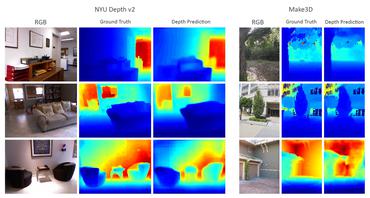
_Depth estimation_ is a crucial step towards inferring scene geometry from 2D images.
The goal in _monocular depth estimation_ is to predict the depth value of each pixel or
inferring depth information, given only a single RGB image as input.
This example will show an approach to build a depth estimation model with a convnet
and simple loss functions.
"""
"""
## Setup
"""
import os
os.environ["KERAS_BACKEND"] = "tensorflow"
import sys
import tensorflow as tf
import keras
from keras import layers
from keras import ops
import pandas as pd
import numpy as np
import cv2
import matplotlib.pyplot as plt
keras.utils.set_random_seed(123)
"""
## Downloading the dataset
We will be using the dataset **DIODE: A Dense Indoor and Outdoor Depth Dataset** for this
tutorial. However, we use the validation set generating training and evaluation subsets
for our model. The reason we use the validation set rather than the training set of the original dataset is because
the training set consists of 81GB of data, which is challenging to download compared
to the validation set which is only 2.6GB.
Other datasets that you could use are
**[NYU-v2](https://cs.nyu.edu/~silberman/datasets/nyu_depth_v2.html)**
and **[KITTI](http://www.cvlibs.net/datasets/kitti/)**.
"""
annotation_folder = "/dataset/"
if not os.path.exists(os.path.abspath(".") + annotation_folder):
annotation_zip = keras.utils.get_file(
"val.tar.gz",
cache_subdir=os.path.abspath("."),
origin="http://diode-dataset.s3.amazonaws.com/val.tar.gz",
extract=True,
)
"""
## Preparing the dataset
We only use the indoor images to train our depth estimation model.
"""
path = "val/indoors"
filelist = []
for root, dirs, files in os.walk(path):
for file in files:
filelist.append(os.path.join(root, file))
filelist.sort()
data = {
"image": [x for x in filelist if x.endswith(".png")],
"depth": [x for x in filelist if x.endswith("_depth.npy")],
"mask": [x for x in filelist if x.endswith("_depth_mask.npy")],
}
df = pd.DataFrame(data)
df = df.sample(frac=1, random_state=42)
"""
## Preparing hyperparameters
"""
HEIGHT = 256
WIDTH = 256
LR = 0.00001
EPOCHS = 30
BATCH_SIZE = 32
"""
## Building a data pipeline
1. The pipeline takes a dataframe containing the path for the RGB images,
as well as the depth and depth mask files.
2. It reads and resize the RGB images.
3. It reads the depth and depth mask files, process them to generate the depth map image and
resize it.
4. It returns the RGB images and the depth map images for a batch.
"""
class DataGenerator(keras.utils.PyDataset):
def __init__(self, data, batch_size=6, dim=(768, 1024), n_channels=3, shuffle=True):
super().__init__()
"""
Initialization
"""
self.data = data
self.indices = self.data.index.tolist()
self.dim = dim
self.n_channels = n_channels
self.batch_size = batch_size
self.shuffle = shuffle
self.min_depth = 0.1
self.on_epoch_end()
def __len__(self):
return int(np.ceil(len(self.data) / self.batch_size))
def __getitem__(self, index):
if (index + 1) * self.batch_size > len(self.indices):
self.batch_size = len(self.indices) - index * self.batch_size
# Generate one batch of data
# Generate indices of the batch
index = self.indices[index * self.batch_size : (index + 1) * self.batch_size]
# Find list of IDs
batch = [self.indices[k] for k in index]
x, y = self.data_generation(batch)
return x, y
def on_epoch_end(self):
"""
Updates indexes after each epoch
"""
self.index = np.arange(len(self.indices))
if self.shuffle == True:
np.random.shuffle(self.index)
def load(self, image_path, depth_map, mask):
"""Load input and target image."""
image_ = cv2.imread(image_path)
image_ = cv2.cvtColor(image_, cv2.COLOR_BGR2RGB)
image_ = cv2.resize(image_, self.dim)
image_ = tf.image.convert_image_dtype(image_, tf.float32)
depth_map = np.load(depth_map).squeeze()
mask = np.load(mask)
mask = mask > 0
max_depth = min(300, np.percentile(depth_map, 99))
depth_map = np.clip(depth_map, self.min_depth, max_depth)
depth_map = np.log(depth_map, where=mask)
depth_map = np.ma.masked_where(~mask, depth_map)
depth_map = np.clip(depth_map, 0.1, np.log(max_depth))
depth_map = cv2.resize(depth_map, self.dim)
depth_map = np.expand_dims(depth_map, axis=2)
depth_map = tf.image.convert_image_dtype(depth_map, tf.float32)
return image_, depth_map
def data_generation(self, batch):
x = np.empty((self.batch_size, *self.dim, self.n_channels))
y = np.empty((self.batch_size, *self.dim, 1))
for i, batch_id in enumerate(batch):
x[i,], y[i,] = self.load(
self.data["image"][batch_id],
self.data["depth"][batch_id],
self.data["mask"][batch_id],
)
x, y = x.astype("float32"), y.astype("float32")
return x, y
"""
## Visualizing samples
"""
def visualize_depth_map(samples, test=False, model=None):
input, target = samples
cmap = plt.cm.jet
cmap.set_bad(color="black")
if test:
pred = model.predict(input)
fig, ax = plt.subplots(6, 3, figsize=(50, 50))
for i in range(6):
ax[i, 0].imshow((input[i].squeeze()))
ax[i, 1].imshow((target[i].squeeze()), cmap=cmap)
ax[i, 2].imshow((pred[i].squeeze()), cmap=cmap)
else:
fig, ax = plt.subplots(6, 2, figsize=(50, 50))
for i in range(6):
ax[i, 0].imshow((input[i].squeeze()))
ax[i, 1].imshow((target[i].squeeze()), cmap=cmap)
visualize_samples = next(
iter(DataGenerator(data=df, batch_size=6, dim=(HEIGHT, WIDTH)))
)
visualize_depth_map(visualize_samples)
"""
## 3D point cloud visualization
"""
depth_vis = np.flipud(visualize_samples[1][1].squeeze()) # target
img_vis = np.flipud(visualize_samples[0][1].squeeze()) # input
fig = plt.figure(figsize=(15, 10))
ax = plt.axes(projection="3d")
STEP = 3
for x in range(0, img_vis.shape[0], STEP):
for y in range(0, img_vis.shape[1], STEP):
ax.scatter(
[depth_vis[x, y]] * 3,
[y] * 3,
[x] * 3,
c=tuple(img_vis[x, y, :3] / 255),
s=3,
)
ax.view_init(45, 135)
"""
## Building the model
1. The basic model is from U-Net.
2. Addditive skip-connections are implemented in the downscaling block.
"""
class DownscaleBlock(layers.Layer):
def __init__(
self, filters, kernel_size=(3, 3), padding="same", strides=1, **kwargs
):
super().__init__(**kwargs)
self.convA = layers.Conv2D(filters, kernel_size, strides, padding)
self.convB = layers.Conv2D(filters, kernel_size, strides, padding)
self.reluA = layers.LeakyReLU(negative_slope=0.2)
self.reluB = layers.LeakyReLU(negative_slope=0.2)
self.bn2a = layers.BatchNormalization()
self.bn2b = layers.BatchNormalization()
self.pool = layers.MaxPool2D((2, 2), (2, 2))
def call(self, input_tensor):
d = self.convA(input_tensor)
x = self.bn2a(d)
x = self.reluA(x)
x = self.convB(x)
x = self.bn2b(x)
x = self.reluB(x)
x += d
p = self.pool(x)
return x, p
class UpscaleBlock(layers.Layer):
def __init__(
self, filters, kernel_size=(3, 3), padding="same", strides=1, **kwargs
):
super().__init__(**kwargs)
self.us = layers.UpSampling2D((2, 2))
self.convA = layers.Conv2D(filters, kernel_size, strides, padding)
self.convB = layers.Conv2D(filters, kernel_size, strides, padding)
self.reluA = layers.LeakyReLU(negative_slope=0.2)
self.reluB = layers.LeakyReLU(negative_slope=0.2)
self.bn2a = layers.BatchNormalization()
self.bn2b = layers.BatchNormalization()
self.conc = layers.Concatenate()
def call(self, x, skip):
x = self.us(x)
concat = self.conc([x, skip])
x = self.convA(concat)
x = self.bn2a(x)
x = self.reluA(x)
x = self.convB(x)
x = self.bn2b(x)
x = self.reluB(x)
return x
class BottleNeckBlock(layers.Layer):
def __init__(
self, filters, kernel_size=(3, 3), padding="same", strides=1, **kwargs
):
super().__init__(**kwargs)
self.convA = layers.Conv2D(filters, kernel_size, strides, padding)
self.convB = layers.Conv2D(filters, kernel_size, strides, padding)
self.reluA = layers.LeakyReLU(negative_slope=0.2)
self.reluB = layers.LeakyReLU(negative_slope=0.2)
def call(self, x):
x = self.convA(x)
x = self.reluA(x)
x = self.convB(x)
x = self.reluB(x)
return x
"""
## Defining the loss
We will optimize 3 losses in our mode.
1. Structural similarity index(SSIM).
2. L1-loss, or Point-wise depth in our case.
3. Depth smoothness loss.
Out of the three loss functions, SSIM contributes the most to improving model performance.
"""
def image_gradients(image):
if len(ops.shape(image)) != 4:
raise ValueError(
"image_gradients expects a 4D tensor "
"[batch_size, h, w, d], not {}.".format(ops.shape(image))
)
image_shape = ops.shape(image)
batch_size, height, width, depth = ops.unstack(image_shape)
dy = image[:, 1:, :, :] - image[:, :-1, :, :]
dx = image[:, :, 1:, :] - image[:, :, :-1, :]
# Return tensors with same size as original image by concatenating
# zeros. Place the gradient [I(x+1,y) - I(x,y)] on the base pixel (x, y).
shape = ops.stack([batch_size, 1, width, depth])
dy = ops.concatenate([dy, ops.zeros(shape, dtype=image.dtype)], axis=1)
dy = ops.reshape(dy, image_shape)
shape = ops.stack([batch_size, height, 1, depth])
dx = ops.concatenate([dx, ops.zeros(shape, dtype=image.dtype)], axis=2)
dx = ops.reshape(dx, image_shape)
return dy, dx
class DepthEstimationModel(keras.Model):
def __init__(self):
super().__init__()
self.ssim_loss_weight = 0.85
self.l1_loss_weight = 0.1
self.edge_loss_weight = 0.9
self.loss_metric = keras.metrics.Mean(name="loss")
f = [16, 32, 64, 128, 256]
self.downscale_blocks = [
DownscaleBlock(f[0]),
DownscaleBlock(f[1]),
DownscaleBlock(f[2]),
DownscaleBlock(f[3]),
]
self.bottle_neck_block = BottleNeckBlock(f[4])
self.upscale_blocks = [
UpscaleBlock(f[3]),
UpscaleBlock(f[2]),
UpscaleBlock(f[1]),
UpscaleBlock(f[0]),
]
self.conv_layer = layers.Conv2D(1, (1, 1), padding="same", activation="tanh")
def calculate_loss(self, target, pred):
# Edges
dy_true, dx_true = image_gradients(target)
dy_pred, dx_pred = image_gradients(pred)
weights_x = ops.cast(ops.exp(ops.mean(ops.abs(dx_true))), "float32")
weights_y = ops.cast(ops.exp(ops.mean(ops.abs(dy_true))), "float32")
# Depth smoothness
smoothness_x = dx_pred * weights_x
smoothness_y = dy_pred * weights_y
depth_smoothness_loss = ops.mean(abs(smoothness_x)) + ops.mean(
abs(smoothness_y)
)
# Structural similarity (SSIM) index
ssim_loss = ops.mean(
1
- tf.image.ssim(
target, pred, max_val=WIDTH, filter_size=7, k1=0.01**2, k2=0.03**2
)
)
# Point-wise depth
l1_loss = ops.mean(ops.abs(target - pred))
loss = (
(self.ssim_loss_weight * ssim_loss)
+ (self.l1_loss_weight * l1_loss)
+ (self.edge_loss_weight * depth_smoothness_loss)
)
return loss
@property
def metrics(self):
return [self.loss_metric]
def train_step(self, batch_data):
input, target = batch_data
with tf.GradientTape() as tape:
pred = self(input, training=True)
loss = self.calculate_loss(target, pred)
gradients = tape.gradient(loss, self.trainable_variables)
self.optimizer.apply_gradients(zip(gradients, self.trainable_variables))
self.loss_metric.update_state(loss)
return {
"loss": self.loss_metric.result(),
}
def test_step(self, batch_data):
input, target = batch_data
pred = self(input, training=False)
loss = self.calculate_loss(target, pred)
self.loss_metric.update_state(loss)
return {
"loss": self.loss_metric.result(),
}
def call(self, x):
c1, p1 = self.downscale_blocks[0](x)
c2, p2 = self.downscale_blocks[1](p1)
c3, p3 = self.downscale_blocks[2](p2)
c4, p4 = self.downscale_blocks[3](p3)
bn = self.bottle_neck_block(p4)
u1 = self.upscale_blocks[0](bn, c4)
u2 = self.upscale_blocks[1](u1, c3)
u3 = self.upscale_blocks[2](u2, c2)
u4 = self.upscale_blocks[3](u3, c1)
return self.conv_layer(u4)
"""
## Model training
"""
optimizer = keras.optimizers.SGD(
learning_rate=LR,
nesterov=False,
)
model = DepthEstimationModel()
# Compile the model
model.compile(optimizer)
train_loader = DataGenerator(
data=df[:260].reset_index(drop="true"), batch_size=BATCH_SIZE, dim=(HEIGHT, WIDTH)
)
validation_loader = DataGenerator(
data=df[260:].reset_index(drop="true"), batch_size=BATCH_SIZE, dim=(HEIGHT, WIDTH)
)
model.fit(
train_loader,
epochs=EPOCHS,
validation_data=validation_loader,
)
"""
## Visualizing model output
We visualize the model output over the validation set.
The first image is the RGB image, the second image is the ground truth depth map image
and the third one is the predicted depth map image.
"""
test_loader = next(
iter(
DataGenerator(
data=df[265:].reset_index(drop="true"), batch_size=6, dim=(HEIGHT, WIDTH)
)
)
)
visualize_depth_map(test_loader, test=True, model=model)
test_loader = next(
iter(
DataGenerator(
data=df[300:].reset_index(drop="true"), batch_size=6, dim=(HEIGHT, WIDTH)
)
)
)
visualize_depth_map(test_loader, test=True, model=model)
"""
## Possible improvements
1. You can improve this model by replacing the encoding part of the U-Net with a
pretrained DenseNet or ResNet.
2. Loss functions play an important role in solving this problem.
Tuning the loss functions may yield significant improvement.
"""
"""
## References
The following papers go deeper into possible approaches for depth estimation.
1. [Depth Prediction Without the Sensors: Leveraging Structure for Unsupervised Learning from Monocular Videos](https://arxiv.org/abs/1811.06152v1)
2. [Digging Into Self-Supervised Monocular Depth Estimation](https://openaccess.thecvf.com/content_ICCV_2019/papers/Godard_Digging_Into_Self-Supervised_Monocular_Depth_Estimation_ICCV_2019_paper.pdf)
3. [Deeper Depth Prediction with Fully Convolutional Residual Networks](https://arxiv.org/abs/1606.00373v2)
You can also find helpful implementations in the papers with code depth estimation task.
You can use the trained model hosted on [Hugging Face Hub](https://huggingface.co/spaces/keras-io/Monocular-Depth-Estimation)
and try the demo on [Hugging Face Spaces](https://huggingface.co/keras-io/monocular-depth-estimation).
"""
|