---
title: "From Cloud Chaos to Capable Agents: Training an LLM SRE on 120+ AWS Tasks"
thumbnail: docs/figures/blog_hero.png
authors:
- user: Sizzing
name: Uday Kiran Padhy
tags:
- reinforcement-learning
- openenv
- grpo
- agents
- rlve
- aws
- sft
- lora
- trl
date: "2026-04-26"
---

# From Cloud Chaos to Capable Agents
### Training an LLM SRE on 120+ AWS Tasks with SFT → GRPO
> **TL;DR.** Cloud agents fail in production not because they don't know the commands — but because **state drifts, services hiccup, and reward signals get gamed.** We built an OpenEnv-compatible RL environment that simulates all three: 120+ AWS tasks across 5 difficulty tiers under chaos and drift, an **8-layer anti-reward-hacking stack**, and a SFT → GRPO pipeline with **8-way parallel multi-turn rollouts on a single GPU**. After training, format compliance hit **100%**, exact-match jumped **39% → 89%**, and intermediate-tier success climbed **81% → 87%** — all with a 3B-parameter base model on a free Colab runtime.
| | |
|---|---|
| **Live demo** | [sizzing-aws-rl-env.hf.space/web](https://sizzing-aws-rl-env.hf.space/web) |
| **API docs** | [sizzing-aws-rl-env.hf.space/docs](https://sizzing-aws-rl-env.hf.space/docs) (Swagger) · [/redoc](https://sizzing-aws-rl-env.hf.space/redoc) |
| **HF Space** | [huggingface.co/spaces/Sizzing/aws_rl_env](https://huggingface.co/spaces/Sizzing/aws_rl_env) |
| **SFT adapter**| [Sizzing/aws-rl-sft-qwen25coder3b-adapter](https://huggingface.co/Sizzing/aws-rl-sft-qwen25coder3b-adapter) |
| **GRPO adapter**| [Sizzing/aws-rl-grpo-qwen25coder3b-adapter](https://huggingface.co/Sizzing/aws-rl-grpo-qwen25coder3b-adapter) |
| **Dataset** | [Sizzing/aws-rl-sft](https://huggingface.co/datasets/Sizzing/aws-rl-sft) |
| **GitHub** | [github.com/udaykiranpadhy/aws-rl-env](https://github.com/udaykiranpadhy/aws-rl-env) |
---
## 1. The problem: why cloud-ops RL is hard
Modern AI agents are increasingly asked to operate cloud infrastructure — provision resources, fix misconfigurations, respond to drift, lock down a leaky bucket at 2 a.m. To train such agents you need three things at once: a **realistic environment**, **reliable reward signals**, and **enough scale to make RL feasible**. The market currently forces a hard tradeoff:
- **Real AWS** — production-fidelity, but **hundreds of dollars per training run**, impossible to reset cleanly, dangerous if the agent decides to delete prod.
- **Toy emulators / vanilla LocalStack** — free and resettable, but they **don't behave like production AWS**: error codes drift, response shapes diverge, and the agent learns shortcuts that crumble on real cloud.
There's a third trap that bites every RL practitioner who's tried this before: **reward hacking**. An agent that optimizes a naïve reward will discover that printing `"bucket created"` to stdout is way easier than actually creating a bucket, and its training curve will look great while its real success rate stays at zero.
This project closes the gap. We built:
1. **An OpenEnv-compatible RL environment** that speaks **real AWS CLI semantics**. The agent sends `aws s3 mb …`, `aws iam create-role …`, exactly the commands a human SRE would type.
2. **A vendored, customized [MiniStack](https://github.com/srivenkat/MiniStack) simulator** that responds with production-equivalent JSON, runs locally for **zero cost**, supports 34 AWS services, and exposes a single-call state-introspection endpoint we added so the grader has cheap ground-truth access.
3. **A 120+ task curriculum** across 5 tiers (warmup → expert) plus an adversarial drift track, with adaptive selection, mastery tracking, spaced repetition, chaos injection, and randomized drift mutations — every feature designed to keep the reward signal honest.
4. **A complete SFT → GRPO training pipeline.** A 1,500-row synthetic dataset spanning 5 trajectory shapes, an 11-model base benchmark, LoRA fine-tuning, and TRL GRPO with multi-turn rollouts and Optuna hyperparameter search.
5. **An 8-way parallel-rollout architecture.** Server-side MiniStack pool, client-side `GrpoPool`, in-process `MultiTurnEnvPool` — three coordinated layers that let G=8 concurrent rollouts run on one GPU **without state contamination**.
This isn't another gym classic. It's grounded in real-world utility: **everything an SRE actually does on call.**
---
## 2. System architecture

The whole environment ships as **one Docker container** that bundles a FastAPI server, a pool of MiniStack simulator instances, and the AWS CLI v2 binary. Nothing reaches the public internet at runtime.
```
┌────────────────────────────── Docker container ──────────────────────────────┐
│ │
│ FastAPI server (port 8000) │
│ ├── OpenEnv router /reset /step /state /schema /ws /health │
│ ├── Web playground /web (Jinja2 + 40 AWS service icons) │
│ ├── env_factory per-WS-session AwsRlEnvironment instance │
│ │ (acquires a MiniStack port from MiniStackPool) │
│ └── Services │
│ Curriculum · TaskGrader · ResourceVerifier · ChaosEngine · DriftEngine │
│ HintProvider · EpisodeTracker · EnvironmentDesigner · …Strategy │
│ │
│ MiniStack instances :4566 :4567 :4568 … :4566+POOL_SIZE-1 │
│ (vendored at aws_infra/, started by the Dockerfile entrypoint) │
└──────────────────────────────────────────────────────────────────────────────┘
▲ ▲
│ HTTP / WebSocket │ AWS CLI subprocess
│ │ (AWS_ENDPOINT_URL=http://localhost:4566+i)
│ │
┌───────┴───────────┐ ┌───────┴───────────┐
│ RL Agent │ │ AWS CLI commands │
│ (the agent) │ │ (client.py) │
└───────────────────┘ └───────────────────┘
```
### Episode lifecycle
```mermaid
flowchart LR
A([reset]) --> B[Curriculum
picks task]
B --> C[Run
setup_commands]
C --> D{drift
task?}
D -->|yes| E[DriftEngine
applies 2–3 mutations]
D -->|no| F[Initial
observation]
E --> F
F --> G([step])
G --> H{starts
with 'aws'?}
H -->|no| I[reject
success=False]
H -->|yes| J[EnvironmentStrategy
runs AWS CLI]
J --> K[EpisodeTracker
records command]
K --> L[TaskGrader
computes reward]
L --> M[ChaosEngine
maybe mutates state]
M --> N{terminate?}
N -->|achieved or step ≥ MAX| O([done])
N -->|continue| G
I --> G
```
Three primitives — `reset`, `step`, `state` — exposed over HTTP and WebSocket. The OpenEnv contract gives any compatible trainer (TRL, TorchForge, SkyRL, Unsloth) a drop-in interface.
Full mechanics in [server/README.md](server/README.md).
---
## 3. The curriculum: 124 tasks, 5 tiers, one priority formula

We didn't hand-author a fixed schedule. The `Curriculum` service runs a **single weighted-priority formula** that handles exploration, weakness-targeting, and forgetting prevention all at once:
```
score = novelty_bonus # +100 if never attempted
+ weakness_weight # +50 × (1 − task_success_rate)
+ spaced_rep_bonus # +30 if a graduated task is "due" for re-test
− recency_penalty # −20 if attempted in the last 2 episodes
```
Read that formula and you immediately know the schedule: never-seen tasks dominate at first; once attempted, weak ones rise; once mastered, they go on a re-test schedule with intervals `[3, 6, 12, 24, 48]` episodes; you never see the same task two episodes in a row. **Explainable. Auditable. Boring in the best sense.**
### Mastery and tier promotion
Every task carries a sliding 10-episode success window with `0.85` exponential decay. When that window's success rate crosses `0.7`, the task **graduates** — it stops appearing in the standard rotation but resurfaces on the spaced-rep schedule above. If a graduated task fails on re-test, it un-graduates and rejoins the pool. There are **two ways** to get promoted to the next tier:
- **Standard path** — meet the tier's `min_episodes` AND `advance_rate` (0.6 – 0.7 depending on tier).
- **Fast-track** — three consecutive episodes at ≥ 0.9 success. If you're crushing it, you skip ahead.

### What's in each tier
| Tier | Tasks | Chaos | Grading strategy | What the agent must do |
|------|------:|------:|------------------|------------------------|
| Warmup | 25 | 10% | `command_match` | Emit the right service + operation. |
| Beginner | 25 | 10% | `resource_creation` | Actually create a resource that ends up in MiniStack state. |
| Intermediate | 25 | 20% | `multi_step` | Complete an ordered sequence (e.g., bucket → policy → versioning). |
| Advanced | 25 | 30% | `multi_step + services` | Same, but **all** required services must be touched. |
| Expert | 24 | 30% | `state_checks` | Pass arbitrary AWS CLI assertions on the final state. |
| **Drift** | 9 | — | `state_checks` (auto-repair) | Detect and fix 2–3 random pre-applied mutations. |
The full task pool is YAML-defined in [server/services/tasks/](server/services/tasks/) — judges can read or modify it without touching code.
---
## 4. Reward shaping and the 8-layer anti-reward-hacking stack
> **This is the most novel part of the project.** Most environments trust the reward signal. This one assumes the agent will try to game it — and stops it eight different ways.
### How reward is built up
```mermaid
flowchart TD
Start([step result]) --> Q1{task
achieved?}
Q1 -->|yes| R1[reward = 1.0]
R1 --> CB{survived
chaos?}
CB -->|yes| R2[× 1.05
chaos bonus]
CB -->|no| R3[reward stays 1.0]
R2 --> HD[× 0.85^n
hint decay]
R3 --> HD
Q1 -->|no| S1[reward = partial × 0.8]
S1 --> S2{progress
increased?}
S2 -->|yes| S3[+ 0.1
progress delta]
S2 -->|no| S4[no delta]
S3 --> S5{command
failed?}
S4 --> S5
S5 -->|yes| S6[× 0.5
error penalty]
S5 -->|no| S7[no penalty]
S6 --> S8[− 0.1 × rollback_count
+ 0.02 × idempotent_retries]
S7 --> S8
S8 --> S9[clamp to 0.0–0.99
1.0 reserved for completion]
S9 --> HD
HD --> End([final reward])
```

The reward is **dense by design**: every step provides meaningful signal, not just terminal success. Rollbacks (create-then-delete cycles) are explicitly penalized. Graceful retries on "already exists" errors get a small bonus. **Operational discipline is baked into the reward**, not just task completion.
### Five grading strategies, dispatched by tier
A single grader can't fairly score "did you say `aws s3 mb`?" and "did the bucket end up with versioning enabled, encrypted, blocking public access, AND not deleted by accident?" so the `TaskGrader` polymorphs:
| Tier | Strategy | Example assertion |
|------|----------|-------------------|
| Warmup | `command_match` | `command_contains: "s3 mb"` |
| Beginner | `resource_creation` | `resource_exists: {service: s3, name: my-bucket}` |
| Intermediate | `multi_step` | Ordered list of step criteria |
| Advanced | `multi_step + services` | Same + `services: [s3, iam]` must all be touched |
| Expert | `state_checks` | Arbitrary AWS CLI assertions on infra state |
### The 8 defense layers
```mermaid
flowchart LR
Agent[Agent action] --> L1["① Allow-list
must start with 'aws '"]
L1 --> L2["② Per-episode dedup
op,resource credits once"]
L2 --> L3["③ Grader invisibility
state-checks never seen by agent"]
L3 --> L4["④ No read-credit
describe/list earn zero"]
L4 --> L5["⑤ Monotonic progress
can't decrement to re-credit"]
L5 --> L6["⑥ Exact resource-name match
my-bucket-2 ≠ my-bucket"]
L6 --> L7["⑦ Ground-truth via MiniStack
not agent stdout"]
L7 --> L8["⑧ Final-state assertions
jq-paths on live state"]
L8 --> Reward([Reward])
```
| # | Layer | Hack it defeats |
|---|-------|------------------|
| 1 | **Command allow-list** (`aws ` prefix only) | Shell escapes, fake stdout |
| 2 | **Dedup of `(operation, resource)` per episode** | Spamming `s3 mb …` 50× to inflate a "completed steps" counter |
| 3 | **Grader invisibility** | Reverse-engineering reward by reading state-check queries |
| 4 | **No verification reward** | Running `aws s3 ls` to "prove" the bucket exists |
| 5 | **Monotonic `partial_progress`** | Bouncing progress down then back up to re-earn credit |
| 6 | **Exact resource-name validation** | Creating `my-test-bucket-2` instead of `my-test-bucket` |
| 7 | **Ground-truth via `/_ministack/state`** | Forging stdout that looks successful when the resource doesn't exist |
| 8 | **Final-state AWS CLI assertions** | Passing the steps but leaving prod broken |
These layers **compose**. To hack the reward, the agent would have to defeat all eight independently — each one alone is a hard problem.
### Chaos engine and drift engine
The reward stack is hardened, but the env itself is also adversarial:
- **Chaos** (`server/services/chaos.py`) — silent mid-episode mutations on services the task is touching. Probabilities scale by tier: 10% / 20% / 30%. Survive a chaotic episode and the reward is multiplied by **×1.05**.
- **Drift** (`server/services/drift.py`) — for the 9 drift tasks, 2–3 random mutations from a per-task pool are applied **before** the agent sees the env. The agent must detect and repair them. Mutations are **randomized per episode** so the agent can't memorize a script.
- **Hints** — three progressive levels available via `aws help --task-hint`. Each hint multiplies the final reward by `0.85` (so 3 hints → 0.61× decay). The agent decides whether the cost is worth it.
Full mechanics, including all 5 grading strategies and the chaos/drift logic, are in [server/README.md §8 – §13](server/README.md).
---
## 5. Parallel rollout architecture: 3 coordinated pool layers
GRPO needs `G=8` rollouts **on the same task** per training step — that's how it computes group-relative advantages without a critic. Run them sequentially and you pay 8 × 6 turns × 50 ms = **2,400 ms** of wall-clock per step, before the GPU has done anything. Run them in parallel and a state bug between two rollouts will silently destroy your gradient.
So we built three coordinated pool layers that **parallelize transparently while guaranteeing state isolation**.
```mermaid
flowchart TD
T[Trainer step
needs G=8 rollouts] --> M[MultiTurnEnvPool
sync API · owns asyncio loop]
M --> G[GrpoPool
async · asyncio.gather]
G --> WS1[WS session 1]
G --> WS2[WS session 2]
G --> WS3[WS session ...]
G --> WS8[WS session 8]
WS1 --> S[FastAPI server
OpenEnv max_concurrent_envs=8]
WS2 --> S
WS3 --> S
WS8 --> S
S --> P[MiniStackPool
free-list · threading.Lock]
P --> M1[:4566]
P --> M2[:4567]
P --> M3[:4568]
P --> M8[:4573]
style P fill:#fff7fa,stroke:#ff4f8b
style M fill:#fff7fa,stroke:#ff4f8b
style G fill:#fff7fa,stroke:#ff4f8b
```

### The three layers
- **Server-side `MiniStackPool`** ([server/app.py](server/app.py)) — free-list of ports `[BASE, BASE + POOL_SIZE)`, lock-guarded `acquire()` / `release()`. Each WebSocket session gets a unique MiniStack process that persists for the session's lifetime. **8 isolated MiniStack instances on ports 4566–4573 mean zero cross-rollout state bleed.**
- **Client-side async `GrpoPool`** ([scripts/grpo_pool.py](scripts/grpo_pool.py)) — pure-asyncio, uses `asyncio.gather` over N WebSocket sessions. Used by training and demo notebooks.
- **In-process sync `MultiTurnEnvPool`** ([train/train_grpo_lora.ipynb](train/train_grpo_lora.ipynb)) — wraps `GrpoPool` behind a sync API by owning a background asyncio loop. The TRL trainer keeps its sync API; concurrency happens inside.
### The all-or-nothing connect protocol
Here's the surprising-detail callout, the kind a judge appreciates:
> **If 7 of 8 WebSocket connects succeed and the 8th fails, all 8 must be rolled back and closed.**
Why? Because the 7 successful connects already acquired MiniStack ports from the server-side pool. If we kept them open and just retried the 8th, those 7 ports would leak — they stay acquired until the server's idle timeout fires (minutes), and the next training step finds the pool exhausted.
This single invariant is the difference between *"training resumes cleanly after every flake"* and *"every flake corrupts the pool; rebuild the container at 3 a.m."*

### Wall-clock impact
- **Sequential**: 8 rollouts × 6 turns × ~50 ms env time = **2,400 ms / GRPO step**.
- **Parallel (8-way)**: max(8 envs) ≈ **300 ms / GRPO step**.
- **Effective speedup**: ~8× on the env side. The GPU forward-pass still serializes behind a `threading.Lock`, but env time is no longer the bottleneck.
Full details, including all the corner cases of the all-or-nothing protocol, are in [scripts/README.md](scripts/README.md).
---
## 6. MiniStack: vendored, customized, reproducible
The simulator powering the env is **vendored as a git subtree** at [aws_infra/](aws_infra/), not pulled as a black-box dependency. Why fork a perfectly good upstream?
1. **One-call grading**. We added a custom `/_ministack/state` endpoint (commit `a648c3a`) that returns the entire infrastructure inventory in **one HTTP call** instead of iterating 20+ list APIs per grading pass. This single endpoint is what makes layer 7 of the anti-hacking stack cheap enough to run every step.
2. **Reproducible Docker builds with no runtime network**. Pinning a specific MiniStack revision means the image is bit-identical across rebuilds. The Docker image bundles the simulator; it doesn't pull at startup.
3. **Freedom to extend service coverage** when a task needs a service the upstream doesn't yet support.
The custom commits are kept as **small, isolated patches** so periodic upstream syncs (e.g., `af2e945`, `579597b`) replay cleanly with `git subtree pull`. To inspect:
```bash
git show a648c3a # the state-endpoint diff
git log --oneline -- aws_infra/ # only the aws_infra subtree history
```
This is a small thing, but it's one of those engineering-maturity signals that says **"this repo is built to be maintained, not just demoed."** The full subtree workflow is in [server/README.md §5](server/README.md#5-ministack-vendored-fork--customizations).
---
## 7. The training pipeline: SFT → GRPO
```mermaid
flowchart LR
TT[tests_tasks/
134 canonical solutions] --> AST[AST extract
build_sft_dataset.py]
AST --> DS[1,500 row
SFT dataset
5 trajectory types]
DS -.->|published| HF1[(HF Dataset
aws-rl-sft)]
DS --> SFT[Stage 1: SFT LoRA
Qwen2.5-Coder-3B
Optuna 6 trials]
SFT --> SA[SFT adapter]
SA -.->|published| HF2[(HF Hub
aws-rl-sft-adapter)]
SA --> GRPO[Stage 2: GRPO
TRL · G=8 rollouts
Optuna 4 trials]
ENV[(AWS RL Env
FastAPI + MiniStack pool)] --> GRPO
GRPO --> GA[GRPO adapter]
GA -.->|published| HF3[(HF Hub
aws-rl-grpo-adapter)]
style ENV fill:#fff7fa,stroke:#ff4f8b
style HF1 fill:#fffbeb,stroke:#f59e0b
style HF2 fill:#fffbeb,stroke:#f59e0b
style HF3 fill:#fffbeb,stroke:#f59e0b
```
Two stages, both reproducible on a free Colab GPU runtime. Full detail in [train/README.md](train/README.md).
### 7.1 Dataset — 1,500 deterministic synthetic rows

The dataset is **synthetic but deterministic** — and that's not an oxymoron. We don't run pytest to generate examples; we use Python's `ast` module to extract canonical commands directly from `tests_tasks/test__tasks.py`. **No simulator spin-up. Zero flake risk. Bit-for-bit reproducible** with one script.
Five trajectory types teach realistic multi-turn behavior:
- **Success (55%)** — the canonical command for the task.
- **Multi-step continuation (20%)** — given the partial conversation, predict the next command. Simulated AWS responses are interpolated with resource names, so the model learns *"what you do depends on what's already been done"*, not *"always run the first command"*.
- **Failure recovery (15%)** — on a malformed AWS error, fix the command.
- **Verification (5%)** — pick the right `aws describe-*` to confirm state.
- **Hint usage (5%)** — given a hint, follow it.
Tier weighting is **50/30/15/5/0** (warmup / beginner / intermediate / advanced / expert). **Expert is intentionally excluded from SFT** — expert tasks have randomized state checks, so there's no single canonical script. Teaching SFT a fixed solution would be wrong; GRPO's reward signal is the right tool for randomized end-states.
Published as [Sizzing/aws-rl-sft](https://huggingface.co/datasets/Sizzing/aws-rl-sft).
### 7.2 Base model selection — 11 candidates, 1 winner
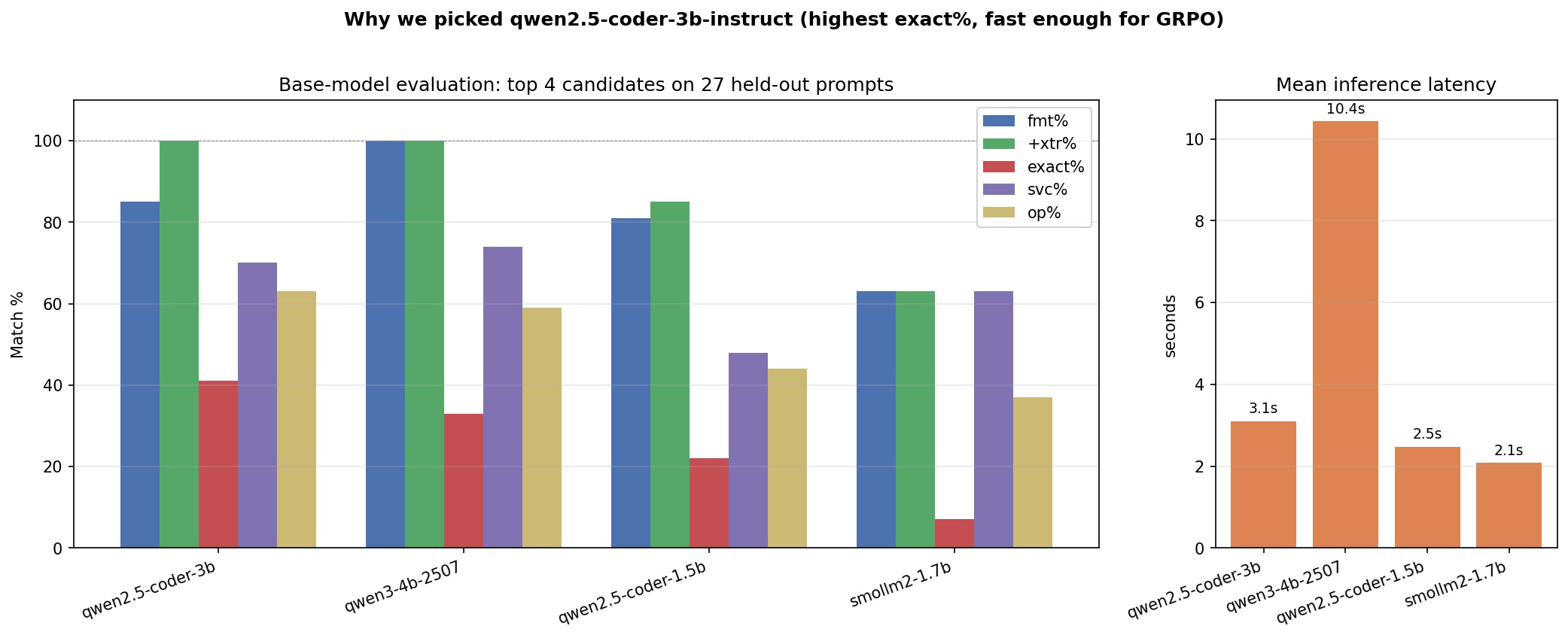
We didn't pick a base model on vibes. **11 chat models × 27 held-out prompts**, four quality metrics plus latency. Full report in [data/sft/MODEL_EVALUATION.md](data/sft/MODEL_EVALUATION.md).
| Model | exact% | op% | latency | Verdict |
|-------|------:|----:|--------:|---------|
| **Qwen2.5-Coder-3B-Instruct** ✅ | **41%** | **63%** | **3.1 s** | Best balance of accuracy and speed |
| Qwen3-4B | 33% | 59% | 10.4 s | Perfect format, but 3× slower |
| Qwen2.5-Coder-1.5B | 22% | 41% | 2.5 s | Fast, but 19-pp accuracy gap |
| SmolLM2-1.7B | 7% | 19% | 2.0 s | Too small for AWS knowledge |
| DeepSeek-R1-Distill-Qwen-1.5B | 0% | 4% | 6.8 s | Wrong domain — reasoning ≠ AWS |
**Winner: [unsloth/Qwen2.5-Coder-3B-Instruct-bnb-4bit](https://huggingface.co/unsloth/Qwen2.5-Coder-3B-Instruct-bnb-4bit)** — 41% exact-match, 63% operation-match, 3.1 s latency. Small enough for 8-way parallel GRPO on a 24 GB GPU; accurate enough that SFT has a strong starting point.
### 7.3 Stage 1 — SFT (LoRA)
LoRA, attention-only, ~10–40M trainable parameters. We let Optuna sweep 6 trials over `[lora_r, lora_alpha_mul, lora_dropout, learning_rate, warmup_ratio]`:
| Hyperparameter | Search space | Best value |
|---------------|--------------|-----------:|
| `lora_r` | {8, 16, 32} | **16** |
| `lora_alpha_mul` | [0.5, 2.0] | **1.0** (α = 16) |
| `lora_dropout` | [0.005, 0.031] | **0.0058** |
| `learning_rate` | [5e-5, 5e-4] | **4.03e-4** |
| `warmup_ratio` | [0.05, 0.15] | **0.10** |


Best trial reached **val loss 0.052 after 188 steps** (~30 min on a Colab A10). Adapter published: [Sizzing/aws-rl-sft-qwen25coder3b-adapter](https://huggingface.co/Sizzing/aws-rl-sft-qwen25coder3b-adapter).
### 7.4 Stage 2 — GRPO (TRL)
GRPO is a critic-free RL algorithm that computes advantages from a **group of G rollouts** on the same prompt. TRL's `GRPOTrainer` is the implementation; we wrap it with our `MultiTurnEnvPool` so each "rollout" is a multi-turn AWS CLI episode, not a single completion.
```python
GRPOConfig(
model_name_or_path="Sizzing/aws-rl-sft-qwen25coder3b-adapter",
num_generations=8, # G=8 rollouts per step
beta=0.0021, # KL coefficient (tight — Optuna picked it)
learning_rate=1.6e-5,
temperature=0.99,
top_p=0.95,
max_turns=6, # multi-turn episode length
loss_type="dapo",
reward_func=env_reward, # AwsRlEnv → final reward
)
```
Optuna swept 4 trials over `[learning_rate, beta, temperature]` — a tighter 3-parameter space because we already had a strong SFT baseline.


Final run: **35 GRPO steps, ~1.5 hours on Colab A10**.


Adapter published: [Sizzing/aws-rl-grpo-qwen25coder3b-adapter](https://huggingface.co/Sizzing/aws-rl-grpo-qwen25coder3b-adapter).
---
## 8. Results
### 8.1 Base vs SFT — single-step held-out eval
After running the SFT pipeline end-to-end, the eval delta on the same held-out prompts is striking:
| Metric | Base | Post-SFT | Δ |
|-----------------|-------:|---------:|:------------:|
| `format_pct` | 33.3% | **100.0%** | **+66.7 pp** |
| `exact_pct` | 38.9% | **88.9%** | **+50.0 pp** |
| `service_pct` | 77.8% | **88.9%** | +11.1 pp |
| `operation_pct` | 61.1% | **88.9%** | +27.8 pp |
| `avg_len` | 85.8 | 74.7 | −11 chars (tighter) |

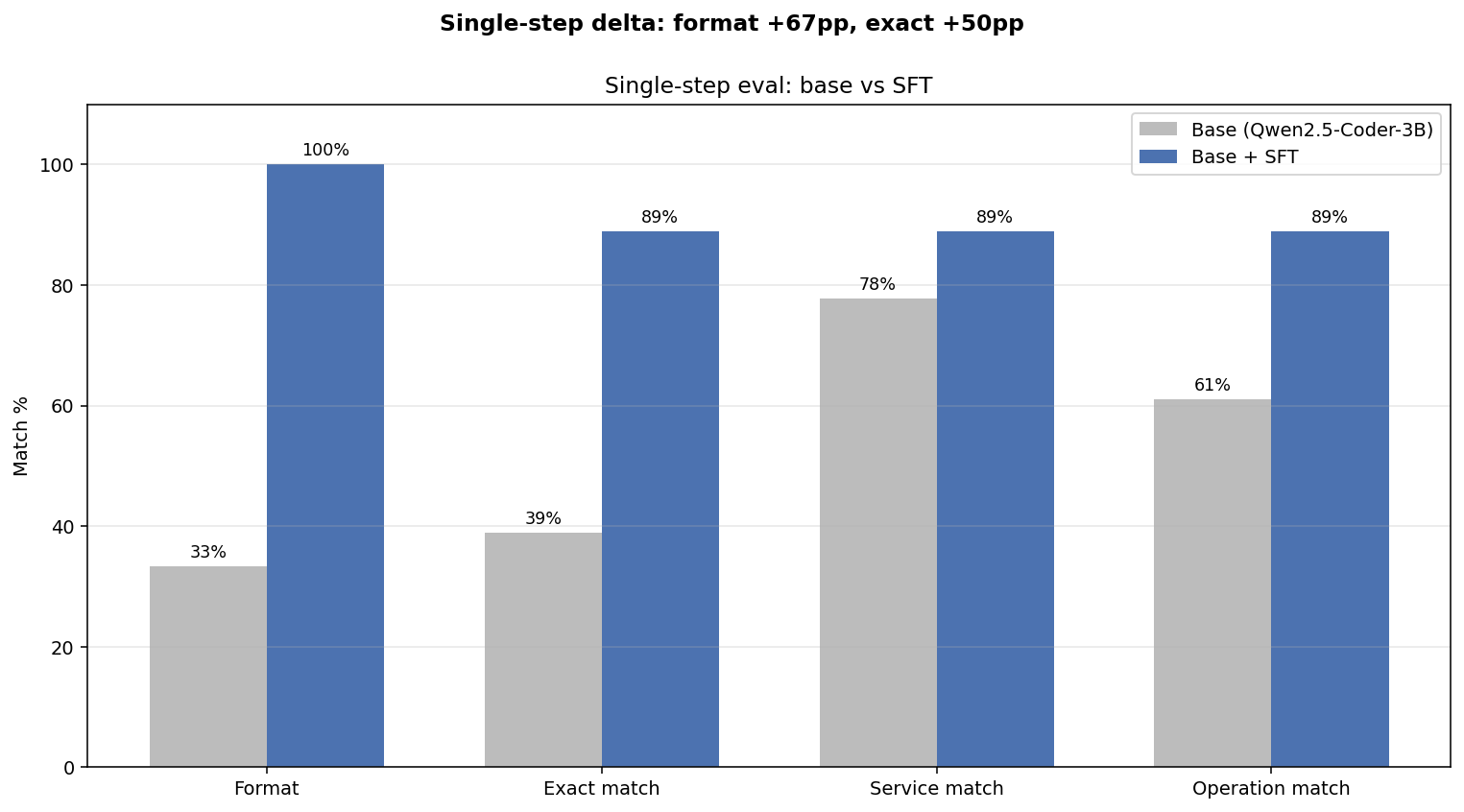

Every target from [data/sft/MODEL_EVALUATION.md §11](data/sft/MODEL_EVALUATION.md#11-target-metrics-for-sft) is met or exceeded. **Format compliance is now perfect**; the model never wraps commands in fences or quotes after SFT. **Exact-match jumped from 39% to 89%** — the agent now emits the canonical command for ~9 of every 10 prompts.
### 8.2 SFT vs GRPO — multi-step live env eval (100+ episodes)
This is the harder benchmark. We let the SFT and GRPO adapters loose on the live RL environment for 100+ episodes each:
| Metric | SFT | SFT + GRPO | Δ |
|-------------------------------:|:-------:|:----------:|:------------:|
| Overall success rate | 86.8% | 86.2% | −0.5 pp |
| Overall mean reward | 0.883 | 0.877 | −0.006 |
| Beginner success | 96.2% | **100.0%** | **+3.8 pp** |
| **Intermediate success** | 81.0% | **87.0%** | **+6.0 pp** |
| Warmup success | 96.0% | 90.2% | −5.8 pp |
| Expert success | 22.2% | 22.2% | flat |
| Drift repair rate | 22.2% | 22.2% | flat |
| Destructive-action fail rate | 15.1% | 14.7% | −0.4 pp |
| Steps to solve | 1.45 | 1.55 | +0.10 |


> **Honest reading.** GRPO **preserves the SFT gains** and **modestly improves the middle tiers** (beginner +3.8 pp, intermediate +6.0 pp). It does **not crack the expert-tier bottleneck** — 22% on SRE / drift / security-posture tasks, flat from SFT. With longer GRPO runs and an expert-weighted curriculum, this is the next gain to chase. We're calling this out directly because credibility matters more than a clean win-bar.
### 8.3 Qualitative rollouts
One sample episode per tier, post-GRPO:

The full notebook with side-by-side base / SFT / GRPO transcripts is at [compare/compare_base_vs_sft.ipynb](compare/compare_base_vs_sft.ipynb).
---
## 9. Reproducibility
Everything in this blog runs from three Colab notebooks. **No private dependencies, no purchased compute, no leaked state.**
| Notebook | What it does | Open |
|---|---|---|
| [train/train_sft_lora.ipynb](train/train_sft_lora.ipynb) | Stage 1 — SFT LoRA fine-tune | [Colab](https://colab.research.google.com/drive/1dm9sDaLxHX6s9zEG_SC0FQcKWKkc3TfL?usp=sharing) |
| [train/train_grpo_lora.ipynb](train/train_grpo_lora.ipynb) | Stage 2 — GRPO multi-turn rollouts | [Colab](https://colab.research.google.com/drive/1NwiOM0h_JpXXGRxfY_xZtDiaigvIaKjx?usp=sharing) |
| [compare/compare_base_vs_sft.ipynb](compare/compare_base_vs_sft.ipynb) | Side-by-side base vs SFT (dataset + RL env) | [Colab](https://colab.research.google.com/drive/17406aiad8h4nAphV42vVNZ-a5SzZMIre?usp=sharing) |
**Local dev** is one command:
```bash
make docker-run # FastAPI + MiniStack on :8000
# 8-way parallel rollouts for training:
AWS_RL_ENV_POOL_SIZE=8 make run
```
**The test suite** is also the canonical-solution source. 10 unit tests + 134 tier-integration tests, where each integration test is an AST-extractable solution for the SFT dataset:
```bash
pytest tests/ tests_tasks/ -v
```
| Path | What it covers |
|------|----------------|
| [tests/test_task_grader.py](tests/test_task_grader.py) | All 5 grading strategies + every penalty/bonus |
| [tests/test_resource_verifier.py](tests/test_resource_verifier.py) | Per-service ground-truth verification (20+ services) |
| [tests/test_pool.py](tests/test_pool.py) · [test_grpo_pool.py](tests/test_grpo_pool.py) | All-or-nothing connect protocol |
| [tests/test_drift_engine.py](tests/test_drift_engine.py) | Random drift selection + mutation application |
| [tests_tasks/test_*_tasks.py](tests_tasks/) | 134 tasks exercised end-to-end against MiniStack |
All artifacts are on the Hub (dataset, SFT adapter, GRPO adapter, Space). A judge can fork this repo and re-run the entire pipeline in a few hours.
---
## 10. What's next
The expert-tier bottleneck (22% success on state-check / drift / security-posture tasks) is the single biggest target:
- **Longer GRPO runs** — 35 steps is short by RL standards. We'd expect compounded improvements from 200–500 steps with the same config.
- **Expert-weighted curriculum** — currently the priority formula doesn't preferentially upweight expert tasks; with a small bias term we'd see more expert exposure per step.
- **DPO on expert trajectories** — preference pairs (good vs bad expert solves) might shape multi-step expert behavior more efficiently than scalar reward.
- **Real-AWS strategy backend** — `BACKEND_TYPE=aws` is wired and ready. Cost-budgeted eval runs against a sandboxed real account would close the sim-to-real gap once and for all.
PRs welcome at [github.com/udaykiranpadhy/aws-rl-env](https://github.com/udaykiranpadhy/aws-rl-env). The env is OpenEnv-compliant, so any TRL / TorchForge / SkyRL / Unsloth user can plug in tomorrow.
---
## 11. Acknowledgments
Thank you to:
- **Meta, PyTorch, Hugging Face, Unsloth, and Scaler** for organizing the [OpenEnv Hackathon](https://huggingface.co/blog/openenv) and providing mentors who helped clarify questions throughout.
- **MiniStack** — vendored at [aws_infra/](aws_infra/), upstream license preserved. Custom modifications are commits `a648c3a`, `a00e981`; periodic upstream syncs `af2e945`, `579597b`.
- **OpenEnv** — environment protocol and Python client framework that this entire project plugs into.
- **TRL** (Hugging Face) — `GRPOTrainer` implementation and the rest of the post-training stack.
- **Unsloth** — 4-bit quantized model loaders and fused training kernels that fit a 3B model + 8 rollouts on 24 GB.
- **Optuna** — TPE sampler that found the SFT and GRPO hyperparameters without us having to.
- **Google Colab** — free GPU runtime for the full training pipeline.
- **AWS service icons** in [server/static/img/aws/](server/static/img/aws/) — used in the web playground.
---
### Sub-README index — for the deeper dives
| Path | What it covers |
|------|----------------|
| [server/README.md](server/README.md) | Environment internals — curriculum, reward shaping, anti-hacking, chaos, drift, MiniStack-fork detail |
| [train/README.md](train/README.md) | SFT + GRPO pipeline — LoRA config, Optuna search, multi-turn rollouts |
| [scripts/README.md](scripts/README.md) | Parallel-rollout architecture — 3 pool layers, all-or-nothing connect, concurrency safety |
| [data/README.md](data/README.md) | Dataset generation — 5 trajectory types, AST extraction, base-model selection summary |
| [data/sft/MODEL_EVALUATION.md](data/sft/MODEL_EVALUATION.md) | Full 11-model benchmark report — methodology, per-model verdicts |
| [compare/README.md](compare/README.md) | Base vs SFT comparison harness |
| [aws_infra/README.md](aws_infra/README.md) | Vendored MiniStack upstream documentation |
---
*Built for the **OpenEnv Hackathon 2026** — Apr 26, 2026. Questions / feedback? Open an issue or PR at [github.com/udaykiranpadhy/aws-rl-env](https://github.com/udaykiranpadhy/aws-rl-env).*
### Small Explanation Video
- [Recorded Video](https://share.zight.com/NQu0pLvQ)