---
title: Lolaby
emoji: 🌙
colorFrom: yellow
colorTo: blue
sdk: gradio
python_version: "3.11"
sdk_version: "6.17.3"
app_file: app.py
pinned: true
license: llama3.2
short_description: AI-powered lullabies.
tags:
- lullaby
- children
- small-models
- llama-cpp
- fine-tuned
- on-device
- build-small-hackathon
- backyard-ai
- text-to-audio
- agentic
- gradio
- track:backyard
- sponsor:openbmb
- achievement:offgrid
- achievement:welltuned
- achievement:offbrand
- achievement:llama
- achievement:sharing
- achievement:fieldnotes
- badge-tiny-titan
models:
- build-small-hackathon/lolaby-llama-3b
- openbmb/MiniCPM-V-4.6
- hexgrad/Kokoro-82M
datasets:
- build-small-hackathon/lolaby-traces
---
# Lolaby — AI-powered lullabies
Meet Lola, your personal bedtime singer.
A tiny AI that watches your child's drawings and sings them a personalised lullaby.
Built for the [Hugging Face **Build Small Hackathon 2026**](https://huggingface.co/build-small-hackathon) · **Backyard AI** track 🏡
**Team:** [andyolivers](https://huggingface.co/andyolivers) & [volivers](https://huggingface.co/volivers)
**Try it:** [the live Space](https://huggingface.co/spaces/build-small-hackathon/lolaby)
**Demo video:** [YouTube walkthrough](https://youtu.be/eY_JnijT62E)
**Field notes:** [the build journal](https://huggingface.co/blog/build-small-hackathon/lolaby-blog)
**Social media post**: [live on LinkedIn](https://www.linkedin.com/posts/andyolivers_huggingface-gradio-hackathon-ugcPost-7471134065912573953-4uv2)
**Models:**
- [`lolaby-llama-3b`](https://huggingface.co/build-small-hackathon/lolaby-llama-3b) — lyrics
- MiniCPM-V 4.6 1.3B — vision
- Kokoro 82M — voice
Every runtime model in Lolaby runs under **4B parameters**, keeping the full pipeline comfortably within the hackathon's **32B cap**.
---
## The Problem
Getting a small child to fall asleep is a daily battle for parents and anyone who looks after kids.
My partner's sister teaches kindergarten. Every day she runs nap time for fifteen 4-year-olds, and ever since they learned about music and instruments in class, it starts the same way: *"sing a song for me."* She'd love to give each child their own song, built from whatever they love that week — a stuffed fox, a new puppy, the rainbow. She doesn't have the time, the musical training, or a tool that could do it.
**Lolaby is that tool.** The child shows Lola what they love — doodling on screen, or handing over a paper drawing for the teacher to photograph. The teacher types the child's name. A small, on-device AI looks at the drawing, writes a lullaby about it, and sings it back — in about a minute.
Everything runs locally. No cloud LLM, no per-song API cost, no child's drawing or name ever leaving the device. No massive models — just genuinely tiny AI that fits everywhere.
Lola turns any child's drawing into a unique lullaby, all on-device.
## How it works
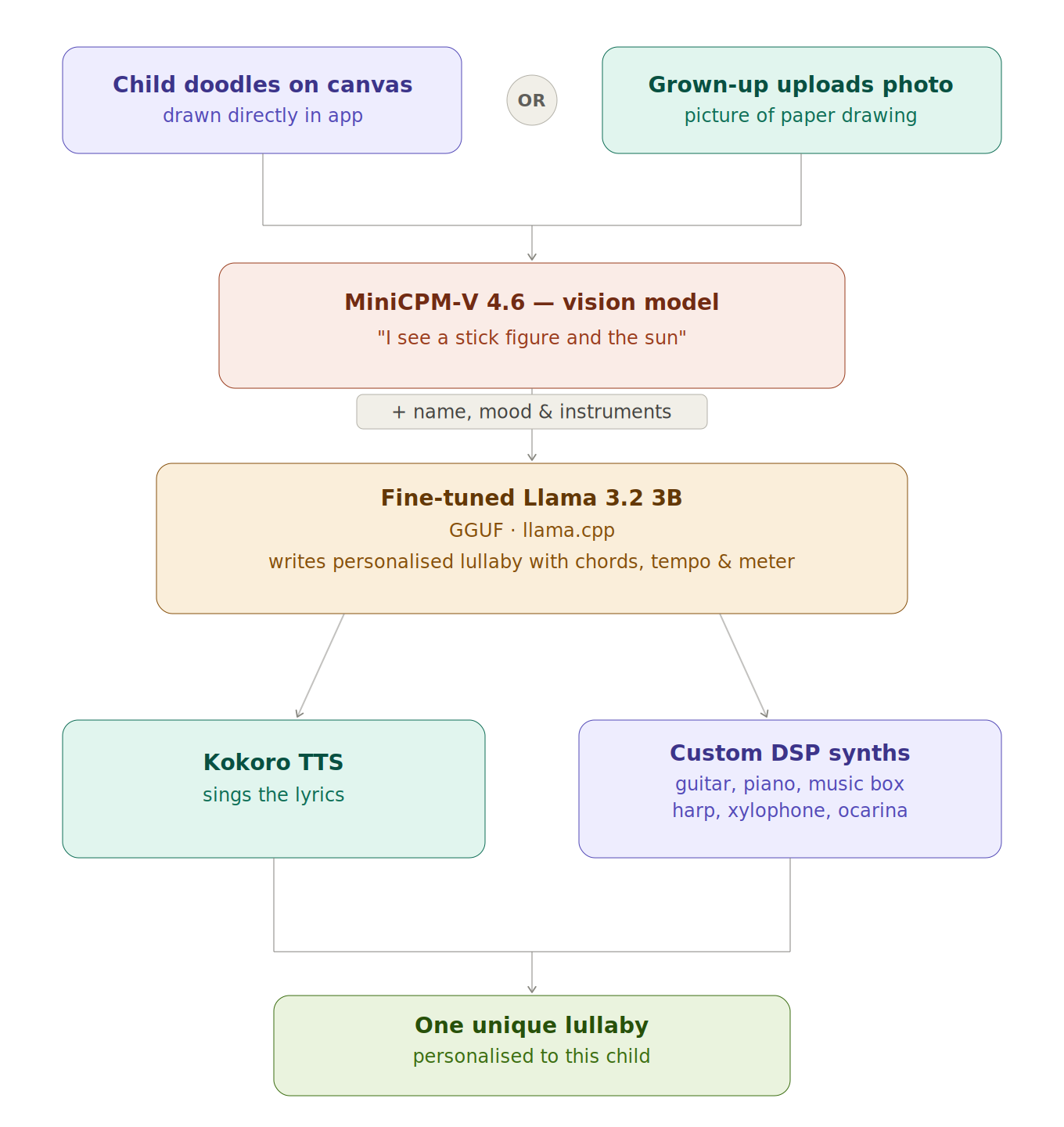
**The drawing is optional.**
No canvas drawing AND no upload? ⭢ The form's *What do they love?* field is used instead.
Drawing AND typed loves? ⭢ Both inform the song.
*Lola* (Lolaby's AI character) tells you what she saw between the audio and the lyrics, so you can see how the drawing turned into the song.
## What's inside: built as a tiny titan
The **total parameters** across the whole pipeline are **well under 32B**. The lyric model is 3B, the vision model is 1.3B, and the voice is 82M. The synths have zero parameters — they're DSP (Digital Signal Processors).
This app was intentionally designed as a **tiny titan**: every model in the pipeline is genuinely small, with lyrics, vision, and voice all running **under 4B parameters**. The goal wasn't just efficiency, it was portability. Lolaby was built to run locally, fit on modest hardware, and work the same way everywhere: a laptop, a CPU-only Hugging Face Space, or an offline machine with no cloud dependency at all.
No giant foundation models, no hidden API calls, and no GPU requirement — just compact, local-first AI designed to run anywhere.
| Component | Model / Library | Where it runs |
| ---------------- | -------------------------------------------------- | ------------- |
| Lyric generation | **Llama 3.2 3B**, fine-tuned, via `llama.cpp` | CPU, locally |
| Drawing → words | **MiniCPM-V 4.6** (1.3B) via `transformers` | CPU, locally |
| Stroke fallback | Pure NumPy color/density analysis | CPU, locally |
| Singing voice | **Kokoro 82M** (<32B) | CPU, locally |
| Instruments | Custom DSP synths, built from spectral analysis | CPU, locally |
| Content safety | Local keyword + intent filter | CPU, locally |
## Hardware
Lolaby runs locally on whatever machine you give it — a laptop, or a CPU-only Hugging Face Space. There's no cloud LLM in the loop at runtime: the lyric model, the vision model, and the audio synthesis all run on-device.
The whole pipeline is CPU-only by design. The fine-tuned Llama 3.2 3B runs as a Q4_K_M GGUF through llama.cpp; the MiniCPM-V vision model and Kokoro TTS run in-process on CPU. Nothing is offloaded to a GPU or an external API, so the experience is identical wherever it runs — no model is skipped and no feature degrades depending on the host.
If the vision model can't load for any reason, the app falls back to a NumPy stroke-and-colour analyzer so songs keep generating rather than breaking.
This portability is intentional: the same repo can be forked and run anywhere — a laptop, a free CPU Space, an offline box — without changing a line of code. That's the "build small" idea taken literally: a complete, personalised lullaby pipeline that fits on modest hardware and owes nothing to the cloud at runtime.
## Badges
This submission satisfies all six hackathon bonus quests:
- 🔌 **Off the Grid** — No cloud APIs at runtime. Every model in the deployed app runs locally.
- 🎯 **Well-Tuned** — The lyric model is a custom fine-tune of Llama 3.2 3B, [published on the Hub](https://huggingface.co/build-small-hackathon/lolaby-llama-3b). Trained on a 1,500-example dataset built from scratch with mechanical anti-boilerplate gates and 99.4% line uniqueness across the lyric corpus.
- 🎨 **Off-Brand** — Fully custom Gradio UI served through `gr.Server` (Gradio's Server mode) rather than a stock launch: hand-drawn crayon aesthetic, paper-textured cards, light/dark themes with browser preference detection, and a character voice via the "Lola" persona that guides your experience by streaming the output.
- 🦙 **Llama Champion** — Lyric inference runs through `llama-cpp-python` (the `llama.cpp` Python binding) on CPU at Q4_K_M quantisation.
- 📡 **Sharing is Caring** — A full generation trace (drawing → vision → lyric prompt → raw model output → audio render parameters) is [published on the Hub](https://huggingface.co/datasets/build-small-hackathon/lolaby-traces) so anyone can study how the pipeline composes.
- 📓 **Field Notes** — [Build journal here](https://huggingface.co/blog/build-small-hackathon/lolaby-blog): the lullaby fine-tune pipeline, the instrument synthesis, the drawing-to-lyrics vision model, and the local-first approach.
## Demo
→ Walkthrough powered by **[Google Gemini](https://gemini.google.com/)** and **[Veo 3](https://deepmind.google/models/veo/)**.
Watch the demo ↓
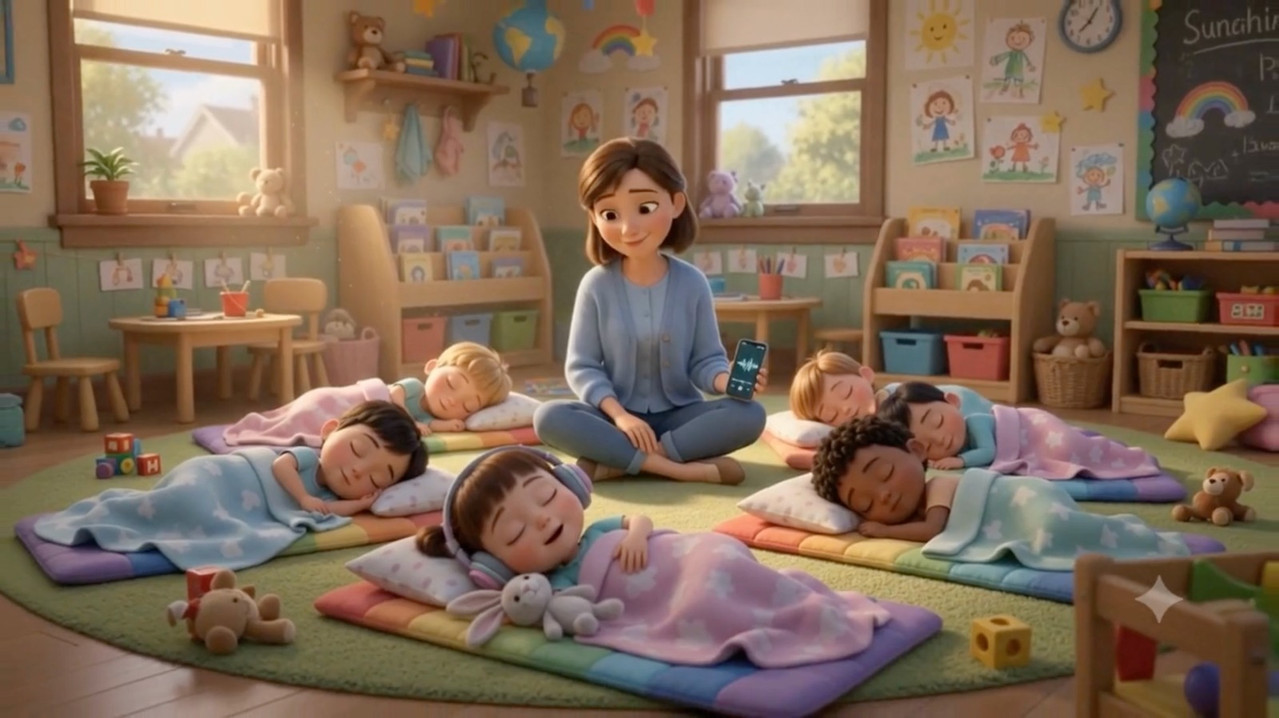
→ Drop a like, upvote, comment or share on [LinkedIn](https://www.linkedin.com/posts/andyolivers_huggingface-gradio-hackathon-ugcPost-7471134065912573953-4uv2) and [YouTube](https://youtu.be/eY_JnijT62E).
## Try it yourself
**Field notes:** [the build journal](https://huggingface.co/blog/build-small-hackathon/lolaby-blog)
**Web version:** [the live Space](https://huggingface.co/spaces/build-small-hackathon/lolaby)
Or to run it locally:
```bash
git clone https://huggingface.co/spaces/build-small-hackathon/lolaby
cd lolaby
pip install -r requirements.txt
python app.py
```
The lyric model is fetched from the Hub on first run (~2 GB GGUF, cached after).
## Dataset
The lyric model was fine-tuned on **1,500 lullabies distilled from Claude Haiku 4.5** with strict anti-boilerplate gates: per-line n-gram dedup, opener dedup, theme caps, format gates, and per-example safety screening. The dataset itself, the generator (`generate_dataset.py`), and the training notebook (`train_lullaby.ipynb`) are in the [`train/`](./train/) folder. Regenerating the dataset requires an Anthropic API key; running the deployed app does not.
Full details in the [model card](https://huggingface.co/build-small-hackathon/lolaby-llama-3b) and the [Field Notes blog post](https://huggingface.co/blog/build-small-hackathon/lolaby-blog).
## Repository
```
.
├── app.py # Gradio entrypoint
├── requirements.txt
├── utils/
│ └── safety.py # Content-safety filter
├── draw/ # Drawing-related helpers
│ ├── vision.py # MiniCPM-V 4.6 wrapper
│ └── strokes.py # NumPy fallback if vision is unavailable
├── synths/ # Custom DSP instruments + Kokoro voice
│ ├── guitar.py
│ ├── piano.py
│ ├── musicbox.py
│ ├── harp.py
│ ├── xylophone.py
│ ├── ocarina.py
│ └── voice.py
├── train/ # Dataset + training (build-time only; not used at runtime)
│ ├── generate_dataset.py
│ ├── train_lullaby.ipynb
│ └── lullaby_dataset.jsonl
└── tests/ # Sanity checks for audio + LLM + voice
```
## Safety
Lolaby is built for small children, so safety isn't an afterthought — it's wired through the pipeline at three points:
- **At training time** — every example in the lyric model's training set was screened during dataset distillation. The model learned from already-wholesome material, not from the open web.
- **At input time** — when a user types a *love* or *fear*, the text is screened against a curated list of terms inappropriate for a child's lullaby (death, weapons, horror, substances, self-harm). Anything matching gets a gentle redirect ("Let's keep the lullaby to gentle, cosy things…") instead of a generation.
- **At generation time** — the same filter is shared between the runtime app and the dataset generator, so the training data and the live app can never enforce different rules.
## Limitations
- **English only.** The lyric model was trained on English data.
- **First-time Space cold-start** might take some time while all models pre-warm at boot.
- **Strange or unusual loves** may be gently generalised by the lyric model into a nearby comforting concept — that's a deliberate behaviour for a bedtime song (soft landing > literal lookup) and described in the model card.
- **Children's drawings are interpreted by an AI** that maps rough shapes and colours onto familiar concepts — much like an adult parent guessing what a kid drew. It can miss subtle details: a stick figure becomes "a little person", a wobbly square with a triangle becomes "a house". The "Lola saw…" hint shows exactly what she understood, so you can redraw or use the What do they love? field instead.
## Credits
- **[Meta](https://ai.meta.com/llama/)** — Llama 3.2 3B Instruct (base model, used under the Llama 3.2 Community License).
- **[OpenBMB](https://huggingface.co/openbmb)** — MiniCPM-V 4.6 (vision).
- **[hexgrad/Kokoro-82M](https://huggingface.co/hexgrad/Kokoro-82M)** — TTS voice.
- **[Unsloth](https://github.com/unslothai/unsloth)** — 4-bit + LoRA training stack.
- **[Hugging Face & Gradio](https://huggingface.co/build-small-hackathon)** — for hosting the Build Small Hackathon and creating space for small-AI projects.
## License
Apache 2.0 for the app code in this repo. The lyric model weights inherit the **Llama 3.2 Community License** from their base — see the [model card](https://huggingface.co/build-small-hackathon/lolaby-llama-3b) for full terms.
---
Built with bedtime magic. ✨
Lolaby • 2026