
Spaces:
Sleeping

Sleeping
File size: 5,735 Bytes
213fb21 6d671f9 213fb21 2e8d6bf 7428575 fad8108 7428575 724cc79 7428575 2e8d6bf 724cc79 2e8d6bf 724cc79 2e8d6bf 724cc79 2e8d6bf c4e21e6 2e8d6bf 189dce9 2e8d6bf 7428575 2e8d6bf f88b3c5 2e8d6bf | 1 2 3 4 5 6 7 8 9 10 11 12 13 14 15 16 17 18 19 20 21 22 23 24 25 26 27 28 29 30 31 32 33 34 35 36 37 38 39 40 41 42 43 44 45 46 47 48 49 50 51 52 53 54 55 56 57 58 59 60 61 62 63 64 65 66 67 68 69 70 71 72 73 74 75 76 77 78 79 80 81 82 83 84 85 86 87 88 89 90 91 92 93 94 95 96 97 98 99 100 101 102 103 104 105 106 107 108 109 110 111 112 113 114 115 116 117 118 119 120 121 122 123 124 125 126 127 128 129 130 131 132 133 134 135 136 137 138 139 140 141 142 143 144 145 146 147 148 149 150 151 152 153 154 155 156 157 158 159 160 161 162 163 164 165 166 167 168 | ---
title: Adaptive Study Agent
emoji: 📚
colorFrom: blue
colorTo: purple
sdk: gradio
sdk_version: "6.9.0"
app_file: app.py
pinned: false
private: true
---
# Adaptive Study Agent
A **two-model LLM self-examination simulation** built with **LangGraph**, **Claude (Anthropic)**, and **GPT-4o-mini (OpenAI)**. The agent reads any document you provide and runs a fully autonomous study loop — no human answers anything.
**How the two models collaborate:**
- **GPT-4o-mini** generates comprehension questions from document chunks (temperature 0.7 — creative) and evaluates the answers against the source material (temperature 0.0 — deterministic)
- **Claude Sonnet** answers the questions using RAG retrieval from ChromaDB (temperature 0.3 — balanced)
- **OpenAI text-embedding-3-small** handles document chunking and embedding into ChromaDB only — not used for reasoning
The purpose is to **probe where Claude's understanding of the document breaks down** — GPT acts as the examiner, Claude as the student. When Claude scores below the mastery threshold, the agent re-reads the weak chunk and tries again.
The output is a structured session report revealing Claude's weak areas within your document — useful for identifying conceptually dense or underrepresented sections in any text.
Applicable to **any domain** — ML papers, medical literature, legal documents, textbooks — anything in PDF or TXT format.
---
## Research Connection
This is a standalone extended example project inspired by ongoing research on multi-agent knowledge systems. The core idea — using retrieval-augmented self-evaluation to surface knowledge gaps — is the single-agent version of a feedback mechanism explored at scale in that research. There is no shared infrastructure or data pipeline between the two.
---
---
## Architecture
The agent operates as a LangGraph state machine with conditional branching. After evaluating each answer, the agent decides whether to re-read weak material, continue to the next question, or finalize the session.
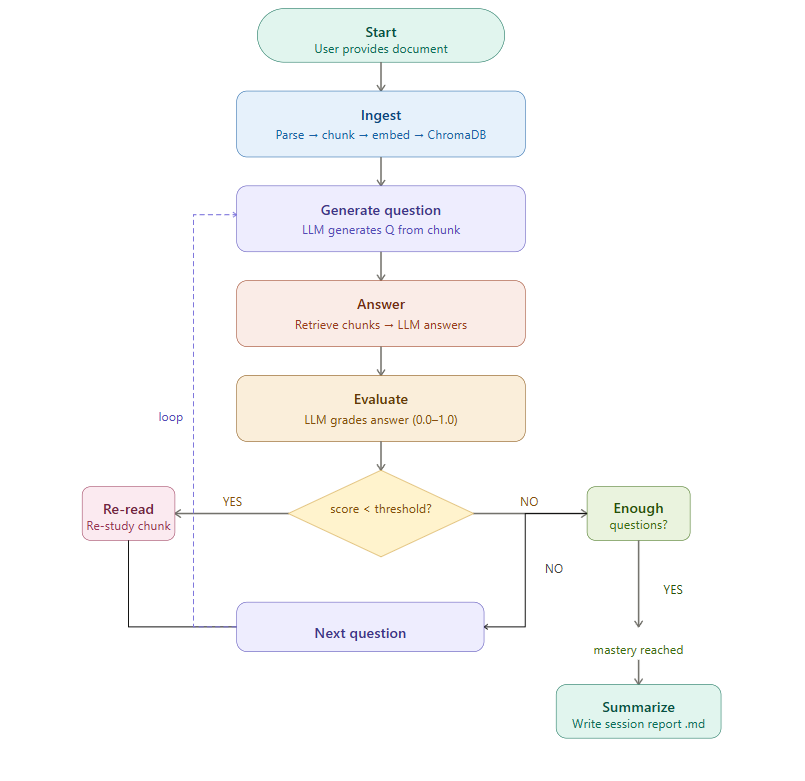

---
## Tech Stack
| Component | Technology | Purpose |
|------------------|-------------------------------|------------------------------------------------------|
| Agent framework | LangGraph | Stateful loops with conditional branching |
| Examiner LLM | GPT-4o-mini (OpenAI) | Question generation (0.7) + evaluation (0.0) |
| Student LLM | Claude Sonnet 4 (Anthropic) | Answering questions via RAG (0.3) |
| Embeddings | OpenAI text-embedding-3-small | Document chunking and embedding into ChromaDB only |
| Vector store | ChromaDB (local, embedded) | No Docker required |
| Document parsing | PyMuPDF (fitz) | PDF support |
| UI | Gradio | Web interface and Hugging Face Spaces deploy |
| Package manager | uv | Dependency management |
---
## Setup
**1. Install dependencies**
```bash
uv sync
```
**2. Configure environment variables**
Create a `.env` file in the project root:
```
ANTHROPIC_API_KEY=sk-ant-...
OPENAI_API_KEY=sk-...
```
The Anthropic key powers the LLM (question generation, answering, evaluation). The OpenAI key is used only for embeddings.
**3. Add documents**
Place PDF or TXT files in `data/documents/`.
---
## Usage
### Command line
```bash
# Run with a document
uv run python src/main.py --doc data/documents/attention_is_all_you_need.pdf
# Override the mastery threshold (default: 0.75)
uv run python src/main.py --doc data/documents/myfile.pdf --threshold 0.8
# Persist the ChromaDB collection between runs
uv run python src/main.py --doc data/documents/myfile.pdf --persist
```
### Gradio web interface
```bash
uv run python app.py
```
The web interface allows you to upload a document, configure the mastery threshold, start a study session, and view the resulting session report from the browser.
### Running tests
```bash
uv run pytest tests/ -v
```
---
## Configuration
The following constants in `src/graph/edges.py` control the study loop:
| Parameter | Default | Description |
|----------------------|---------|----------------------------------------------|
| MASTERY_THRESHOLD | 0.75 | Score needed to skip re-read |
| MIN_QUESTIONS | 10 | Minimum questions before mastery check |
| MAX_REREAD_CYCLES | 3 | Max re-read attempts per weak chunk |
The mastery threshold can also be overridden at runtime via the `--threshold` flag or the Gradio slider.
---
## Output Format
Each session produces a Markdown report in `output/session_reports/`:
```markdown
# Study Session Report
Date: 2026-03-16
Document: attention_is_all_you_need.pdf
## Summary
- Questions asked: 14
- Questions correct (score >= 0.75): 11
- Final mastery score: 0.81
- Re-read cycles triggered: 3
## Weak Areas
- Multi-head attention computation
- Positional encoding formula
## Q&A Log
### Q1
Question: What is the purpose of the scaling factor in dot-product attention?
Answer: ...
Score: 0.9
...
```
---
## Author
**Halima Akhter**
PhD Student in Computer Science
Specialization: ML, Deep Learning, Bioinformatics
GitHub: [github.com/Mituvinci](https://github.com/Mituvinci)
|