

File size: 7,674 Bytes
c6abe34 | 1 2 3 4 5 6 7 8 9 10 11 12 13 14 15 16 17 18 19 20 21 22 23 24 25 26 27 28 29 30 31 32 33 34 35 36 37 38 39 40 41 42 43 44 45 46 47 48 49 50 51 52 53 54 55 56 57 58 59 60 61 62 63 64 65 66 67 68 69 70 71 72 73 74 75 76 77 78 79 80 81 82 83 84 85 86 87 88 89 90 91 92 93 94 95 96 97 98 99 100 101 102 103 104 105 106 107 108 109 110 111 112 113 114 115 116 117 118 119 120 121 122 123 124 125 126 127 128 129 130 131 132 133 134 135 136 137 138 139 140 141 142 143 144 145 146 147 148 149 150 151 152 153 154 155 156 157 158 159 160 161 162 163 164 165 166 167 168 169 170 171 172 173 174 175 176 177 178 179 180 181 182 183 184 185 186 187 188 189 190 191 192 193 194 195 196 197 198 199 200 201 202 203 204 205 206 207 208 209 210 | ---
title: BakoAI
emoji: 🏀
colorFrom: indigo
colorTo: blue
sdk: docker
app_port: 7860
pinned: false
---
# 🏀 Basketball Video Analysis
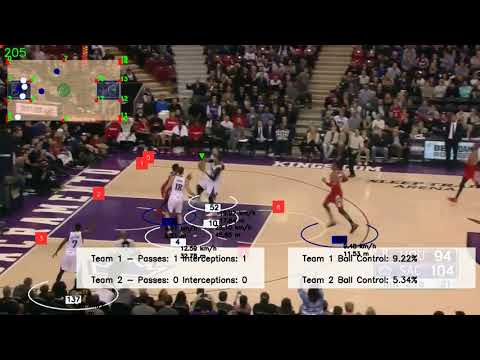
Analyze basketball footage with automated detection of players, ball, team assignment, and more. This repository integrates object tracking, zero-shot classification, and custom keypoint detection for a fully annotated basketball game experience.
Leveraging the convenience of Roboflow for dataset management and Ultralytics' YOLO models for both training and inference, this project provides a robust framework for basketball video analysis.
Training notebooks are included to help you customize and fine-tune models to suit your specific needs, ensuring a seamless and efficient workflow.
## 📁 Table of Contents
1. [Features](#-features)
2. [Prerequisites](#-prerequisites)
3. [Demo Video](#-demo-video)
4. [Installation](#-installation)
5. [Training the Models](#-training-the-models)
6. [Usage](#-usage)
7. [Project Structure](#-project-structure)
8. [Future Work](#-future-work)
9. [Contributing](#-contributing)
10. [License](#-license)
---
## ✨ Features
- Player and ball detection/tracking using pretrained models.
- Court keypoint detection for visualizing important zones.
- Team assignment with jersey color classification.
- Ball possession detection, pass detection, and interception detection.
- Easy stubbing to skip repeated computation for fast iteration.
- Various “drawers” to overlay detected elements onto frames.
---
## 🎮 Demo Video
Below is the final annotated output video.
[](https://youtu.be/xWpP0LjEUng)
## 🔧 Prerequisites
- Python 3.8+
- (Optional) Docker
---
## ⚙️ Installation
Setup your environment locally or via Docker.
### Python Environment
1. Create a virtual environment (e.g., venv/conda).
2. Install the required packages:
```bash
pip install -r requirements.txt
```
### Docker
#### Build the Docker image:
```bash
docker build -t basketball-analysis .
```
#### Verify the image:
```bash
docker images
```
## 🎓 Training the Models
Harnessing the powerful tools offered by Roboflow and Ultralytics makes it straightforward to manage datasets, handle annotations, and train advanced object detection models. Roboflow provides an intuitive platform for dataset preprocessing and augmentation, while Ultralytics’ YOLO architectures (v5, v8, and beyond) deliver state-of-the-art detection performance.
This repository relies on trained models for detecting basketballs, players, and court keypoints. You have two options to get these models:
1. Download the Pretrained Weights
- ball_detector_model.pt
(https://drive.google.com/file/d/1KejdrcEnto2AKjdgdo1U1syr5gODp6EL/view?usp=sharing)
- court_keypoint_detector.pt
(https://drive.google.com/file/d/1nGoG-pUkSg4bWAUIeQ8aN6n7O1fOkXU0/view?usp=sharing)
- player_detector.pt
(https://drive.google.com/file/d/1fVBLZtPy9Yu6Tf186oS4siotkioHBLHy/view?usp=sharing)
Simply download these files and place them into the `models/` folder in your project. This allows you to run the pipelines without manually retraining.
2. Train Your Own Models
The training scripts are provided in the `training_notebooks/` folder. These Jupyter notebooks use Roboflow datasets and the Ultralytics YOLO frameworks to train various detection tasks:
- `basketball_ball_training.ipynb`: Trains a basketball ball detector (using YOLOv5). Incorporates motion blur augmentations to improve ball detection accuracy on fast-moving game footage.
- `basketball_court_keypoint_training.ipynb`: Uses YOLOv8 to detect keypoints on the court (e.g., lines, corners, key zones).
- `basketball_player_detection_training.ipynb`: Trains a player detection model (using YOLO v11) to identify players in each frame.
You can easily run these notebooks in Google Colab or another environment with GPU access. After training, download the newly generated `.pt` files and place them in the `models/` folder.
## Once you have your models in place, you may proceed with the usage steps described above. If you want to retrain or fine-tune for your specific dataset, remember to adjust the paths in the notebooks and in `main.py` to point to the newly generated models.
## 🚀 Usage
You can run this repository’s core functionality (analysis pipeline) with Python or Docker.
### 1) Using Python Directly
Run the main entry point with your chosen video file:
```bash
python main.py path_to_input_video.mp4 --output_video output_videos/output_result.avi
```
- By default, intermediate “stubs” (pickled detection results) are used if found, allowing you to skip repeated detection/tracking.
- Use the `--stub_path` flag to specify a custom stub folder, or disable stubs if you want to run everything fresh.
### 2) Using Docker
#### Build the container if not built already:
```bash
docker build -t basketball-analysis .
```
#### Run the container, mounting your local input video folder:
```bash
docker run \
-v $(pwd)/videos:/app/videos \
-v $(pwd)/output_videos:/app/output_videos \
basketball-analysis \
python main.py videos/input_video.mp4 --output_video output_videos/output_result.avi
```
---
## 🏰 Project Structure
- `main.py`
– Orchestrates the entire pipeline: reading video frames, running detection/tracking, team assignment, drawing results, and saving the output video.
- `trackers/`
– Houses `PlayerTracker` and `BallTracker`, which use detection models to generate bounding boxes and track objects across frames.
- `utils/`
– Contains helper functions like `bbox_utils.py` for geometric calculations, `stubs_utils.py` for reading and saving intermediate results, and `video_utils.py` for reading/saving videos.
- `drawers/`
– Contains classes that overlay bounding boxes, court lines, passes, etc., onto frames.
- `ball_aquisition/`
– Logic for identifying which player is in possession of the ball.
- `pass_and_interception_detector/`
– Identifies passing events and interceptions.
- `court_keypoint_detector/`
– Detects lines and keypoints on the court using the specified model.
- `team_assigner/`
– Uses zero-shot classification (Hugging Face or similar) to assign players to teams based on jersey color.
- `configs/`
– Holds default paths for models, stubs, and output video.
---
## 🔮 Future Work
As we continue to enhance the capabilities of this basketball video analysis tool, several areas for future development have been identified:
1. **Integrating a Pose Model for Advanced Rule Detection**
Incorporating a pose detection model could enable the identification of complex basketball rules such as double dribbling and traveling. By analyzing player movements and positions, the system could automatically flag these infractions, adding another layer of analysis to the video footage.
These enhancements will further refine the analysis capabilities and provide users with more comprehensive insights into basketball games.
## 🤝 Contributing
Contributions are welcome!
1. Fork the repository.
2. Create a new branch for your feature or bug fix.
3. Submit a pull request with a clear explanation of your changes.
---
## 🐜 License
This project is licensed under the MIT License.
See `LICENSE` for details.
---
## 💬 Questions or Feedback?
Feel free to open an issue or reach out via email if you have questions about the project, suggestions for improvements, or just want to say hi!
Enjoy analyzing basketball footage with automatic detection and tracking!
|