## Neural Style Transfer (optimization method) :computer: + :art: = :heart:
This repo contains a concise PyTorch implementation of the original NST paper (:link: [Gatys et al.](https://www.cv-foundation.org/openaccess/content_cvpr_2016/papers/Gatys_Image_Style_Transfer_CVPR_2016_paper.pdf)).
It's an accompanying repository for [this video series on YouTube](https://www.youtube.com/watch?v=S78LQebx6jo&list=PLBoQnSflObcmbfshq9oNs41vODgXG-608).
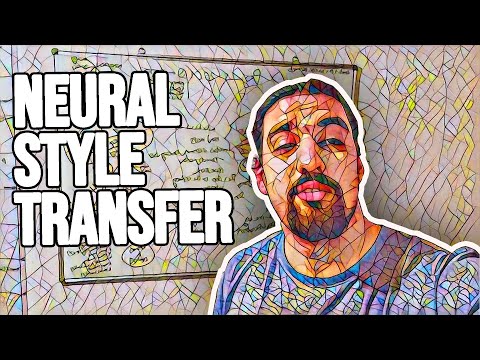
### What is NST algorithm?
The algorithm transfers style from one input image (the style image) onto another input image (the content image) using CNN nets (usually VGG-16/19) and gives a composite, stylized image out which keeps the content from the content image but takes the style from the style image.


### Why yet another NST repo?
It's the **cleanest and most concise** NST repo that I know of + it's written in **PyTorch!** :heart:
Most of NST repos were written in TensorFlow (before it even had L-BFGS optimizer) and torch (obsolete framework, used Lua) and are overly complicated often times including multiple functionalities (video, static image, color transfer, etc.) in 1 repo and exposing 100 parameters over command-line (out of which maybe 5 or 6 may actually be used on a regular basis).
## Examples
Transfering style gives beautiful artistic results:


And here are some results coupled with their style:


*Note: all of the stylized images were produced by me (using this repo), credits for original image artists [are given bellow](#acknowledgements).*
### Content/Style tradeoff
Changing style weight gives you less or more style on the final image, assuming you keep the content weight constant.
I did increments of 10 here for style weight (1e1, 1e2, 1e3, 1e4), while keeping content weight at constant 1e5, and I used random image as initialization image.


### Impact of total variation (tv) loss
Rarely explained, the total variation loss i.e. it's corresponding weight controls the smoothness of the image.
I also did increments of 10 here (1e1, 1e4, 1e5, 1e6) and I used content image as initialization image.


### Optimization initialization
Starting with different initialization images: noise (white or gaussian), content and style leads to different results.
Empirically content image gives the best results as explored in [this research paper](https://arxiv.org/pdf/1602.07188.pdf) also.
Here you can see results for content, random and style initialization in that order (left to right):


You can also see that with style initialization we had some content from the artwork leaking directly into our output.
### Famous "Figure 3" reconstruction
Finally if I haven't included this portion you couldn't say that I've successfully reproduced the [original paper]((https://www.cv-foundation.org/openaccess/content_cvpr_2016/papers/Gatys_Image_Style_Transfer_CVPR_2016_paper.pdf)) (laughs in Python):


I haven't give it much effort results can be much nicer.
### Content reconstruction
If we only use the content (perceptual) loss and try to minimize that objective function this is what we get (starting from noise):


In steps 0, 26, 70 and 509 of the L-BFGS numerical optimizer, using layer relu3_1 for content representation.
Check-out [this section](#reconstruct-image-from-representation) if you want to play with this.
### Style reconstruction
We can do the same thing for style (on the left is the original art image "Candy") starting from noise:


In steps 45, 129 and 510 of the L-BFGS using layers relu1_1, relu2_1, relu3_1, relu4_1 and relu5_1 for style representation.
## Setup
1. Open Anaconda Prompt and navigate into project directory `cd path_to_repo`
2. Run `conda env create` (while in project directory)
3. Run `activate pytorch-nst`
That's it! It should work out-of-the-box executing environment.yml file which deals with dependencies.
-----
PyTorch package will pull some version of CUDA with it, but it is highly recommended that you install system-wide CUDA beforehand, mostly because of GPU drivers. I also recommend using Miniconda installer as a way to get conda on your system.
Follow through points 1 and 2 of [this setup](https://github.com/Petlja/PSIML/blob/master/docs/MachineSetup.md) and use the most up-to-date versions of Miniconda (Python 3.7) and CUDA/cuDNN.
(I recommend CUDA 10.1 as it is compatible with PyTorch 1.4, which is used in this repo, and newest compatible cuDNN)
## Usage
1. Copy content images to the default content image directory: `/data/content-images/`
2. Copy style images to the default style image directory: `/data/style-images/`
3. Run `python neural_style_transfer.py --content_img_name --style_img_name `
It's that easy. For more advanced usage take a look at the code it's (hopefully) self-explanatory (if you speak Python ^^).
Or take a look at [this accompanying YouTube video](https://www.youtube.com/watch?v=XWMwdkaLFsI), it explains how to use this repo in greater detail.
Just run it! So that you can get something like this: :heart:

### Debugging/Experimenting
Q: L-BFGS can't run on my computer it takes too much GPU VRAM?
A: Set Adam as your default and take a look at the code for initial style/content/tv weights you should use as a start point.
Q: Output image looks too much like style image?
A: Decrease style weight or take a look at the table of weights (in neural_style_transfer.py), which I've included, that works.
Q: There is too much noise (image is not smooth)?
A: Increase total variation (tv) weight (usually by multiples of 10, again the table is your friend here or just experiment yourself).
### Reconstruct image from representation
I've also included a file that will help you better understand how the algorithm works and what the neural net sees.
What it does is that it allows you to visualize content **(feature maps)** and style representations **(Gram matrices)**.
It will also reconstruct either only style or content using those representations and corresponding model that produces them.
Just run this:
`reconstruct_image_from_representation.py --should_reconstruct_content --should_visualize_representation `
And that's it! --should_visualize_representation if set to True will visualize these for you
--should_reconstruct_content picks between style and content reconstruction
Here are some feature maps (relu1_1, VGG 19) as well as a Gram matrix (relu2_1, VGG 19) for Van Gogh's famous [starry night](https://en.wikipedia.org/wiki/The_Starry_Night):


No more dark magic.
## Acknowledgements
I found these repos useful: (while developing this one)
* [fast_neural_style](https://github.com/pytorch/examples/tree/master/fast_neural_style) (PyTorch, feed-forward method)
* [neural-style-tf](https://github.com/cysmith/neural-style-tf/) (TensorFlow, optimization method)
* [neural-style](https://github.com/anishathalye/neural-style/) (TensorFlow, optimization method)
I found some of the content/style images I was using here:
* [style/artistic images](https://www.rawpixel.com/board/537381/vincent-van-gogh-free-original-public-domain-paintings?sort=curated&mode=shop&page=1)
* [awesome figures pic](https://www.pexels.com/photo/action-android-device-electronics-595804/)
* [awesome bridge pic](https://www.pexels.com/photo/gray-bridge-and-trees-814499/)
Other images are now already classics in the NST world.
## Citation
If you find this code useful for your research, please cite the following:
```
@misc{Gordić2020nst,
author = {Gordić, Aleksa},
title = {pytorch-neural-style-transfer},
year = {2020},
publisher = {GitHub},
journal = {GitHub repository},
howpublished = {\url{https://github.com/gordicaleksa/pytorch-neural-style-transfer}},
}
```
## Connect with me
If you'd love to have some more AI-related content in your life :nerd_face:, consider:
* Subscribing to my YouTube channel [The AI Epiphany](https://www.youtube.com/c/TheAiEpiphany) :bell:
* Follow me on [LinkedIn](https://www.linkedin.com/in/aleksagordic/) and [Twitter](https://twitter.com/gordic_aleksa) :bulb:
* Follow me on [Medium](https://gordicaleksa.medium.com/) :books: :heart:
## Licence
[](https://github.com/gordicaleksa/pytorch-neural-style-transfer/blob/master/LICENCE)