


File size: 15,538 Bytes
6c37dff 033ca06 f2f2616 033ca06 9c0e837 033ca06 9c0e837 033ca06 82dbc68 033ca06 | 1 2 3 4 5 6 7 8 9 10 11 12 13 14 15 16 17 18 19 20 21 22 23 24 25 26 27 28 29 30 31 32 33 34 35 36 37 38 39 40 41 42 43 44 45 46 47 48 49 50 51 52 53 54 55 56 57 58 59 60 61 62 63 64 65 66 67 68 69 70 71 72 73 74 75 76 77 78 79 80 81 82 83 84 85 86 87 88 89 90 91 92 93 94 95 96 97 98 99 100 101 102 103 104 105 106 107 108 109 110 111 112 113 114 115 116 117 118 119 120 121 122 123 124 125 126 127 128 129 130 131 132 133 134 135 136 137 138 139 140 141 142 143 144 145 146 147 148 149 150 151 152 153 154 155 156 157 158 159 160 161 162 163 164 165 166 167 168 169 170 171 172 173 174 175 176 177 178 179 180 181 182 183 184 185 186 187 188 189 190 191 192 193 194 195 196 197 198 199 200 201 202 203 204 205 206 207 208 209 210 211 212 213 214 215 216 217 218 219 220 221 222 223 224 225 226 227 228 229 230 231 232 233 234 235 236 237 238 239 240 241 242 243 244 245 246 247 248 249 250 251 252 253 254 255 256 257 258 259 260 261 262 263 264 265 266 267 268 269 270 271 272 273 274 275 276 277 278 279 280 281 282 283 284 285 286 287 288 289 290 291 292 293 294 295 296 297 298 299 300 301 302 303 304 305 306 307 308 309 310 311 312 313 314 315 316 317 318 319 320 321 322 323 324 325 326 327 328 329 330 331 332 333 334 335 336 337 338 339 340 341 342 343 344 345 346 347 348 349 350 351 352 353 354 355 356 | ---
title: DeerFlow GPT-5.1
emoji: "🦌"
colorFrom: green
colorTo: blue
sdk: docker
app_port: 7860
pinned: false
---
# 🦌 DeerFlow - 2.0
<a href="https://trendshift.io/repositories/14699" target="_blank"><img src="https://trendshift.io/api/badge/repositories/14699" alt="bytedance%2Fdeer-flow | Trendshift" style="width: 250px; height: 55px;" width="250" height="55"/></a>
> On February 28th, 2026, DeerFlow claimed the 🏆 #1 spot on GitHub Trending following the launch of version 2. Thanks a million to our incredible community — you made this happen! 💪🔥
DeerFlow (**D**eep **E**xploration and **E**fficient **R**esearch **Flow**) is an open-source **super agent harness** that orchestrates **sub-agents**, **memory**, and **sandboxes** to do almost anything — powered by **extensible skills**.
https://github.com/user-attachments/assets/a8bcadc4-e040-4cf2-8fda-dd768b999c18
> [!NOTE]
> **DeerFlow 2.0 is a ground-up rewrite.** It shares no code with v1. If you're looking for the original Deep Research framework, it's maintained on the [`1.x` branch](https://github.com/bytedance/deer-flow/tree/main-1.x) — contributions there are still welcome. Active development has moved to 2.0.
## Official Website
Learn more and see **real demos** on our official website.
**[deerflow.tech](https://deerflow.tech/)**
---
## Table of Contents
- [🦌 DeerFlow - 2.0](#-deerflow---20)
- [Offiical Website](#offiical-website)
- [Table of Contents](#table-of-contents)
- [Quick Start](#quick-start)
- [Configuration](#configuration)
- [Running the Application](#running-the-application)
- [Option 1: Docker (Recommended)](#option-1-docker-recommended)
- [Option 2: Local Development](#option-2-local-development)
- [Advanced](#advanced)
- [Sandbox Mode](#sandbox-mode)
- [MCP Server](#mcp-server)
- [From Deep Research to Super Agent Harness](#from-deep-research-to-super-agent-harness)
- [Core Features](#core-features)
- [Skills \& Tools](#skills--tools)
- [Sub-Agents](#sub-agents)
- [Sandbox \& File System](#sandbox--file-system)
- [Context Engineering](#context-engineering)
- [Long-Term Memory](#long-term-memory)
- [Recommended Models](#recommended-models)
- [Documentation](#documentation)
- [Contributing](#contributing)
- [License](#license)
- [Acknowledgments](#acknowledgments)
- [Key Contributors](#key-contributors)
- [Star History](#star-history)
## Quick Start
### Configuration
1. **Clone the DeerFlow repository**
```bash
git clone https://github.com/bytedance/deer-flow.git
cd deer-flow
```
2. **Generate local configuration files**
From the project root directory (`deer-flow/`), run:
```bash
make config
```
This command creates local configuration files based on the provided example templates.
3. **Configure your preferred model(s)**
Edit `config.yaml` and define at least one model:
```yaml
models:
- name: gpt-4 # Internal identifier
display_name: GPT-4 # Human-readable name
use: langchain_openai:ChatOpenAI # LangChain class path
model: gpt-4 # Model identifier for API
api_key: $OPENAI_API_KEY # API key (recommended: use env var)
max_tokens: 4096 # Maximum tokens per request
temperature: 0.7 # Sampling temperature
```
4. **Set API keys for your configured model(s)**
Choose one of the following methods:
- Option A: Edit the `.env` file in the project root (Recommended)
```bash
# Optional but recommended: improves web_search quality
TAVILY_API_KEY=your-tavily-api-key
OPENAI_API_KEY=your-openai-api-key
# Add other provider keys as needed
```
- Option B: Export environment variables in your shell
```bash
export OPENAI_API_KEY=your-openai-api-key
```
- Option C: Edit `config.yaml` directly (Not recommended for production)
```yaml
models:
- name: gpt-4
api_key: your-actual-api-key-here # Replace placeholder
```
### Running the Application
#### Option 1: Docker (Recommended)
The fastest way to get started with a consistent environment:
1. **Initialize and start**:
```bash
make docker-init # Pull sandbox image (Only once or when image updates)
make docker-start # Start services (auto-detects sandbox mode from config.yaml)
```
`make docker-start` now starts `provisioner` only when `config.yaml` uses provisioner mode (`sandbox.use: src.community.aio_sandbox:AioSandboxProvider` with `provisioner_url`).
2. **Access**: http://localhost:2026
See [CONTRIBUTING.md](CONTRIBUTING.md) for detailed Docker development guide.
#### Option 2: Local Development
If you prefer running services locally:
1. **Check prerequisites**:
```bash
make check # Verifies Node.js 22+, pnpm, uv, nginx
```
2. **(Optional) Pre-pull sandbox image**:
```bash
# Recommended if using Docker/Container-based sandbox
make setup-sandbox
```
3. **Start services**:
```bash
make dev
```
4. **Access**: http://localhost:2026
### Advanced
#### Sandbox Mode
DeerFlow supports multiple sandbox execution modes:
- **Local Execution** (runs sandbox code directly on the host machine)
- **Docker Execution** (runs sandbox code in isolated Docker containers)
- **Docker Execution with Kubernetes** (runs sandbox code in Kubernetes pods via provisioner service)
For Docker development, service startup follows `config.yaml` sandbox mode. In Local/Docker modes, `provisioner` is not started.
See the [Sandbox Configuration Guide](backend/docs/CONFIGURATION.md#sandbox) to configure your preferred mode.
#### MCP Server
DeerFlow supports configurable MCP servers and skills to extend its capabilities.
For HTTP/SSE MCP servers, OAuth token flows are supported (`client_credentials`, `refresh_token`).
See the [MCP Server Guide](backend/docs/MCP_SERVER.md) for detailed instructions.
For dynamic websites, DeerFlow also supports the `agent_browser` tool (based on `vercel-labs/agent-browser` CLI).
#### Agent Browser (vercel-labs/agent-browser)
- Tool name: `agent_browser`
- Default behavior: use installed `agent-browser`; fallback to `npx -y agent-browser@latest`
- Recommended one-time setup:
```bash
npm i -g agent-browser
agent-browser install
# Linux servers may need:
# agent-browser install --with-deps
```
#### Persistent Storage (Space / External DB)
By default, local `langgraph dev` state is in-memory and will be lost after restart.
This Space startup now supports persistent state with:
- `DEER_FLOW_HOME` (defaults to `/data/deer-flow`): stores thread files, artifacts, and memory
- `DEER_FLOW_EXTENSIONS_CONFIG_PATH`: stores MCP/skills enable-state JSON
- LangGraph checkpointer:
- `LANGGRAPH_CHECKPOINT_POSTGRES_URI` (recommended external DB, PostgreSQL)
- fallback: `LANGGRAPH_CHECKPOINT_SQLITE_PATH` (SQLite file, defaults to `${DEER_FLOW_HOME}/checkpoints.sqlite`)
If you enable HF persistent storage, `/data` survives restarts, so memory/skills/thread artifacts and SQLite checkpoints persist.
## From Deep Research to Super Agent Harness
DeerFlow started as a Deep Research framework — and the community ran with it. Since launch, developers have pushed it far beyond research: building data pipelines, generating slide decks, spinning up dashboards, automating content workflows. Things we never anticipated.
That told us something important: DeerFlow wasn't just a research tool. It was a **harness** — a runtime that gives agents the infrastructure to actually get work done.
So we rebuilt it from scratch.
DeerFlow 2.0 is no longer a framework you wire together. It's a super agent harness — batteries included, fully extensible. Built on LangGraph and LangChain, it ships with everything an agent needs out of the box: a filesystem, memory, skills, sandboxed execution, and the ability to plan and spawn sub-agents for complex, multi-step tasks.
Use it as-is. Or tear it apart and make it yours.
## Core Features
### Skills & Tools
Skills are what make DeerFlow do *almost anything*.
A standard Agent Skill is a structured capability module — a Markdown file that defines a workflow, best practices, and references to supporting resources. DeerFlow ships with built-in skills for research, report generation, slide creation, web pages, image and video generation, and more. But the real power is extensibility: add your own skills, replace the built-in ones, or combine them into compound workflows.
Skills are loaded progressively — only when the task needs them, not all at once. This keeps the context window lean and makes DeerFlow work well even with token-sensitive models.
Tools follow the same philosophy. DeerFlow comes with a core toolset — web search, web fetch, file operations, bash execution — and supports custom tools via MCP servers and Python functions. Swap anything. Add anything.
```
# Paths inside the sandbox container
/mnt/skills/public
├── research/SKILL.md
├── report-generation/SKILL.md
├── slide-creation/SKILL.md
├── web-page/SKILL.md
└── image-generation/SKILL.md
/mnt/skills/custom
└── your-custom-skill/SKILL.md ← yours
```
### Sub-Agents
Complex tasks rarely fit in a single pass. DeerFlow decomposes them.
The lead agent can spawn sub-agents on the fly — each with its own scoped context, tools, and termination conditions. Sub-agents run in parallel when possible, report back structured results, and the lead agent synthesizes everything into a coherent output.
This is how DeerFlow handles tasks that take minutes to hours: a research task might fan out into a dozen sub-agents, each exploring a different angle, then converge into a single report — or a website — or a slide deck with generated visuals. One harness, many hands.
### Sandbox & File System
DeerFlow doesn't just *talk* about doing things. It has its own computer.
Each task runs inside an isolated Docker container with a full filesystem — skills, workspace, uploads, outputs. The agent reads, writes, and edits files. It executes bash commands and codes. It views images. All sandboxed, all auditable, zero contamination between sessions.
This is the difference between a chatbot with tool access and an agent with an actual execution environment.
```
# Paths inside the sandbox container
/mnt/user-data/
├── uploads/ ← your files
├── workspace/ ← agents' working directory
└── outputs/ ← final deliverables
```
### Context Engineering
**Isolated Sub-Agent Context**: Each sub-agent runs in its own isolated context. This means that the sub-agent will not be able to see the context of the main agent or other sub-agents. This is important to ensure that the sub-agent is able to focus on the task at hand and not be distracted by the context of the main agent or other sub-agents.
**Summarization**: Within a session, DeerFlow manages context aggressively — summarizing completed sub-tasks, offloading intermediate results to the filesystem, compressing what's no longer immediately relevant. This lets it stay sharp across long, multi-step tasks without blowing the context window.
### Long-Term Memory
Most agents forget everything the moment a conversation ends. DeerFlow remembers.
Across sessions, DeerFlow builds a persistent memory of your profile, preferences, and accumulated knowledge. The more you use it, the better it knows you — your writing style, your technical stack, your recurring workflows. Memory is stored locally and stays under your control.
## Recommended Models
DeerFlow is model-agnostic — it works with any LLM that implements the OpenAI-compatible API. That said, it performs best with models that support:
- **Long context windows** (100k+ tokens) for deep research and multi-step tasks
- **Reasoning capabilities** for adaptive planning and complex decomposition
- **Multimodal inputs** for image understanding and video comprehension
- **Strong tool-use** for reliable function calling and structured outputs
## Embedded Python Client
DeerFlow can be used as an embedded Python library without running the full HTTP services. The `DeerFlowClient` provides direct in-process access to all agent and Gateway capabilities, returning the same response schemas as the HTTP Gateway API:
```python
from src.client import DeerFlowClient
client = DeerFlowClient()
# Chat
response = client.chat("Analyze this paper for me", thread_id="my-thread")
# Streaming (LangGraph SSE protocol: values, messages-tuple, end)
for event in client.stream("hello"):
if event.type == "messages-tuple" and event.data.get("type") == "ai":
print(event.data["content"])
# Configuration & management — returns Gateway-aligned dicts
models = client.list_models() # {"models": [...]}
skills = client.list_skills() # {"skills": [...]}
client.update_skill("web-search", enabled=True)
client.upload_files("thread-1", ["./report.pdf"]) # {"success": True, "files": [...]}
```
All dict-returning methods are validated against Gateway Pydantic response models in CI (`TestGatewayConformance`), ensuring the embedded client stays in sync with the HTTP API schemas. See `backend/src/client.py` for full API documentation.
## Documentation
- [Contributing Guide](CONTRIBUTING.md) - Development environment setup and workflow
- [Configuration Guide](backend/docs/CONFIGURATION.md) - Setup and configuration instructions
- [Architecture Overview](backend/CLAUDE.md) - Technical architecture details
- [Backend Architecture](backend/README.md) - Backend architecture and API reference
## Contributing
We welcome contributions! Please see [CONTRIBUTING.md](CONTRIBUTING.md) for development setup, workflow, and guidelines.
Regression coverage includes Docker sandbox mode detection and provisioner kubeconfig-path handling tests in `backend/tests/`.
## License
This project is open source and available under the [MIT License](./LICENSE).
## Acknowledgments
DeerFlow is built upon the incredible work of the open-source community. We are deeply grateful to all the projects and contributors whose efforts have made DeerFlow possible. Truly, we stand on the shoulders of giants.
We would like to extend our sincere appreciation to the following projects for their invaluable contributions:
- **[LangChain](https://github.com/langchain-ai/langchain)**: Their exceptional framework powers our LLM interactions and chains, enabling seamless integration and functionality.
- **[LangGraph](https://github.com/langchain-ai/langgraph)**: Their innovative approach to multi-agent orchestration has been instrumental in enabling DeerFlow's sophisticated workflows.
These projects exemplify the transformative power of open-source collaboration, and we are proud to build upon their foundations.
### Key Contributors
A heartfelt thank you goes out to the core authors of `DeerFlow`, whose vision, passion, and dedication have brought this project to life:
- **[Daniel Walnut](https://github.com/hetaoBackend/)**
- **[Henry Li](https://github.com/magiccube/)**
Your unwavering commitment and expertise have been the driving force behind DeerFlow's success. We are honored to have you at the helm of this journey.
## Star History
[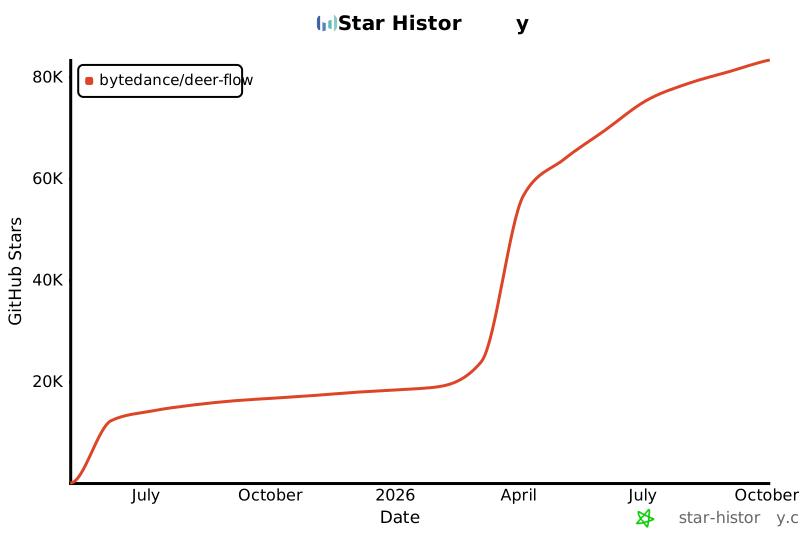](https://star-history.com/#bytedance/deer-flow&Date)
|