---
license: apache-2.0
language:
- en
tags:
- vision-language-action
- edge-deployment
- tensorRT
- qwen
base_model: Stanford-ILIAD/minivla-vq-libero90-prismatic
library_name: transformers
datasets:
- LIBERO
pipeline_tag: image-text-to-text
---
# MiniVLA
This repository hosts **MiniVLA** – a modular and deployment-friendly Vision-Language-Action (VLA) model designed for **edge hardware** (e.g., Jetson Orin Nano).
It contains model checkpoints, Hugging Face–compatible Qwen-0.5B LLM, and ONNX/TensorRT exports for accelerated inference.
---
## 🔎 Introduction
To enable low-latency, high-security desktop robot tasks on local devices, this project focuses on addressing the deployment and performance challenges of lightweight multimodal models on edge hardware. Using OpenVLA-Mini as a case study, we propose a hybrid acceleration pipeline designed to alleviate deployment bottlenecks on resource-constrained platforms.
We reproduced a lightweight VLA model and then significantly reduced its end-to-end latency and GPU memory usage by exporting the vision encoder into ONNX and TensorRT engines. While we observed a moderate drop in the task success rate (around 5-10% in LIBERO desktop operation tasks), our results still demonstrate the feasibility of achieving efficient, real-time VLA inference on the edge side.
---
## 🏗️ System Architecture
The MiniVLA deployment is designed with modular microservices:
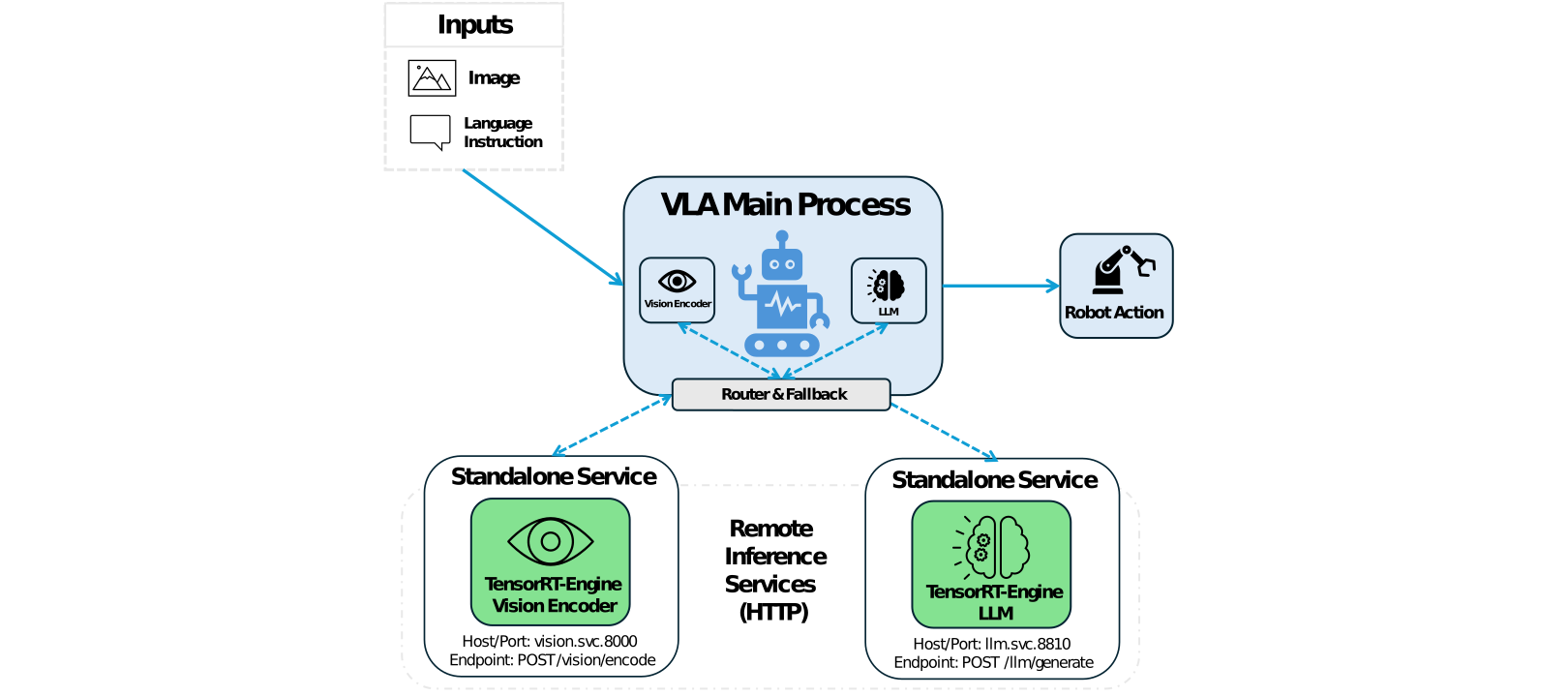
- **Inputs**: image + language instruction
- **Vision Encoder**: DinoV2 / SigLIP → ONNX/TensorRT
- **LLM**: Qwen 2.5 0.5B (Hugging Face / TensorRT-LLM)
- **Router & Fallback**: balances between local inference and accelerated microservices
- **Robot Action**: decoded from predicted action tokens
### Hybrid Acceleration

- **Vision Encoder Acceleration**: PyTorch → ONNX → TensorRT, deployed as microservice (`/vision/encode`)
- **LLM Acceleration**: Hugging Face → TensorRT-LLM engine, deployed as microservice (`/llm/generate`)
- **Main Process**: Orchestrates requests, ensures fallback, and outputs robot actions
---
## 📦 Contents
- **`models/`**
Contains the original MiniVLA model checkpoints, based on
[Stanford-ILIAD/minivla-vq-libero90-prismatic](https://huggingface.co/Stanford-ILIAD/minivla-vq-libero90-prismatic).
Special thanks to the Stanford ILIAD team for their open-source contribution.
- **`qwen25-0_5b-trtllm/`**
Qwen-0.5B language model converted to TensorRT-LLM format.
- **`qwen25-0_5b-with-extra-tokenizer/`**
Hugging Face–compatible Qwen-0.5B model with extended tokenizer.
- **`tensorRT/`**
Vision encoder acceleration files:
-
`vision_encoder_fp16.onnx`
- `vision_encoder_fp16.engine`
---
## 🔗 Related Project
For full implementation and code, please visit the companion GitHub repository:
👉 [https://github.com/Zhenxintao/MiniVLA](https://github.com/Zhenxintao/MiniVLA)
## 🚀 Usage
### Load Hugging Face Qwen-0.5B
```python
from transformers import AutoTokenizer, AutoModelForCausalLM
model_name = "xintaozhen/MiniVLA/qwen25-0_5b-with-extra-tokenizer"
tokenizer = AutoTokenizer.from_pretrained(model_name, trust_remote_code=True)
model = AutoModelForCausalLM.from_pretrained(model_name, trust_remote_code=True)
```
### Call TensorRT Vision Encoder (HTTP API)
```python
import requests
url = "http://vision.svc:8000/vision/encode"
image_data = {"image": "base64_encoded_image"}
response = requests.post(url, json=image_data)
vision_embedding = response.json()
```
### Call TensorRT-LLM (HTTP API)
```python
import requests
url = "http://llm.svc:8810/llm/generate"
payload = {"prompt": "Close the top drawer of the cabinet."}
response = requests.post(url, json=payload)
generated_actions = response.json()
```
---
## 🔑 Key Contributions
- Built an **end-to-end online inference framework** with a FastAPI service (`/act`), transforming offline benchmark code into a **real-time deployable system**.
- Reproduced a lightweight **OpenVLA-Mini** and proposed a **hybrid acceleration pipeline**.
- Exported the **vision encoder** to TensorRT, reducing perception latency and GPU memory usage.
- Improved **GPU memory efficiency**: reduced average utilization from ~67% to ~43%, and peak usage from ~85% to ~65%, making deployment feasible under 8 GB memory constraints (similar to Jetson-class devices).
- Integrated **Qwen 2.5 0.5B** in Hugging Face and TensorRT-LLM formats.
- Designed a **modular system architecture** with router & fallback for robustness.
- Demonstrated efficient **edge-side VLA inference** on Jetson Orin Nano in LIBERO tasks, with only a moderate performance drop (5–10%).
---
## 🖥️ Device & Performance
Target deployment: **Jetson Orin Nano (16 GB / 8 GB variants)**.
For simulation and reproducibility, experiments were conducted on a **local workstation** equipped with:
- **GPU**: NVIDIA GeForce RTX 4060 Laptop GPU (8 GB VRAM)
- **Driver / CUDA**: Driver 550.144.03, CUDA 12.4
- **OS**: Ubuntu 22.04 LTS
⚠️ **Note**: Although the experiments were run on RTX 4060, the GPU memory (8 GB) is comparable to entry-level Jetson devices, making it a suitable proxy for evaluating edge deployment feasibility.
### GPU Memory Utilization (Long-Sequence Tasks)
| Model Variant | Avg. GPU Utilization | Peak GPU Utilization |
| --------------------------------------- | -------------------- | -------------------- |
| Original MiniVLA (PyTorch, no TRT) | ~67% | ~85% |
| MiniVLA w/ TensorRT Vision Acceleration | ~43% | ~65% |
**Observation:**
- The hybrid acceleration pipeline (TensorRT vision + VLA main process) reduced **average GPU utilization by ~24%** and **peak usage by ~20%**.
- This indicates better **GPU memory efficiency**, allowing longer sequence tasks to run stably under resource-constrained devices.
### Example nvidia-smi Output
Original model:
```
GPU Memory-Usage: 4115MiB / 8188MiB
GPU-Util: 67% (peak 85%)
```
With TensorRT vision acceleration:
```
GPU Memory-Usage: 4055MiB / 8188MiB
GPU-Util: 43% (peak 65%)
```
---
## 📑 License
Specify the license here (e.g., Apache 2.0, MIT, or same as MiniVLA / Qwen license).
---
## 📚 Citation
If you use **MiniVLA** in your research or deployment, please cite:
```
@misc{MiniVLA2025,
title = {MiniVLA: A Modular Vision-Language-Action Model for Edge Deployment},
author = {Xintao Zhen},
year = {2025},
url = {https://huggingface.co/xintaozhen/MiniVLA}
}
```
We also acknowledge and thank the authors of [Stanford-ILIAD/minivla-vq-libero90-prismatic](https://huggingface.co/Stanford-ILIAD/minivla-vq-libero90-prismatic), which serves as the base for the checkpoints included in this repository.
---