

AI999X Scientific Models
Collection
All 31 AI999X scientific models: offline solvers with exact, step-by-step answers across 7 fields (2,696 capabilities). • 31 items • Updated
Calculus covers limits, derivatives, integrals, series, Taylor polynomials, multivariable and vector calculus, special functions and numerical differentiation and integration: 82 calculations in 16 topics, each with its formula, its steps and its units, and a plain reason instead of a number when an input is missing or out of range. One compiled engine, four ways to use it: the desktop app, the command line, the browser and Python. Everything runs on your own computer, offline.
| Desktop app (Windows, Linux) | Windows · Linux |
Command line calculus (Windows, Linux) |
Windows · Linux |
| Browser (any device) | Try it on the model page |
| Python 3.10+ | pip install calculus-ai999x: a pure-Python build of the same calculations (the compiled engine is in the app, the command line and the browser) |
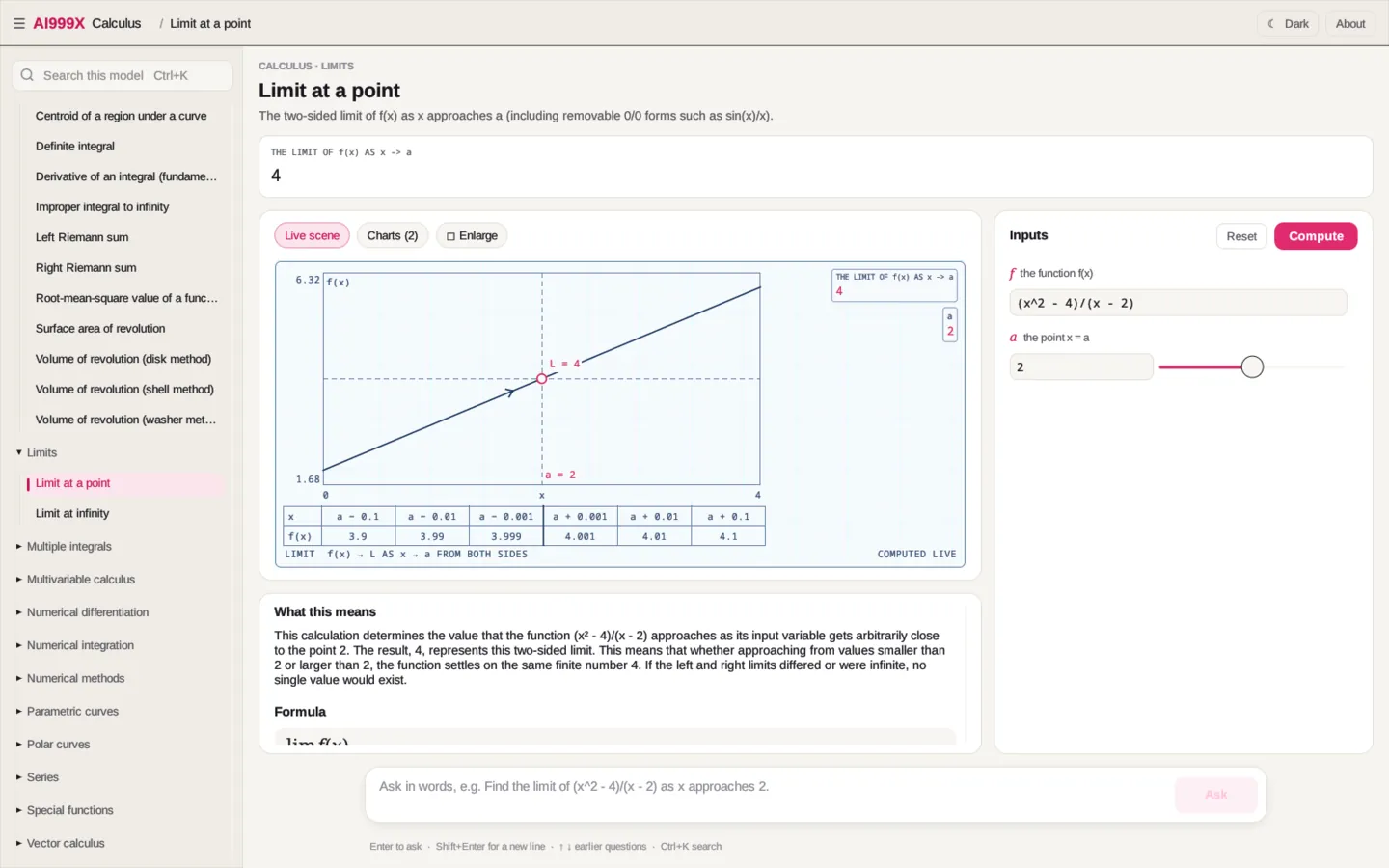
From the Calculus desktop app: every scene and chart is drawn from the computed answer.

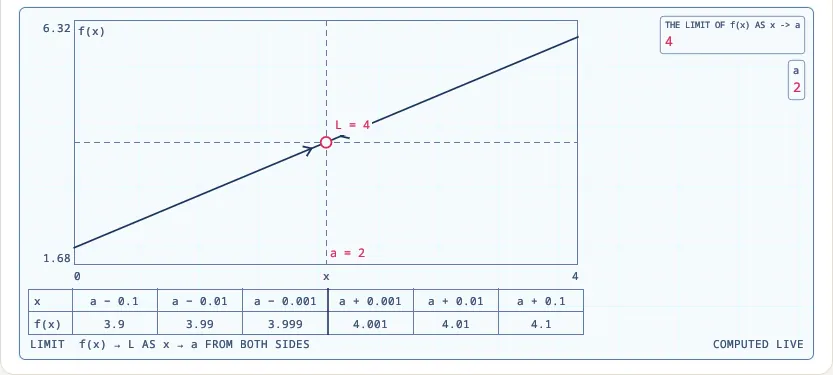 Limit at a point |
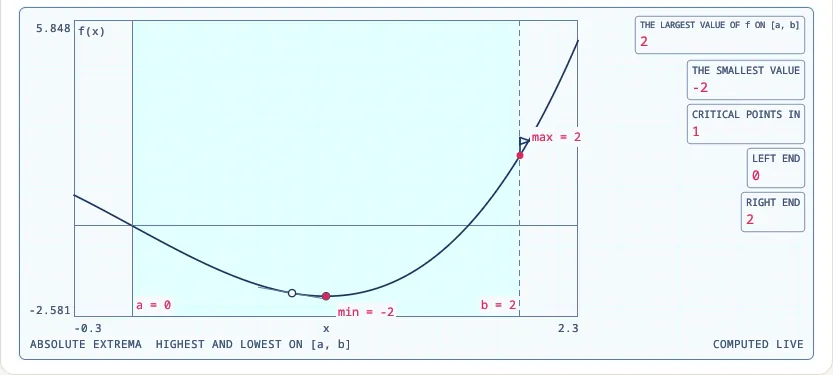 Absolute extrema on a closed interval |
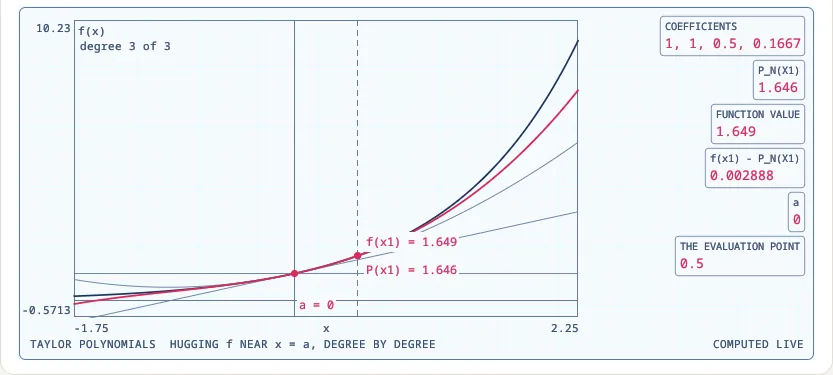 Taylor polynomial |
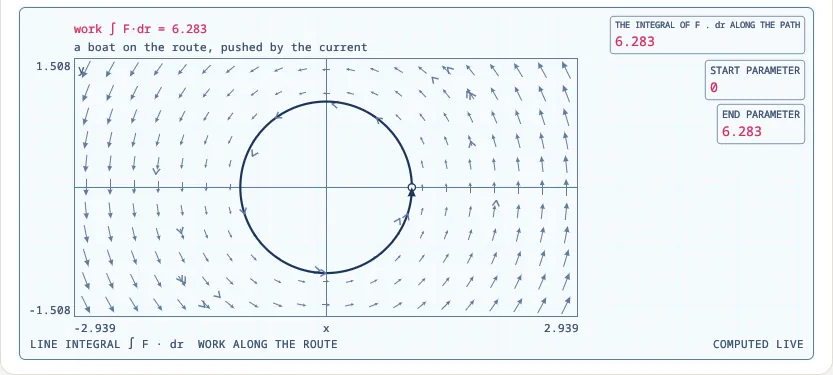 Line integral of a vector field |
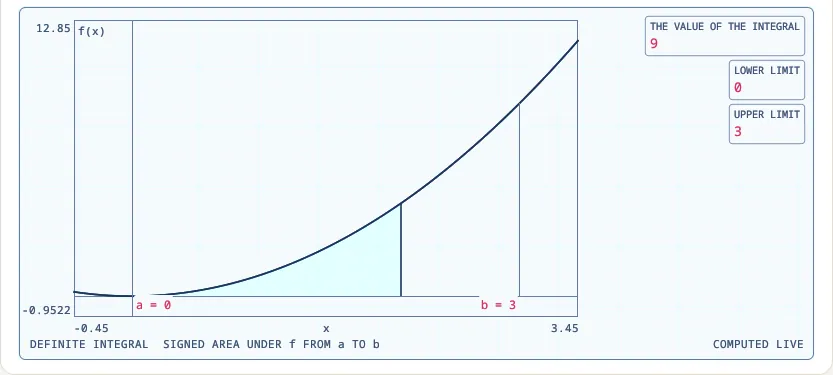 Definite integral |
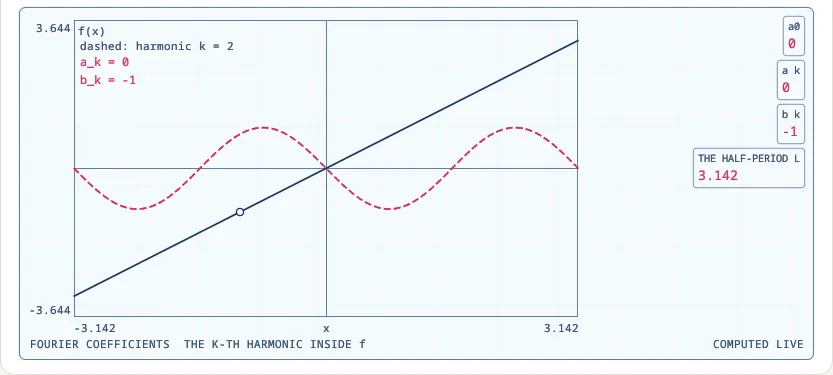 Fourier coefficients |
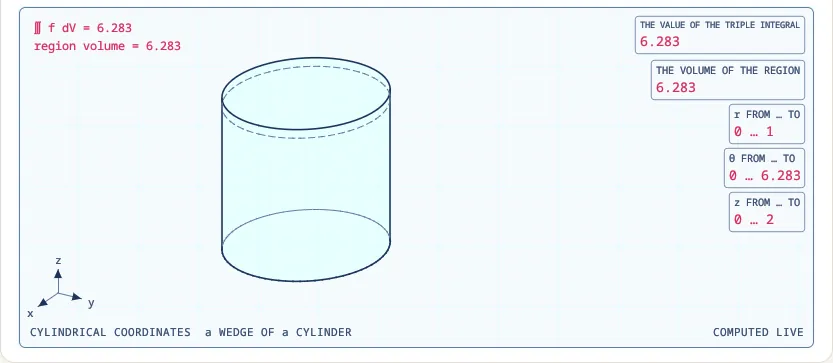 Triple integral in cylindrical or spherical coordinates |
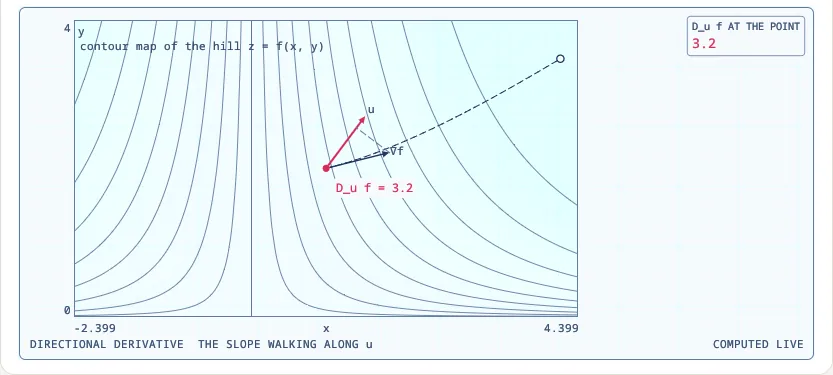 Directional derivative |
Charts:
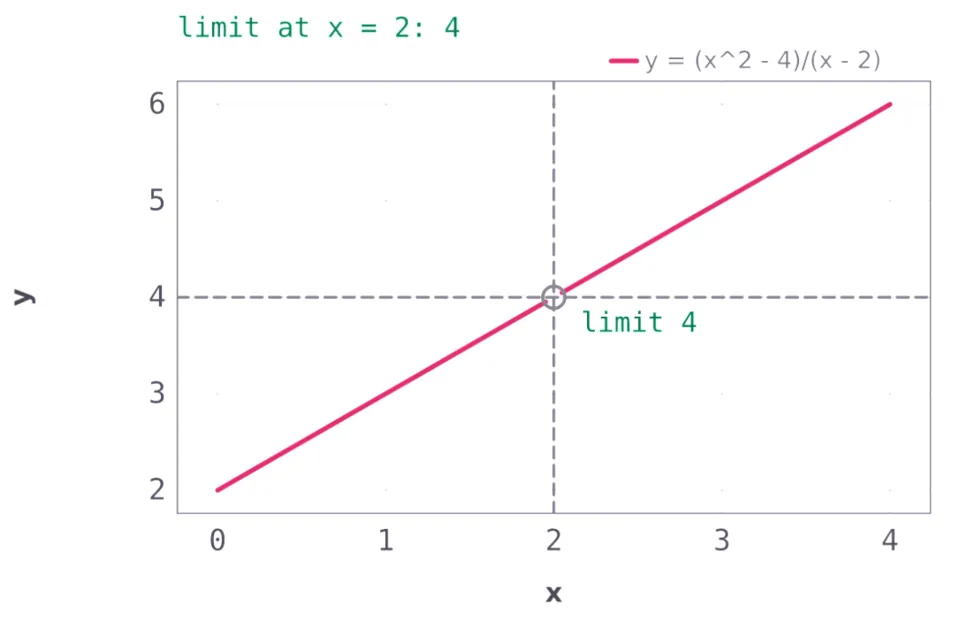 Limit at a point |
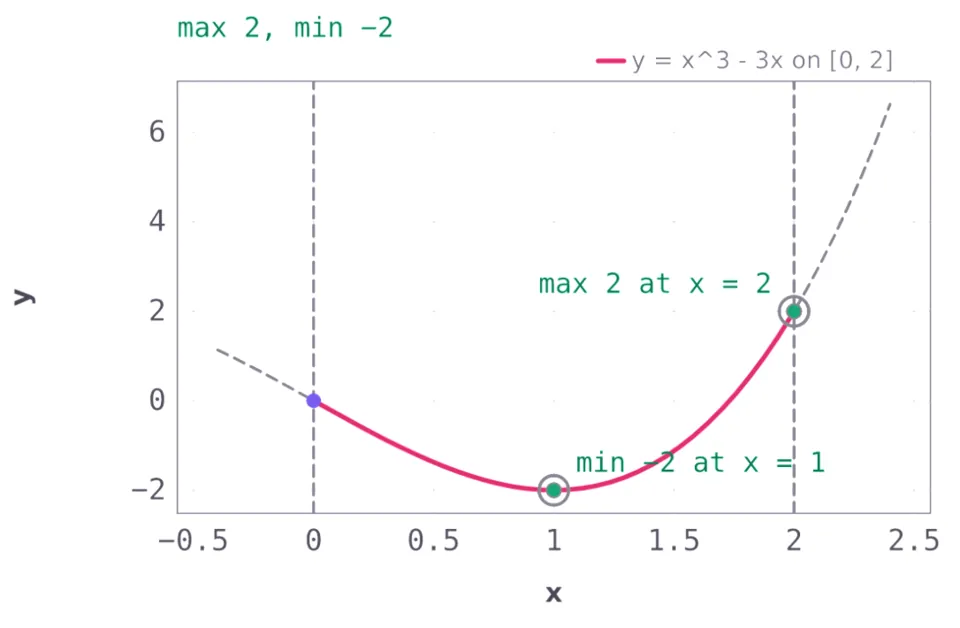 Absolute extrema on a closed interval |
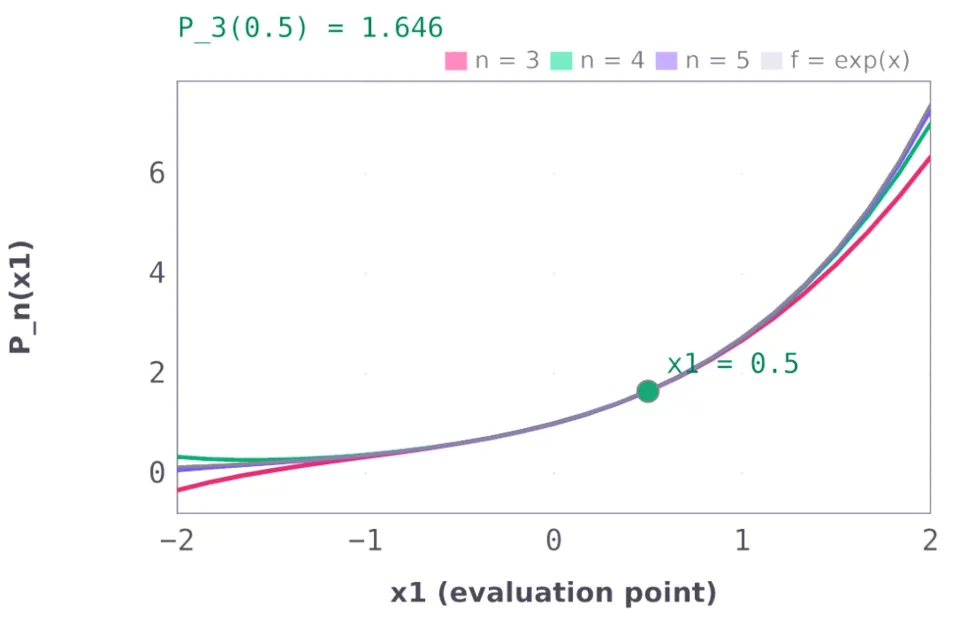 Taylor polynomial |
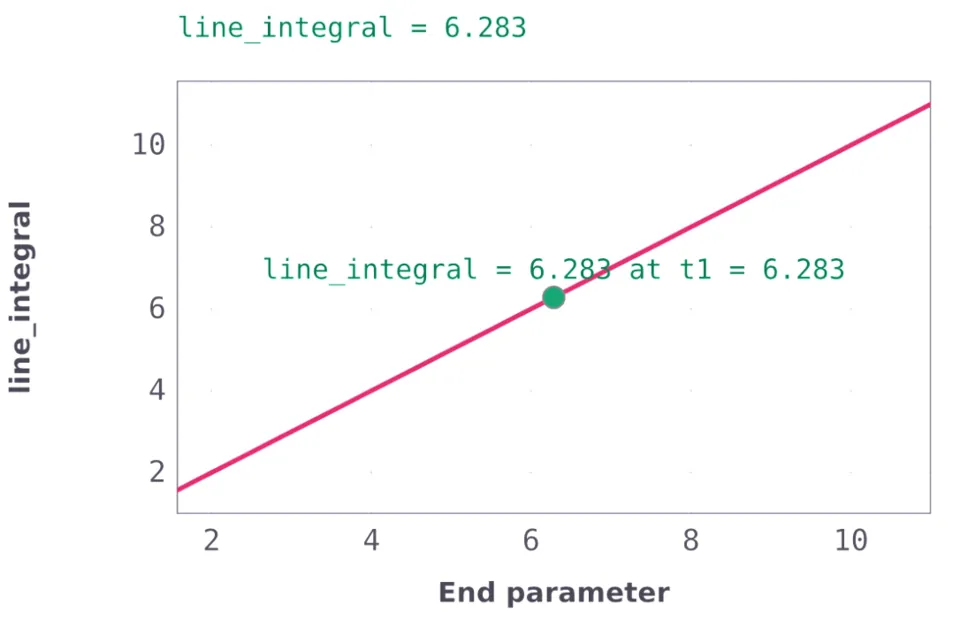 Line integral of a vector field |
Each question below was asked on this release; the comment under it is the line it printed.
import calculus_ai999x as calculus

a = calculus.ask(
    "Find the Fourier coefficients of order 2 of f(x) = x on [-pi, "
    "pi]."
)
print(a.outcome, a.values)
# SOLVED {'a0': 0.0, 'a_k': 0.0, 'b_k': -1.0}

a = calculus.ask("Find the antiderivative of 3x^2 + 2x.")
print(a.outcome, a.values)
# SOLVED {'antiderivative': 'x^3 + x^2 + C'}

a = calculus.ask(
    "Find the limit of (x^2 - 4)/(x - 2) as x approaches 2."
)
print(a.outcome, a.values)
# SOLVED {'limit': 4.0}

a = calculus.ask(
    "Find the double integral of x^2 + y^2 over 0 <= r <= 1, 0 <= "
    "theta <= 2pi."
)
print(a.outcome, a.values)
# SOLVED {'integral': 1.57079632679, 'region_area': 3.14159265359}

a = calculus.ask(
    "Find the directional derivative of x^2*y at (1, 2) in the "
    "direction (3, 4)."
)
print(a.outcome, a.values)
# SOLVED {'directional_derivative': 3.2}

a = calculus.ask(
    "Estimate the derivative of x^2 at x = 1 using a central "
    "difference with h = 0.1."
)
print(a.outcome, a.values)
# SOLVED {'approximation': 2.0, 'exact': 2.0, 'error': 0.0}

a = calculus.ask(
    "Find the arc length of the parametric curve x = cos(t), y = "
    "sin(t) from t = 0 to t = pi."
)
print(a.outcome, a.values)
# SOLVED {'arc_length': 3.141592653589793}

a = calculus.ask(
    "Find the area enclosed by the polar curve r = 1 + cos(theta) from "
    "theta = 0 to theta = 2pi."
)
print(a.outcome, a.values)
# SOLVED {'area': 4.71238898038469}

a = calculus.ask(
    "Find the sum of the first 4 terms of the geometric series with "
    "first term 2 and ratio 3."
)
print(a.outcome, a.values)
# SOLVED {'sum': 80.0}

a = calculus.ask("Evaluate the Bessel function J_0(1).")
print(a.outcome, a.values)
# SOLVED {'J': 0.7651976865579666}

a = calculus.ask("Is F = (2x*y, x^2) conservative?")
print(a.outcome, a.values)
# SOLVED {'conservative': 'yes', 'potential': 'x^2*y + C'}

a = calculus.ask(
    "Find the arc length of r(t) = (cos(t), sin(t), t) from t = 0 to t "
    "= 2pi."
)
print(a.outcome, a.values)
# SOLVED {'arc_length': 8.885765876316732}

a = calculus.ask(
    "Find the average rate of change of f(x) = x^2 from x = 1 to x = "
    "3."
)
print(a.outcome, a.values)
# SOLVED {'average_rate': 4.0, 'fa': 1.0, 'fb': 9.0}

a = calculus.ask("Find the arc length of y = x^2 from x = 0 to x = 1.")
print(a.outcome, a.values)
# SOLVED {'arc_length': 1.4789428575445975}

a = calculus.ask(
    "Find the limit of (3x^2 + 1)/(x^2 - 5) as x approaches infinity."
)
print(a.outcome, a.values)
# SOLVED {'limit': 3.0}
Each command below was run with calculus of this release; the lines under it are the answer it printed (the full answer goes on with the method, every input in SI units and the conditions it assumes).
$ calculus solve extrema_on_interval a=0 b=2 "f=x^3 - 3x"
absolute_max = 2
absolute_min = -2
critical_points = [1.0]

$ calculus solve fourier_coefficients L=3.141592654 f=x k=2
a0 = 0
a_k = 0
b_k = -1

$ calculus solve antiderivative "f=3x^2 + 2x"
antiderivative = x^3 + x^2 + C

$ calculus solve limit_at_point a=2 "f=(x^2 - 4)/(x - 2)"
limit = 4

$ calculus solve polar_double_integral al=0 be=6.283185307 "f=x^2 + y^2" r1=0 r2=1
integral = 1.570796327
region_area = 3.141592654

$ calculus solve directional_derivative "f=x^2*y" "p=[1, 2]" "u=[3, 4]"
directional_derivative = 3.2

$ calculus solve numerical_derivative a=1 "f=x^2" h=0.1 method=central
approximation = 2
exact = 2
error = 0

$ calculus solve gauss_legendre a=0 b=2 "f=x^3 + x^2" n=2
approximation = 6.666666667
exact = 6.666666667
error = 0

$ calculus solve newton_method "f=x^2 - 2" n=3 x0=1
x_n = 1.414215686
f_x_n = 6.007304883e-06
iterates = [1.5,1.4166666666666667,1.4142156862745099]

$ calculus solve parametric_arc_length t0=0 t1=3.141592654 "xt=cos(t)" "yt=sin(t)"
arc_length = 3.141592654

$ calculus solve polar_area al=0 be=6.283185307 "r=1 + cos(theta)"
area = 4.71238898

$ calculus solve geometric_partial_sum a=2 n=4 r=3
sum = 80

$ calculus solve bessel_j n=0 x=1
J = 0.7651976866

$ calculus solve conservative_field "P=2x*y" "Q=x^2"
conservative = yes
potential = y*x^2 + C

$ calculus solve space_curve_arc_length t0=0 t1=6.283185307 "xt=cos(t)" "yt=sin(t)" zt=t
arc_length = 8.885765876
Every calculation, with its formula, a worked example and its figures: Calculus on ai999x.com. Install guides for the app and the command line: https://www.ai999x.com/desktop-cli/.
Version 1.6.7 · License: Apache-2.0 · Author: Ibnul Jaif Farabi · Organization: AI999X · Contact: support@ai999x.com · Support the project
The Future Is Self-Improving.