

AI999X Scientific Models
Collection
All 31 AI999X scientific models: offline solvers with exact, step-by-step answers across 7 fields (2,696 capabilities). • 31 items • Updated
Nuclear Engineering covers radioactive decay and decay chains, binding energy, reactor physics basics, radiation shielding and attenuation, and dosimetry: 84 calculations in 10 topics, each with its formula, its steps and its units, and a plain reason instead of a number when an input is missing or out of range. One compiled engine, four ways to use it: the desktop app, the command line, the browser and Python. Everything runs on your own computer, offline.
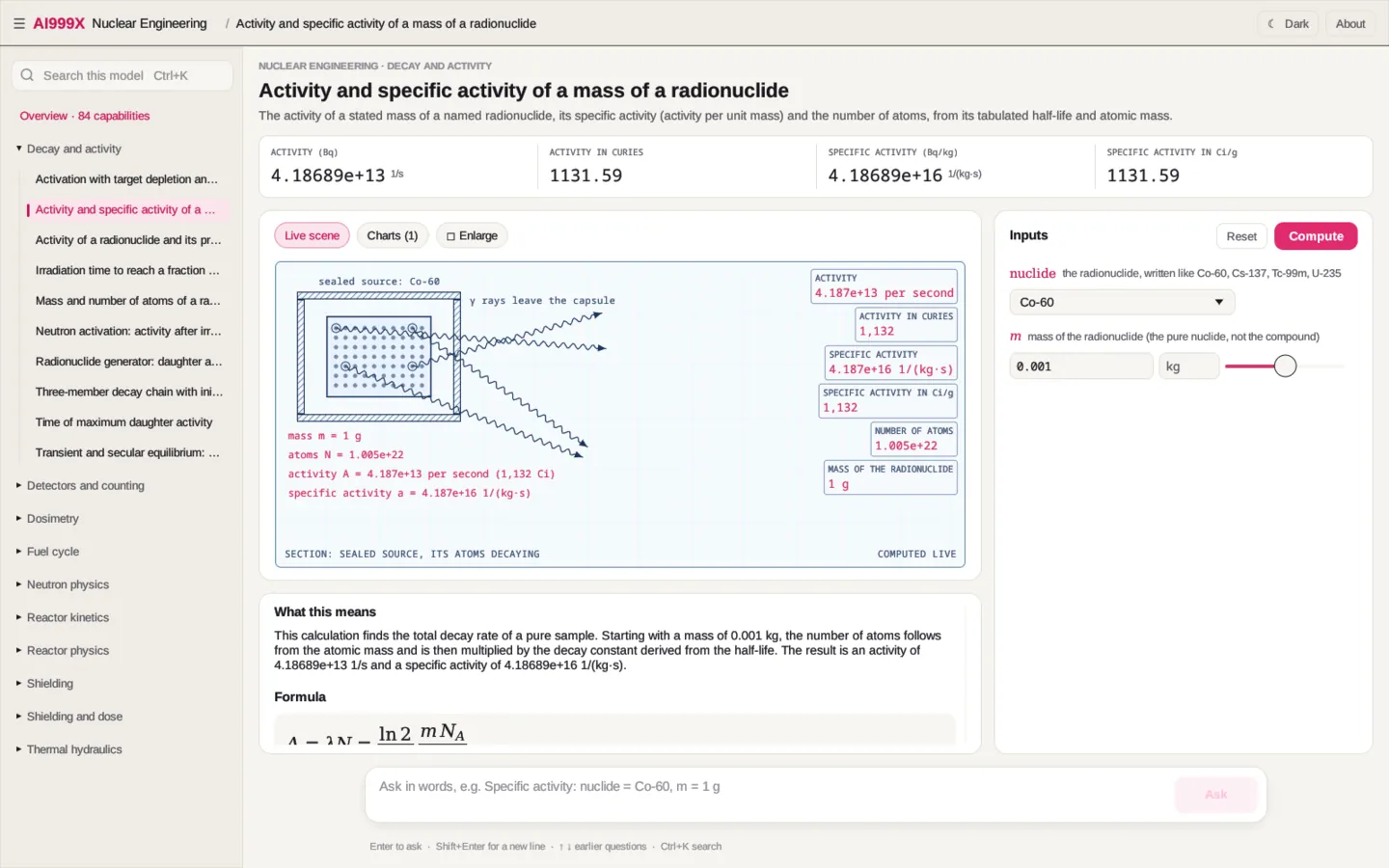
| Desktop app (Windows, Linux) | Windows · Linux |
Command line nuclear-engineering (Windows, Linux) |
Windows · Linux |
| Browser (any device) | Try it on the model page |
| Python 3.10+ | pip install nuclear-engineering-ai999x: on Windows and Linux (x86-64) pip installs the same compiled engine; on other systems (macOS, ARM) it installs a pure-Python build that gives the same answers |
From the Nuclear Engineering desktop app: every scene and chart is drawn from the computed answer.
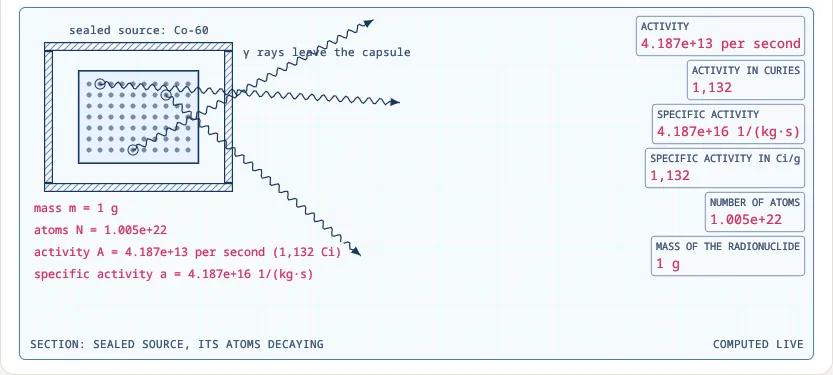 Activity and specific activity of a mass of a radionuclide |
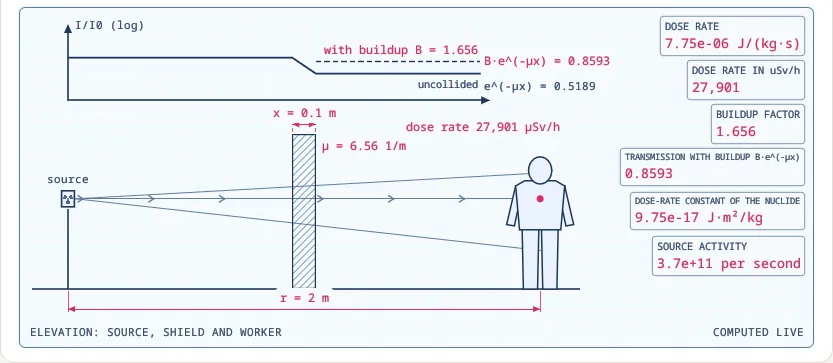 Dose rate from a shielded point gamma source with buildup |
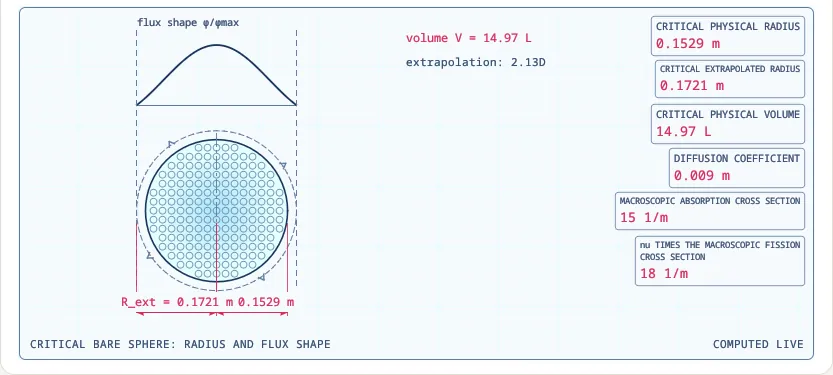 Critical radius of a bare spherical reactor (one group) |
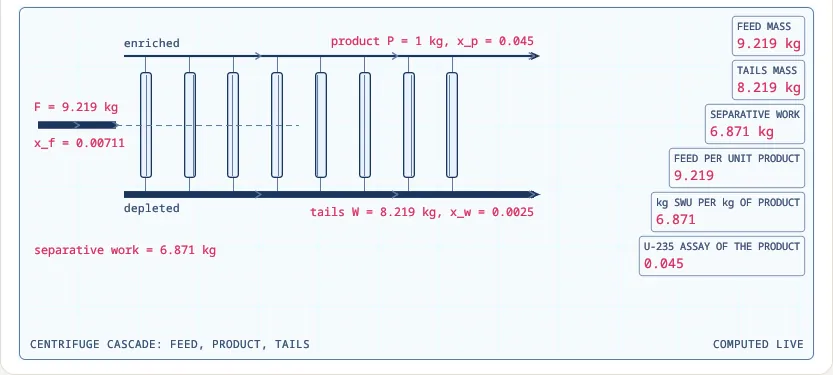 Uranium enrichment: feed, tails and separative work (SWU) |
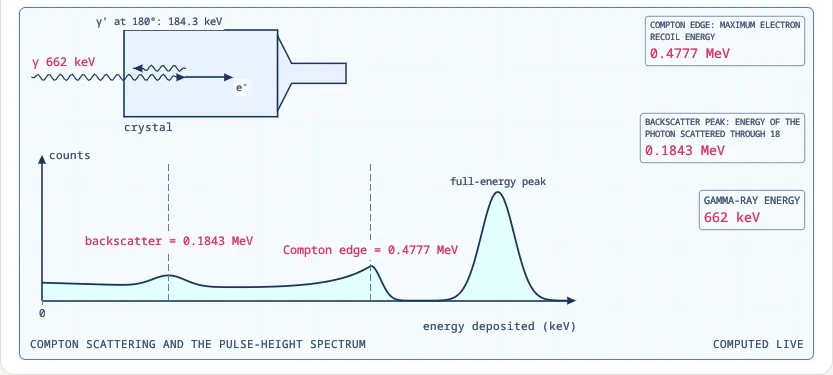 Compton edge and backscatter peak of a gamma line |
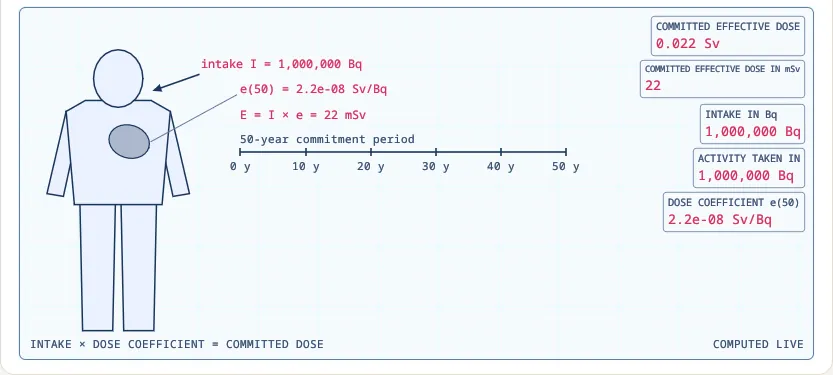 Committed effective dose from a dose coefficient |
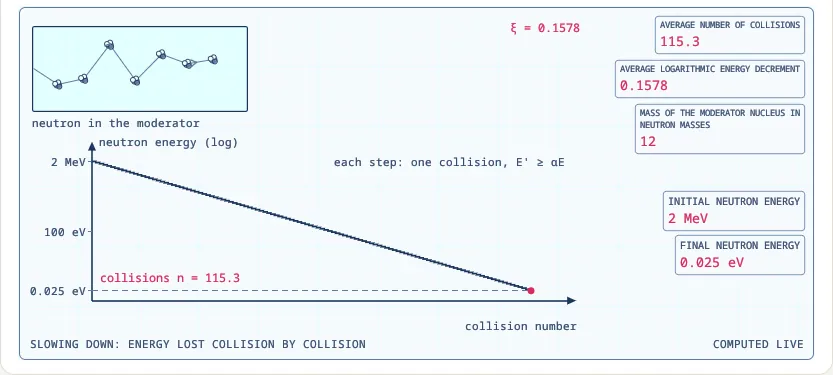 Average number of collisions to slow a neutron down |
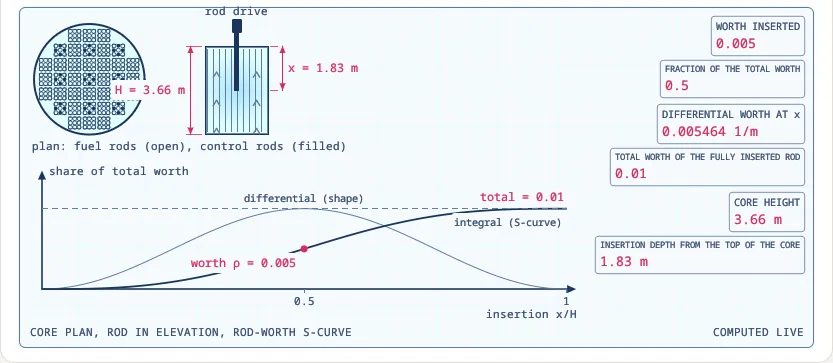 Integral and differential control-rod worth (sine-squared weighting) |
Charts:
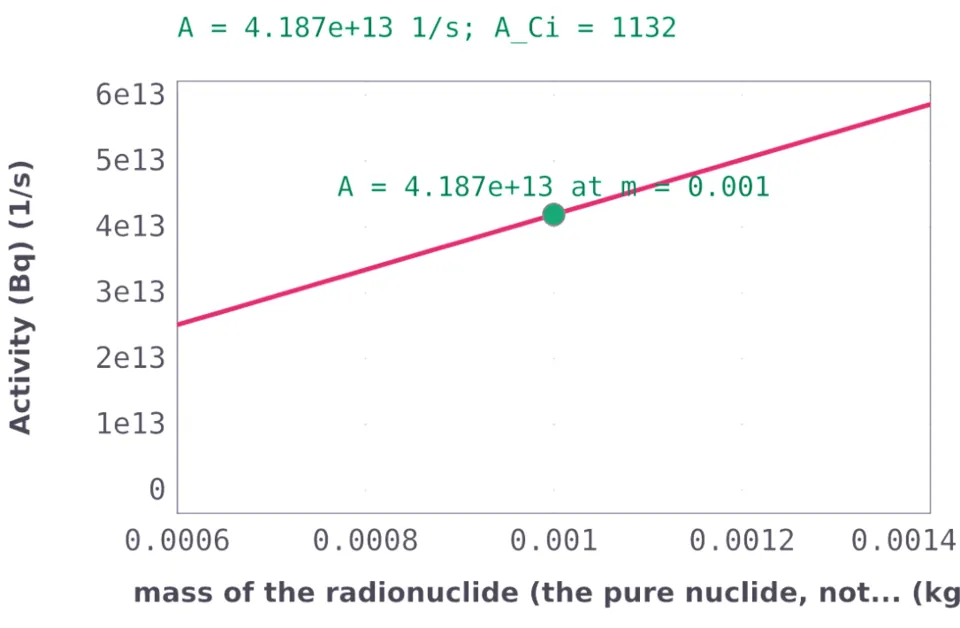 Activity and specific activity of a mass of a radionuclide |
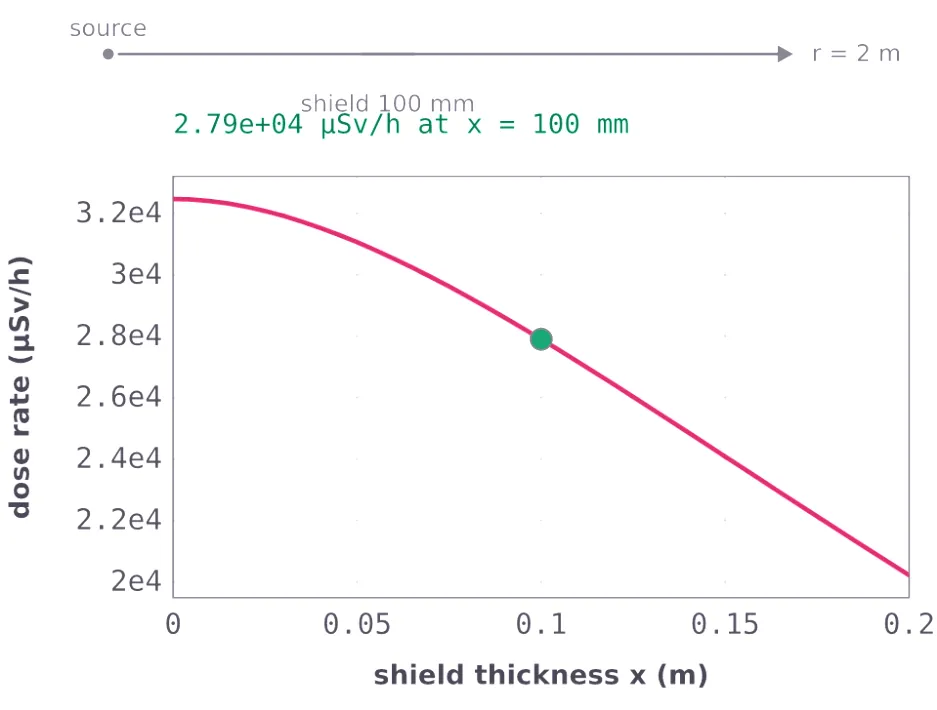 Dose rate from a shielded point gamma source with buildup |
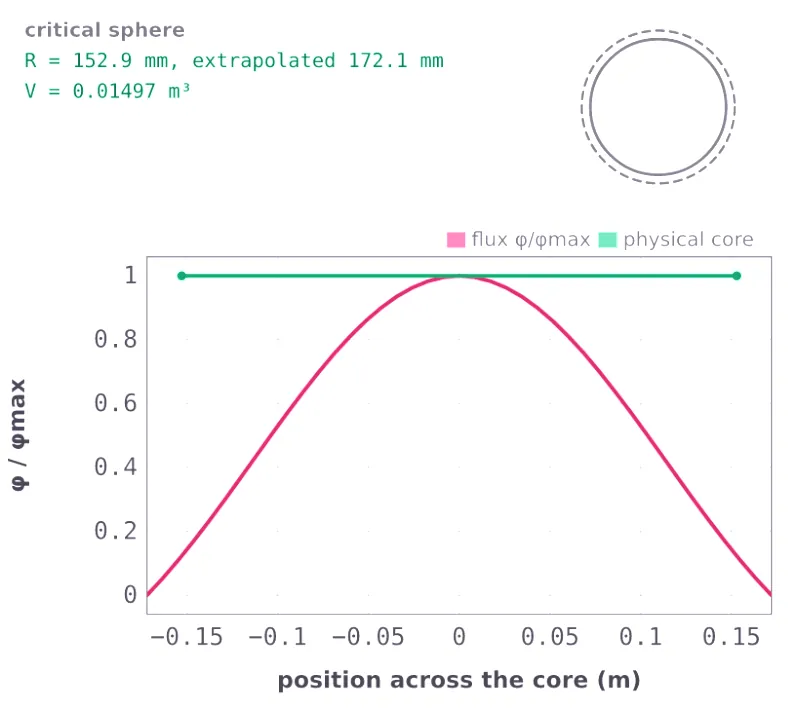 Critical radius of a bare spherical reactor (one group) |
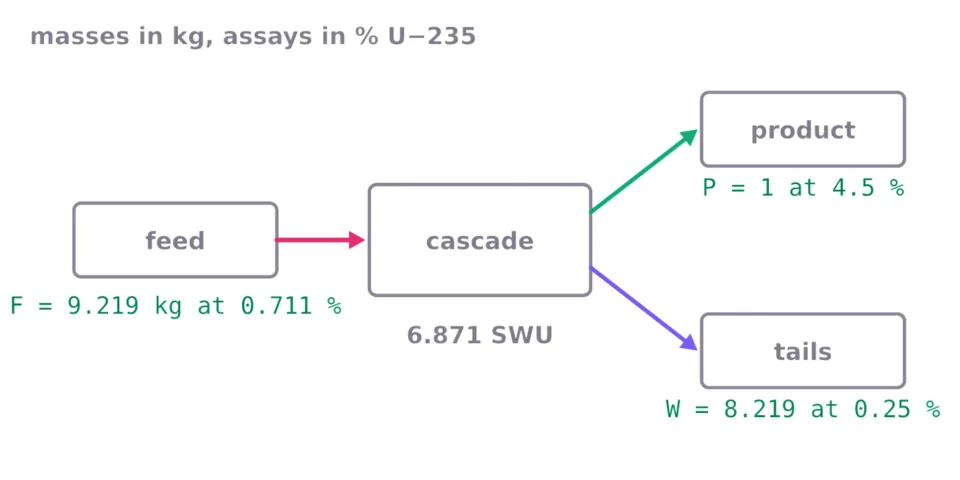 Uranium enrichment: feed, tails and separative work (SWU) |
Each question below was asked on this release; the comment under it is the line it printed.
import nuclear_engineering_ai999x as nuclear_engineering

a = nuclear_engineering.ask("Compton edge: E = 662 keV")
print(a.outcome, a.values)
# SOLVED {'T_max': 0.477650409375, 'E_bs': 0.184349590625}

a = nuclear_engineering.ask(
    "Committed dose from a dose coefficient: I = 1 MBq, e = 2.2e-8 "
    "Sv/Bq"
)
print(a.outcome, a.values)
# SOLVED {'E': 0.022, 'E_mSv': 22.0, 'I_Bq': 1000000.0}

a = nuclear_engineering.ask(
    "Control rod worth: rho_tot = 1000 pcm, H = 3.66 m, x = 1.83 m"
)
print(a.outcome, a.values)
# SOLVED {'rho': 0.005, 'frac': 0.5, 'drho_dx': 0.00546448087432}

a = nuclear_engineering.ask(
    "Channel coolant temperature: q0 = 43 kW/m, H = 3.66 m, H_e = 4 m, "
    "m_dot = 0.3 kg/s, c_p = 5500 J/(kg*K), T_in = 565 K, z = 0 m"
)
print(a.outcome, a.values)
# SOLVED {'T': 597.886071405, 'T_out': 630.77214281, 'Q': 108524.035637}

a = nuclear_engineering.ask(
    "Counting time for precision: Rg = 100 cps, Rb = 25 cps, r = 1%"
)
print(a.outcome, a.values)
# SOLVED {'T': 400.0, 'tg': 266.666666667, 'tb': 133.333333333}

a = nuclear_engineering.ask(
    "Collisions to thermalize: A = 12.0, E0 = 2 MeV, Ef = 0.025 eV"
)
print(a.outcome, a.values)
# SOLVED {'n': 115.342927739, 'xi': 0.157768989823}

a = nuclear_engineering.ask(
    "Counts during decay: A0 = 100 kBq, T_half = 6586.2 s, tc = 1 h, "
    "eff = 20%, y = 96.7%"
)
print(a.outcome, a.values)
# SOLVED {'N': 57953848.461, 'A_mean': 83238.3207816, 'F': 1.20136974246}

a = nuclear_engineering.ask(
    "Effective dose: H = [10.0, 5.0, 2.0], w = [0.12, 0.04, 0.01]"
)
print(a.outcome, a.values)
# SOLVED {'E_mSv': 1.42, 'E': 0.00142, 'w_sum': 0.17}

a = nuclear_engineering.ask(
    "Exponential pile: z = [20.0, 40.0, 60.0, 80.0, 100.0], phi = "
    "[10000.0, 6200.0, 3850.0, 2390.0, 1480.0], a = 2 m, b = 2 m"
)
print(a.outcome, a.values)
# SOLVED {'gamma': 2.38717096827, 'L': 1.14423439231, 'L2': 1.30927234454}

a = nuclear_engineering.ask(
    "Irradiation time for saturation: T_half = 15 h, f = 90%"
)
print(a.outcome, a.values)
# SOLVED {'t_irr': 179384.117124, 'n_half': 3.32192809489}

a = nuclear_engineering.ask("Currie detection limits: B = 100.0")
print(a.outcome, a.values)
# SOLVED {'L_C': 23.2617430735, 'L_D': 49.2290296012}

a = nuclear_engineering.ask(
    "Effective half-life: T_p = 8.0207 d, T_b = 80 d"
)
print(a.outcome, a.values)
# SOLVED {'T_eff': 629841.371405, 'lambda_eff': 1.10051071909e-06}

a = nuclear_engineering.ask(
    "Critical slab: D = 0.9 cm, Sigma_a = 0.15 1/cm, nuSigma_f = 0.18 "
    "1/cm, extrapolation = 2.13D"
)
print(a.outcome, a.values)
# SOLVED {'a': 0.133710516286, 'a_ext': 0.172072116286}

a = nuclear_engineering.ask(
    "Non-paralyzable dead time: m = 50000 cps, tau = 5 us"
)
print(a.outcome, a.values)
# SOLVED {'n': 66666.6666667, 'loss': 0.25, 'corr': 1.33333333333}

a = nuclear_engineering.ask(
    "Reflected slab critical: D_c = 0.9 cm, Sigma_ac = 0.15 1/cm, "
    "nuSigma_fc = 0.18 1/cm, D_r = 0.16 cm, Sigma_ar = 0.0197 1/cm, "
    "T_r = 20 cm, extrapolation = 2.13D"
)
print(a.outcome, a.values)
# SOLVED {'a': 0.0360662339368, 'delta': 0.0680029411748}
Each command below was run with nuclear-engineering of this release; the lines under it are the answer it printed (the full answer goes on with the method, every input in SI units and the conditions it assumes).
$ nuclear-engineering solve nuc_activation_with_burnup N_T0=1e+22 "sigma_T=3.718e-27 m^2" "sigma_P=2e-28 m^2" "phi=1e+14 1/(cm^2*s)" "T_half=166346024.4 s" "t=31557600 s"
A_P = 4.303591319e+12 1/s
f_T = 0.8892906498
t_max = 247907988.5 s
A_max = 1.41140119e+13 1/s

$ nuclear-engineering solve nuc_compton_edge "E=662 keV"
T_max = 0.4776504094 MeV
E_bs = 0.1843495906 MeV

$ nuclear-engineering solve nuc_committed_dose_coefficient "I=1000000 (1/s)" "e=2.2e-08 (J/kg)/(1/s)"
E = 0.022 J/kg
E_mSv = 22
I_Bq = 1000000 1/s

$ nuclear-engineering solve nuc_enrichment_swu x_p=0.045 x_f=0.00711 x_w=0.0025 "P=1 kg"
F = 9.219088937 kg
W = 8.219088937 kg
SWU = 6.871112989 kg
F_per_P = 9.219088937
SWU_per_P = 6.871112989

$ nuclear-engineering solve nuc_logarithmic_energy_decrement A=12
alpha = 0.7159763314
xi = 0.1577689898
mu_bar = 0.05555555556

$ nuclear-engineering solve nuc_control_rod_worth rho_tot=0.01 "H=3.66 m" "x=1.83 m"
rho = 0.005
frac = 0.5
drho_dx = 0.005464480874 1/m

$ nuclear-engineering solve nuc_inverse_multiplication "x=[0, 20, 40, 60, 80]" "C=[100, 125, 167, 250, 500]"
x_crit = 99.9760479
slope = -0.01
x_crit_last2 = 100
inv_M_last = 0.2

$ nuclear-engineering solve nuc_half_value_layer "mu=0.656 1/cm"
HVL = 0.010566268 m
TVL = 0.03510038252 m
mfp = 0.01524390244 m
HVL_cm = 1.0566268
TVL_cm = 3.510038252

$ nuclear-engineering solve nuc_accumulated_dose_decaying_source "H0=0.001 (J/kg)/h" "T_half=6586.2 s" "t=2 h"
D = 0.001402260154 J/kg
D_mSv = 1.402260154
D_inf = 0.002639410577 J/kg
H_mean = 1.947583547e-07 J/(kg*s)

$ nuclear-engineering solve nuc_channel_coolant_temperature "q0=43 kW/m" "H=3.66 m" "H_e=4 m" "m_dot=0.3 kg/s" "c_p=5500 J/(kg*K)" "T_in=565 K" "z=0 m"
T = 597.8860714 K
T_out = 630.7721428 K
Q = 108524.0356 W

$ nuclear-engineering solve nuc_specific_activity nuclide=Co-60 "m=1 g"
A = 4.18689443e+13 1/s
A_Ci = 1131.593089
a = 4.18689443e+16 1/(kg*s)
a_Ci_per_g = 1131.593089
N = 1.004798494e+22

$ nuclear-engineering solve nuc_count_time_for_precision "Rg=100 (1/s)" "Rb=25 (1/s)" r=0.01
T = 400 s
tg = 266.6666667 s
tb = 133.3333333 s

$ nuclear-engineering solve nuc_committed_dose_retention "I=1000000 (1/s)" "f=[0.3]" "Tb=[80]" t_unit=d "T_p=692988.48 s" "E=0.18 MeV" w_R=1 "m=20 g" "tau=1577880000 s"
U = 2.726007069e+11
H = 0.3930790347 J/kg
H_mSv = 393.0790347

$ nuclear-engineering solve nuc_collisions_to_thermalize A=12 "E0=2 MeV" "Ef=0.025 eV"
n = 115.3429277
xi = 0.1577689898

$ nuclear-engineering solve nuc_power_after_step_one_group rho=0.001 beta=0.0065 "lam=0.08 1/s" "Lambda=0.0001 s" "t=10 s"
P = 1.365788055
A1 = 1.181194942
omega = 0.01452050027 1/s
Every calculation, with its formula, a worked example and its figures: Nuclear Engineering on ai999x.com. Install guides for the app and the command line: https://www.ai999x.com/desktop-cli/.
Version 1.6.7 · License: Apache-2.0 · Author: Ibnul Jaif Farabi · Organization: AI999X · Contact: support@ai999x.com · Support the project
The Future Is Self-Improving.