|
|
--- |
|
|
license: apache-2.0 |
|
|
license_link: LICENSE |
|
|
tags: |
|
|
- chemistry |
|
|
- molecular simulations |
|
|
- machine learning potentials |
|
|
- neural network potentials |
|
|
- drug discovery |
|
|
--- |
|
|
|
|
|
# Acellera AceFF 1.1 |
|
|
|
|
|
**Organization(s):** Acellera Therapeutics, inc |
|
|
**Contact:** info@acellera.com |
|
|
**License:** apache 2.0 |
|
|
|
|
|
--- |
|
|
|
|
|
## Overview |
|
|
|
|
|
Acellera AceFF 1.1 is a next-generation **Neural Network Potential (NNP)** designed for **Relative Binding Free Energy (RBFE)** calculations in drug discovery. |
|
|
It addresses key limitations of traditional molecular mechanics (MM) force fields and earlier NNP models, including restricted atom types, limited charge support, and computational inefficiencies. |
|
|
|
|
|
The model leverages the TensorNet architecture[1] and the NNP software library TorchMD-Net [2] to provide accurate predictions for diverse drug-like compounds, supporting all key chemical elements and charged molecules. |
|
|
AceFF 1.1 improves the stability of molecular dynamics simulations, supports 2 fs timesteps, and achieves state-of-the-art accuracy with fewer outliers in RBFE predictions. |
|
|
|
|
|
|
|
|
## Description |
|
|
|
|
|
AceFF 1.1 is the second version of a new family of potentials released by [Acellera](https://www.acellera.com). |
|
|
It uses [TensorNet](https://proceedings.neurips.cc/paper_files/paper/2023/file/75c2ec5f98d7b2f50ad68033d2c07086-Paper-Conference.pdf) 1-layer trained |
|
|
on Acellera's internal proprietary dataset of molecular forces and energies using the wB97M-V/def2-tzvppd level of theory and VV10 dispersion corrections. |
|
|
|
|
|
The training set was built on [PubChem](https://ftp.ncbi.nlm.nih.gov/pubchem/Compound/CURRENT-Full/SDF). |
|
|
We extracted the SMILES and generated molecules, filtering out molecules larger than 30 atoms. |
|
|
We kept only molecules with the elements H, B, C, N, O, F, Si, P, S, Cl, Br, and I. |
|
|
|
|
|
The AceFF1.1 dataset includes an additional 1 million conformations of molecules with up to 30 atoms and more diverse charges, building upon the AceFF1.0 dataset. |
|
|
|
|
|
--- |
|
|
|
|
|
## Bechmarks |
|
|
|
|
|
### Wiggle150 |
|
|
The table shows the results on the [Wiggle150](https://pubs.acs.org/doi/10.1021/acs.jctc.5c00015) benchmark. We include AIMNet2 and ANI-2x for comparison. |
|
|
|
|
|
| **Method** | **MAE (kcal/mol)** | **RMSE (kcal/mol)** | |
|
|
|------------|--------------------|---------------------| |
|
|
| AceFF1.1 | 2.51 | 3.18 | |
|
|
| AceFF1.0 | 2.73 | 3.32 | |
|
|
| AIMNet2 | 2.39 | 3.13 | |
|
|
| ANI-2X | 4.41 | 5.41 | |
|
|
|
|
|
*Performance of NNPs on Wiggle150 benchmark* |
|
|
|
|
|
### Schrodinger ligands test set |
|
|
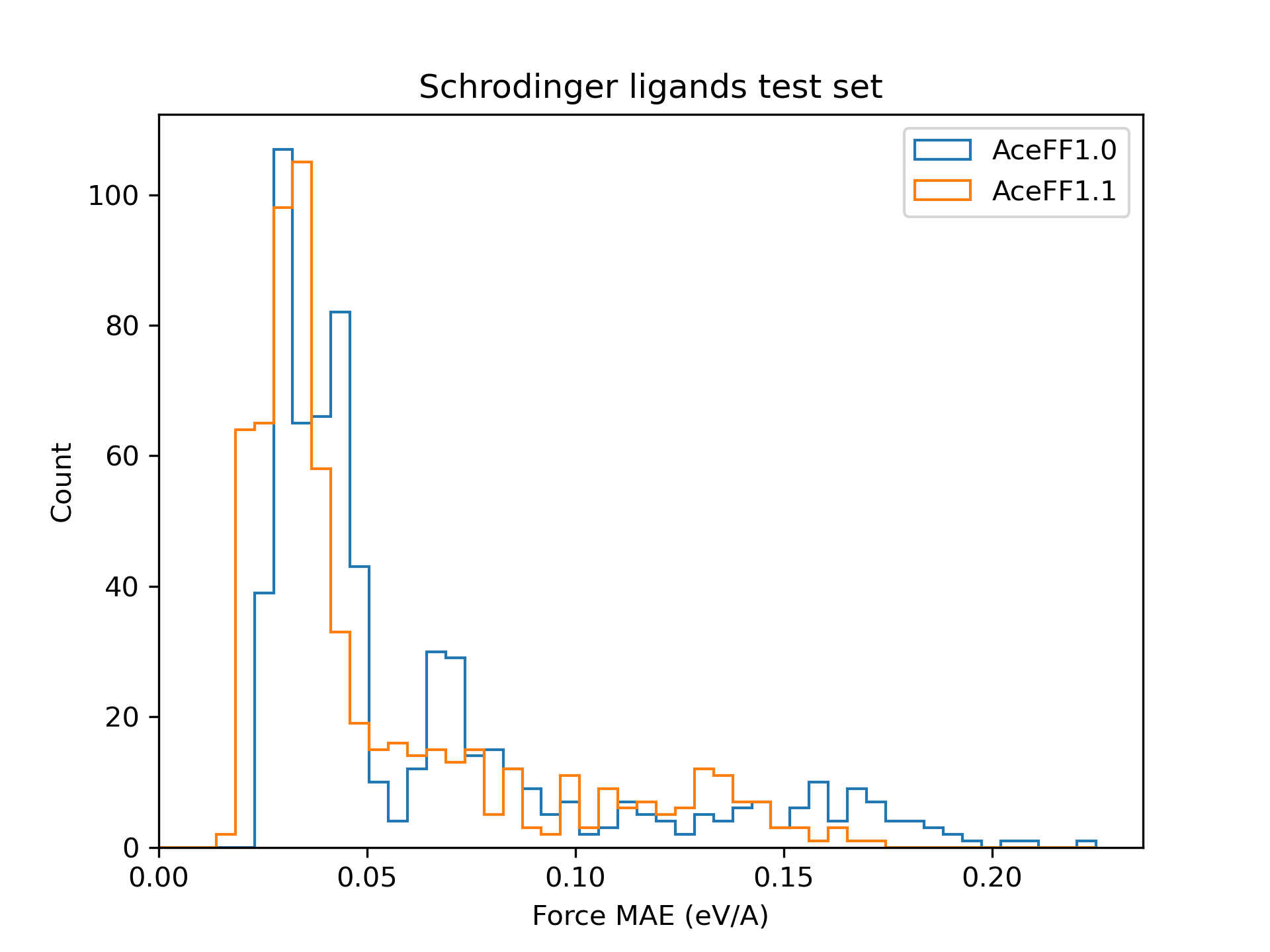
We create our own hold-out test set by labelling 650 ligands from the [Schrodinger public binding free energy benchmark](https://github.com/schrodinger/public_binding_free_energy_benchmark) (Jacs, Merk, and charge_annhil sets) with AceFF DFT level of theory. We evaluate the Force MAE of the AceFF predictions. |
|
|
 |
|
|
|
|
|
--- |
|
|
|
|
|
## Key Features |
|
|
|
|
|
- **Broad Applicability:** Supports diverse drug-like molecules, including charged species and rare chemical groups. |
|
|
- **High Accuracy:** Benchmark-tested on the JACS dataset, demonstrating performance comparable to or better than MM-based methods (e.g., GAFF2, FEP+). |
|
|
- **Improved Stability:** Enables a 2 fs timestep for NNP/MM simulations, significantly reducing computational costs. |
|
|
- **Integration-Friendly:** Available for RBFE calculations via [HTMD](https://github.com/acellera/htmd). |
|
|
- **Open Science:** The model and all benchmarking data are accessible on GitHub for not-for-profit usage. |
|
|
|
|
|
|
|
|
--- |
|
|
|
|
|
## Usage |
|
|
|
|
|
AceFF 1.1 is designed for use alone or in an NNP/MM approach, where the ligand is treated with the neural network potential and the environment with molecular mechanics. |
|
|
|
|
|
1. [Example notebooks](https://github.com/Acellera/aceff_examples) are available in **Google Colab**, demonstrating the use of AceFF with OpenMM and ASE. |
|
|
|
|
|
- Single point calculation with ASE [](https://colab.research.google.com/github/Acellera/aceff_examples/blob/main/notebooks/aceff_single_point_calculation.ipynb) |
|
|
- ML molecular dynamics of a small molecule with OpenMM [](https://colab.research.google.com/github/Acellera/aceff_examples/blob/main/notebooks/aceff_MD_example.ipynb) |
|
|
- MM/ML protein-ligand simulations with OpenMM [](https://colab.research.google.com/github/Acellera/aceff_examples/blob/main/notebooks/aceff_protein_ligand.ipynb) |
|
|
2. Run ML potential molecular simulations of a small molecule using ACEMD with this [tutorial](https://software.acellera.com/acemd/nnp.html) , e.g. to minimize. |
|
|
3. For a tutorial on running mixed protein-ligand simulations, refer to [NNP/MM in ACEMD](https://software.acellera.com/acemd/nnpmm.html). |
|
|
|
|
|
|
|
|
--- |
|
|
|
|
|
## Applications |
|
|
|
|
|
- **Drug Discovery:** Optimizing lead compounds in hit-to-lead and lead optimization stages using free energy methods. |
|
|
- **Binding Free Energy Calculations:** Accurate and efficient RBFE predictions for diverse molecular systems. |
|
|
- **Molecular dynamics:** Capturing higher-body terms than traditional MM force fields, AceFF can be used for structure minimization and dynamics of small molecules. |
|
|
|
|
|
## Limitations |
|
|
|
|
|
- **Small molecules only**: AceFF 1.1 is trained on specifically curated and extended PubChem data. However, proteins, water, etc are not part of the dataset. AceFF 2.0 will be capable of simulations of proteins. |
|
|
- **Time step**: Use time steps of 2fs to run dynamics with hydrogen mass repartitioning. |
|
|
- **Only -1,0,1 charges**: For simplicity, we have trained only on these types of charged molecules; do not use it on +2,-2, etc. AceFF 1.2 will fix this. |
|
|
|
|
|
--- |
|
|
|
|
|
## References |
|
|
|
|
|
[1] Simeon, Guillem, and Gianni De Fabritiis, Tensornet: Cartesian tensor representations for efficient learning of molecular potentials, Advances in Neural Information Processing Systems 36 (2024), https://arxiv.org/abs/2306.06482 |
|
|
|
|
|
[2] Raul P. Pelaez, Guillem Simeon, Raimondas Galvelis, Antonio Mirarchi, Peter Eastman, Stefan Doerr, Philipp Thölke, Thomas E. Markland, Gianni De Fabritiis, TorchMD-Net 2.0: Fast Neural Network Potentials for Molecular Simulations, J. Chem. Theory Comput. 2024, 20, 10, 4076–4087, https://arxiv.org/abs/2402.17660 |
|
|
|
|
|
[3] Francesc Sabanés Zariquiey, Stephen E. Farr, Stefan Doerr, Gianni De Fabritiis, QuantumBind-RBFE: Accurate Relative Binding Free Energy Calculations Using Neural Network Potentials, https://arxiv.org/abs/2501.01811 (2025). |
|
|
|