

AnveshAI Edge
A fully offline, hybrid AI assistant with chain-of-thought reasoning and a symbolic mathematics engine.
AnveshAI Edge is a terminal-based AI assistant designed to run entirely on-device (CPU only). It combines a rule-based symbolic math engine, a local knowledge base, and a compact large language model into a unified hierarchical pipeline. A dedicated chain-of-thought reasoning engine decomposes every problem before the LLM is invoked, dramatically improving answer quality and reducing hallucinations.
Table of Contents
- Architecture Overview
- Benchmark test & Evaluation experiments
- Components
- Advanced Math Engine
- Reasoning Engine
- Getting Started
- Usage Examples
- Commands
- Design Principles
- File Structure
- Technical Details
- Links
Architecture Overview
AnveshAI Edge uses a hierarchical fallback pipeline with reasoning at every non-trivial stage:
User Input
    │
    ├── [/command]      ──► System Handler (instant)
    │
    ├── [arithmetic]    ──► Math Engine (AST safe-eval, instant)
    │
    ├── [advanced math] ──► Reasoning Engine: analyze()
    │                          │  (problem decomposition, strategy selection)
    │                          ▼
    │                       Advanced Math Engine (SymPy)
    │                          │  EXACT symbolic answer computed
    │                          ▼
    │                       Reasoning Engine: build_math_prompt()
    │                          │  (CoT plan embedded in LLM prompt)
    │                          ▼
    │                       LLM (Qwen2.5-0.5B)
    │                          └► Step-by-step explanation → User
    │
    ├── [knowledge]     ──► Knowledge Engine (local KB)
    │                          ├── match found → User
    │                          └── no match:
    │                               Reasoning Engine: analyze() + build_general_prompt()
    │                                   └► LLM with CoT context → User
    │
    └── [conversation]  ──► Conversation Engine (pattern rules)
                               ├── matched → User
                               └── no match:
                                    Reasoning Engine: analyze() + build_general_prompt()
                                        └► LLM with CoT context → User
Benchmark test & Evaluation experiments
.png)
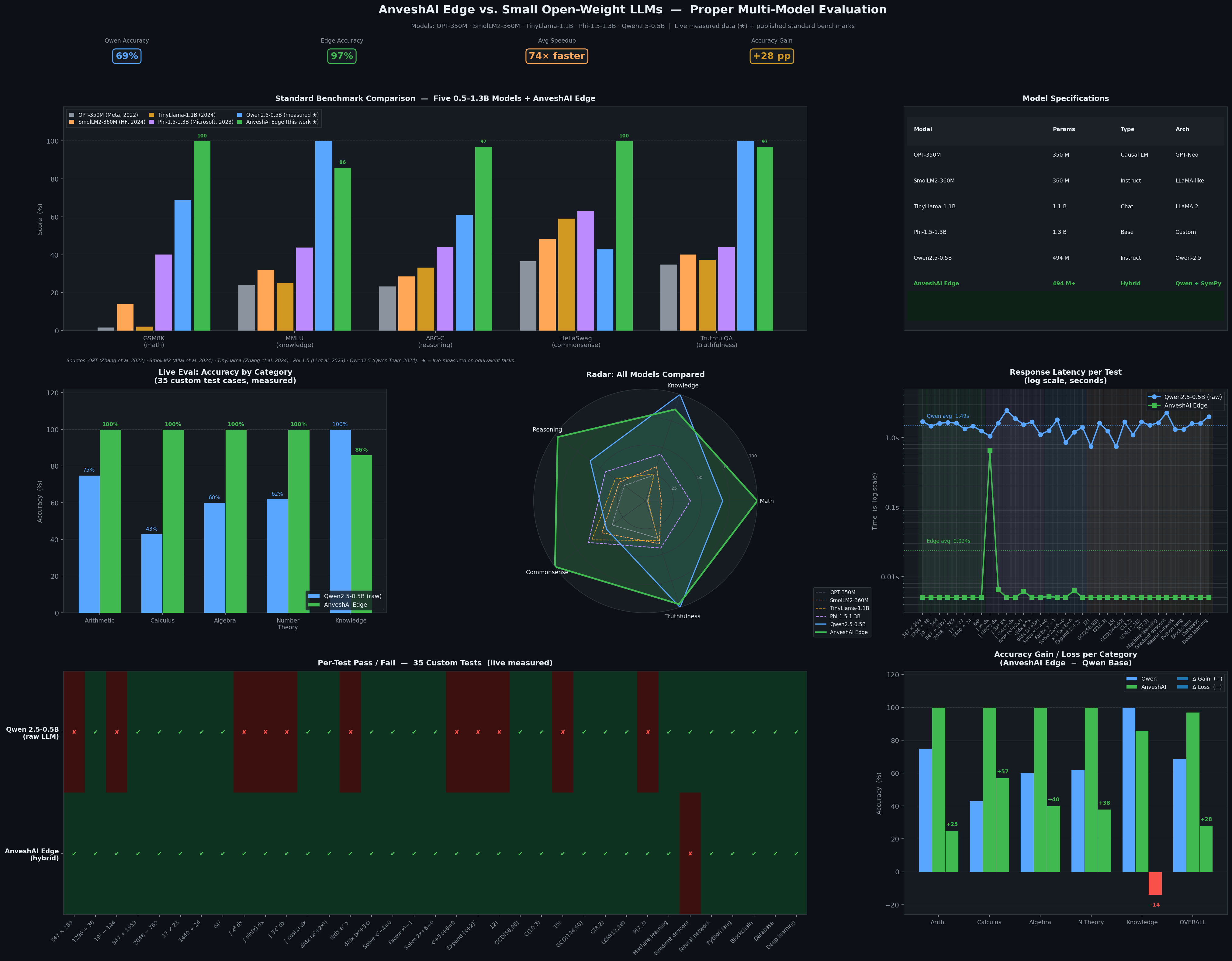
Key Design Principle
Correctness-first: For mathematics, the symbolic engine computes the exact answer before the LLM is called. The LLM's only task is to explain the working — it cannot invent a wrong answer.
Components
| Module | File | Role |
|---|---|---|
| Intent Router | router.py |
Keyword + regex classifier. Outputs: system, advanced_math, math, knowledge, conversation. Checked in priority order — advanced math is always detected before simple arithmetic. |
| Math Engine | math_engine.py |
Safe AST-based evaluator for plain arithmetic (2 + 3 * (4^2)). No eval() — uses a whitelist of allowed AST node types. |
| Advanced Math Engine | advanced_math_engine.py |
SymPy symbolic computation engine. 31+ operation types. Returns (success, result_str, latex_str). |
| Reasoning Engine | reasoning_engine.py |
Chain-of-thought decomposer. Identifies problem type, selects strategy, generates ordered sub-steps, assigns confidence, flags warnings. Builds structured LLM prompts. |
| Knowledge Engine | knowledge_engine.py |
Local knowledge-base lookup from knowledge.txt. Returns (response, found: bool). |
| Conversation Engine | conversation_engine.py |
Pattern-matching response rules from conversation.txt. Returns (response, matched: bool). |
| LLM Engine | llm_engine.py |
Lazy-loading Qwen2.5-0.5B-Instruct (GGUF, Q4_K_M, ~350 MB) via llama-cpp-python. CPU-only, no GPU required. |
| Memory | memory.py |
SQLite-backed conversation history. Powers the /history command. |
| Main | main.py |
Terminal REPL loop. Orchestrates all engines. Displays colour-coded output. |
Advanced Math Engine
The engine supports 31+ symbolic mathematics operations across 11 categories:
Calculus
| Operation | Example Input |
|---|---|
| Indefinite integration | integrate x^2 sin(x) |
| Definite integration | definite integral of x^2 from 0 to 3 |
| Differentiation (any order) | second derivative of sin(x) * e^x |
| Limits (including ±∞) | limit of sin(x)/x as x approaches 0 |
Algebra & Equations
| Operation | Example Input |
|---|---|
| Equation solving | solve x^2 - 5x + 6 = 0 |
| Factorisation | factor x^3 - 8 |
| Expansion | expand (x + y)^4 |
| Simplification | simplify (x^2 - 1)/(x - 1) |
| Partial fractions | partial fraction 1/(x^2 - 1) |
| Trig simplification | simplify trig sin^2(x) + cos^2(x) |
Differential Equations
| Operation | Example Input |
|---|---|
| ODE solving (dsolve) | solve differential equation y'' + y = 0 |
| First-order ODEs | solve ode dy/dx = y |
Series & Transforms
| Operation | Example Input |
|---|---|
| Taylor / Maclaurin series | taylor series of e^x around 0 order 6 |
| Laplace transform | laplace transform of sin(t) |
| Inverse Laplace transform | inverse laplace of 1/(s^2 + 1) |
| Fourier transform | fourier transform of exp(-x^2) |
Linear Algebra
| Operation | Example Input |
|---|---|
| Determinant | determinant of [[1,2],[3,4]] |
| Matrix inverse | inverse matrix [[2,1],[5,3]] |
| Eigenvalues & eigenvectors | eigenvalue [[4,1],[2,3]] |
| Matrix rank | rank of matrix [[1,2,3],[4,5,6]] |
| Matrix trace | trace of matrix [[1,2],[3,4]] |
Number Theory
| Operation | Example Input |
|---|---|
| GCD | gcd of 48 and 18 |
| LCM | lcm of 12 and 15 |
| Prime factorisation | prime factorization of 360 |
| Modular arithmetic | 17 mod 5 |
| Modular inverse | modular inverse of 3 mod 7 |
Statistics
| Operation | Example Input |
|---|---|
| Descriptive stats | mean of 2, 4, 6, 8, 10 |
| Standard deviation | standard deviation of 1, 2, 3, 4, 5 |
Combinatorics
| Operation | Example Input |
|---|---|
| Factorial | factorial of 10 |
| Binomial coefficient | binomial coefficient 10 choose 3 |
| Permutations | permutation 6 P 2 |
Summations & Products
| Operation | Example Input |
|---|---|
| Finite sum | sum of k^2 for k from 1 to 10 |
| Infinite series | summation of 1/n^2 for n from 1 to infinity |
Complex Numbers
| Operation | Example Input |
|---|---|
| All properties | modulus of 3 + 4*I |
Reasoning Engine
The ReasoningEngine adds structured chain-of-thought reasoning at every stage.
Reasoning Pipeline (4 Stages)
Stage 1 — Problem Analysis
- Detects domain (calculus, linear algebra, statistics, physics, …)
- Classifies problem type (integration, ODE, comparative analysis, …)
- Identifies sub-questions implicit in the problem
Stage 2 — Strategy Selection
- Chooses the optimal solution method (u-substitution, L'Hôpital, characteristic equation, …)
- Decomposes the problem into an ordered list of numbered reasoning steps
Stage 3 — Verification & Confidence
- Assigns confidence:
HIGH(symbolic answer available),MEDIUM, orLOW - Detects warnings: missing bounds, undetected variables, potential singularities
Stage 4 — Prompt Engineering
- Builds a structured LLM prompt that embeds the full reasoning plan
- For math: forces the LLM to follow the exact numbered steps toward the verified answer
- For knowledge: guides the LLM through the identified sub-questions in order
ReasoningPlan Data Structure
@dataclass
class ReasoningPlan:
    problem_type:    str        # e.g. "integration", "equation_solving"
    domain:          str        # e.g. "calculus", "linear_algebra"
    sub_problems:    list[str]  # ordered reasoning steps
    strategy:        str        # solution method description
    expected_form:   str        # what the answer should look like
    assumptions:     list[str]  # stated assumptions
    confidence:      str        # HIGH / MEDIUM / LOW
    warnings:        list[str]  # potential issues flagged
Why Chain-of-Thought Matters for a Small LLM
The Qwen2.5-0.5B model has only 0.5 billion parameters. Without guidance it frequently:
- Skips algebraic steps
- Produces a plausible-looking but incorrect final answer
- Confuses method with result
By embedding a detailed reasoning plan in every prompt — and for math problems, by providing the correct answer upfront — the model's role becomes that of a step-by-step explainer rather than an unsupervised solver. This dramatically improves output quality without requiring a larger model.
Getting Started
Requirements
pip install sympy llama-cpp-python colorama
The LLM model (Qwen2.5-0.5B-Instruct-GGUF, Q4_K_M, ~350 MB) is downloaded automatically from HuggingFace on first use and cached locally.
Running
python main.py
Usage Examples
You › integrate x^2 sin(x)

  SymPy → ∫ (x**2*sin(x)) dx = -x**2*cos(x) + 2*x*sin(x) + 2*cos(x) + C
  Reasoning engine: decomposing problem…
  [Reasoning] domain=calculus | strategy=Apply integration rules (IBP) | confidence=HIGH
  Building chain-of-thought prompt → LLM…

AnveshAI [AdvMath+CoT+LLM] › -x**2*cos(x) + 2*x*sin(x) + 2*cos(x) + C
  [Reasoning: integration | Apply integration rules (IBP)]
  Step 1: We use Integration by Parts twice…
  …
You › solve differential equation y'' + y = 0

AnveshAI [AdvMath+CoT+LLM] › Eq(y(x), C1*sin(x) + C2*cos(x))
  [Reasoning: ode_solving | Classify ODE and apply characteristic equation]
  Step 1: Classify the ODE — this is a 2nd-order linear homogeneous ODE…
  …
You › summation of 1/n^2 for n from 1 to infinity

AnveshAI [AdvMath+CoT+LLM] › Σ(n**(-2), n=1..oo) = pi**2/6
  [Reasoning: summation]
  Step 1: This is the Basel Problem…
Commands
| Command | Action |
|---|---|
/help |
Show all commands and usage examples |
/history |
Display the last 10 conversation turns |
/exit |
Quit the assistant |
Design Principles
Correctness-first for mathematics — The symbolic engine always runs before the LLM for mathematical queries. The LLM explains, it does not compute.
Offline-first — All computation runs locally. No API keys, no internet connection required after the one-time model download.
Transparency — The system prints its internal reasoning trace to the console (engine used, reasoning plan summary, confidence, warnings).
Graceful degradation — Every engine has a fallback: SymPy failures fall back to CoT-guided LLM, KB misses fall back to reasoning-guided LLM, and so on.
Safety — Arithmetic uses AST-based safe-eval (no
eval()). Matrix parsing uses a validated bracket pattern beforeeval(). The LLM prompt explicitly forbids inventing a different answer.Modularity — Every engine is independent and communicates through simple return types. Adding a new math operation requires only a new handler function and a keyword entry.
File Structure
anveshai/
├── main.py                 # REPL loop, orchestration, response composer
├── router.py               # Intent classification (regex + keyword)
├── math_engine.py          # Safe AST arithmetic evaluator
├── advanced_math_engine.py # SymPy symbolic engine (31+ operations)
├── reasoning_engine.py     # Chain-of-thought reasoning (CoT)
├── llm_engine.py           # Qwen2.5-0.5B-Instruct GGUF loader
├── knowledge_engine.py     # Local KB lookup (knowledge.txt)
├── conversation_engine.py  # Pattern-response engine (conversation.txt)
├── memory.py               # SQLite conversation history
├── knowledge.txt           # Local knowledge base paragraphs
├── conversation.txt        # PATTERN|||RESPONSE rule pairs
└── anveshai_memory.db      # Auto-created SQLite DB (gitignored)
Technical Details
Model
- Name: Qwen2.5-0.5B-Instruct
- Format: GGUF (Q4_K_M quantisation, ~350 MB)
- Runtime: llama-cpp-python (CPU-only via llama.cpp)
- Context window: 16,384 tokens
- Parameters: 0.5B
- Threads: 4 CPU threads
Symbolic Engine
- Library: SymPy 1.x
- Parsing:
sympy.parsing.sympy_parserwith implicit multiplication and XOR-to-power transforms - Supported variables: x, y, z, t, n, k, a, b, c, m, n, p, q, r, s
- Special constants: π, e, i (imaginary), ∞
Chain-of-Thought Reasoning
- Domain detection: 12 domain categories with keyword matching
- Problem type classification: 18 problem types via regex
- Strategy library: Pre-defined strategies for 18 problem types
- Decomposition: Problem-specific step generators for 15 operation types
- Confidence levels: HIGH (symbolic result available) / MEDIUM / LOW
Response Labels
| Label | Meaning |
|---|---|
Math |
Instant arithmetic result |
AdvMath+CoT+LLM |
SymPy exact answer + CoT plan + LLM explanation |
AdvMath+CoT |
CoT-guided LLM fallback (SymPy failed) |
Knowledge |
Local KB answer |
LLM+CoT-KB |
KB miss → reasoning-guided LLM |
Chat |
Conversation pattern match |
LLM+CoT |
Reasoning-guided LLM for open conversation |
Link
- GitHub:- Click Here!
- Zenodo:- Click Here!