

Cola2: Co-Adaptive Hierarchical Language Modeling with Continuous Semantic Compression and Balanced Discrete Generation
Paper • 2610.31305 • Published • 17
# pip install -U transformers accelerate
# Load model directly
from transformers import AutoModel
model = AutoModel.from_pretrained("ByteDance-Seed/Cola2", trust_remote_code=True, device_map="auto")Cola2 is a continuous-latent language model that co-adapts semantic compression and discrete text generation. It combines a dynamic-compression VAE, a block-causal Diffusion Transformer (DiT), and a span-causal token decoder with latent feedback.
GitHub · 中文说明 · Paper · Project page
The accompanying paper is titled “Cola2: Co-Adaptive Hierarchical Language Modeling with Continuous Semantic Compression and Balanced Discrete Generation.” Cola2 dynamically groups text into semantic spans, represents each span with a compact continuous latent, generates latent blocks with a DiT, and realizes those latents as discrete tokens.
The released checkpoint was trained on 346.03B source tokens and reaches a reported 60.10 average across eight evaluation tasks. These are reported paper results; individual runs may differ because latent generation is stochastic.
This repository contains:
SHA256SUMS for release-file verification.The inference implementation, command-line tools, examples, benchmark runner, and documentation are maintained in the Cola2 GitHub repository. Training code is not included in this release.
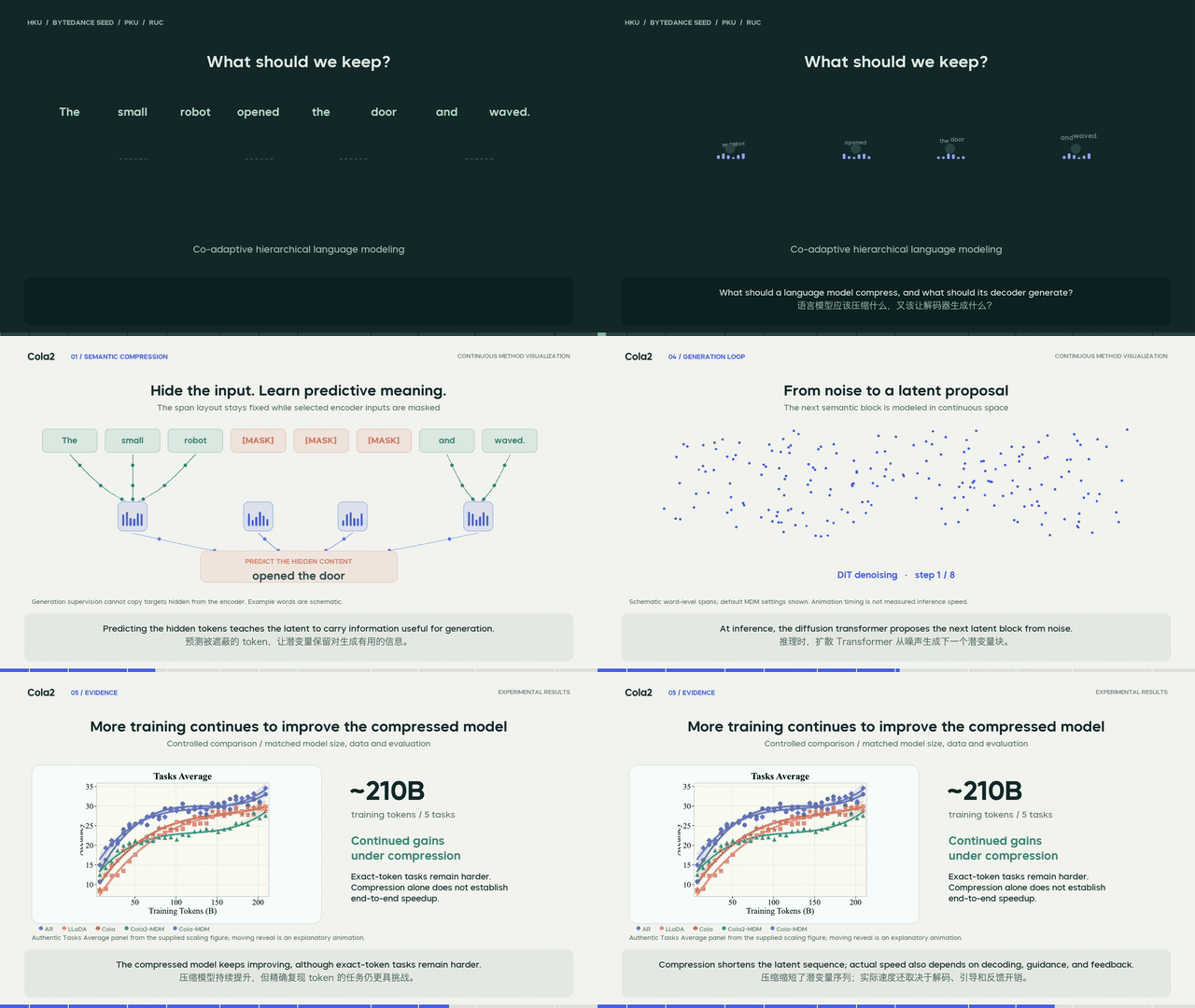
Click the preview to watch the full video · Open the interactive project page

Stage I jointly trains the dynamic-compression encoder and the token decoder. Stage II continues adapting that VAE with token-side supervision while an approximately 4B DiT learns the detached latent distribution through Flow Matching. During inference, Cola2 repeatedly proposes a latent block, decodes tokens, and re-encodes the committed text under the fixed span layout so the continuous and discrete histories stay aligned.
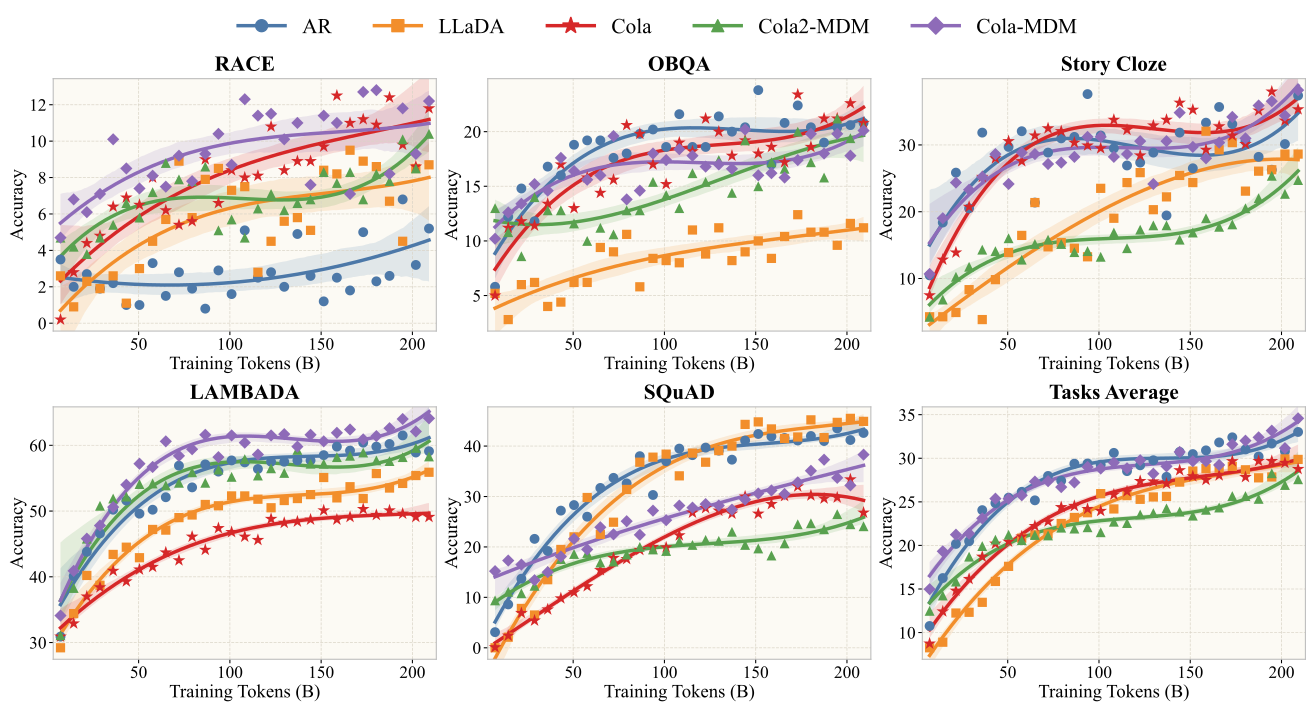
The controlled study compares AR, LLaDA, Cola DLM, uncompressed Cola-MDM, and compressed Cola2-MDM at matched model size, data, and evaluation settings. Cola-MDM has the strongest aggregate scaling; Cola2-MDM converges more slowly but continues closing its gap to LLaDA after roughly 150B tokens and remains unsaturated at about 210B tokens.
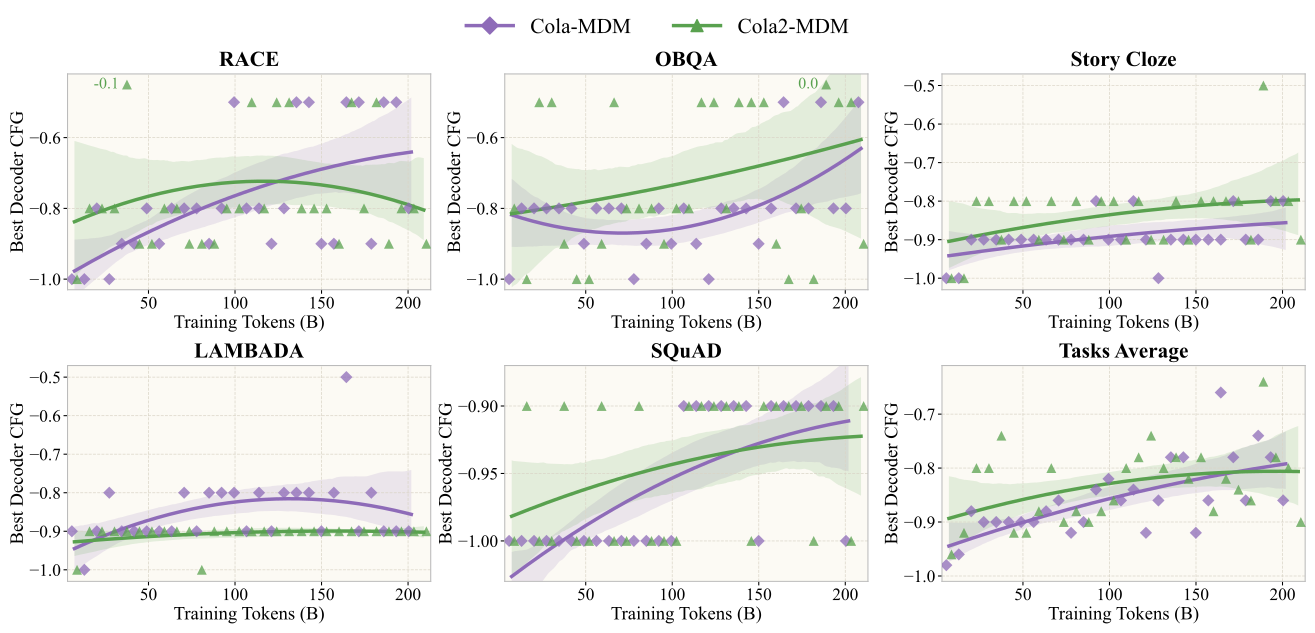
The optimal decoder classifier-free-guidance weight remains near -0.9 for
most of training and gradually moves toward zero.
The resource-constrained checkpoint uses 346.03B source tokens. Its latent DiT is still unconverged, yet Cola2 reaches a 60.10 eight-task average and exceeds Llama-3-8B on HellaSwag and StoryCloze with more than 43× fewer reported pretraining tokens.
| Task | Llama-3-8B | Qwen2.5-7B | Qwen3-8B-Base | LLaDA-8B-Base | Cola2 |
|---|---|---|---|---|---|
| Pretraining tokens | 15T+ | 18T | ~36T | 2.3T | 346B |
| RACE | 75.77 | 89.95 | 90.65 | 87.40 | 69.91 |
| NarrativeQA | 42.70 | 32.90 | 37.30 | 36.00 | 32.70 |
| HellaSwag | 39.21 | 75.67 | 68.13 | 69.65 | 41.75 |
| StoryCloze | 79.49 | 95.09 | 97.44 | 95.94 | 80.42 |
| LAMBADA | 75.70 | 71.82 | 71.20 | 67.90 | 63.00 |
| ARC-Easy | 90.86 | 96.00 | 97.35 | 93.85 | 87.62 |
| TruthfulQA | 63.04 | 69.03 | 72.58 | 64.87 | 54.10 |
| MMLU | 63.19 | 70.16 | 72.31 | 61.27 | 51.32 |
| 8-task average | 66.25 | 75.08 | 75.87 | 72.11 | 60.10 |
Values are accuracies (%) except for the token row. Models use different training recipes, tokenizers, and token-counting conventions, so this table contextualizes capability rather than isolating the generation paradigm. Each Cola2 task value is the mean of three latent-noise sampled evaluations; see the reference results and reproduction protocol.
Python 3.10+, PyTorch 2.2+, Transformers 4.51–4.x, and safetensors 0.4+ are required. CUDA with bfloat16 is recommended.
python -m pip install "torch>=2.2" "transformers>=4.51,<5" "safetensors>=0.4" accelerate
This model uses custom Transformers code, so trust_remote_code=True is
required.
import torch
from transformers import AutoModel, AutoTokenizer
model_id = "ByteDance-Seed/Cola2"
tokenizer = AutoTokenizer.from_pretrained(model_id, trust_remote_code=True)
model = AutoModel.from_pretrained(
model_id,
trust_remote_code=True,
torch_dtype=torch.bfloat16,
low_cpu_mem_usage=True,
).to("cuda").eval()
prompt = "Question: What is the capital of France? Answer:"
inputs = tokenizer(prompt, return_tensors="pt").to(model.device)
generator = torch.Generator(device=model.device).manual_seed(42)
with torch.inference_mode():
output = model.generate(**inputs, generator=generator)
answer = tokenizer.decode(
output[0, inputs.input_ids.shape[1] :],
skip_special_tokens=True,
)
print(answer)
Cola2 is a base model, not an instruction-tuned chat assistant.
Without overrides, generate() uses the released paper preset:
max_new_tokens=32.Greedy token selection does not make generation deterministic: latent
generation starts from Gaussian noise. Pass a seeded torch.Generator when
comparing outputs.
Clone and install the source repository to use the included chat and benchmark scripts:
git clone https://github.com/ByteDance-Seed/Cola2.git
cd Cola2
python -m pip install -e .
export COLA2_MODEL_PATH=ByteDance-Seed/Cola2
bash scripts/run_chat.sh
Use /reset to clear local chat history and /quit to exit.
The eval_data/ directory contains normalized JSONL files for ARC-Easy,
HellaSwag, LAMBADA, MMLU, NarrativeQA, RACE, Story Cloze, and TruthfulQA. To
run the 200-example smoke benchmark from a source checkout:
export COLA2_MODEL_PATH=ByteDance-Seed/Cola2
export GENERATE_TASK_DATA_DIR=/path/to/downloaded/cola2/eval_data
bash scripts/run_benchmark_quick.sh --models cola2
For the full benchmark grid and three-seed paper protocol, see the evaluation documentation and reproduction protocol. The original paper seeds are not published, so small differences from the reference results are expected.
hf download ByteDance-Seed/Cola2 --local-dir /path/to/cola2
cd /path/to/cola2
sha256sum -c SHA256SUMS
Please cite the Cola2 arXiv paper. BibTeX
and machine-readable metadata are provided in
CITATION.md
and
CITATION.cff.
The repository code is licensed under the
Apache License 2.0.
Model weights, tokenizer assets, benchmark datasets, and other third-party
materials remain subject to their respective terms. See
NOTICE for
attribution details.
# Use a pipeline as a high-level helper
from transformers import pipeline

pipe = pipeline("text-generation", model="ByteDance-Seed/Cola2", trust_remote_code=True)
messages = [
    {"role": "user", "content": "Who are you?"},
]
pipe(messages)