


language:
  - en
license: cc-by-nc-sa-4.0
pipeline_tag: other
MYRIAD (Envisioning the Future, One Step at a Time)



MYRIAD (Motion hYpothesis Reasoning via Iterative Autoregressive Diffusion) is an autoregressive diffusion model that predicts open-set future scene dynamics as step-wise inference over sparse point trajectories. Starting from a single image, it can efficiently explore thousands of plausible future outcomes, maintaining physical plausibility and long-range coherence.
Paper and Abstract
The MYRIAD model was presented in the paper Envisioning the Future, One Step at a Time.
From a single image, MYRIAD predicts distributions over sparse point trajectories autoregressively. This allows the model to predict consistent futures in open-set environments and plan actions by exploring a large number of counterfactual interactions.
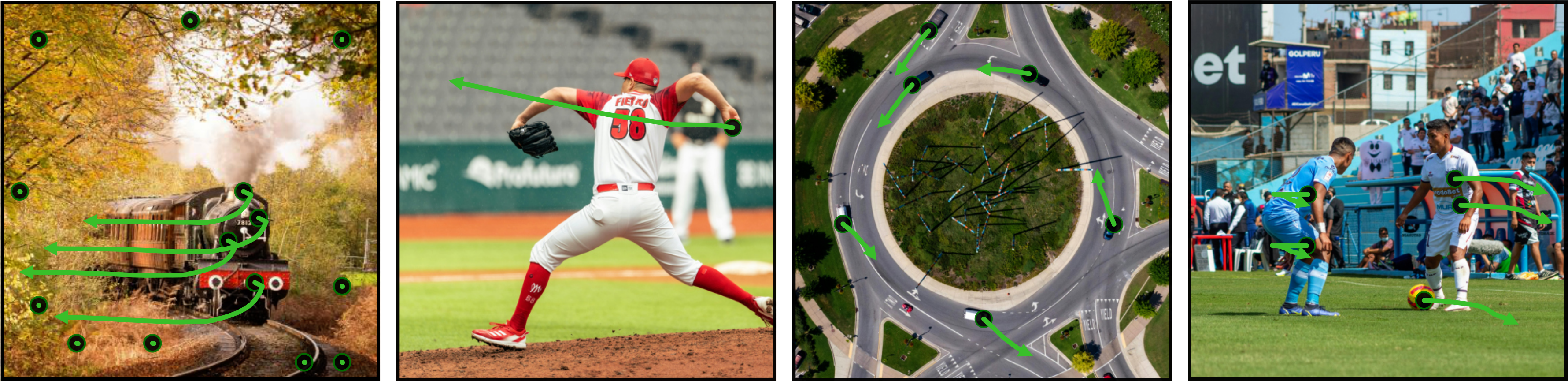 From a single image, our model envisions diverse, physically consistent futures by predicting sparse point trajectories step by step.
 Its efficiency enables exploring thousands of counterfactual rollouts directly in motion space - here illustrated for billiards planning, where candidate shots are evaluated by simulating many possible outcomes.
Usage
For programmatic use, the simplest way to use MYRIAD is via torch.hub:
import torch

# Load the open-set model
myriad_openset = torch.hub.load("CompVis/myriad", "myriad_openset")

# Load the billiard-specific model
myriad_billiard = torch.hub.load("CompVis/myriad", "myriad_billiard")
If you wish to integrate MYRIAD in your own codebase, you can copy model.py and dinov3.py from the GitHub repository.
The MyriadStepByStep class contains a predict_simulate method for unrolling trajectories and a low-level forward method to predict distributions for previously observed trajectories.
Citation
If you find our model or code useful, please cite our paper:
@inproceedings{baumann2026envisioning,
  title={Envisioning the Future, One Step at a Time},
  author={Baumann, Stefan Andreas and Wiese, Jannik and Martorella, Tommaso and Kalayeh, Mahdi M. and Ommer, Bjorn},
  booktitle={Proceedings of the IEEE/CVF Conference on Computer Vision and Pattern Recognition (CVPR)},
  year={2026}
}