| --- |
| license: cc-by-nc-4.0 |
| library_name: transformers |
| tags: |
| - dermatology |
| - medical-imaging |
| - embeddings |
| - image-feature-extraction |
| - clip |
| pipeline_tag: image-feature-extraction |
| --- |
| |
| # A Global Atlas of Digital Dermatology to Map Innovation and Disparities |
|
|
|  |
|
|
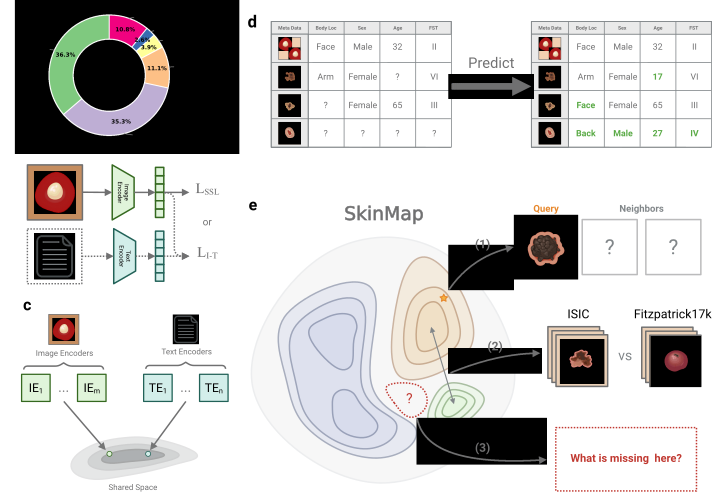
| SkinMap is a dermatology image/text embedding model. It fuses **12 frozen teacher |
| encoders** (multi-modal and self-supervised models) through a trained projector |
| into a single **1024-d shared image/text space**, that can be used to infer |
| missing metadata, solve downstream tasks, and get relational information about the |
| samples. |
|
|
| **Compute.** This is the faithful full ensemble: 12 backbones load into memory at |
| once and need roughly **16 GB of GPU VRAM**. It runs on CPU but slowly. |
|
|
| ## Usage |
|
|
| ```python |
| from transformers import AutoModel |
| |
| model = AutoModel.from_pretrained( |
| "Digital-Dermatology/SkinMap", |
| trust_remote_code=True, |
| device="cuda", # "cpu" also works |
| ) |
| |
| # 1) Encode an image into the 1024-d SkinMap space (L2-normalized) |
| img_emb = model.encode_image("lesion.jpg") # np.ndarray, shape (1024,) |
| |
| # 2) Encode a text query into the same space |
| txt_emb = model.encode_text("melanoma on the back") # np.ndarray, shape (1024,) |
| |
| # 3) Predict clinical metadata from the image |
| meta = model.predict_meta("lesion.jpg") |
| # {'fitzpatrick': 3, 'fitzpatrick_grouped': '3-4', 'age': 42.1, |
| # 'gender': 'female', 'origin': ..., 'body_region': ..., ...} |
| |
| import numpy as np |
| sim = float(np.dot(img_emb, txt_emb)) # cosine in the shared space |
| ``` |
|
|
| `encode_image` accepts a file path, raw bytes, or a `PIL.Image`. `encode_text` |
| expands the query into clinical prompt templates and averages the results; pass |
| `templates=["{}"]` to encode the raw text as-is. |
|
|
| ### Metadata prediction |
|
|
| `predict_meta` applies bundled linear probes to the SkinMap embedding to estimate |
| Fitzpatrick skin type, age, sex, geographic origin, body region and more. By |
| default it uses **global** probes, which reproduce the demographic estimates |
| reported in the paper. If you know the imaging modality, pass it to switch the |
| Fitzpatrick prediction to a **modality-specific** probe (more accurate when the |
| modality is known); the other attributes stay global: |
|
|
| ```python |
| meta = model.predict_meta("lesion.jpg", modality="dermoscopy") # clinical | dermoscopy | TBP |
| ``` |
|
|
| `predict_meta` also accepts a precomputed 1024-d vector instead of an image, and a |
| subset via `attributes=[...]`. |
|
|
| ### Nearest-neighbor search (optional) |
|
|
| If this repo was built with an atlas index bundled, you can retrieve neighbors |
| directly: |
|
|
| ```python |
| indices, distances = model.search("lesion.jpg", k=10) |
| ``` |
|
|
| Without a bundled index, `search()` raises a clear error. Encoding still works. |
|
|
| ## What's inside |
|
|
| | Component | Role | |
| |---|---| |
| | 9 multi-modal teachers (CLIP & SigLIP; ViT-L/14 & ViT-B/32) | image + text features | |
| | 3 self-supervised teachers (DINO, iBOT, MAE; ViT-B/16) | dermatology image features | |
| | Per-teacher whitening (`whitening_stats.npz`) | decorrelate before fusion | |
| | Trained projector (`projector_model.pth`) | fuse to 1024-d image/text heads | |
| | Metadata probes (`probes/`) | linear probes for `predict_meta` | |
|
|
| ## Licensing |
|
|
| SkinMap is released under the Creative Commons Attribution-NonCommercial 4.0 |
| International license, for research use only. **Not a medical device. Not for |
| clinical decision-making.** |
|
|


