| | --- |
| | license: apache-2.0 |
| | library_name: tfhub |
| | language: en |
| | tags: |
| | - text |
| | - sentence-similarity |
| | - use |
| | - universal-sentence-encoder |
| | - tensorflow |
| | --- |
| | |
| | ## Model name: universal-sentence-encoder |
| | ## Description adapted from [TFHub](https://tfhub.dev/google/universal-sentence-encoder/4) |
| |
|
| | # Overview |
| |
|
| | The Universal Sentence Encoder encodes text into high-dimensional vectors that can be used for text classification, semantic similarity, clustering and other natural language tasks. |
| |
|
| | The model is trained and optimized for greater-than-word length text, such as sentences, phrases or short paragraphs. It is trained on a variety of data sources and a variety of tasks with the aim of dynamically accommodating a wide variety of natural language understanding tasks. The input is variable length English text and the output is a 512 dimensional vector. We apply this model to the [STS benchmark](https://ixa2.si.ehu.es/stswiki/index.php/STSbenchmark) for semantic similarity, and the results can be seen in the [example notebook](https://colab.research.google.com/github/tensorflow/hub/blob/master/examples/colab/semantic_similarity_with_tf_hub_universal_encoder.ipynb) made available. The universal-sentence-encoder model is trained with a deep averaging network (DAN) encoder. |
| |
|
| | To learn more about text embeddings, refer to the [TensorFlow Embeddings](https://www.tensorflow.org/tutorials/text/word_embeddings) documentation. Our encoder differs from word level embedding models in that we train on a number of natural language prediction tasks that require modeling the meaning of word sequences rather than just individual words. Details are available in the paper "Universal Sentence Encoder" [1]. |
| |
|
| | ## Universal Sentence Encoder family |
| |
|
| | There are several versions of universal sentence encoder models trained with different goals including size/performance multilingual, and fine-grained question answer retrieval. |
| |
|
| | - [Universal Sentence Encoder family](https://tfhub.dev/google/collections/universal-sentence-encoder/1) |
| |
|
| | ### Example use |
| |
|
| |
|
| | ### Using TF Hub and HF Hub |
| | ``` |
| | model_path = snapshot_download(repo_id="Dimitre/universal-sentence-encoder") |
| | model = KerasLayer(handle=model_path) |
| | embeddings = model([ |
| | "The quick brown fox jumps over the lazy dog.", |
| | "I am a sentence for which I would like to get its embedding"]) |
| | |
| | print(embeddings) |
| | |
| | # The following are example embedding output of 512 dimensions per sentence |
| | # Embedding for: The quick brown fox jumps over the lazy dog. |
| | # [-0.03133016 -0.06338634 -0.01607501, ...] |
| | # Embedding for: I am a sentence for which I would like to get its embedding. |
| | # [0.05080863 -0.0165243 0.01573782, ...] |
| | ``` |
| |
|
| | ### Using [TF Hub fork](https://github.com/dimitreOliveira/hub) |
| | ``` |
| | model = pull_from_hub(repo_id="Dimitre/universal-sentence-encoder") |
| | embeddings = model([ |
| | "The quick brown fox jumps over the lazy dog.", |
| | "I am a sentence for which I would like to get its embedding"]) |
| | |
| | print(embeddings) |
| | |
| | # The following are example embedding output of 512 dimensions per sentence |
| | # Embedding for: The quick brown fox jumps over the lazy dog. |
| | # [-0.03133016 -0.06338634 -0.01607501, ...] |
| | # Embedding for: I am a sentence for which I would like to get its embedding. |
| | # [0.05080863 -0.0165243 0.01573782, ...] |
| | ``` |
| |
|
| | This module is about 1GB. Depending on your network speed, it might take a while to load the first time you run inference with it. After that, loading the model should be faster as modules are cached by default ([learn more about caching](https://www.tensorflow.org/hub/tf2_saved_model)). Further, once a module is loaded to memory, inference time should be relatively fast. |
| |
|
| | ### Preprocessing |
| |
|
| | The module does not require preprocessing the data before applying the module, it performs best effort text input preprocessing inside the graph. |
| |
|
| | # Semantic Similarity |
| |
|
| |  |
| |
|
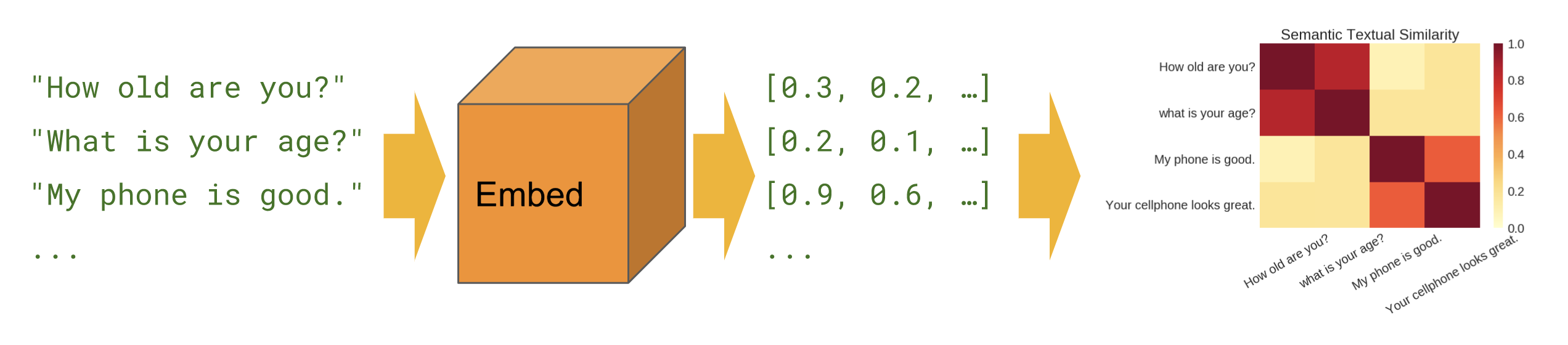
| | Semantic similarity is a measure of the degree to which two pieces of text carry the same meaning. This is broadly useful in obtaining good coverage over the numerous ways that a thought can be expressed using language without needing to manually enumerate them. |
| |
|
| | Simple applications include improving the coverage of systems that trigger behaviors on certain keywords, phrases or utterances. [This section of the notebook](https://colab.research.google.com/github/tensorflow/hub/blob/master/examples/colab/semantic_similarity_with_tf_hub_universal_encoder.ipynb#scrollTo=BnvjATdy64eR) shows how to encode text and compare encoding distances as a proxy for semantic similarity. |
| |
|
| | # Classification |
| |  |
| |
|
| | [This notebook](https://colab.research.google.com/github/tensorflow/hub/blob/master/docs/tutorials/text_classification_with_tf_hub.ipynb) shows how to train a simple binary text classifier on top of any TF-Hub module that can embed sentences. The Universal Sentence Encoder was partially trained with custom text classification tasks in mind. These kinds of classifiers can be trained to perform a wide variety of classification tasks often with a very small amount of labeled examples. |