| --- |
| tags: |
| - model_hub_mixin |
| - pytorch_model_hub_mixin |
| - keypoint-matching |
| library_name: transformers |
| license: apache-2.0 |
| pipeline_tag: keypoint-detection |
| --- |
| |
| This model has been pushed to the Hub using the [PytorchModelHubMixin](https://huggingface.co/docs/huggingface_hub/package_reference/mixins#huggingface_hub.PyTorchModelHubMixin) integration: |
|
|
| This is a LightGlue variant trained on DISK, with a commecially permissive license, which requires `kornia` to be installed and is usable with transformers up to [v5.4.0](https://github.com/huggingface/transformers/pull/45122) with the following lines of code |
| ```python |
| from transformers import LightGlueForKeypointMatching |
| |
| model = LightGlueForKeypointMatching.from_pretrained("ETH-CVG/lightglue_disk", trust_remote_code=True) |
| ``` |
|
|
|
|
| # LightGlue |
|
|
| The LightGlue model was proposed |
| in [LightGlue: Local Feature Matching at Light Speed](http://arxiv.org/abs/2306.13643) by Philipp Lindenberger, Paul-Edouard Sarlin and Marc Pollefeys. |
|
|
| This model consists of matching two sets of interest points detected in an image. Paired with the |
| [SuperPoint model](https://huggingface.co/magic-leap-community/superpoint), it can be used to match two images and |
| estimate the pose between them. This model is useful for tasks such as image matching, homography estimation, etc. |
|
|
| The abstract from the paper is the following : |
| We introduce LightGlue, a deep neural network that learns to match local features across images. We revisit multiple |
| design decisions of SuperGlue, the state of the art in sparse matching, and derive simple but effective improvements. |
| Cumulatively, they make LightGlue more efficient – in terms of both memory and computation, more accurate, and much |
| easier to train. One key property is that LightGlue is adaptive to the difficulty of the problem: the inference is |
| much faster on image pairs that are intuitively easy to match, for example because of a larger visual overlap or |
| limited appearance change. This opens up exciting prospects for deploying deep matchers in latency-sensitive |
| applications like 3D reconstruction. The code and trained models are publicly available at [github.com/cvg/LightGlue](https://github.com/cvg/LightGlue). |
|
|
|
|
| <img src="https://raw.githubusercontent.com/cvg/LightGlue/main/assets/easy_hard.jpg" alt="drawing" width="800"/> |
|
|
| This model was contributed by [stevenbucaille](https://huggingface.co/stevenbucaille). |
| The original code can be found [here](https://github.com/cvg/LightGlue). |
|
|
| ## Demo notebook |
|
|
| A demo notebook showcasing inference + visualization with LightGlue can be found [TBD](). |
|
|
|
|
| ## Model Details |
|
|
| ### Model Description |
|
|
| LightGlue is a neural network that matches two sets of local features by jointly finding correspondences and rejecting non-matchable points. |
| Building on the success of SuperGlue, this model has the ability to introspect the confidence of its own predictions. It adapts the amount of |
| computation to the difficulty of each image pair to match. Both its depth and width are adaptive : |
| 1. the inference can stop at an early layer if all predictions are ready |
| 2. points that are deemed not matchable are discarded early from further steps. |
| The resulting model, LightGlue, is finally faster, more accurate, and easier to train than the long-unrivaled SuperGlue. |
|
|
| <img src="https://cdn-uploads.huggingface.co/production/uploads/632885ba1558dac67c440aa8/ILpGyHuWwK2M9Bz0LmZLh.png" alt="drawing" width="1000"/> |
|
|
| - **Developed by:** ETH Zurich - Computer Vision and Geometry Lab |
| - **Model type:** Image Matching |
| - **License:** Apache 2.0 |
|
|
| ### Model Sources |
|
|
| <!-- Provide the basic links for the model. --> |
|
|
| - **Repository:** https://github.com/cvg/LightGlue |
| - **Paper:** http://arxiv.org/abs/2306.13643 |
| - **Demo:** https://colab.research.google.com/github/cvg/LightGlue/blob/main/demo.ipynb |
|
|
| ## Uses |
|
|
| <!-- Address questions around how the model is intended to be used, including the foreseeable users of the model and those affected by the model. --> |
|
|
| ### Direct Use |
|
|
| LightGlue is designed for feature matching and pose estimation tasks in computer vision. It can be applied to a variety of multiple-view |
| geometry problems and can handle challenging real-world indoor and outdoor environments. However, it may not perform well on tasks that |
| require different types of visual understanding, such as object detection or image classification. |
|
|
| ## How to Get Started with the Model |
|
|
| Here is a quick example of using the model. Since this model is an image matching model, it requires pairs of images to be matched. |
| The raw outputs contain the list of keypoints detected by the keypoint detector as well as the list of matches with their corresponding |
| matching scores. |
| ```python |
| from transformers import AutoImageProcessor, AutoModel |
| import torch |
| from PIL import Image |
| import requests |
| |
| url_image1 = "https://raw.githubusercontent.com/magicleap/SuperGluePretrainedNetwork/refs/heads/master/assets/phototourism_sample_images/united_states_capitol_98169888_3347710852.jpg" |
| image1 = Image.open(requests.get(url_image1, stream=True).raw) |
| url_image2 = "https://raw.githubusercontent.com/magicleap/SuperGluePretrainedNetwork/refs/heads/master/assets/phototourism_sample_images/united_states_capitol_26757027_6717084061.jpg" |
| image2 = Image.open(requests.get(url_image2, stream=True).raw) |
| |
| images = [image1, image2] |
| |
| processor = AutoImageProcessor.from_pretrained("ETH-CVG/lightglue_disk", trust_remote_code=True) |
| model = AutoModel.from_pretrained("ETH-CVG/lightglue_disk") |
| |
| inputs = processor(images, return_tensors="pt") |
| with torch.no_grad(): |
| outputs = model(**inputs) |
| ``` |
|
|
| You can use the `post_process_keypoint_matching` method from the `LightGlueImageProcessor` to get the keypoints and matches in a readable format: |
| ```python |
| image_sizes = [[(image.height, image.width) for image in images]] |
| outputs = processor.post_process_keypoint_matching(outputs, image_sizes, threshold=0.2) |
| for i, output in enumerate(outputs): |
| print("For the image pair", i) |
| for keypoint0, keypoint1, matching_score in zip( |
| output["keypoints0"], output["keypoints1"], output["matching_scores"] |
| ): |
| print( |
| f"Keypoint at coordinate {keypoint0.numpy()} in the first image matches with keypoint at coordinate {keypoint1.numpy()} in the second image with a score of {matching_score}." |
| ) |
| ``` |
|
|
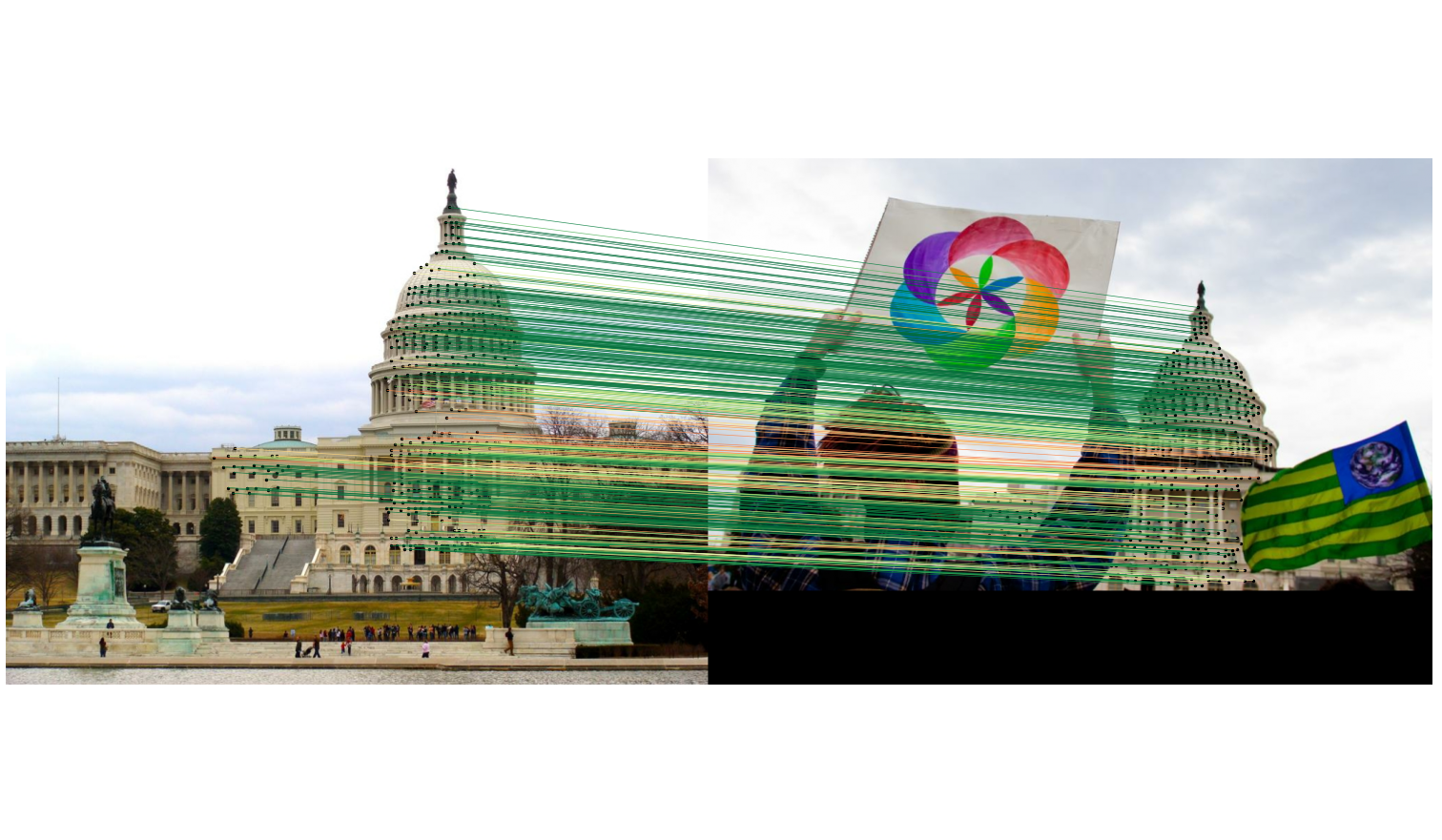
| You can visualize the matches between the images by providing the original images as well as the outputs to this method: |
| ```python |
| processor.plot_keypoint_matching(images, outputs) |
| ``` |
|
|
|  |
|
|
| ## Training Details |
|
|
| LightGlue is trained on large annotated datasets for pose estimation, enabling it to learn priors for pose estimation and reason about the 3D scene. |
| The training data consists of image pairs with ground truth correspondences and unmatched keypoints derived from ground truth poses and depth maps. |
|
|
| LightGlue follows the supervised training setup of SuperGlue. It is first pre-trained with synthetic homographies sampled from 1M images. |
| Such augmentations provide full and noise-free supervision but require careful tuning. LightGlue is then fine-tuned with the MegaDepth dataset, |
| which includes 1M crowd-sourced images depicting 196 tourism landmarks, with camera calibration and poses recovered by SfM and |
| dense depth by multi-view stereo. |
|
|
| #### Training Hyperparameters |
|
|
| - **Training regime:** fp32 |
|
|
| #### Speeds, Sizes, Times |
|
|
| LightGlue is designed to be efficient and runs in real-time on a modern GPU. A forward pass takes approximately 44 milliseconds (22 FPS) for an image pair. |
| The model has 13.7 million parameters, making it relatively compact compared to some other deep learning models. |
| The inference speed of LightGlue is suitable for real-time applications and can be readily integrated into |
| modern Simultaneous Localization and Mapping (SLAM) or Structure-from-Motion (SfM) systems. |
|
|
| ## Citation |
|
|
| <!-- If there is a paper or blog post introducing the model, the APA and Bibtex information for that should go in this section. --> |
|
|
| **BibTeX:** |
|
|
| ```bibtex |
| @inproceedings{lindenberger2023lightglue, |
| author = {Philipp Lindenberger and |
| Paul-Edouard Sarlin and |
| Marc Pollefeys}, |
| title = {{LightGlue: Local Feature Matching at Light Speed}}, |
| booktitle = {ICCV}, |
| year = {2023} |
| } |
| ``` |
|
|
| ## Model Card Authors |
|
|
| [Steven Bucaille](https://github.com/sbucaille) |