


metadata
license: cc-by-nc-sa-4.0
pipeline_tag: image-segmentation
SAM2Matting: Generalized Image and Video Matting
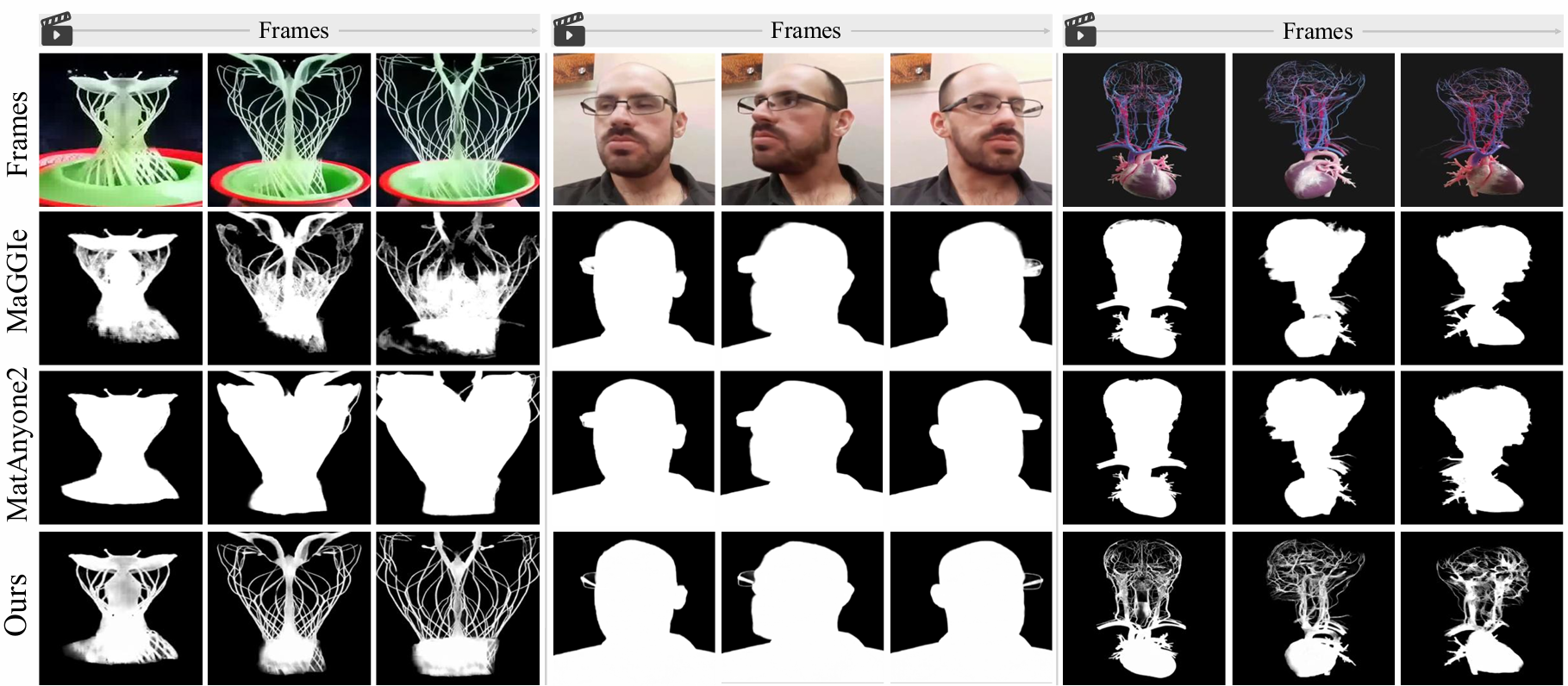
This repository contains the official checkpoints for SAM2Matting, a generalized matting framework that decouples high-level tracking from dedicated low-level matting to support robust image and video matting of any open-world targets.
📄 Paper | 🏠 Project Page | 💻 GitHub
Highlights
- Decoupled design: Combines a VOS tracker for temporal consistency with ROI Detection & Progressive Matting for fine details.
- Image-only training, video SOTA: Strong zero-shot video matting performance without requiring expensive video matting datasets.
- Diverse prompts: Supports masks, points, boxes, and text prompts.
- Open-world generalization: Robust matting for humans, animals, anime, translucent objects, and rapid-motion scenes.
Installation
To run SAM2Matting locally, clone the repository and install the dependencies:
# clone the repo and enter directory
git clone https://github.com/FudanCVL/SAM2Matting.git
cd SAM2Matting

# create and activate conda environment
conda create -n sam2matting python=3.10 -y
conda activate sam2matting

# install required packages
pip install -r requirements.txt
Quick Start
The codebase provides separate inference scripts for image and video matting.
To run video matting on a sample with SAM2-based trackers, run:
python inference_video_sam2.py --save_mp4
To enable compilation for faster execution (though the first run may be slower):
python inference_video_sam2.py --save_mp4 --compiled
Citation
If you find SAM2Matting useful in your research, please consider citing the work:
@inproceedings{SAM2Matting,
  title={{SAM2Matting}: Generalized Image and Video Matting},
  author={Shen, Ruiqi and Jie, Guangquan and Liu, Chang and Ding, Henghui},
  booktitle={European Conference on Computer Vision (ECCV)},
  year={2026}
}