| --- |
| pipeline_tag: video-to-video |
| tags: |
| - video |
| - video-reconstruction |
| - video-generation |
| - video-representation |
| - v-rae |
| - rae |
| - pytorch |
| - arxiv:2608.13556 |
| datasets: |
| - quchenyuan/UCF101-ZIP |
| --- |
| |
| <div align="center"> |
| <h1>V-RAE: Rethinking Video Latent Spaces for Generation</h1> |
| <p> |
| <a href="https://guominghui07.github.io/">Minghui Guo</a><sup>1</sup> <a href="https://sqwu.top/">Shengqiong Wu</a><sup>2</sup> <a href="https://haofei.vip/">Hao Fei</a><sup>2</sup> |
| </p> |
| <p> |
| <sup>1</sup>National University of Singapore <sup>2</sup>University of Oxford |
| </p> |
| </div> |
|
|
| <p align="center"> |
| <a href="https://arxiv.org/abs/2608.13556"><img src="https://img.shields.io/badge/Paper-arXiv-b31b1b" alt="Paper"></a> |
| <a href="https://v-rae.github.io/"><img src="https://img.shields.io/badge/Homepage-Project%20Page-blue" alt="Project Page"></a> |
| <a href="https://github.com/V-RAE/V-RAE"><img src="https://img.shields.io/badge/Code-GitHub-black" alt="Code"></a> |
| </p> |
|
|
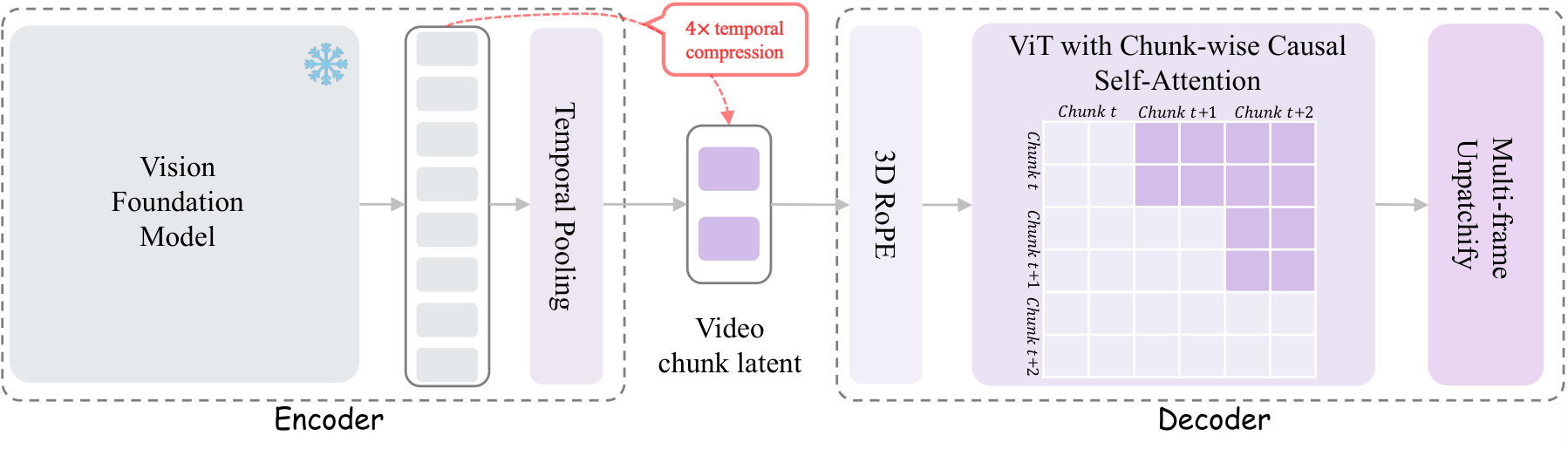
| V-RAE is a video representation autoencoder that builds compact generative |
| latents on top of frozen vision foundation model representations. It uses a |
| lightweight temporal pooling module to remove temporal redundancy while |
| preserving semantic structure, together with a video decoder for reconstructing |
| continuous motion. |
|
|
|  |
|
|
|  |
|
|
| ## Released Models |
|
|
| This repository provides V-RAE checkpoints based on four frozen visual encoders: |
|
|
| | Checkpoint | Encoder | |
| | --- | --- | |
| | `vrae/vrae_dinov3.pt` | DINOv3 ViT-L/16 | |
| | `vrae/vrae_siglip2.pt` | SigLIP2 ViT-L/16 | |
| | `vrae/vrae_vjepa2.1.pt` | V-JEPA2.1 ViT-L/16 | |
| | `vrae/vrae_eupe.pt` | EUPE ViT-B/16 | |
|
|
| Class-conditional VideoDiT checkpoints and their matching latent statistics are |
| also provided for UCF101 and Kinetics-600: |
|
|
| - UCF101: V-JEPA2.1 and EUPE variants |
| - Kinetics-600: V-JEPA2.1 variant |
|
|
| ## Quick Start |
|
|
| Install the official implementation: |
|
|
| ```bash |
| git clone https://github.com/V-RAE/V-RAE.git |
| cd V-RAE |
| |
| conda create -n vrae python=3.10 -y |
| conda activate vrae |
| conda install -c conda-forge ffmpeg -y |
| |
| pip install uv |
| uv pip install -e . |
| ``` |
|
|
| Download the released checkpoints: |
|
|
| ```bash |
| hf download Guomh0707/V-RAE-Models --local-dir ckpts |
| ``` |
|
|
| Download the matching frozen encoder by following the |
| [encoder instructions](https://github.com/V-RAE/V-RAE/blob/main/third_party/README.md#download-pre-trained-encoder-weights). |
|
|
| Place three input videos at `assets/sample1.mp4`, `assets/sample2.mp4`, and |
| `assets/sample3.mp4`, then run one of: |
|
|
| ```bash |
| python sampling.py dino |
| python sampling.py siglip |
| python sampling.py vjepa |
| python sampling.py eupe |
| ``` |
|
|
| Reconstruction results are saved under `outputs/<variant>/`. |
|
|
| ## Results |
|
|
| | Evaluation | Result | |
| | --- | ---: | |
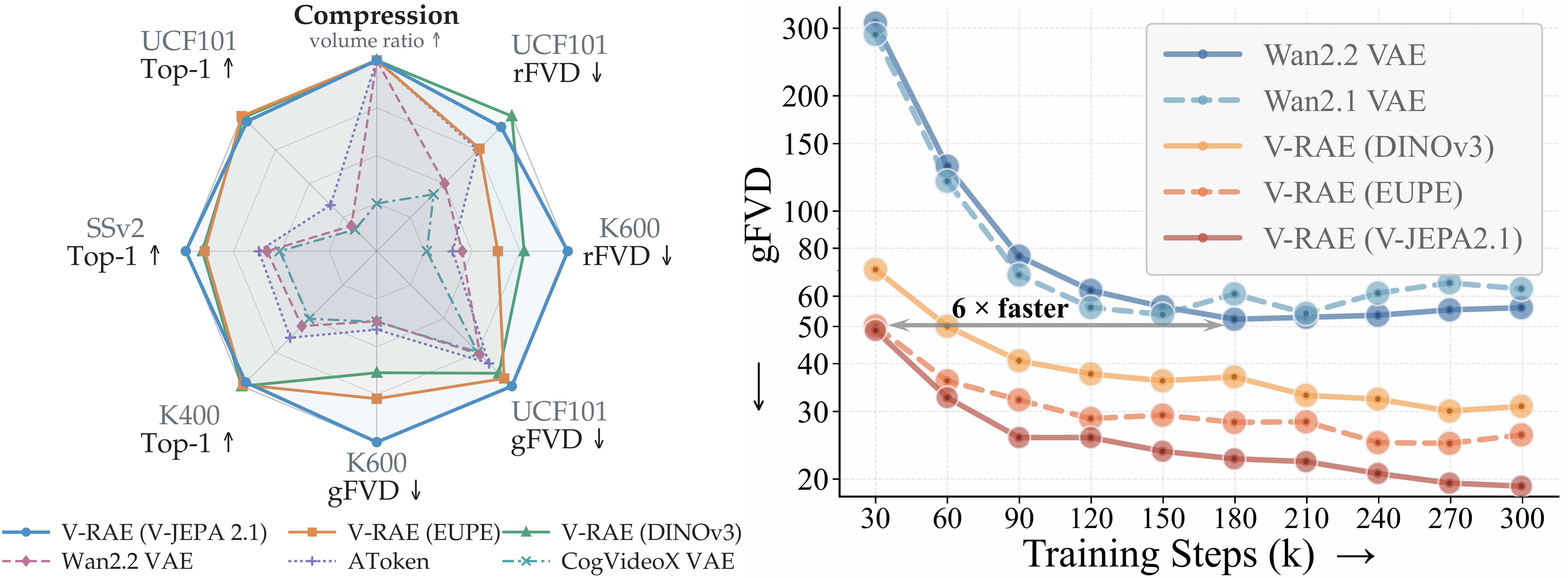
| | Kinetics-600 reconstruction | **2.13 rFVD** | |
| | UCF101 class-conditional generation | **117.86 gFVD** | |
| | Kinetics-600 class-conditional generation | **19.16 gFVD** | |
|
|
|
|
| ## Notes |
|
|
| - Each V-RAE checkpoint requires its corresponding frozen encoder weights. |
| - These are custom PyTorch checkpoints and require the official V-RAE codebase. |
| - This repository is intended primarily for research use. |
|
|
| ## Citation |
|
|
| ```bibtex |
| @article{guo2026vrae, |
| title = {V-RAE: Rethinking Video Latent Spaces for Generation}, |
| author = {Guo, Minghui and Wu, Shengqiong and Fei, Hao}, |
| journal = {arXiv preprint arXiv:2608.13556}, |
| year = {2026}, |
| } |
| ``` |
|
|

