




DiffuDETR: Rethinking Detection Transformers with Denoising Diffusion Process
ICLR 2026
Youssef Nawar* Mohamed Badran* Marwan Torki
Alexandria University · Technical University of Munich · Applied Innovation Center
* Equal Contribution
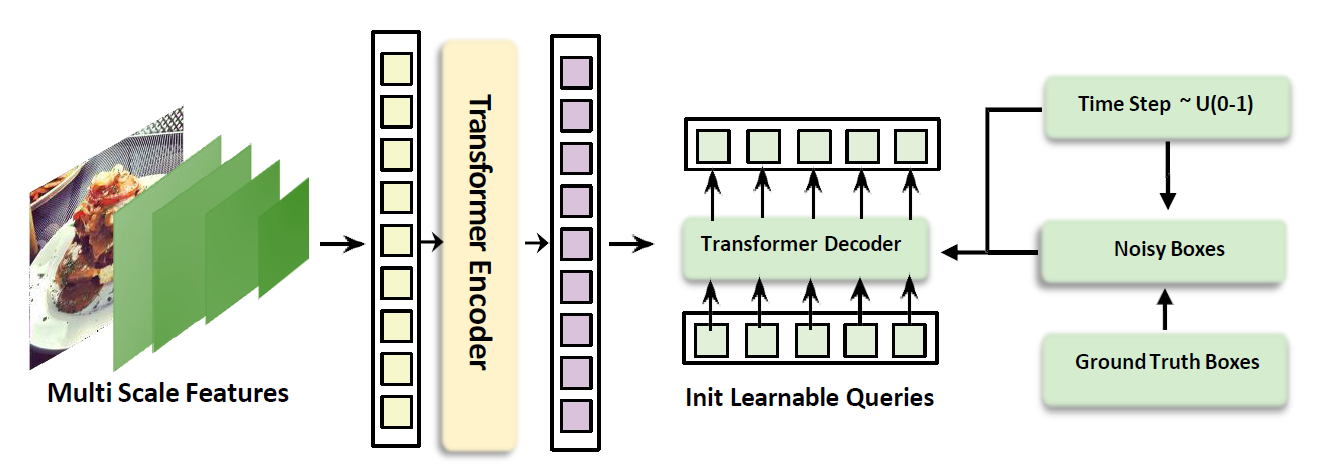
DiffuDETR reformulates object detection as a conditional query generation task using denoising diffusion, improving strong baselines on COCO, LVIS, and V3Det.
🔥 Highlights
51.9mAP on COCO+1.0 over DINO |
28.9AP on LVIS+2.4 over DINO |
50.3AP on V3Det+8.3 over DINO |
3×Decoder PassesOnly ~17% Extra FLOPs |
- 🎯 Diffusion-Based Query Generation — Reformulates object detection in DETR as a denoising diffusion process, progressively denoising queries' reference points from Gaussian noise to precise object locations
- 🏗️ Two Powerful Variants — DiffuDETR (built on Deformable DETR) and DiffuDINO (built on DINO with contrastive denoising queries), demonstrating the generality of our approach
- ⚡ Efficient Inference — Only the lightweight decoder runs multiple times; backbone and encoder execute once, adding just ~17% extra FLOPs with 3 decoder passes
- 📊 Consistent Gains Across Benchmarks — Improvements on COCO 2017, LVIS, and V3Det across multiple backbones (ResNet-50, ResNet-101, Swin-B) with high multi-seed stability (±0.2 AP)
📥 Model Weights
Note for Hugging Face Users: The pre-trained model weights (
.pthfiles) for DiffuDETR and DiffuDINO can be found in the checkpoints tab to download for evaluating or finetuning the models on your custom datasets. Please visit our GitHub Code Repository for complete documentation on architecture and data preparation.
📋 Abstract
We present DiffuDETR, a novel approach that formulates object detection as a conditional object query generation task, conditioned on the image and a set of noisy reference points. We integrate DETR-based models with denoising diffusion training to generate object queries' reference points from a prior Gaussian distribution. We propose two variants: DiffuDETR, built on top of the Deformable DETR decoder, and DiffuDINO, based on DINO's decoder with contrastive denoising queries. To improve inference efficiency, we further introduce a lightweight sampling scheme that requires only multiple forward passes through the decoder.
Our method demonstrates consistent improvements across multiple backbones and datasets, including COCO 2017, LVIS, and V3Det, surpassing the performance of their respective baselines, with notable gains in complex and crowded scenes.
🏛️ Method
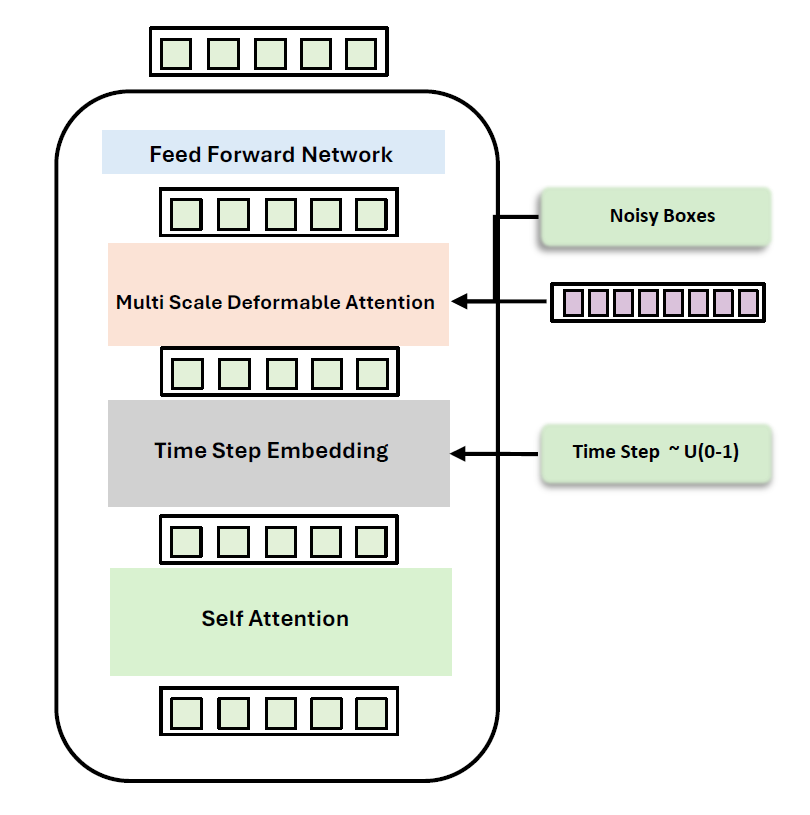
Decoder Architecture — Timestep embeddings are injected after self-attention, followed by multi-scale deformable cross-attention with noisy reference points attending to encoded image features.
How It Works
| Step | Description |
|---|---|
| Feature Extraction | A backbone (ResNet / Swin) + transformer encoder extracts multi-scale image features |
| Forward Diffusion (training) | Ground-truth box coordinates are corrupted with Gaussian noise at a random timestep $t \sim U(0, 100)$ via a cosine noise schedule |
| Reverse Denoising (inference) | Reference points start as pure Gaussian noise and are iteratively denoised using DDIM sampling with only 3 decoder forward passes |
| Timestep Conditioning | The decoder integrates timestep embeddings after self-attention: $q_n = \text{FFN}(\text{MSDA}(\text{SA}(q_{n-1}) + t), r_t, O_{\text{enc}})$ |
📊 Main Results
COCO 2017 val — Object Detection
| Model | Backbone | Epochs | AP | AP₅₀ | AP₇₅ | APₛ | APₘ | APₗ |
|---|---|---|---|---|---|---|---|---|
| Pix2Seq | R50 | 300 | 43.2 | 61.0 | 46.1 | 26.6 | 47.0 | 58.6 |
| DiffusionDet | R50 | — | 46.8 | 65.3 | 51.8 | 29.6 | 49.3 | 62.2 |
| Deformable DETR | R50 | 50 | 48.2 | 67.0 | 52.2 | 30.7 | 51.4 | 63.0 |
| Align-DETR | R50 | 24 | 51.4 | 69.1 | 55.8 | 35.5 | 54.6 | 65.7 |
| DINO | R50 | 36 | 50.9 | 69.0 | 55.3 | 34.6 | 54.1 | 64.6 |
| DiffuDETR (Ours) | R50 | 50 | 50.2 (+2.0) | 66.8 | 55.2 | 33.3 | 53.9 | 65.8 |
| DiffuAlignDETR (Ours) | R50 | 24 | 51.9 (+0.5) | 69.2 | 56.4 | 34.9 | 55.6 | 66.2 |
| DiffuDINO (Ours) | R50 | 50 | 51.9 (+1.0) | 69.4 | 55.7 | 35.8 | 55.7 | 67.1 |
| Pix2Seq | R101 | 300 | 44.5 | 62.8 | 47.5 | 26.0 | 48.2 | 60.3 |
| DiffusionDet | R101 | — | 47.5 | 65.7 | 52.0 | 30.8 | 50.4 | 63.1 |
| Align-DETR | R101 | 12 | 51.2 | 68.8 | 55.7 | 32.9 | 55.1 | 66.6 |
| DINO | R101 | 12 | 50.0 | 67.7 | 54.4 | 32.2 | 53.4 | 64.3 |
| DiffuAlignDETR (Ours) | R101 | 12 | 51.7 (+0.5) | 69.3 | 56.1 | 34.0 | 55.6 | 67.0 |
| DiffuDINO (Ours) | R101 | 12 | 51.2 (+1.2) | 68.6 | 55.8 | 33.2 | 55.6 | 67.2 |
LVIS val — Large Vocabulary Detection
| Model | Backbone | AP | AP₅₀ | APr | APc | APf |
|---|---|---|---|---|---|---|
| DINO | R50 | 26.5 | 35.9 | 9.2 | 24.6 | 36.2 |
| DiffuDINO (Ours) | R50 | 28.9 (+2.4) | 38.5 | 13.7 (+4.5) | 27.6 | 36.9 |
| DINO | R101 | 30.9 | 40.4 | 13.9 | 29.7 | 39.7 |
| DiffuDINO (Ours) | R101 | 32.5 (+1.6) | 42.4 | 13.5 | 32.0 | 41.5 |
V3Det val — Vast Vocabulary Detection (13,204 categories)
| Model | Backbone | AP | AP₅₀ | AP₇₅ |
|---|---|---|---|---|
| DINO | R50 | 33.5 | 37.7 | 35.0 |
| DiffuDINO (Ours) | R50 | 35.7 (+2.2) | 41.4 | 37.7 |
| DINO | Swin-B | 42.0 | 46.8 | 43.9 |
| DiffuDINO (Ours) | Swin-B | 50.3 (+8.3) | 56.6 | 52.9 |
📈 Convergence & Qualitative Results
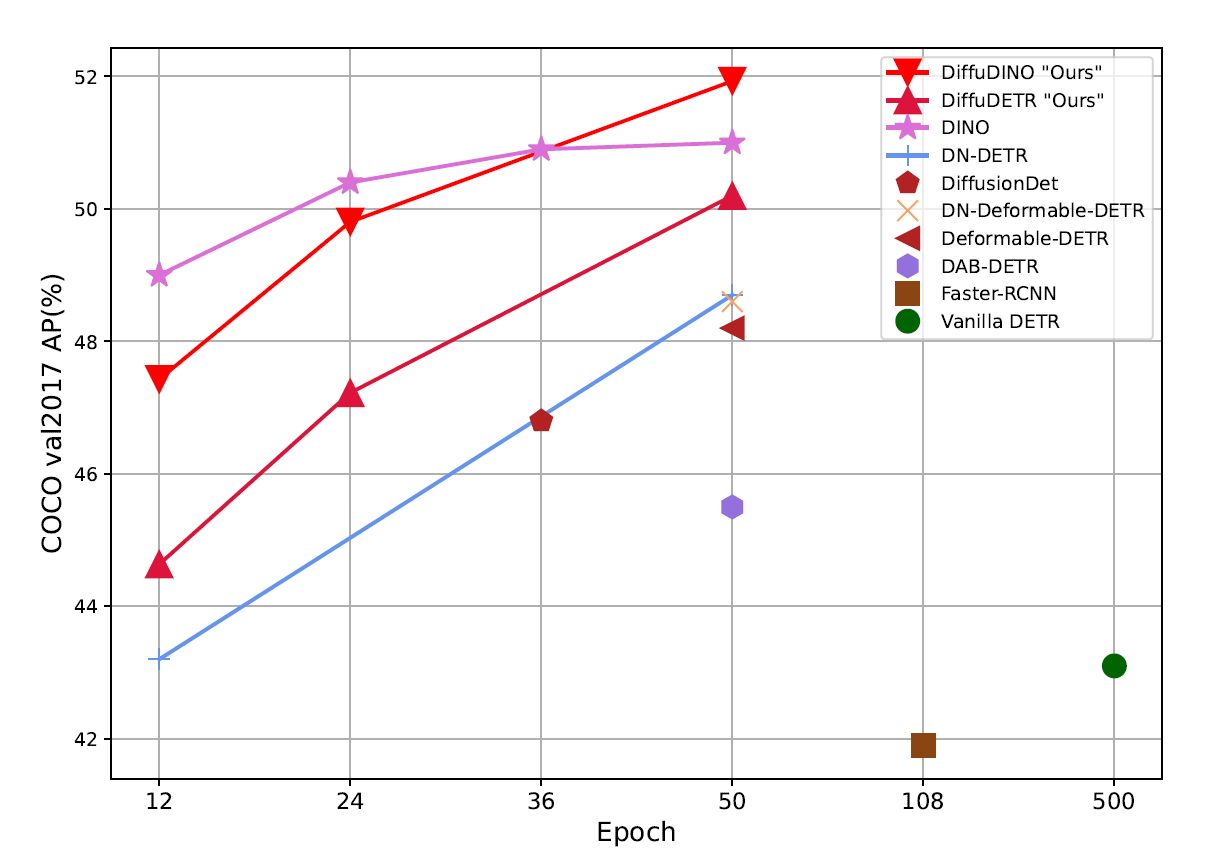
Training Convergence — COCO val2017 AP (%) vs. training epochs. DiffuDINO converges to the highest AP, surpassing all baseline methods.
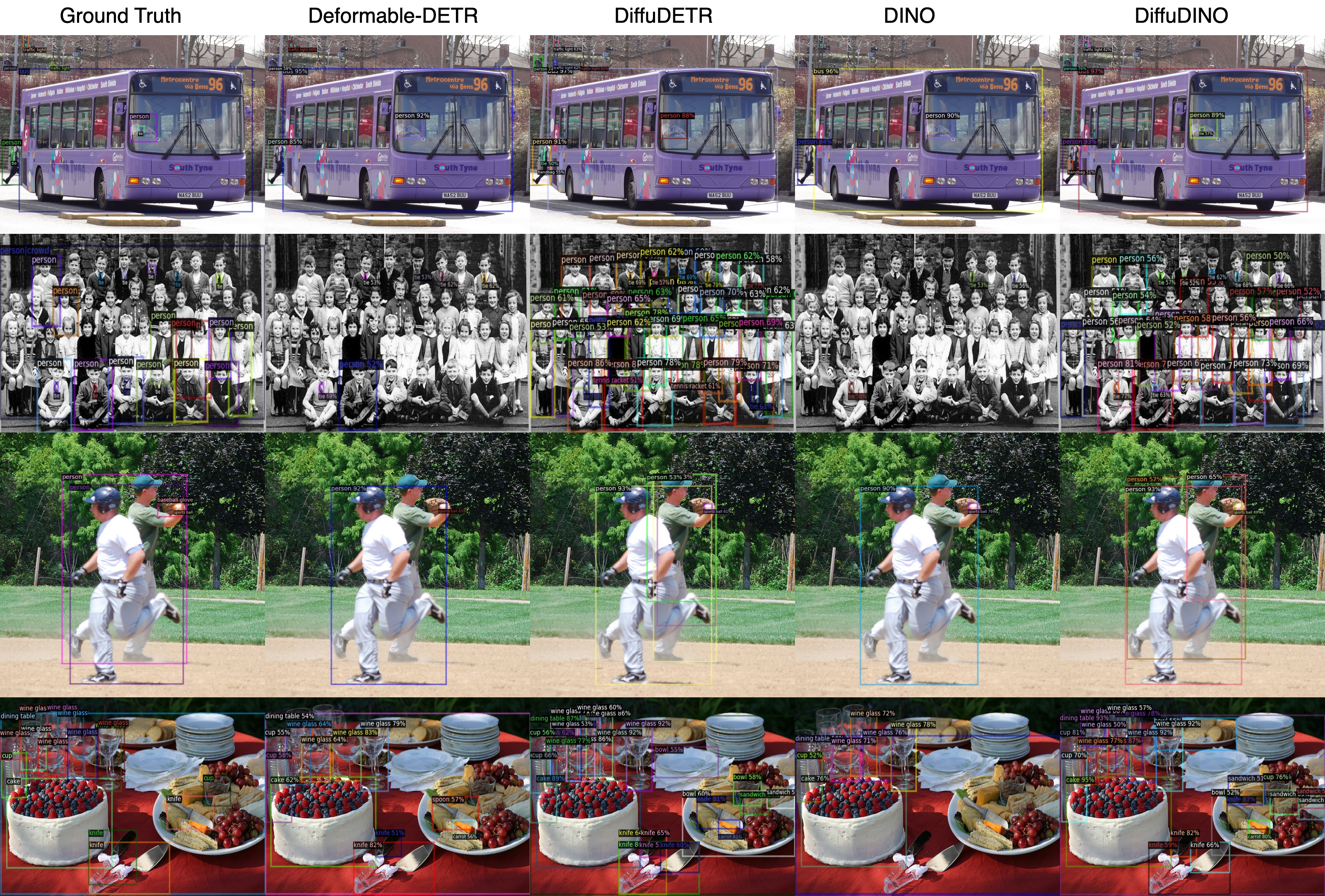
Qualitative Comparison — Deformable DETR vs. DiffuDETR and DINO vs. DiffuDINO on COCO 2017 val. Our models produce more accurate and complete detections, especially in crowded scenes.
🔬 Ablation Studies
All ablations on COCO 2017 val with DiffuDINO (R50 backbone).
| Ablation | Setting | AP |
|---|---|---|
| Noise Distribution | Gaussian (best) | 51.9 |
| Sigmoid | 50.4 | |
| Beta | 49.5 | |
| Noise Scheduler | Cosine (best) | 51.9 |
| Linear | 51.6 | |
| Sqrt | 51.4 | |
| Decoder Evaluations | 1 eval | 51.6 |
| 3 evals (best) | 51.9 | |
| 5 evals | 51.8 | |
| 10 evals | 51.4 | |
| FLOPs | 1 eval → 244.5G | — |
| 3 evals → 285.2G (+17%) | — | |
| 5 evals → 326.0G | — |
🛡️ Multi-Seed Robustness: Across 5 random seeds, standard deviation remains below ±0.2 AP in all settings.
🛠️ Installation
DiffuDETR is built on top of detrex and detectron2. For a complete local setup, see below:
Prerequisites
- Linux with Python ≥ 3.11
- PyTorch ≥ 2.3.1 and corresponding torchvision
- CUDA 12.x
Step-by-Step Setup
# 1. Create and activate conda environment
conda create -n diffudetr python=3.11 -y
conda activate diffudetr

# 2. Install PyTorch
pip install torch==2.3.1 torchvision==0.18.1 torchaudio==2.3.1 --index-url https://download.pytorch.org/whl/cu121

# 3. Clone and install detrex (as a submodule)
git submodule update --init --recursive
cd detrex

# 4. Install detectron2
python -m pip install -e detectron2 --no-build-isolation

# 5. Install detrex
pip install -e . --no-build-isolation
cd ..

# 6. Fix setuptools compatibility
pip uninstall setuptools -y
pip install "setuptools<81"

# 7. Install additional dependencies
pip install pytorch_metric_learning lvis

# 8. Add DiffuDETR to PYTHONPATH
export PYTHONPATH="/path/to/DiffuDETR/:$PYTHONPATH"

# 9. Set dataset path
export DETECTRON2_DATASETS=/path/to/datasets/

---

## 🚀 Usage

Checkpoints downloaded from this Hugging Face repository can be used dynamically using your configured path `/path/to/checkpoint.pth`.

### Evaluation

```bash
python /path/to/detrex/tools/train_net.py \
    --num-gpus 2 \
    --eval-only \
    --config-file projects/diffu_dino/configs/dino-resnet/coco-r50-4scales-50ep.py \
    train.init_checkpoint=/path/to/checkpoint.pth
Training
# DiffuDINO with ResNet-50 on COCO
python /path/to/detrex/tools/train_net.py \
    --num-gpus 2 \
    --config-file projects/diffu_dino/configs/dino-resnet/coco-r50-4scales-50ep.py

# DiffuDINO with ResNet-101 on COCO
python /path/to/detrex/tools/train_net.py \
    --num-gpus 2 \
    --config-file projects/diffu_dino/configs/dino-resnet/coco-r101-4scales-12ep.py

# DiffuDINO on V3Det
python /path/to/detrex/tools/train_net.py \
    --num-gpus 2 \
    --config-file projects/diffu_dino/configs/dino-resnet/v3det-r50-4scales-24ep.py

# DiffuAlignDETR on COCO
python /path/to/detrex/tools/train_net.py \
    --num-gpus 2 \
    --config-file projects/diffu_align_detr/configs/coco-r50-4scales-24ep.py
📝 Citation
If you find DiffuDETR useful in your research, please consider citing our paper:
@inproceedings{nawar2026diffudetr,
  title     = {DiffuDETR: Rethinking Detection Transformers with Denoising Diffusion Process},
  author    = {Nawar, Youssef and Badran, Mohamed and Torki, Marwan},
  booktitle = {International Conference on Learning Representations (ICLR)},
  year      = {2026}
}
🙏 Acknowledgements
This project is built upon the following open-source works:
- detrex — Benchmarking Detection Transformers
- detectron2 — Facebook AI Research's detection library
- DINO — DETR with Improved DeNoising Anchor Boxes
- AlignDETR — Improving DETR with IoU-Aware BCE Loss
- DiffusionDet — Diffusion Model for Object Detection
📄 License
This project is released under the Apache 2.0 License.