

MedMLX
Collection
Medical imaging models in native MLX on Apple Silicon. Paper: doi.org/10.64898/2026.10.28.26366762 • 23 items • Updated

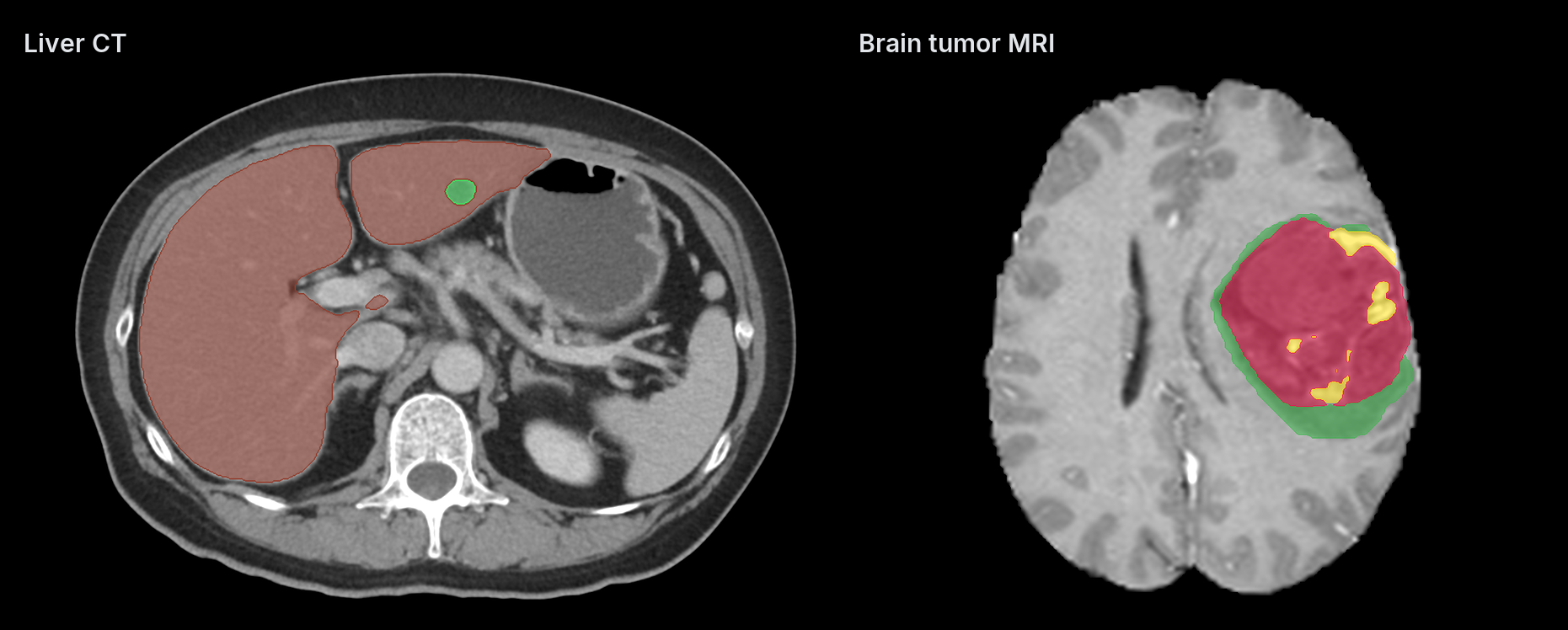
Segment brain tumor regions from four MRI sequences with the nnU-Net BraTS checkpoint.
| Input | Output |
|---|---|
| T1, T1ce, T2 + FLAIR · NIfTI | Brain tumor segmentation |
Apple Silicon · Metal · Python 3.13
uv venv --python 3.13
source .venv/bin/activate

uv pip install "nnunet-mlx>=0.6.4"
uv tool install huggingface-hub

hf download MedMLX/nnunet-brats-mlx --revision 7632a1f3c74d350eb6f2daeb35b43b75ef7601bd --local-dir models
Replace the example input paths with your own files.
from nnunet_mlx.medmlx import run

result = run(
    weights_path='models',
    image_paths=['T1w.nii.gz', 'T1gd.nii.gz', 'T2w.nii.gz', 'FLAIR.nii.gz'],
    output_dir='outputs',
)
print(result["outputs"])
Keep all four MRI volumes on the same voxel grid, in the order shown.
See the project README for package installation and current documentation.
For research and education. Not validated for clinical use.
If you use MedMLX, please cite the MedMLX paper:
@article{sandoval2026medmlx,
  title   = {MedMLX: On-Device Medical Imaging AI for Apple Silicon},
  author  = {Sandoval, A. and Sandoval, J. and Saleem, A.},
  journal = {medRxiv},
  year    = {2026},
  doi     = {10.64898/2026.10.28.26366762}
}
Quantized