

tags:
  - image-classification
  - auto-train
  - vision
widget:
  - src: >-
      https://huggingface.co/datasets/mishig/sample_images/resolve/main/tiger.jpg
    example_title: Tiger
  - src: >-
      https://huggingface.co/datasets/mishig/sample_images/resolve/main/teapot.jpg
    example_title: Teapot
  - src: >-
      https://huggingface.co/datasets/mishig/sample_images/resolve/main/palace.jpg
    example_title: Palace
datasets:
  - Falah/Blood_8_classes_Dataset
license: apache-2.0
pipeline_tag: image-classification
ResNet-50 v1.5
ResNet model pre-trained on ImageNet-1k at resolution 224x224. It was introduced in the paper Deep Residual Learning for Image Recognition by He et al.
Disclaimer: The team releasing ResNet did not write a model card for this model so this model card has been written by the Hugging Face team.
Model description
ResNet (Residual Network) is a convolutional neural network that democratized the concepts of residual learning and skip connections. This enables to train much deeper models.
This is ResNet v1.5, which differs from the original model: in the bottleneck blocks which require downsampling, v1 has stride = 2 in the first 1x1 convolution, whereas v1.5 has stride = 2 in the 3x3 convolution. This difference makes ResNet50 v1.5 slightly more accurate (~0.5% top1) than v1, but comes with a small performance drawback (~5% imgs/sec) according to Nvidia.
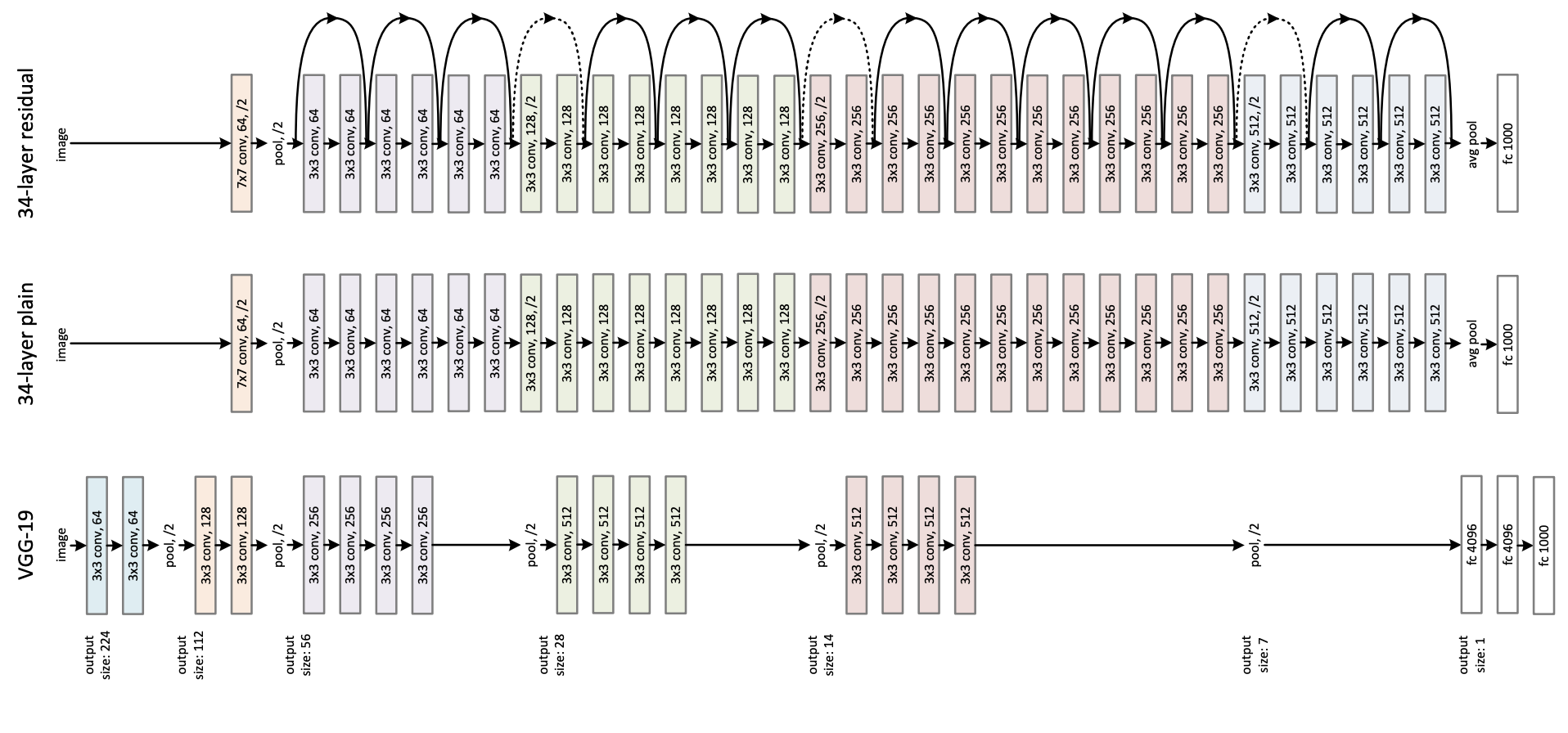
Validation Metrics
No validation metrics available
How to use
Here is how to use this model to classify an image of :
from transformers import AutoImageProcessor, ResNetForImageClassification
import torch
from datasets import load_dataset

dataset = load_dataset("huggingface/cats-image")
image = dataset["test"]["image"][0]

processor = AutoImageProcessor.from_pretrained("microsoft/resnet-50")
model = ResNetForImageClassification.from_pretrained("microsoft/resnet-50")

inputs = processor(image, return_tensors="pt")

with torch.no_grad():
    logits = model(**inputs).logits

# model predicts one of the 1000 ImageNet classes
predicted_label = logits.argmax(-1).item()
print(model.config.id2label[predicted_label])