Qwen3-Coder-480B-A35B-Instruct Model NVFP4 Quantized
Qwen3‑Coder‑480B‑A35B‑Instruct Model Comparison Full vs NVFP4
Test Configuration
| Parameter |
Setting |
| Full‑Precision Model |
DGX-B300 / 4 GPU |
| NVFP4 Quantized Model |
DGX-B300 / 4 GPU |
| Inference Engine |
TRT‑LLM (TensorRT‑LLM) |
| Tested Concurrency Levels |
1, 2, 4, 8, 16, 32 |
| Prompt Length |
≈ 128 tokens (64 different prompts) |
| Maximum Response Length |
128 tokens |
Performance Metrics Comparison
1. Time to First Token (TTFT) – milliseconds
| Full Model |
NVFP Model |
 |
 |
| Concurrency |
Full Model |
NVFP4 Model |
Δ (ms) |
Performance Loss |
| 1 |
73.46 |
92.56 |
+19.10 |
+26.0 % |
| 2 |
136.82 |
173.48 |
+36.66 |
+26.8 % |
| 4 |
130.01 |
163.84 |
+33.83 |
+26.0 % |
| 8 |
136.87 |
177.42 |
+40.55 |
+29.6 % |
| 16 |
163.07 |
174.25 |
+11.18 |
+6.9 % |
| 32 |
134.69 |
169.11 |
+34.42 |
+25.6 % |
TTFT Analysis
- The NVFP4 model shows an average +26.5 % higher TTFT across all concurrency levels.
- The greatest performance degradation occurs at concurrency 8 (+29.6 %).
- The smallest degradation is at concurrency 16 (+6.9 %).
2. Inter‑Token Latency (ITL) – milliseconds
| Full Model |
NVFP Model |
 |
 |
| Concurrency |
Full Model |
NVFP4 Model |
Δ (ms) |
Performance Loss |
| 1 |
8.31 |
8.99 |
+0.68 |
+8.2 % |
| 2 |
9.92 |
10.01 |
+0.09 |
+0.9 % |
| 4 |
12.11 |
11.52 |
–0.59 |
–4.9 % |
| 8 |
14.99 |
13.66 |
–1.33 |
–8.9 % |
| 16 |
18.42 |
15.68 |
–2.74 |
–14.9 % |
| 32 |
22.12 |
18.03 |
–4.09 |
–18.5 % |
ITL Analysis
- At low concurrency (1‑2) the NVFP4 model is slightly slower.
- From medium to high concurrency (8‑32) the NVFP4 model outperforms the full‑precision model, achieving up to ‑18.5 % lower latency at concurrency 32.
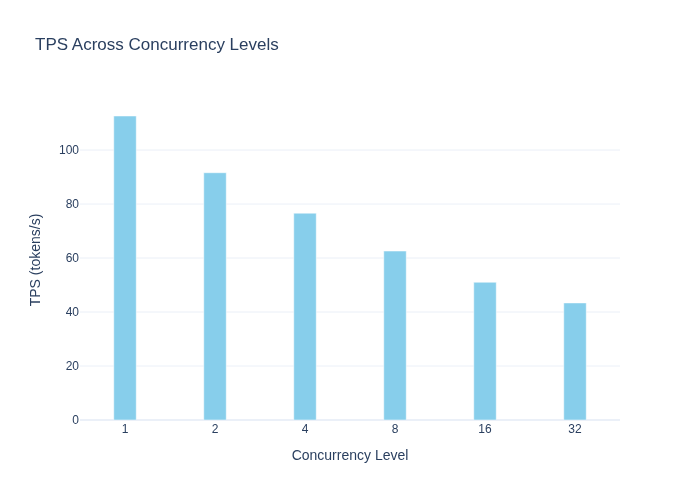
3. Tokens Per Second (TPS) – tokens / s
| Full Model |
NVFP Model |
 |
 |
| Concurrency |
Full Model |
NVFP4 Model |
Δ (tokens/s) |
Performance Change |
| 1 |
112.61 |
103.54 |
–9.07 |
–8.1 % |
| 2 |
91.60 |
88.53 |
–3.07 |
–3.3 % |
| 4 |
76.61 |
78.11 |
+1.50 |
+2.0 % |
| 8 |
62.58 |
66.77 |
+4.19 |
+6.7 % |
| 16 |
51.03 |
58.03 |
+7.00 |
+13.7 % |
| 32 |
43.37 |
51.75 |
+8.38 |
+19.3 % |
TPS Analysis
- The full‑precision model is faster at low concurrency (1‑2).
- From concurrency 4 upward, the NVFP4 model yields higher throughput, reaching +19.3 % at concurrency 32.
4. Total Latency – seconds
| Full Model |
NVFP Model |
 |
 |
| Concurrency |
Full Model |
NVFP4 Model |
Δ (s) |
Performance Change |
| 1 |
1.12 |
1.23 |
+0.11 |
+9.8 % |
| 2 |
1.40 |
1.45 |
+0.05 |
+3.6 % |
| 4 |
1.66 |
1.61 |
–0.05 |
–3.0 % |
| 8 |
2.03 |
1.90 |
–0.13 |
–6.4 % |
| 16 |
2.49 |
2.15 |
–0.34 |
–13.7 % |
| 32 |
2.94 |
2.43 |
–0.51 |
–17.3 % |
Latency Analysis
- Full‑precision model is better at low concurrency.
- NVFP4 model becomes superior as concurrency increases.
5. Throughput (RPS) – requests / s
| Full Model |
NVFP Model |
 |
 |
| Concurrency |
Full Model |
NVFP4 Model |
Δ (RPS) |
Performance Change |
| 1 |
0.90 |
0.81 |
–0.09 |
–10.0 % |
| 2 |
0.72 |
0.69 |
–0.03 |
–4.2 % |
| 4 |
0.60 |
0.62 |
+0.02 |
+3.3 % |
| 8 |
0.49 |
0.53 |
+0.04 |
+8.2 % |
| 16 |
0.40 |
0.46 |
+0.06 |
+15.0 % |
| 32 |
0.34 |
0.41 |
+0.07 |
+20.6 % |
Throughput Analysis
- Full‑precision model wins at very low concurrency.
- NVFP4 model surpasses it from concurrency 4 onward, achieving +20.6 % at concurrency 32.