

GLM-4.7
Collection
3 items • Updated
NVFP4 (W4A4) quantized version of trohrbaugh/GLM-4.7-heretic — a decensored zai-org/GLM-4.7, made using Heretic v1.2.0+custom.
Requires NVIDIA Blackwell GPUs (B200, GB200, RTX 5090, RTX PRO 6000 Blackwell). Hopper/Ampere GPUs do not have native FP4 tensor cores. See the FP8 version for broader GPU compatibility.
| Parameter | Value |
|---|---|
| direction_index | per layer |
| attn.o_proj.max_weight | 1.84 |
| attn.o_proj.max_weight_position | 49.16 |
| attn.o_proj.min_weight | 1.64 |
| attn.o_proj.min_weight_distance | 26.42 |
| mlp.down_proj.max_weight | 1.02 |
| mlp.down_proj.max_weight_position | 53.46 |
| mlp.down_proj.min_weight | 0.97 |
| mlp.down_proj.min_weight_distance | 45.98 |
| Metric | This model | Original model (zai-org/GLM-4.7) |
|---|---|---|
| KL divergence | 0.0748 | 0 (by definition) |
| Refusals | 0/100 | 99/100 |
Quantized using llm-compressor (v0.10.1-dev, main branch) to produce a compressed-tensors format checkpoint natively supported by vLLM — no --quantization flag or patches needed.
Earlier versions of this model were quantized with NVIDIA ModelOpt, which produced a modelopt_fp4 format checkpoint. This caused multiple issues with vLLM:
k_scale/v_scale KeyError due to missing name remapping in vLLM's GLM-4 MoE weight loaderglm4_moe.pyThe compressed-tensors format produced by llm-compressor avoids all of these issues and loads natively in vLLM without any modifications.
compressed-tensors (auto-detected by vLLM)| Component | Precision | Rationale |
|---|---|---|
| Routed expert weights (160 experts × 89 MoE layers) | NVFP4 E2M1 | Bulk of model — two-level scaling via calibration |
| Attention projections (q/k/v/o) | NVFP4 E2M1 | GQA with 96Q / 8KV heads, head_dim=128 |
| Shared expert weights | NVFP4 E2M1 | Active every token, well-calibrated |
| Dense MLP (layers 0–2) | NVFP4 E2M1 | Only 3 dense layers |
| Attention biases (q/k/v) | BF16 | Small tensors, sensitive to precision loss |
| Router/gate weights | BF16 | Routing errors cascade through all downstream computation |
| MoE e_score_correction_bias | BF16 | Critical for expert load balancing |
| RMSNorm / QK norms | BF16 | Negligible size, high sensitivity |
| Embeddings / LM head | BF16 | Standard practice for quantized models |
| MTP head (layer 92: enorm, hnorm, eh_proj) | BF16 | Speculative decoding head, kept full precision |
IGNORE_PATTERNS = [
    "re:.*embed_tokens.*",
    "lm_head",
    "re:.*layernorm.*",
    "re:.*q_norm.*",
    "re:.*k_norm.*",
    "model.norm",
    "re:.*self_attn\\.q_proj\\.bias",
    "re:.*self_attn\\.k_proj\\.bias",
    "re:.*self_attn\\.v_proj\\.bias",
    "re:.*mlp\\.gate$",
    "re:.*mlp\\.gate\\.weight",
    "re:.*mlp\\.gate\\.e_score_correction_bias",
    "re:.*\\.enorm",
    "re:.*\\.hnorm",
    "re:.*\\.eh_proj",
    "re:.*shared_head\\.norm",
]
vLLM auto-detects the compressed-tensors NVFP4 format from config.json. No --quantization flag required.
vllm serve trohrbaugh/GLM-4.7-heretic-NVFP4 \
    --tensor-parallel-size 4 \
    --max-model-len 131072 \
    --tool-call-parser glm47 \
    --reasoning-parser glm45 \
    --enable-auto-tool-choice
To disable thinking mode (shorter, faster responses):
vllm serve trohrbaugh/GLM-4.7-heretic-NVFP4 \
    --tensor-parallel-size 4 \
    --max-model-len 131072 \
    --tool-call-parser glm47 \
    --reasoning-parser glm45 \
    --enable-auto-tool-choice \
    --default-chat-template-kwargs '{"enable_thinking": false}'
Or disable per-request:
{
  "model": "trohrbaugh/GLM-4.7-heretic-NVFP4",
  "messages": [{"role": "user", "content": "Hello"}],
  "chat_template_kwargs": {"enable_thinking": false}
}
| Configuration | Approx. VRAM | Example hardware |
|---|---|---|
| TP=4 | ~200 GB | 4× RTX PRO 6000 96GB (Blackwell) |
| TP=2 | ~200 GB | 2× B200 192GB |
Note: NVFP4 requires Blackwell FP4 tensor cores (SM100+). This model will not run on Hopper (H100/A100) or earlier GPUs. Use the FP8 version for those GPUs.
| Variant | Size | Format | GPU requirement | Link |
|---|---|---|---|---|
| BF16 (full precision) | ~706 GB | safetensors | Any | trohrbaugh/GLM-4.7-heretic |
| FP8 W8A8 | ~362 GB | compressed-tensors | Hopper+ | trohrbaugh/GLM-4.7-heretic-fp8 |
| NVFP4 W4A4 (this model) | ~200 GB | compressed-tensors | Blackwell only | trohrbaugh/GLM-4.7-heretic-NVFP4 |

👋 Join our Discord community.
📖 Check out the GLM-4.7 technical blog, technical report(GLM-4.5).
📍 Use GLM-4.7 API services on Z.ai API Platform.
👉 One click to GLM-4.7.
GLM-4.7, your new coding partner, is coming with the following features:
You can also see significant improvements in many other scenarios such as chat, creative writing, and role-play scenario.
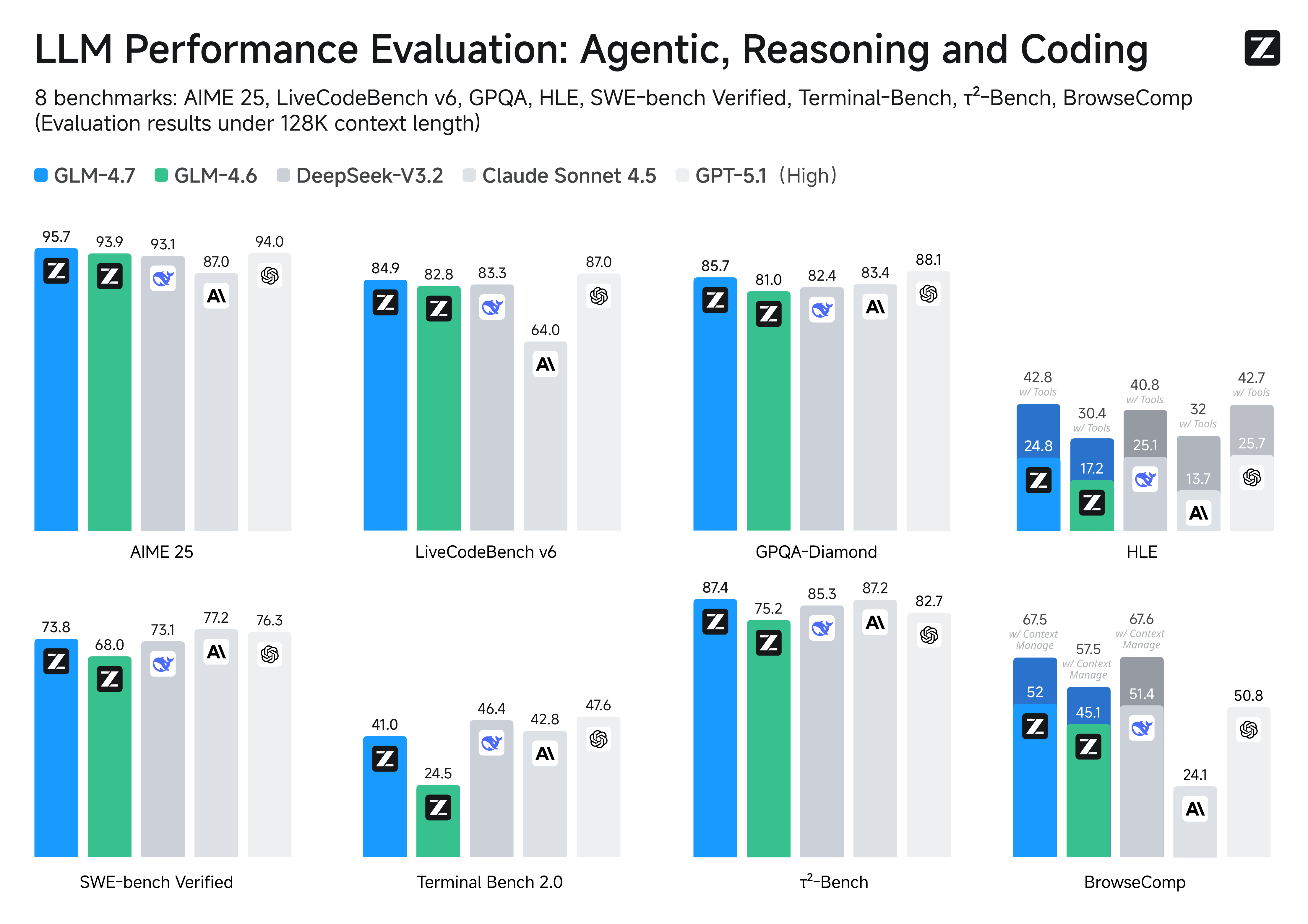
Performances on Benchmarks. More detailed comparisons of GLM-4.7 with other models GPT-5-High, GPT-5.1-High, Claude Sonnet 4.5, Gemini 3.0 Pro, DeepSeek-V3.2, Kimi K2 Thinking, on 17 benchmarks (including 8 reasoning, 5 coding, and 3 agents benchmarks) can be seen in the below table.
| Benchmark | GLM-4.7 | GLM-4.6 | Kimi K2 Thinking | DeepSeek-V3.2 | Gemini 3.0 Pro | Claude Sonnet 4.5 | GPT-5-High | GPT-5.1-High |
|---|---|---|---|---|---|---|---|---|
| MMLU-Pro | 84.3 | 83.2 | 84.6 | 85.0 | 90.1 | 88.2 | 87.5 | 87.0 |
| GPQA-Diamond | 85.7 | 81.0 | 84.5 | 82.4 | 91.9 | 83.4 | 85.7 | 88.1 |
| HLE | 24.8 | 17.2 | 23.9 | 25.1 | 37.5 | 13.7 | 26.3 | 25.7 |
| HLE (w/ Tools) | 42.8 | 30.4 | 44.9 | 40.8 | 45.8 | 32.0 | 35.2 | 42.7 |
| AIME 2025 | 95.7 | 93.9 | 94.5 | 93.1 | 95.0 | 87.0 | 94.6 | 94.0 |
| HMMT Feb. 2025 | 97.1 | 89.2 | 89.4 | 92.5 | 97.5 | 79.2 | 88.3 | 96.3 |
| HMMT Nov. 2025 | 93.5 | 87.7 | 89.2 | 90.2 | 93.3 | 81.7 | 89.2 | - |
| IMOAnswerBench | 82.0 | 73.5 | 78.6 | 78.3 | 83.3 | 65.8 | 76.0 | - |
| LiveCodeBench-v6 | 84.9 | 82.8 | 83.1 | 83.3 | 90.7 | 64.0 | 87.0 | 87.0 |
| SWE-bench Verified | 73.8 | 68.0 | 71.3 | 73.1 | 76.2 | 77.2 | 74.9 | 76.3 |
| SWE-bench Multilingual | 66.7 | 53.8 | 61.1 | 70.2 | - | 68.0 | 55.3 | - |
| Terminal Bench Hard | 33.3 | 23.6 | 30.6 | 35.4 | 39.0 | 33.3 | 30.5 | 43.0 |
| Terminal Bench 2.0 | 41.0 | 24.5 | 35.7 | 46.4 | 54.2 | 42.8 | 35.2 | 47.6 |
| BrowseComp | 52.0 | 45.1 | - | 51.4 | - | 24.1 | 54.9 | 50.8 |
| BrowseComp (w/ Context Manage) | 67.5 | 57.5 | 60.2 | 67.6 | 59.2 | - | - | - |
| BrowseComp-Zh | 66.6 | 49.5 | 62.3 | 65.0 | - | 42.4 | 63.0 | - |
| τ²-Bench | 87.4 | 75.2 | 74.3 | 85.3 | 90.7 | 87.2 | 82.4 | 82.7 |
Coding: AGI is a long journey, and benchmarks are only one way to evaluate performance. While the metrics provide necessary checkpoints, the most important thing is still how it feels. True intelligence isn't just about acing a test or processing data faster; ultimately, the success of AGI will be measured by how seamlessly it integrates into our lives-"coding" this time.
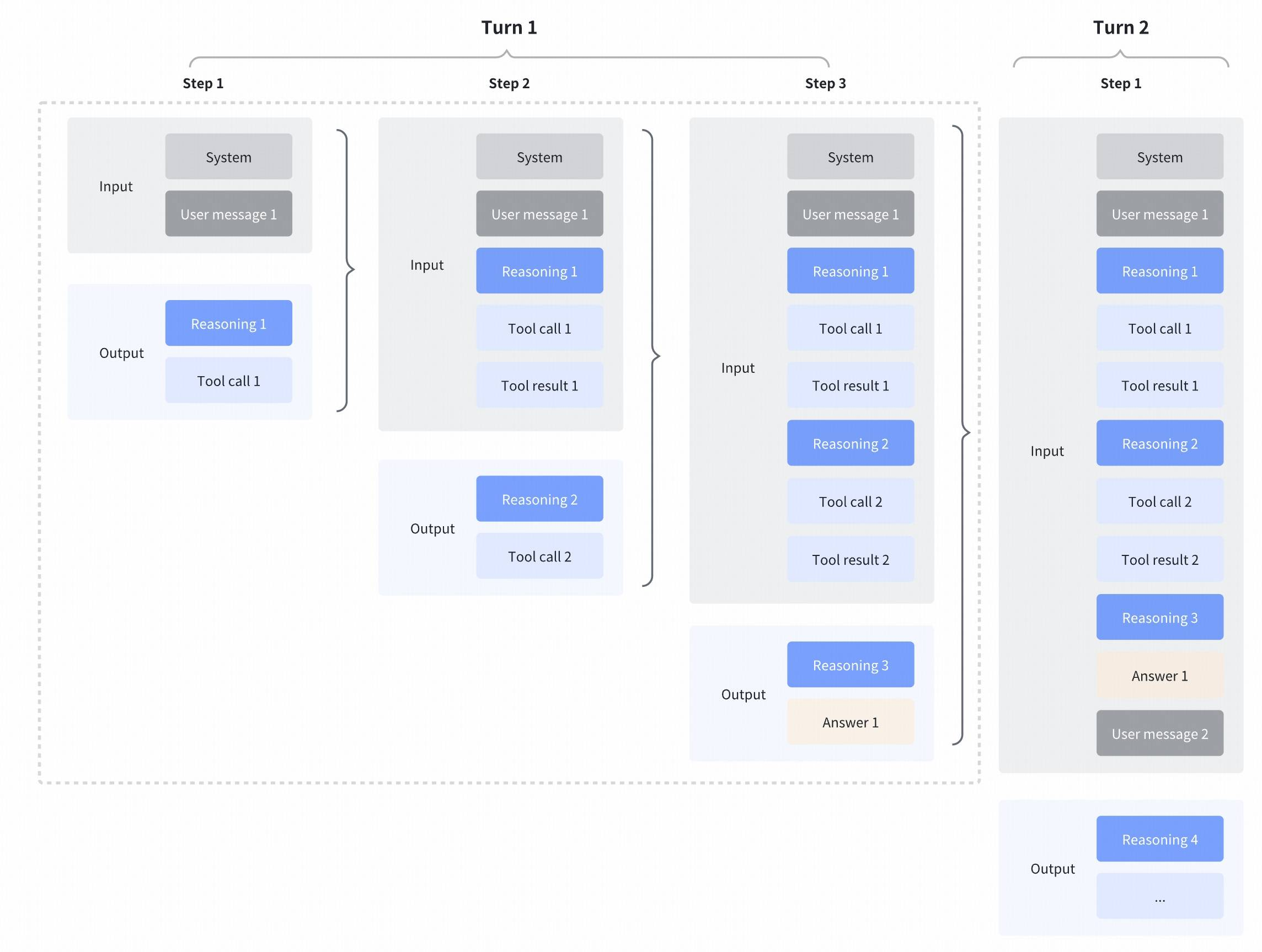
GLM-4.7 further enhances Interleaved Thinking (a feature introduced since GLM-4.5) and introduces Preserved Thinking and Turn-level Thinking. By thinking between actions and staying consistent across turns, it makes complex tasks more stable and more controllable:
More details: https://docs.z.ai/guides/capabilities/thinking-mode
Default Settings (Most Tasks)
1.00.95131072For multi-turn agentic tasks (τ²-Bench and Terminal Bench 2), please turn on Preserved Thinking mode.
Terminal Bench, SWE Bench Verified
0.71.016384τ^2-Bench
016384For τ^2-Bench evaluation, we added an additional prompt to the Retail and Telecom user interaction to avoid failure modes caused by users ending the interaction incorrectly. For the Airline domain, we applied the domain fixes as proposed in the Claude Opus 4.5 release report.
For local deployment, GLM-4.7 supports inference frameworks including vLLM and SGLang. Comprehensive deployment instructions are available in the official Github repository.
vLLM and SGLang only support GLM-4.7 on their main branches. You can use their official docker images for inference.
Using Docker:
docker pull vllm/vllm-openai:nightly
or using pip (must use pypi.org as the index url):
pip install -U vllm --pre --index-url https://pypi.org/simple --extra-index-url https://wheels.vllm.ai/nightly
Using Docker:
docker pull lmsysorg/sglang:dev
or using pip install sglang from source.
For agentic tasks of GLM-4.7, please turn on Preserved Thinking mode by adding the following config (only sglang support):
"chat_template_kwargs": {
    "enable_thinking": true,
    "clear_thinking": false
}
When using vLLM and SGLang, thinking mode is enabled by default when sending requests. If you want to disable the thinking switch, you need to add the "chat_template_kwargs": {"enable_thinking": false} parameter.
Both support tool calling. Please use OpenAI-style tool description format for calls.
@misc{5team2025glm45agenticreasoningcoding,
      title={GLM-4.5: Agentic, Reasoning, and Coding (ARC) Foundation Models},
      author={GLM Team and Aohan Zeng and Xin Lv and others},
      year={2025},
      eprint={2508.06471},
      archivePrefix={arXiv},
      primaryClass={cs.CL},
      url={https://arxiv.org/abs/2508.06471},
}
Base model
zai-org/GLM-4.7