


| # ChineseBERT-base | |
| This repository contains code, model, dataset for **ChineseBERT** at ACL2021. | |
| paper: | |
| **[ChineseBERT: Chinese Pretraining Enhanced by Glyph and Pinyin Information](https://arxiv.org/abs/2106.16038)** | |
| *Zijun Sun, Xiaoya Li, Xiaofei Sun, Yuxian Meng, Xiang Ao, Qing He, Fei Wu and Jiwei Li* | |
| code: | |
| [ChineseBERT github link](https://github.com/ShannonAI/ChineseBert) | |
| ## Model description | |
| We propose ChineseBERT, which incorporates both the glyph and pinyin information of Chinese | |
| characters into language model pretraining. | |
| First, for each Chinese character, we get three kind of embedding. | |
| - **Char Embedding:** the same as origin BERT token embedding. | |
| - **Glyph Embedding:** capture visual features based on different fonts of a Chinese character. | |
| - **Pinyin Embedding:** capture phonetic feature from the pinyin sequence ot a Chinese Character. | |
| Then, char embedding, glyph embedding and pinyin embedding | |
| are first concatenated, and mapped to a D-dimensional embedding through a fully | |
| connected layer to form the fusion embedding. | |
| Finally, the fusion embedding is added with the position embedding, which is fed as input to the BERT model. | |
| The following image shows an overview architecture of ChineseBERT model. | |
| 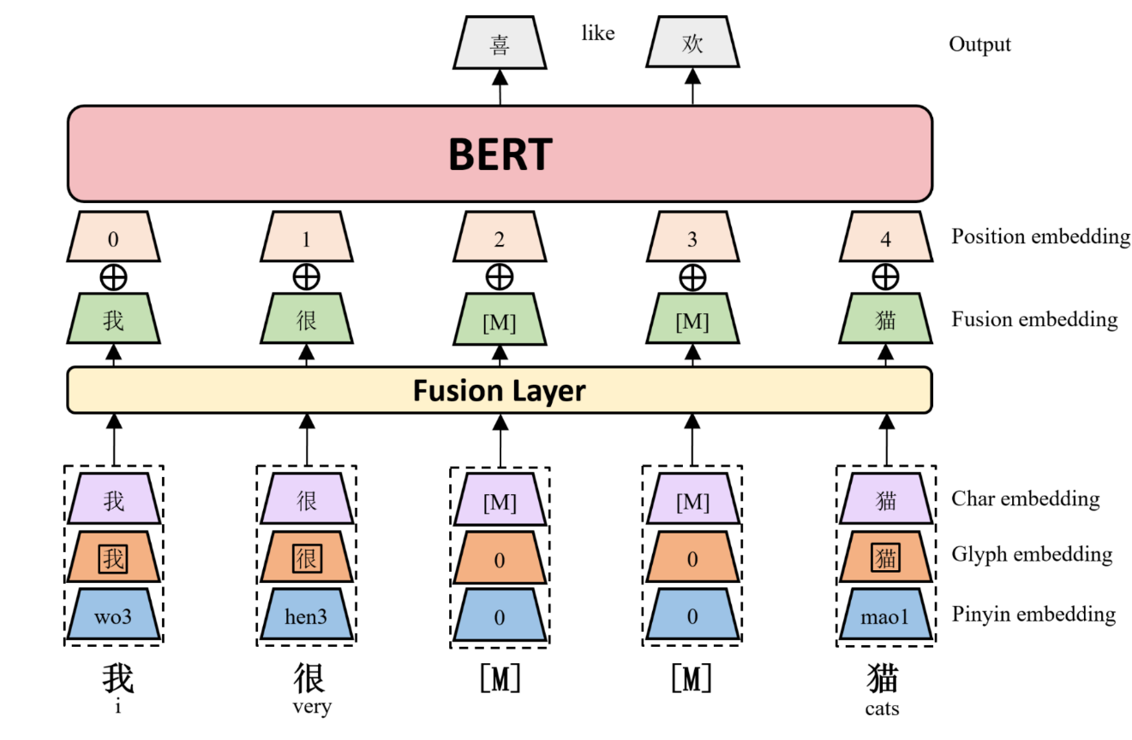 | |
| ChineseBERT leverages the glyph and pinyin information of Chinese | |
| characters to enhance the model's ability of capturing | |
| context semantics from surface character forms and | |
| disambiguating polyphonic characters in Chinese. |