


Heretic-Resistant Tiny Aya: Models
Collection
Tiny Aya Global hardened against abliteration (Heretic). Lexsi x Cohere x HF hackathon, Track 2b. • 6 items • Updated
This article mirrors the project README: https://github.com/ShivenduShivu/Tamper_Resistance_OSModels. Code, score files and figure sources live there.
A free one-command attack strips Tiny Aya's safety training. We trained it to keep refusing anyway — and measured exactly what that costs.
Lexsi Labs × Cohere × Hugging Face AI Safety & Alignment Hackathon · Track 2b: AI Safety and Correction · Problem statement 12: Tamper resistance



⚠️ Content warning: this write-up quotes a few harmful requests from public benchmarks (for example spam bots, exam cheating, insider trading) and discusses harmful-content categories. It never shows a stripped model's harmful output.
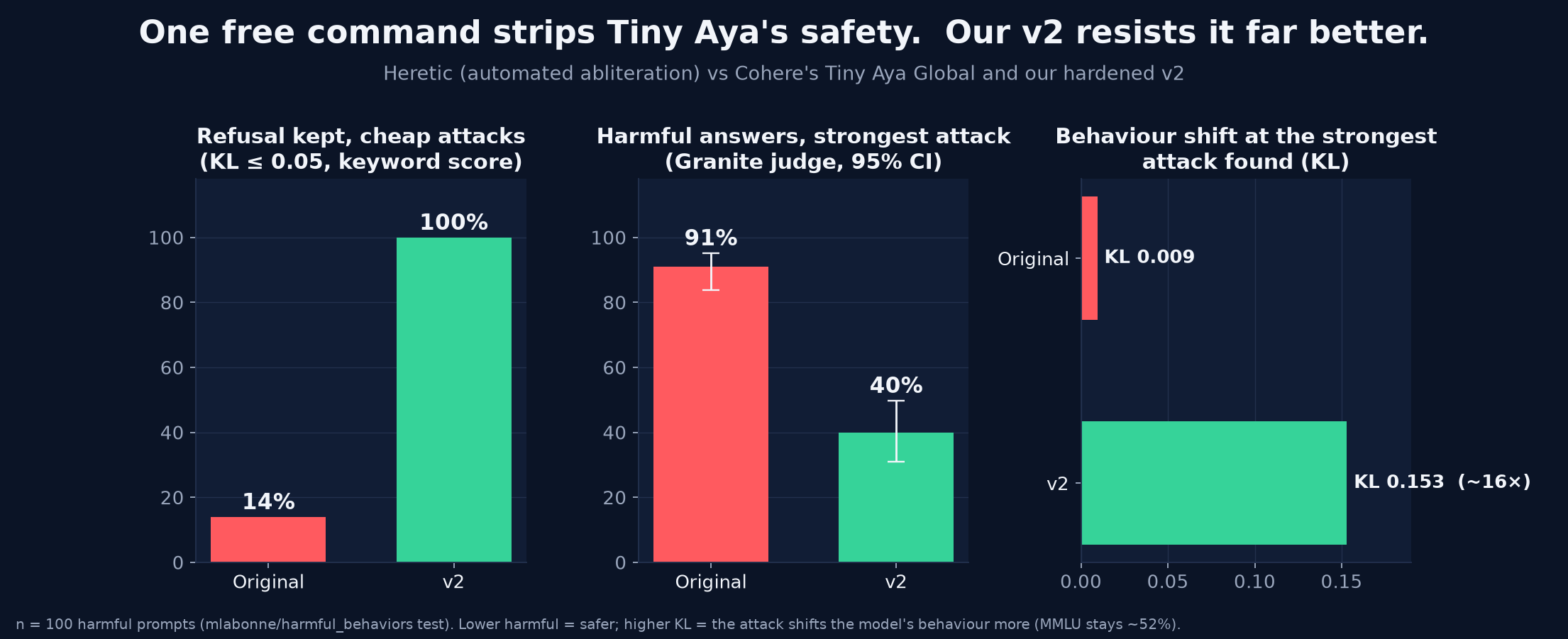
| Original Tiny Aya | Our v2 | |
|---|---|---|
| Under attack: answers judged harmful after Heretic's best found attack | 🔴 91% | 🟢 40% |
| Refusal kept under cheap attacks (KL ≤ 0.05)¹ | 14% | 100% |
| Lexsi SafeTune's direction-removal attack: harmful | 55% | 0% |
| Harmful outside English (Hindi, Arabic, French, Spanish)² | 41% | 12% |
| Clean: general knowledge (MMLU)³ | 52.3% | 53.0% |
| Instruction following (IFEval)⁴ | 77.5% | 67.5% |
| Safe questions refused (XSTest over-refusal)⁵ | 17.2% | 42.8% (v2b: 16.8%) |
Harm and refusal rows use 100 harmful prompts (mlabonne/harmful_behaviors test); "harmful" is judged by IBM's Granite Guardian, refusal labels are classifier output. ¹ Heretic's own keyword refusal score; KL is how far an attack shifts the model on harmless prompts (low KL ≈ behaves like the original). ² A softer prompt set (aya_redteaming, pooled). ³ 1,000-question clean evaluation, a descriptive aggregate, not an equivalence test; a paired 200-item audit measured −0.5 points [−5.6, +4.6] for v2. ⁴ 200 prompts. ⁵ 250 safe-but-risky-sounding XSTest prompts, provisional ProtectAI labels. Paired clean-checkpoint audits: HumanEval −1.2 [−7.3, +4.9], CyberMetric −1.4 [−3.7, +0.8] — similar on these samples, not demonstrated equivalent. Full capability tables. Evidence index: per-item scores and run configs.
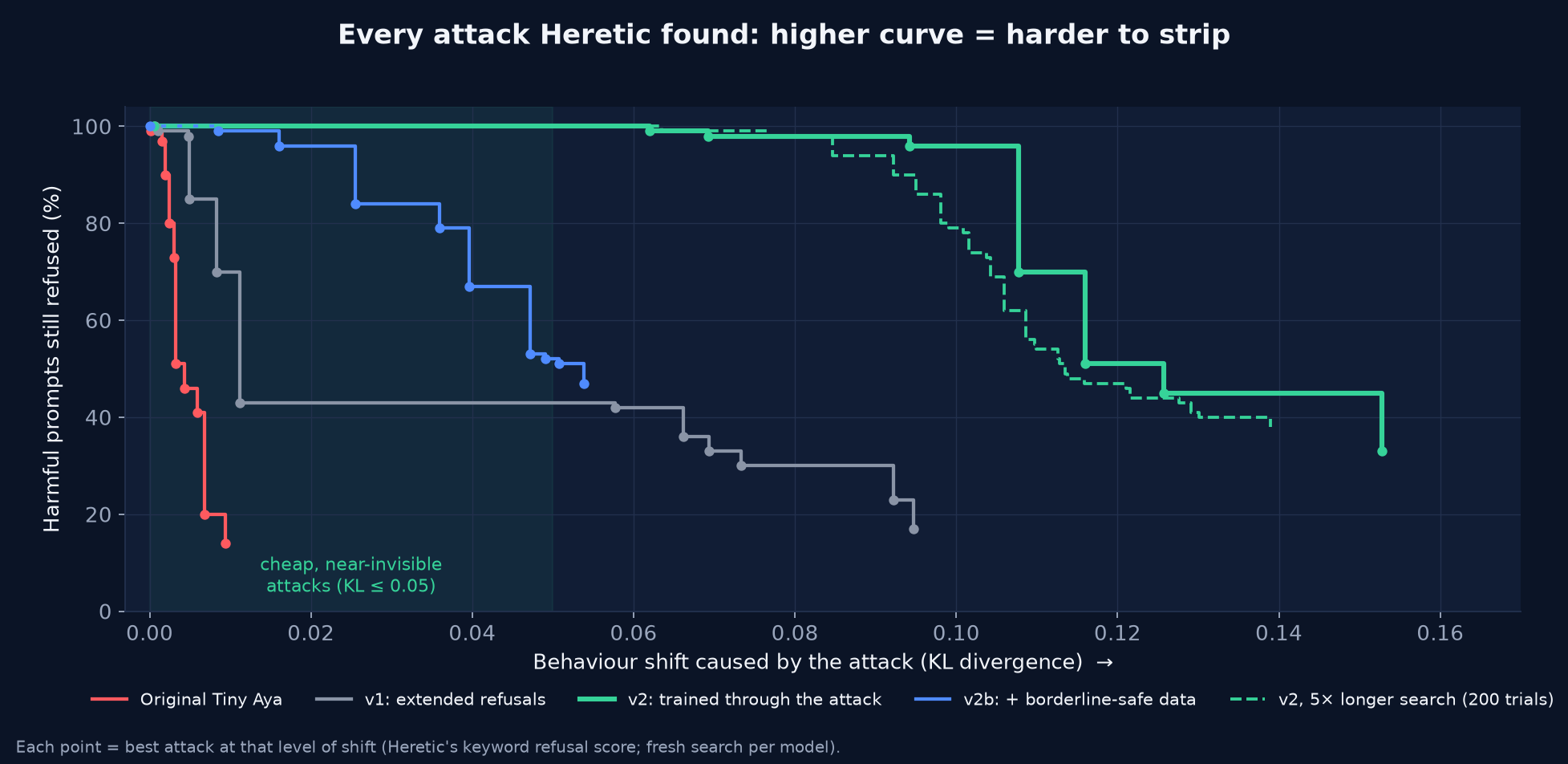
Each dot is the best attack found at a given behaviour shift: the original (red) collapses at low KL, v2 (green) holds across the cheap-attack zone; a 5× longer search found similar worst-case harm (42% vs 40%, overlapping intervals — not an equivalence test).
What it does not stop: prefill attacks and harmful fine-tuning break every checkpoint — A1 only delays (numbers in the track's ask below). Full per-attack matrix: docs/DETAILS.md §8.
A free abliteration tool removes Tiny Aya's refusal behaviour with one command (91% harmful answers after its best attack in our tests). We resist it by running the attack inside LoRA fine-tuning: on half the steps, a freshly re-estimated refusal direction is projected out and the model must still refuse harmful prompts and answer benign ones, using only self-generated data. Evaluated with a fresh Heretic search per model and independent judges, v2 keeps 100% keyword-scored refusal across the cheap-attack zone, transfers to four languages it was never trained in (41% → 12% harmful, pooled), with MMLU within 0.7 points of the original on the clean 1,000-question evaluation (descriptive, not an equivalence test) — while over-refusing safe questions (43% vs 17%, classifier labels) and losing 10 instruction-following points. Harmful fine-tuning still breaks every checkpoint; our A1 variant only delays it about 3–4×, at a capability cost. All models, data, scores and logs are published, including everything that still breaks the defense.
| Model | What it is | Hugging Face |
|---|---|---|
| Original | Cohere's Tiny Aya Global, 3.35B (gated: accept Cohere's terms) | CohereLabs/tiny-aya-global |
| v1 | Fine-tuned on explained refusals only | StarWarrior24x7/tiny-aya-global-xref-v1 |
| v2 | Main result: trained through the attack | StarWarrior24x7/tiny-aya-global-xref-v2 |
| v2b | v2 + borderline-safe questions (less over-refusal) | same repo, subfolder="v2b" |
| A1 | v2 + RepNoise: delays harmful fine-tuning | StarWarrior24x7/tiny-aya-global-phaseA-v2-repnoise |
| A2 | v2 + Booster: negative result | StarWarrior24x7/tiny-aya-global-phaseA-v2-booster |
Hackathon repos: SafeTune extracts the refusal directions our training attack removes and attacks each checkpoint with direction ablation and CAA steering; AuditKIT probes and evaluates the hardened models; CircuitKIT was attempted for circuit analysis (GPU-bound). Five fixes found along the way (four bugs and one memory problem) were fixed with regression tests and merged upstream: AuditKIT #35 and #36, CircuitKIT #37, SafeTune #79 (via #77) and SafeTune #92. What each fixed and how it was tested: DETAILS §14.
"Make safety survive later harmful fine-tuning by someone else, and demonstrate it with attack fine-tunes"
- Abliteration: resisted by v2 in these evaluations (above).
- Harmful fine-tuning: no model prevents it. v2 delays the collapse briefly (89% refusal after 5 attack steps at lr 2e-4 vs 8% original, ~5% for both by step 10; A0, 100
harmful_behaviorsprompts; the held-out HarmBench-193 run below gives 94% vs 3% at step 5). On held-out HarmBench-193, A1 (v2 + RepNoise) holds out about 3–4× longer (breaks between steps 100–175 vs 25–50 at lr 2e-5, one attack seed; scores) at the cost of about half of v2's coding passes.- Our claim is delay, not prevention, with each defense's cost measured alongside.
About 37 GPU-hours total, almost all free Kaggle T4s (about $13 at on-demand prices) plus about $5 rented A10; the defense itself costs about 1–3 T4-hours (about $1) once, against about 1 T4-hour (about $0.35) to strip the original. Projected serving (estimated, not a measured deployment): one always-on T4 ≈ $256/month GPU-only for 1M requests — cheapest closed APIs are about half that, mid-tier 4–10× the GPU cost. Tiny Aya and derived models are CC-BY-NC-4.0; commercial use needs Cohere's permission. Table and sources: docs/DETAILS.md §15.
v2b/), A1, A2 with cards → models collection; training data, Heretic journals, judge scores, logs → data & results collection; interactive results explorer → Hugging Face Space; code, run configs, decision log → this repo. Never published: stripped models, their raw outputs, refusal-direction tensors, credentials.python scripts/rebuild_numbers.py rebuilds every number on this page from results/ (standard library, no GPU) and checks it against the text. Free Kaggle T4s (FP16); one T4 loads v2. Quick-start code, every job folder, figure scripts, model/dataset/licence tables: docs/REPRODUCE.md — note the single-BOS tokenisation detail (the chat template already adds BOS). Heretic's scoring prompts were excluded from training; XSTest never trained on; 200 OR-Bench prompts held out; an audit found two normalized prompt duplicates and no train/eval overlap under the declared lexical checks.| Member | Contributions |
|---|---|
| Shivendu (@StarWarrior24x7) | Threat demo; v1/v2/v2b defenses; adaptive evaluation; Lexsi toolkit integration and the 5 upstream fixes; single-BOS re-evaluation; Phase A fine-tuning defenses (A1, A2) and held-out tests with predictions and Granite re-judge; article, explorer, brief |
| Abhinav (@laterabhi) | Granite Guardian harm judging; Heretic-200; multilingual evaluation with Llama Guard cross-check; ROI; judge-style fresh-clone review with consistency and overclaim fixes, the stop-token fix and the HF sync script |
| Aban (@abanwild) | Found the double-BOS bug; prefix-recovery pilot with matched and benign controls; tokenisation fix; ROI model check; frozen paired capability audit of v2, v2b, A1 and A2 (IFEval, GSM8K, HumanEval, MMLU, CyberMetric, XSTest) |
References: Arditi et al. 2024; Heretic (p-e-w); arXiv 2505.19056; Fool's Gold (arXiv 2608.17202); ART (arXiv 2605.26526); DeepRefusal (arXiv 2509.15202); TAR (Tamirisa et al. 2024); TamperBench (KDD 2026); Qi et al. 2023; XSTest (Röttger et al. 2024); OR-Bench (Cui et al. 2024); Granite Guardian (Padhi et al. 2024); The Multilingual Alignment Prism (Aakanksha et al. 2024).
results/ and notes/LOG.md.